The best part of this private day trip is the sweep of it: in one long outing, you move from a 19th-century canal to the ruins of Corinth and then to Mycenae, the Bronze Age stronghold linked with Agamemnon. It gives you a look at several very different chapters of Greek history without renting a car.
I like the private vehicle and flexible timing, especially for a route with a lot of road time. I also like the stop at a local taverna overlooking Ancient Corinth and the Temple of Apollo. Drivers such as Nikos and Gregory have been singled out for safe driving, good photo stops, cold water, and help finding food and souvenirs.
The main catch is time. Corinth and Mycenae in eight hours is an ambitious plan, and one outing ran short before reaching Mycenae. If both archaeological sites matter to you, start early, keep lunch sensible, and ask your driver to plan the order carefully.
In This Review
- Key Points Before You Book
- Why This Athens Day Trip Works
- The Corinth Canal and Ancient Diolkos
- Acrocorinth, the Fortress Above the Plain
- Peirene Spring and the Geraneia Views
- Ancient Corinth: Temple, Agora, and the Bema
- Lunch Above the Temple of Apollo
- Corinth Village Shops
- Mycenae and the World of Agamemnon
- The Lion Gate and Treasury of Atreus
- Mycenae’s Museum and Gold Grave Goods
- Is $299.78 Per Person Good Value?
- Timing, Pickup, and Who Should Book
- Should You Book This Corinth and Mycenae Tour?
- FAQ
- How long does the private tour last?
- Where can pickup and drop-off take place?
- Is the tour private?
- Is a guide included at the archaeological sites?
- Are entrance fees included?
- Is lunch included?
- Is transportation provided?
- Is Wi-Fi available during the drive?
- Can I cancel for a full refund?
Key Points Before You Book
- Four major historic sights in one day: See the Corinth Canal, Acrocorinth, Ancient Corinth, and Mycenae from Athens.
- A private driver, not automatically a site guide: Your driver provides transport and historical background, but a licensed guide inside the ruins and museums costs extra.
- The route covers serious road time: The drive from Corinth to Mycenae alone is listed at about 40 minutes, before the return to Athens.
- Lunch comes with a memorable setting: You can eat village-style food on a terrace facing Ancient Corinth and the Temple of Apollo.
- Admission is not included: Entrance fees for Ancient Corinth and Mycenae are paid separately.
- Hotel and apartment pickup is included: The driver meets you in your Athens hotel lobby or at your apartment entrance.
Why This Athens Day Trip Works
This is not a quick photo run to one famous monument. It is a broad look at the Corinthian region and the northeastern Peloponnese, with stops tied to trade, mythology, Roman life, early Christianity, and Bronze Age Greece.
You leave Athens in a private first-class vehicle, with hotel, Airbnb, or apartment pickup. Onboard Wi-Fi, bottled water, and refreshing wipes are included. That sounds minor, but on a warm day with several outdoor stops, a cold bottle waiting in the car is useful.
The private format gives you more control than a large coach excursion. You can spend longer at a place that catches your eye, shorten a stop that feels less important, and ask for photo breaks. The experience is offered in English, and multilingual drivers are available.
Still, keep the limits clear. Your driver is not automatically a licensed guide who accompanies you through every site. You get a professional driver with background in Greek history, but guided visits inside the museums and ruins require an added fee. If you want detailed interpretation of mythology, archaeology, and architectural remains, request that service when booking.
You can also read our reviews of more private tours in Athens



The Corinth Canal and Ancient Diolkos
The first major stop is the Isthmus of Corinth, where the canal cuts through the narrow strip of land linking mainland Greece with the Peloponnese. The canal itself is a 19th-century engineering project built to help ships avoid the long route around the southern Peloponnese.
You have about 45 minutes here, including a look at Ancient Diolkos. This old paved trackway reflects an earlier solution to the same problem. In Ancient Greece, boats could be moved overland across the isthmus rather than sailing around the peninsula.
The canal is a good opening stop because it gives you a clear sense of place. You can see the steep cut, the waterway, and the narrow connection between two larger areas of Greece. It is mainly a viewpoint and history stop, not a long walking visit, so the allotted time should be enough for photos and a short explanation.
There is no admission fee for this portion. If you want the canal to be a major highlight rather than a brief pause, tell your driver at the start of the day. The schedule has several later stops, and the time balance matters.
Acrocorinth, the Fortress Above the Plain
From the canal, the route continues to Acrocorinth, the great rocky acropolis above Ancient Corinth. This is one of the most striking parts of the day. The huge rock rises over the old city, and its position explains why different powers kept strengthening it.
You have about an hour here. The entrance system includes three circuit walls reinforced by towers. Inside, you find remains from several periods, including churches, mosques, houses, fountains, and cisterns.
At the top are traces of the Temple of Aphrodite, while the Frankish Tower marks the southwestern edge of the fortified inner keep. The site is less tidy and concentrated than a single temple ruin. You are reading the remains of a fortress and settlement that changed over time.
This stop deserves sturdy shoes and a willingness to walk over uneven ground. The data supplied for the tour does not give an accessibility rating or detailed surface information, so you should ask the provider if mobility is a concern. The views toward the Corinthian Gulf and the southwestern Peloponnese add another reason to keep this stop in the plan.
Peirene Spring and the Geraneia Views
The Upper Peirene Fountain gets a short 15-minute visit inside the encircling walls. In myth, the spring was a gift from Asopus to Sisyphus. In practical terms, fountains and cisterns helped make a fortified hilltop settlement possible.
This is a brief stop, so do not expect a long archaeological talk or extended exploration. It works best as part of the larger Acrocorinth visit.
Another 15-minute pause brings views of Geraneia Mountain, the Corinthian Gulf, and the southwestern Peloponnese. Your driver can use this kind of stop to point out the shape of the region and give you time for photographs. The day includes several such short pauses, which help break up the driving without adding a major detour.
Ancient Corinth: Temple, Agora, and the Bema
Ancient Corinth is the main Corinth stop and gets about three hours, including the archaeological site, museum, lunch, and time in the nearby village. This is where the day feels most layered.
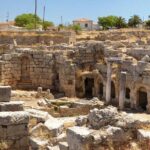
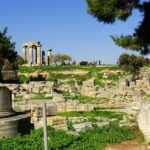
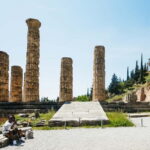
The Temple of Apollo is the visual anchor. Built around 560 BCE, it is one of the earliest Doric temples in the Peloponnese and on the Greek mainland. Its monolithic columns are especially notable. They were made from single blocks of stone, a construction choice that was rare in the ancient world.
The Agora gives you a sense of Corinth as a working city rather than a collection of isolated ruins. The rectangular complex measured about 160 meters by 70 meters and included shops, small temples, an altar, and the Bema. The Bema, or public platform, is associated with Apostle Paul’s address to the Corinthians in 52 AD.
You can also see Roman buildings, the theater, the Odeon, the Asklepieion, and the Lechaion Road leading toward the port. These remains help explain Corinth’s role as a commercial center. The St. Paul’s church has a mosaic mural depicting Saul’s vision of Christ while traveling to Damascus.
The Hadgimoustafa spring, built during the Ottoman period, adds a later chapter to the site. The museum contains artifacts from Ancient Corinth and smaller nearby sites, so it is worth making time for the indoor collection rather than spending the entire stop outside.
- All Day Cruise -3 Islands to Agistri,Moni, Aegina with lunch and drinks included
★ 5.0 · 4,958 reviews





Lunch Above the Temple of Apollo
Lunch is one of the day’s most appealing touches. You can stop at a village-style taverna on a terrace overlooking the archaeological site and the Temple of Apollo.
The meal is not included, so budget separately for food and drinks. The value here is not just the plate. After walking among columns, roads, and public buildings, you get a chance to sit above the site and see how the ruins fit together.
I would keep lunch relaxed but not oversized in time. Three hours must cover Ancient Corinth, the museum, food, and the village stop. A long meal can put pressure on Mycenae later in the day.
Corinth Village Shops
The nearby village receives about an hour. You can stroll among the shops and look for handmade souvenirs.
This is a modest stop, but it gives the day a more local feel than a straight archaeological circuit. You can buy a small gift, stretch your legs, and take a break from formal ruins. Ask your driver how much of the hour should go to shopping if Mycenae is a priority.
The flexible format matters here. A private driver can help you decide if you want more village time or need to preserve minutes for the next site.
Mycenae and the World of Agamemnon
The drive to Mycenae takes about 40 minutes. The archaeological site is tied to King Agamemnon in Homer’s epics and is described as the most important and wealthy center of the Late Bronze Age.
The site includes Grave Circles A and B, royal cemeteries placed south of the Lion Gate and outside the Bronze Age citadel. The Cyclopean Walls are built from enormous limestone blocks. Ancient builders used such large stones that later people imagined only Cyclopes could have moved them.
Inside the citadel, the Royal Palace included domestic rooms, a throne room suite, a grand staircase, rooms for officials, and a forecourt. The supplied timing gives about 30 minutes to the main archaeological site, followed by 15 minutes at the Lion Gate, 20 minutes at the citadel and Treasury of Atreus, and 30 minutes in the museum.
That is enough for a focused introduction, but it is not generous. Mycenae has several separate features, and you may feel pressed if you want to inspect the walls, palace area, graves, and views at an unhurried pace.
The Lion Gate and Treasury of Atreus
The Lion Gate is the main entrance to the Bronze Age citadel. Erected in the 13th century BC, it is one of the most recognizable surviving features at Mycenae.
The short 15-minute allocation lets you see the gate and take photographs, but the setting deserves a little attention. Look at the scale of the masonry and the relief above the entrance before moving on.
The Treasury of Atreus is a large tholos, or beehive-shaped tomb, built around 1250 BC. The nearby Tomb of Clytemnestra is another Mycenaean tholos tomb from roughly the same period, named for Agamemnon’s wife in the ancient story.
The total time listed for this section is 20 minutes. That makes it a quick visit, especially if you want to enter both tombs and pause for photographs. Ask about the exact order of the stops, since the tour can be arranged around your priorities.
Mycenae’s Museum and Gold Grave Goods
The Archaeological Museum of Ancient Mycenae receives about 30 minutes. Its collection includes gold grave goods, burial masks, jewelry, weapons, worship idols, and frescoes.
This museum helps put meaning behind the stones outside. At the citadel, you see walls, gates, and tombs. Inside, the artifacts show the skill, wealth, beliefs, and military culture of Mycenaean society.
The museum and ruins have separate time demands, so you should decide in advance what matters most. If the gold objects and frescoes are your main interest, do not let the earlier stops consume the full day.
Is $299.78 Per Person Good Value?
At $299.78 per person, this is a costly day trip, but the comparison is not simply with a basic bus ticket. The price covers a private vehicle, pickup and drop-off in Athens, a professional English-speaking driver, onboard Wi-Fi, bottled water, and a flexible schedule for your own group.
It can make sense for a small group that wants Corinth and Mycenae in one day without car hire. You avoid navigation, parking, and the strain of driving unfamiliar roads. The private setup also lets you adjust the pace.
The value is weaker if you want a fully guided archaeological experience and assume that is included. It is not. Entrance fees, food, drinks, tips, and a licensed guide are extra. Airport pickup and drop-off also cost more.
Ask for the current admission prices when you book, since the supplied tour details do not state them. Add those fees to the per-person price before deciding.
Timing, Pickup, and Who Should Book
Pickup is available from an Athens hotel, Airbnb, or apartment. At a hotel, you meet the driver in the lobby. For an apartment, the driver contacts you on arrival so you can meet at the building entrance.
Airport and port pickup are available at an additional cost. The driver meets you in the arrivals area with a sign bearing your name.
The tour lasts about eight hours. That is a full day with substantial driving and several outdoor sites. I would choose it if you want a broad first look at Corinth and Mycenae, value privacy, and are comfortable with a brisk schedule.
It is especially suitable for families or small groups that want control over stops. It also works well if car hire feels like a burden. You may prefer separate days if you want long museum visits, slow photography, or detailed walks through both archaeological sites.
The drivers named Nikos and Gregory received especially warm praise for arriving early, driving safely, supplying cold water, and helping with food, photographs, and souvenirs. Driver assignments can change, so treat those names as examples rather than a promise.
Free cancellation is available up to 24 hours before the start time. Most people can participate, and service animals are allowed. The tour is private, so only your own group takes part.
Should You Book This Corinth and Mycenae Tour?
I would book this tour if you have one free day from Athens and want to combine the Corinth Canal, Ancient Corinth, and Mycenae without driving. The private vehicle, flexible stops, Wi-Fi, water, and terrace lunch option give the day real practical value.
I would not book it expecting a slow, fully guided study tour. Eight hours is tight, admission is extra, and a licensed guide costs more. Start early, tell the driver that Mycenae is non-negotiable if it is, and keep lunch within reason.
For a first visit to this part of Greece, the route gives you a strong range of sights: engineering at the canal, myth and defense at Acrocorinth, public life at Ancient Corinth, and Bronze Age power at Mycenae. Just go in with an honest sense of pace.
FAQ
How long does the private tour last?
The tour lasts approximately eight hours, including pickup from Athens, the stops in Corinth and Mycenae, and the return to Athens.
Where can pickup and drop-off take place?
Pickup and drop-off are offered at your Athens hotel, Airbnb, or apartment. Airport and port pickup are available for an additional cost.
Is the tour private?
Yes. Only your group participates in the tour.
Is a guide included at the archaeological sites?
A professional driver with knowledge of Greek history is included. A licensed guide accompanying you inside the archaeological sites and museum is not included but can be requested for an additional cost.
Are entrance fees included?
No. Entrance fees for Ancient Corinth and Mycenae are not included in the tour price.
Is lunch included?
No. Food and drinks are not included. You can stop for village-style lunch on a terrace overlooking Ancient Corinth and the Temple of Apollo.
Is transportation provided?
Yes. Transportation is provided in a private first-class vehicle, with hotel or apartment pickup and return.
Is Wi-Fi available during the drive?
Yes. Wi-Fi is available onboard the vehicle.
Can I cancel for a full refund?
You can cancel at least 24 hours before the experience starts for a full refund. Changes or cancellations made less than 24 hours before the start time are not accepted for a refund.