REVIEW · ATHENS
4 Days Private Tour: Argolida – Olympia & Sparta
Book on Viator →Operated by Olive Sea Travel · Bookable on Viator
The great strength of this four-day journey is its sweep. From the Corinth Canal to the stadium at Olympia, the Byzantine ruins of Mystras, Leonidas in Sparta, and the theater at Epidaurus, you cover a large part of the Peloponnese without changing hotels every night or piecing together buses and taxis.
I especially like two things here. First, the tour links famous ancient sites with places that are easier to miss, such as Mystras and the Olive and Greek Olive Oil Museum. Second, your group has a private vehicle and pickup from your hotel, Airbnb, or port. The main consideration is pace: several days include long drives, and entrance fees, meals, accommodation, and a licensed guide are extra.
In This Review
- Key points at a glance
- Why this Peloponnese route works
- Day 1: Corinth Canal and the Olympic birthplace
- Day 2: Mystras, Sparta, and the story of olive oil
- Day 3: Mycenae, Nafplio, and the sea
- Day 4: Healing, theater, wine country, and Corinth
- What the $1,389 price means
- Who should book this tour
- Practical details before you book
- FAQ
- Where does the tour begin?
- Is this a private tour?
- Are entrance fees included?
- Is accommodation included?
- Can I hire a licensed guide?
- How long is the tour?
- Can I cancel for a full refund?
- Should you book it?
Key points at a glance
- Walk across the Corinth Canal: Begin with a quick look at the engineering cut that separates the Peloponnese from mainland Greece.
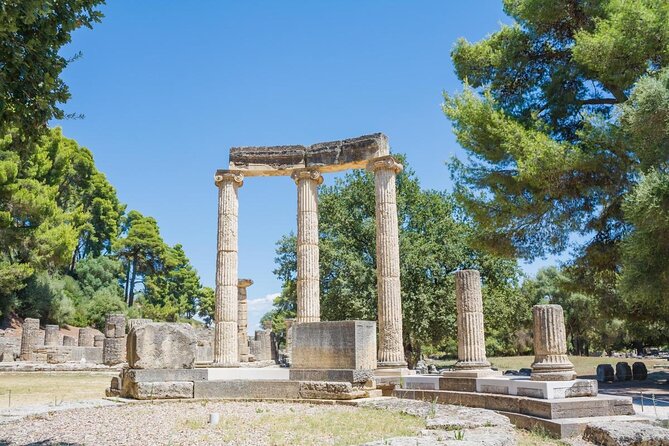
- See Olympia beyond the stadium: Visit the sanctuary, Temple of Zeus, workshop of Phidias, archaeological museum, and Olympic Games museum.
- Explore Byzantine Mystras: Walk downhill through churches, palaces, homes, and courtyards from the medieval city.
- Pair myth with modern Nafplio: Visit Mycenae, then finish the day with a seaside meal and views toward Bourtzi.
- Test the acoustics at Epidaurus: The fourth-century BCE theater remains one of Greece’s finest ancient performance spaces.
- Travel privately from Athens: Your driver handles the long routes, while you set the rhythm within the planned four-day program.
Why this Peloponnese route works
This is not a single-site outing. It is a full tour of the Peloponnese’s major themes: athletic competition at Olympia and Nemea, royal power at Mycenae, Byzantine Christianity at Mystras, military Sparta, healing at Epidaurus, and the early Christian world of Ancient Corinth.
The private format matters. You are not joining a large coach group with one fixed pace. Pickup and drop-off are offered at your hotel, Airbnb, or port, and only your group takes part. That is useful when one person wants more time in a museum or when your group needs a slower morning.
The driver is not a licensed guide and cannot accompany you inside the sites. Drivers are described as having strong historical knowledge, so you can expect context during the road portions and between stops. If you want formal commentary inside each monument and museum, request a licensed guide for an extra fee.
One driver named in the tour’s feedback is Alexander, who is described as taking on the role of host as well as driver, with attention to safety and the practical details of the journey. That is an important distinction on a route with several long days. Still, you should confirm who will drive your departure before booking if having a particular driver matters to you.
You can also read our reviews of more private tours in Athens


Day 1: Corinth Canal and the Olympic birthplace
The route begins along the coast, with views toward seaside villages and Salamis. The island is linked to the naval battle of 480 BCE, when Athenian and allied forces fought the Persians. This part is seen from the road rather than treated as a full historical stop, but it gives the first drive some useful context.
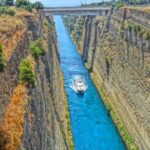
At the Corinth Canal, you have about 15 minutes to walk across a pedestrian bridge and look down into the narrow waterway. The canal opened in 1892 and connects the Saronic Gulf with the Corinthian Sea, cutting the Peloponnese off from the rest of mainland Greece.
This is a short stop, so keep expectations in check. You get a close look and a good photo opportunity, not a long visit to a museum or viewpoint. Bungee jumping may be available on some days for the very adventurous, but it is not presented as a guaranteed part of the tour.
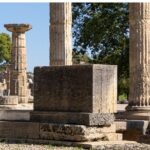
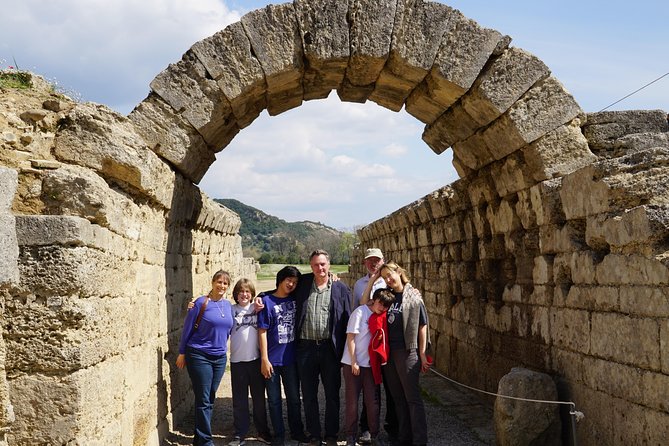
Olympia is the day’s major prize. The sanctuary hosted the ancient Olympic Games, which began in the eighth century BCE. The site is broad, and you walk among the Gymnasium, Palaistra, Temple of Zeus, workshop of Phidias, and stadium.
The stadium is the emotional finish. Ancient competitors came here every four years to compete for glory and honor their cities. I find the scale more meaningful when you remember that Olympia was not simply a sports field. It was a sacred center devoted to Zeus, with athletic training, religious ritual, and civic identity woven together.
The archaeological site receives about an hour in the planned schedule. That is enough to see the main remains, but not enough for a leisurely examination of every feature. Wear shoes suited to uneven ground and plan for sun exposure, since much of the experience takes place outdoors.
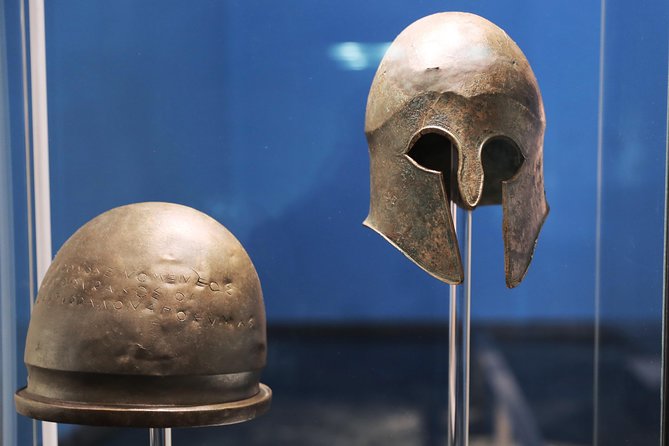
Next comes the Archaeological Museum of Olympia, with about 30 minutes scheduled. Its best-known piece is the Hermes of Praxiteles. The museum also displays tools connected with Phidias, the sculptor associated with the gold and ivory statue of Zeus, one of the ancient world’s seven wonders.
A second museum, devoted to the history of the ancient Olympic Games, adds useful context. Its 463 ancient works range from the second millennium BCE to the fifth century CE. The displays explain how the games developed as a long-lasting ancient institution, not merely as a series of athletic contests.
The three Olympia stops work well together: ruins show the physical sanctuary, the archaeological museum shows major sculpture and craft, and the Olympic Games museum focuses on the event itself. The limitation is time. If Olympia is your main reason for booking, ask in advance how much time you will have at each museum and site.
Day 2: Mystras, Sparta, and the story of olive oil
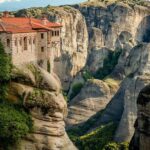
The drive to Mystras takes you through the southern Peloponnese and its mountain scenery. Mystras is known as a ghost city, but that label can be misleading. This is not just a field of broken stones. The fortified city preserves churches, ordinary houses, mansions, palaces, and monasteries, with Byzantine and Frankish elements side by side.
The site runs downhill from the upper citadel. You first reach the high point for views over the surrounding area, then walk past palaces and royal courtyards as you descend. The two-hour visit gives you a reasonable chance to see the main sections, but the route is physically more demanding than a flat archaeological site.
The churches and monasteries are especially important. Several monasteries remain in use, and monks may show you parts of their small religious community. Dress and behave respectfully in active religious spaces, and remember that opening arrangements can affect what you see.
Near the exit, look for the chapel of St. Demetrios and the floor plaque bearing a two-headed eagle, the symbol of Byzantium. Constantine Palaiologos is associated with kneeling on this plaque before his coronation as the last Byzantine emperor. It is a small detail with a powerful link to the final years of the empire.
After Mystras, the route turns to Sparta. Ancient Sparta is often reduced to Leonidas and the 300, but the city had a broader story. In the Mycenaean period it was linked with Helen of Troy and Menelaus. Later, it developed into a military society ruled by two kings and a small aristocratic class, in sharp contrast with Athenian democracy.
The planned stop at the acropolis and ancient theater lasts about 20 minutes, followed by a 10-minute visit to the Leonidas Monument. These are brief orientation stops rather than long archaeological explorations. The Leonidas statue also marks the finish of the Spartathlon, the 245.3-kilometer race from Athens to Sparta.
The Museum of the Olive and Greek Olive Oil takes about 20 minutes. It explains the production and importance of olive oil, one of Greece’s most familiar products. The stop gives the day a welcome connection to everyday Greek life after the grand military and imperial stories of Mystras and Sparta.
Day 3: Mycenae, Nafplio, and the sea
Mycenae carries some of Greece’s most famous names: Achilles, Agamemnon, and Helen of Troy. The citadel dates to the second millennium BCE and gave its name to the Mycenaean era.
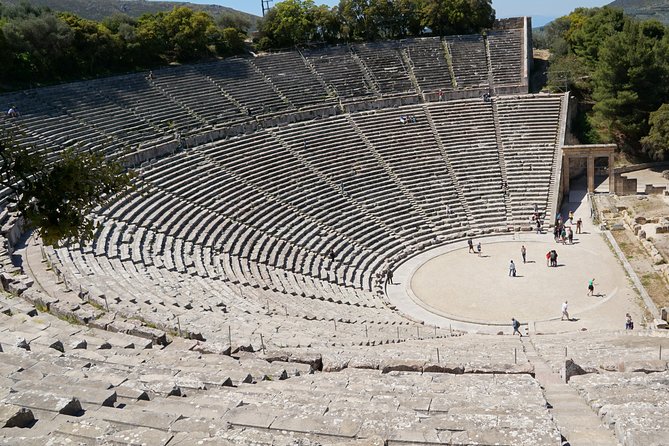
The archaeological site includes the Cyclopean walls, Burial Circle A, and the remains associated with Agamemnon’s palace. The massive stone walls inspired the old idea that only Cyclopes could have built them. You can also pass through the Lion Gate, regarded here as the oldest architectural sculpture in Europe.
Allow yourself time to look closely at how the citadel was arranged. The elevated position, fortified entrance, and palace remains tell you as much about power and defense as the famous legends do. The site is exposed, and one hour can feel short if you want to read every sign and explore slowly.
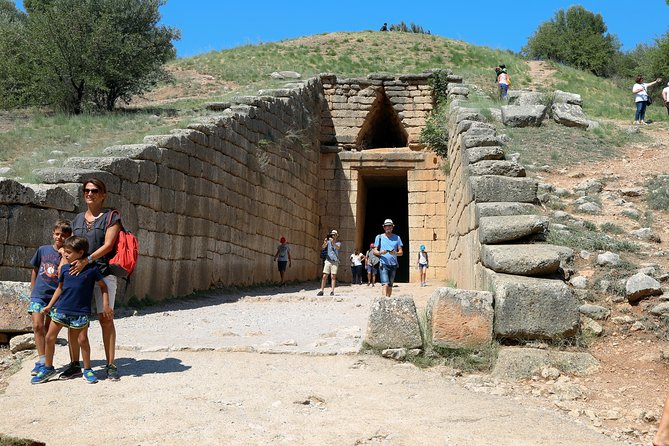
The on-site museum displays finds from the City of Gold. Before leaving, you stop at the Treasury of Atreus, the best-preserved tholos tomb in the area and one of the finest examples of Mycenaean architecture. The 10-minute schedule is brief, but the tomb’s scale and beehive-shaped interior make it worth seeing even on a quick visit.
Nafplio changes the mood completely. This former capital of Greece, used as the capital until 1834, has a waterfront, a large harbor, fortresses, and an old city with Venetian, neoclassical, and Oriental influences.
You have about an hour to walk through the old city and stop for lunch at a traditional seaside taverna. Lunch is not included, so ask your driver about timing and restaurant choices. Nafplio is one of the few places on this tour where you get a relaxed urban break rather than another archaeological site.
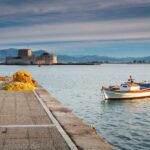
From the harbor, you can see Bourtzi, a small fortified islet. The tour also drives up to Acronauplia for a panoramic view over Nafplio and the water. That 20-minute viewpoint stop is short, but it helps you understand why the town mattered as a port and defensive center.
Nafplio is also where the schedule may feel most compressed. An hour allows a walk and meal, but not an in-depth visit to every fortress. If you prefer cafés, shops, and town streets to ruins, you may wish to ask whether the route can give Nafplio more time.
Day 4: Healing, theater, wine country, and Corinth
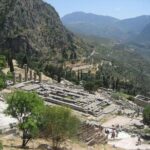
The Sanctuary of Asklepios at Epidaurus was devoted to Asclepius, the Greek god of healing and medicine. It sits in a peaceful hilly setting, and the sanctuary’s location helps explain why healing was connected with rest, ritual, and a change of surroundings.
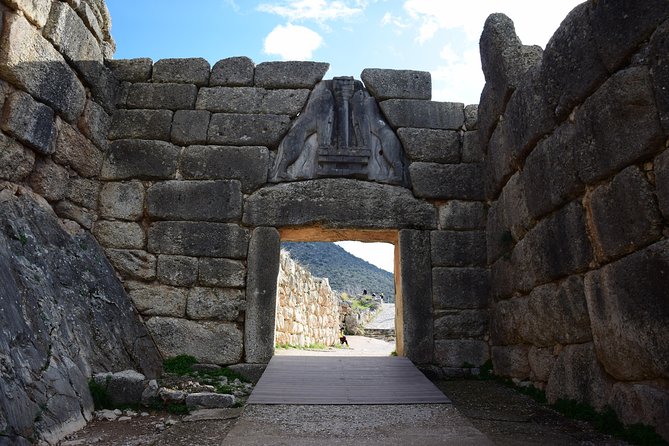
The highlight is the Ancient Theatre of Epidaurus, built in the fourth century BCE. It is one of the best-preserved ancient Greek theaters, famous for its acoustics. You can climb toward the upper seats, close your eyes, and test how clearly sound carries across the theater.
The planned time is about 30 minutes at the sanctuary and 30 minutes at the theater. That gives you enough for the main view and an acoustic test, though you may want longer if you are interested in the sanctuary’s medical buildings and museum displays.
Next comes Ancient Nemea, known for the Nemean Games, the Temple of Zeus, and its stadium. The area is also Greece’s major wine district, with grape growing practiced here since ancient times. The tour focuses on the archaeological museum and sanctuary rather than promising a winery visit, so do not expect wine tasting unless it is separately arranged.
Nemea’s stadium is especially rewarding. It is well preserved and sits on a higher level, with tunnels through which athletes entered. Those tunnels make the ancient competitions easier to picture than a few scattered foundations would.
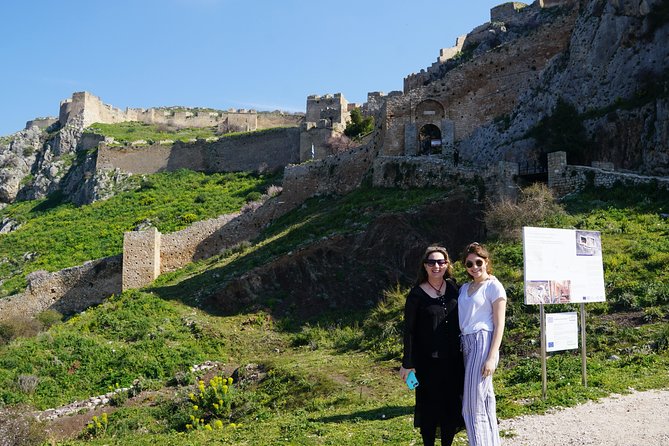
The final major stop is Ancient Corinth, at the foot of Acrocorinth. You see the Roman Agora, the Temple of Apollo, and a small museum. Corinth also matters to Christian history: the Apostle Paul preached here, faced judgment by the tribunal in the Agora, and helped establish an organized early Christian church.
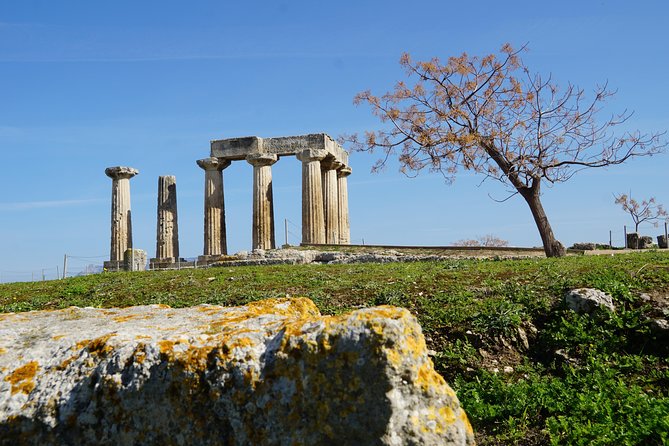
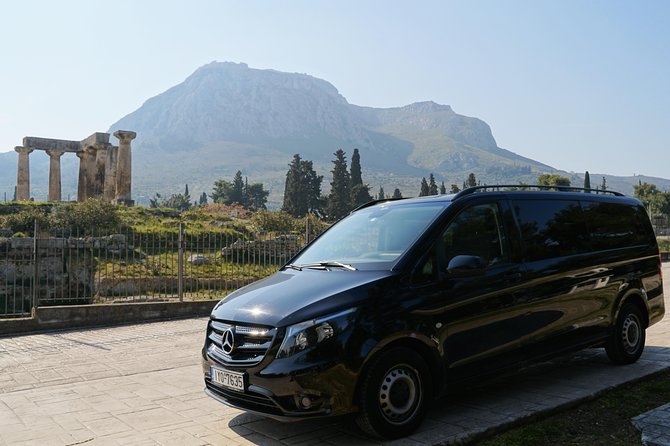
The Temple of Apollo dates to about 560 BCE and is one of the earliest Doric temples in the Peloponnese and mainland Greece. Its surviving columns sit against the rocky rise toward Acrocorinth, the old city’s dominant hill and castle.
The Corinth visit brings the route back to its opening canal stop, but the two places are different. The canal is a nineteenth-century engineering project. Ancient Corinth reveals a city shaped by Greek, Roman, and Christian history. After the visit, the driver returns you to Athens.
A few more Athens tours and experiences worth a look

What the $1,389 price means
At $1,389.12 per person, this is a serious purchase. Its value depends heavily on what is included in your booking and how many people share the cost.
The price includes private transportation, bottled water, pickup and drop-off, and accommodation according to the booking arrangement. The information also says accommodation and breakfast are not included, so check the exact package carefully before paying. Entrance fees are extra, and so are meals and any licensed guide.
The private vehicle is the biggest value point. The itinerary covers a large area that would be awkward to connect by public transport in four days. You also avoid the stress of arranging separate transfers between Athens, Olympia, Mystras, Sparta, Mycenae, Nafplio, Epidaurus, Nemea, and Corinth.
The price makes more sense for a small group than for one person alone. Group discounts may be available. Ask for the total cost after adding admission fees, accommodation, meals, and a licensed guide if desired.
Who should book this tour
I would choose this for a small group that wants a private road trip with major archaeological sites but does not want to plan every transfer. It suits people who enjoy Greek mythology, ancient architecture, Byzantine churches, military history, early Christianity, and local food traditions.
It is also a good fit if pickup from an Athens hotel, Airbnb, or port is useful. The private format lets your group travel together and avoid a large coach.
I would hesitate if you want long, slow visits at each place. Olympia, Mystras, Mycenae, and Epidaurus all deserve more time than the scheduled stops may allow. You should also be comfortable with several hours on the road and with walking on uneven or sloping ground, especially at Mystras.
The driver’s role is another key decision. A driver with historical knowledge can make the journey much more meaningful, and Alexander is specifically noted as combining driving with hosting and attention to safety. But the driver cannot guide inside sites. If detailed explanations at every monument matter to you, budget for a licensed guide.
Practical details before you book
The tour begins at 8:00 a.m. The duration is approximate, since traffic and the time of day can change the schedule. That matters on a route with fixed opening hours, museum visits, and long distances.
Confirmation is provided at booking, and most people can participate according to the supplied information. The company says it follows World Health Organization health instructions concerning COVID-19.
You can cancel for a full refund if you do so at least three full days before the local start time. Cancellations or changes made inside that period are not accepted for a refund.
FAQ
Where does the tour begin?
The tour begins in Athens at 8:00 a.m. Pickup and drop-off are offered from a hotel, Airbnb, or port.
Is this a private tour?
Yes. Only your group participates in the private activity.
Are entrance fees included?
No. Entrance fees are not included and must be paid separately at the archaeological sites and museums.
Is accommodation included?
Accommodation is according to your booking, but the tour information also states that accommodation and breakfast are not included. Confirm the exact package before booking.
Can I hire a licensed guide?
Yes. A licensed tour guide can be requested for an additional cost. The drivers are not licensed to accompany you inside sites or museums.
How long is the tour?
The tour lasts approximately four days. Exact timing can change because of traffic and the time spent at each stop.
Can I cancel for a full refund?
Yes, if you cancel at least three full days before the experience start time. Cancellations or changes made less than three full days before the start are not refunded or accepted.
Should you book it?
Book this tour if you want the Peloponnese’s biggest historical sights in one private, door-to-door trip and you value having a driver such as Alexander handle the long routes. The combination of Olympia, Mystras, Sparta, Mycenae, Nafplio, Epidaurus, Nemea, and Corinth is hard to match in four days without private transport.
Skip it if you want a leisurely archaeological holiday, a fully guided experience inside every site, or a clearly all-inclusive price. Before committing, confirm accommodation, the admission budget, the possibility of a licensed guide, and how much time your group will receive at Olympia and Mystras. For the right small group, this is an ambitious and rewarding introduction to the Peloponnese.