REVIEW · ATHENS
Athens: Acropolis, Parthenon Guided Walking Tour
Book on Viator →Operated by Athenian Tours · Bookable on Viator
The Acropolis makes more sense with a guide. You get expert storytelling that turns stone buildings into a timeline you can follow, from Athens’ big religious ideas to its theater culture. One real caution: the climb is steep and can be slippery, and group tours don’t use the elevator.
What I like next is how the tour handles crowds and sound. If you choose the option with admission, you get help to skip ticket lines, and for groups over five you’re issued disposable earphones for clearer narration.
This is a tight, efficient route—about 2 hours—but it still feels human-paced thanks to guide pacing (and they may change the order to keep things comfortable). If you’re okay with uneven ground and you bring water, you’ll get a lot out of this climb.
In This Review
- Key highlights worth knowing before you go
- Why this 2-hour Acropolis walk feels like real value
- Meeting at Mitseon 2 and what the start experience is really like
- Theater of Dionysus to the Roman Herodion: the story before the temples
- Propylaea gateway views: where the climb starts to feel worth it
- Parthenon time: how to look without getting overwhelmed
- Erechtheion and the Caryatid moment that clicks
- Skip-the-line options: what you can avoid and what you still can’t
- Group size, earphones, and crowd noise: how narration stays clear
- Comfort reality check: steep hill, slippery stone, no elevator
- Guide style makes a big difference—look for the storytelling energy
- Pair it with the Acropolis Museum if you still have steam
- Should you book this Acropolis guided walking tour?
- FAQ
- How long is the Acropolis guided walking tour?
- Where does the tour start and end?
- Is the Acropolis admission ticket included?
- Can I skip the ticket lines?
- Do we get earphones during the tour?
- Is the elevator available at Acropolis Hill on this tour?
- Are strollers allowed at the Acropolis?
- Is the tour suitable for children or people with mobility impairments?
Key highlights worth knowing before you go
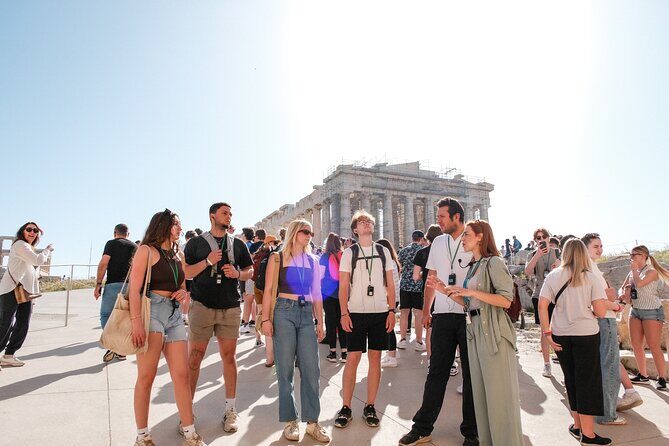
- A route built for time: Theater of Dionysus, Herodion, Propylaea, Temple of Athena Nike views, Parthenon, and Erechtheion
- Earphones on the bigger groups: disposable units for groups over five for easier listening
- Optional admission to reduce waiting: skip the ticket office line when the entry option is selected
- Small-group feel: maximum 24 people, so you’re not just one face in a swarm
- Guides can adjust the order: they may rearrange stops so you don’t feel worn out
- Comfort reality check: steep hill, slippery spots when raining, and no strollers allowed
Why this 2-hour Acropolis walk feels like real value

At about $41.13 per person for a roughly 2-hour guided route, this tour’s value comes from two things: direction and context. The Acropolis looks straightforward on a map, but on the hill you’re walking between layers of history, and it’s easy to see a famous building without fully understanding why it matters.
The other value piece is crowd management. With the optional admission add-on, you’re not spending your limited time figuring out ticket logistics at the busiest moment. You also get narrated wayfinding—so you’re not just walking from one highlight sign to the next, hoping the story catches up.
Just do one math check before you book: admission to the Acropolis isn’t automatically included. If you choose the option without entry, you’ll need to budget for the Acropolis ticket (listed at €30.00 per person). That’s still workable, but it’s smart to decide your preference up front: time-saver with admission included, or do-it-yourself entry with a guided itinerary.
You can also read our reviews of more walking tours in Athens



Meeting at Mitseon 2 and what the start experience is really like
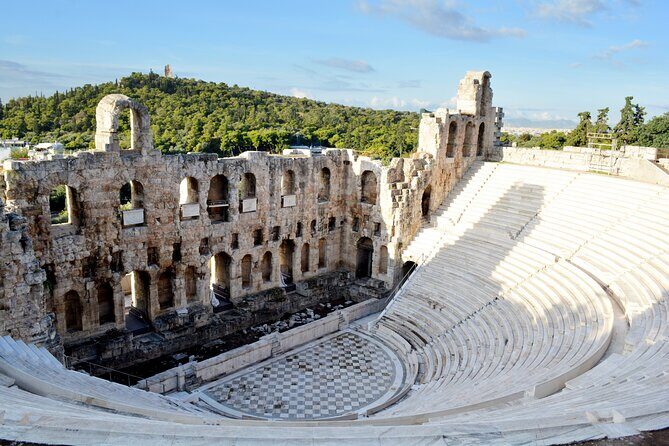
Your tour starts at Mitseon 2, Athina 117 42, Greece, and it ends at the Acropolis of Athens. It’s near public transportation, which matters because getting to the hill at the right moment is half the battle in Athens.
The tour runs with a maximum of 24 people, and many groups run small enough that your guide can keep track of everyone. When the group gets bigger than five, you’ll receive disposable earphones. That’s a big deal at the Acropolis, where wind, footsteps on stone, and other group audio can make it hard to catch every word.
One nice touch: the guide may change the order of sites depending on comfort. That’s not just a “maybe.” It’s useful because the hill’s steep sections can wear you down faster than you expect, especially in hot weather or after a long morning in Athens.
Theater of Dionysus to the Roman Herodion: the story before the temples
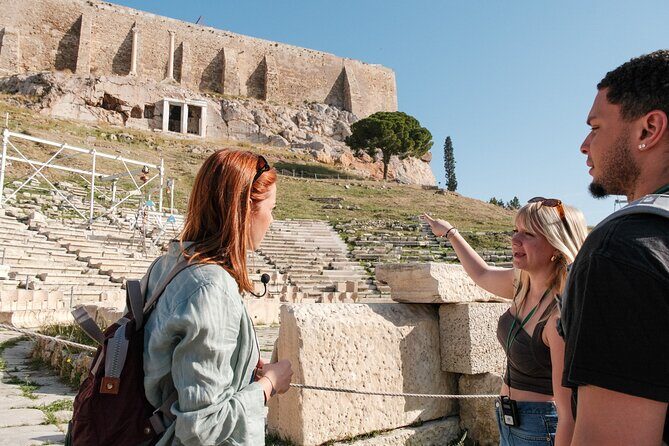
The route begins on the Acropolis grounds with a focus that’s easy to miss if you only think Parthenon. You’ll get a look at the Theater of Dionysus, described as the place where many famous ancient comedies and tragedies were first performed. Even if you’re not a drama buff, this stop helps you understand Athens as a whole—art, politics, religion, and community all tangled together.
Then you continue to the Roman Herodion theater, built in memory of Herodes Atticus’ wife. This contrast is a clever way to frame the hill: it’s not frozen in one era. You’re seeing how later rulers reused the prestige of the Acropolis and layered their own cultural statements on top.
What to expect here: short viewing moments with explanation, not a long museum-style stop. You’ll want a quick scan of the space, then listen for what the guide points out about why the theater locations mattered on the hill.
Propylaea gateway views: where the climb starts to feel worth it
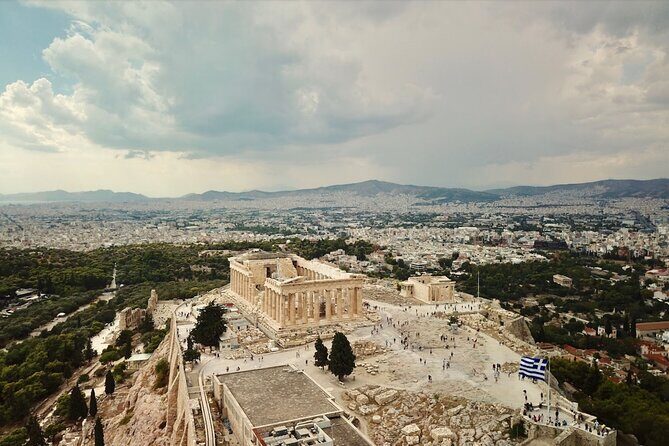
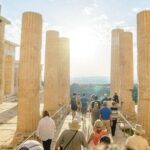
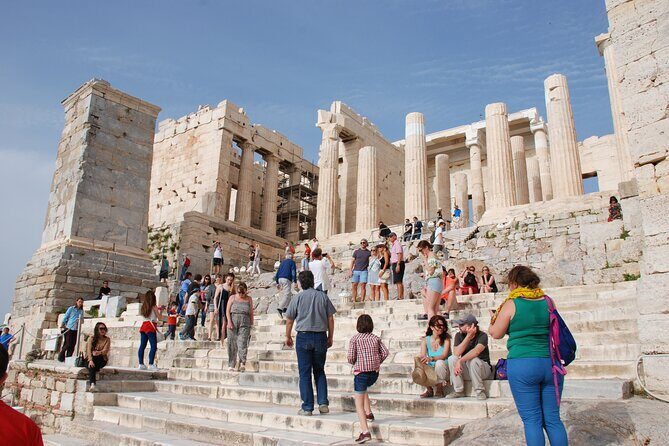
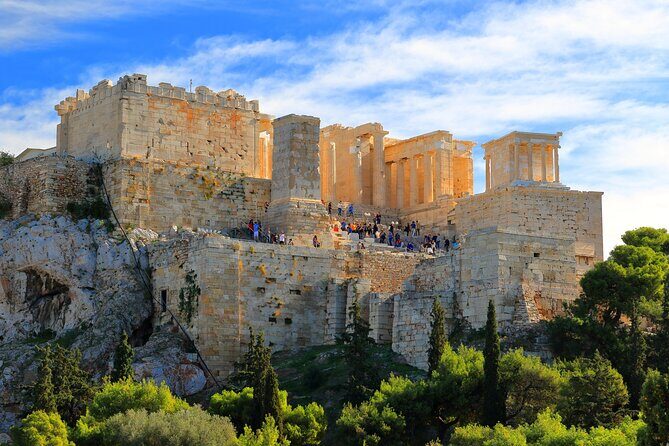
Next comes Propylaea—the gateway up to the Acropolis. The tour gives it about 15 minutes, which is the right amount of time to slow down, look around, and reset your legs before the heavier icons.
Propylaea is also a momentum change. Once you’re standing near the gateway, you can feel you’re truly on the “citadel” level, not just hiking toward it. The guide will also point out views of the Temple of Athena Nike. That view moment is important because it gives you a visual anchor: you’re not only climbing; you’re moving through an architectural plan.
Practical tip: wear shoes you can trust on uneven, sometimes slick surfaces. One review theme is consistent—good walking shoes aren’t optional here. They’re what separate a fun day from a tense one.
Parthenon time: how to look without getting overwhelmed
The Parthenon is the big name, and the tour schedules about 30 minutes for it. That’s enough time to do more than take one iconic photo. You’ll walk to the Parthenon and learn how it was dedicated to Athena, patroness of Athens, and you’ll hear what makes it a major achievement of Doric order architecture.
The value of a guided stop at the Parthenon is what to focus on. Without context, you can get trapped in photo-taking and miss the details that make the building feel so purposeful. With a guide, you get the story behind the design—so you can look at the columns, proportions, and layout with a clearer understanding of what you’re seeing.
This is also where pacing matters. In many groups, guides build in time so you don’t feel rushed through the most crowded points. People have praised guides like Dimitri and Burnie for pace and clarity, including entertaining delivery that keeps the walk from feeling like a lecture. You’ll still be walking uphill—just with a plan.
You can also read our reviews of more guided tours in Athens




Erechtheion and the Caryatid moment that clicks
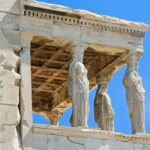
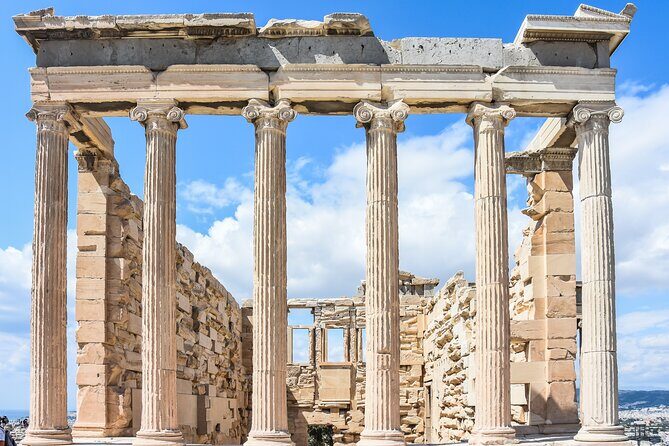
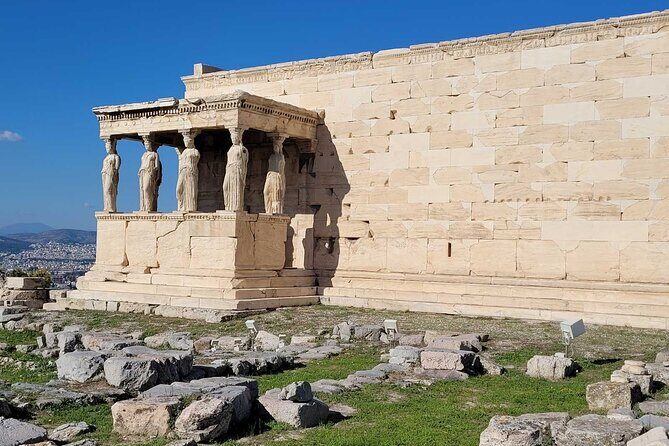
Then you finish with the Erechtheion, allocated about 20 minutes. This is the stop that often turns a “great views” tour into a “wow, I get it” tour.
The Erechtheion’s standout feature is its asymmetrical composition, and the supports include six sculpted female figures. Even if you’ve seen photos before, it’s the kind of detail that becomes unforgettable when someone explains what you’re looking at and why it’s unusual.
Why this matters for your experience: the Parthenon can steal the spotlight, but the Erechtheion is where the site’s personality shows up—complexity, variation, and symbolism you don’t notice from a distance.
If you want one self-check during this stop, do it like this: look for the figures, then look for how the building’s layout adapts around them. It’s the architecture’s logic, not just the sculptures.
Skip-the-line options: what you can avoid and what you still can’t
Here’s the most important logistics truth for the Acropolis: you can reduce some waiting, but you can’t magic away all lines.
When you select the option with admission, you get skip-the-lines at the ticket offices. That helps because ticket lines are usually chaotic and time-consuming. But the tour data also states you cannot skip the separate entrance line to the Acropolis itself—no one can bypass entry queues at the hill.
So what you’re really buying is time at the ticket point, not a guaranteed empty hill. It’s still a busy place, and it’s still outside.
If you choose the option without entry tickets, the provider may buy in advance to avoid queuing for the tickets. In that case, you’ll be asked to carry some cash, and you’ll need to be on time at the meeting point so the whole timing chain works.
Group size, earphones, and crowd noise: how narration stays clear
With a maximum group size of 24 people, you’re not going to feel like you’re walking with hundreds. Still, the Acropolis gets packed, and that affects sound.
For groups over five, disposable earphones are provided. That’s great for hearing the guide clearly, especially when multiple tour groups are talking nearby. The tour data also notes audio quality may be affected by other groups’ equipment during crowded times—so don’t expect studio-perfect audio, but in general it’s a helpful upgrade.
Also remember: the Acropolis is an outdoor site with wind and stone surfaces that carry sound in weird ways. Earphones won’t fix everything, but they usually make it easier to stay with the story instead of guessing what your guide is saying.
Comfort reality check: steep hill, slippery stone, no elevator
This tour is rated as “most travelers can participate,” but the comfort limits are real.
- The Acropolis hill is relatively steep and can be slippery at specific spots, especially when it rains.
- The elevator at Acropolis Hill can’t be used on group tours.
- Strollers aren’t allowed in the Acropolis area.
- The tour isn’t suitable for people with mobility impairments.
- It’s not suitable for children under 6.
Also pack for the site: there’s a water fountain, but no cafe-bar on the grounds, so bring bottled water (or at least plan to refill if that’s available). Bring a hat, sunglasses, and an umbrella on rainy days.
A small humorous truth that’s still practical: your calves will do the comedy, not you. If you expect flat-ground strolling, you’ll be surprised.
If you’re sensitive to long walks uphill, consider booking a start time that helps you avoid the worst heat. One tour tip from the experience data is that earlier can be crowded with cruise ship arrivals, while later afternoon can feel more manageable.
Guide style makes a big difference—look for the storytelling energy
One of the most praised parts of this tour is the guide. Different names show up across experiences: Dimitri, Burnie, John, Orestes, Iris, Ani, Simon, Kat, and Angel. The common thread is delivery: clear English, detailed explanations, and a pace that keeps you together.
A lot of people appreciate guides who treat the climb like a story arc, not a forced march—taking small breaks, pointing out where to rest in shade, and making photo opportunities part of the plan. That’s especially helpful at the Parthenon area, where crowds can make you feel like you’re perpetually waiting.
If you prefer tours that feel like theatre—since you literally start with Dionysus—that storytelling style is a strong match. You’ll walk away with more than a checklist; you’ll have a sense of Athens as a living culture over centuries.
Pair it with the Acropolis Museum if you still have steam
The tour itself focuses on the hilltop monuments. But if you want more context, consider adding the Acropolis Museum visit. Many people found that museum add-on turns the outdoor architecture into something you can study with artifacts in hand.
A good strategy: if you have the energy after the climb, do museum next while the stories are fresh. If you’re wiped out, at least plan for a lighter day afterward. Your legs will tell you the truth.
Should you book this Acropolis guided walking tour?
Book it if you want the Acropolis route without feeling lost between famous spots. This tour is a solid choice because it combines a focused timeline—Dionysus to Erechtheion—with narration that helps you interpret what you’re seeing. The optional admission choice also helps reduce the most annoying waiting moment.
Skip it or reconsider if you have mobility limits, rely on a stroller, or expect flat, easy walking. The hill is steep, the ground is uneven, and the tour doesn’t use the elevator. Also, if audio is a major concern for you, just know crowded conditions can affect sound even with earphones.
If you’re ready for a challenging climb with strong guidance, this is one of the more efficient ways to get the whole Acropolis highlights story in about two hours.
FAQ
How long is the Acropolis guided walking tour?
It’s about 2 hours.
Where does the tour start and end?
It starts at Mitseon 2, Athina 117 42, Greece and ends at the Acropolis of Athens (Athens 105 58, Greece).
Is the Acropolis admission ticket included?
Admission to the Acropolis is not included unless you select the option that includes entry tickets.
Can I skip the ticket lines?
If you choose the option with entry tickets included, you can skip the lines at the ticket offices for the Acropolis of Athens. Note that the tour does not allow skipping the entrance line to the Acropolis itself.
Do we get earphones during the tour?
Disposable earphones are provided for groups of over five people.
Is the elevator available at Acropolis Hill on this tour?
No. The elevator cannot be used on group tours.
Are strollers allowed at the Acropolis?
No, strollers are not allowed in the Acropolis.
Is the tour suitable for children or people with mobility impairments?
It’s not suitable for children under 6 and it’s not suitable for people with mobility impairments.