REVIEW · ATHENS
Athens Historical Private Virtual Tour Live Experience
Book on Viator →Operated by Olive Sea Travel · Bookable on Viator
Athens packs a remarkable amount into a short live session. From your screen, a guide takes you around Syntagma Square, Mount Lycabettus, the Acropolis, and the Temple of Olympian Zeus, linking modern Greece with its ancient monuments.
I like the private format, since your group can ask questions instead of following a fixed recording. I also like the low time commitment: 30 minutes gives you a quick introduction before a future trip, or a useful way to see Athens when walking the hills is not practical.
The tradeoff is clear: this is a fast visual overview, not a substitute for standing beneath the Parthenon. At $115.64 per group of up to 15 people, it can be good value for a full group, but less so for one or two people who want a long, detailed lesson.
In This Review
- Key points to know before booking
- What this virtual Athens tour actually gives you
- Syntagma Square and the Evzones
- Lycabettus Hill and Athens from above
- The Acropolis in a ten-minute sweep
- Hadrian’s Arch and the Temple of Olympian Zeus
- How much value do you get for $115.64?
- Who will get the most from this experience?
- How to decide before you click book
- FAQ
- Where does the Athens virtual tour start?
- What time does the tour start?
- How long does the experience last?
- Is the tour private?
- How many people can join one booking?
- What sights are covered?
- Can I ask questions during the tour?
- Is the tour suitable for people with mobility challenges?
- What is the cancellation policy?
Key points to know before booking
- A private live guide leads the session: You are not watching a pre-recorded film, and you can ask questions during the tour.
- The route begins at Syntagma Square: The Hellenic Parliament and the Evzones’ guard change provide the opening view of modern Athens.
- Mount Lycabettus supplies the big city view: You look across Athens toward the Acropolis and the Aegean Sea.
- The Acropolis gets the most time: The 10-minute section includes the Parthenon, Propylaea, Temple of Athena Nike, Erechtheum, theaters, and more.
- The group limit affects the price: Up to 15 people can join for one group price, making this more attractive for families, classrooms, and organized groups.
- The schedule is short and tightly packed: You see many famous places, but each one receives only a brief introduction.
What this virtual Athens tour actually gives you
This experience is best understood as a live orientation to Athens. You join online at 9:00 a.m., meet your guide at the virtual starting point of Syntagma Square, and follow the route as the guide presents the city’s main sights.
The tour is private, so only your group participates. That matters more than it might seem. You can ask why a building matters, request clarification about a monument, or focus on the places that interest you most. A recorded tour may be smoother, but it cannot respond to your questions.
Guide Joanna Gryllaki led one praised session, and the provider’s response makes clear that she aims to share the Athens she knows and loves. The current rating is 5 out of 5 from six reviews, with one particularly positive note about Joanna and how much the group saw in a short time.
You should expect an overview rather than a long seminar. The planned stops total only about 22 minutes when the listed time allocations are added together, within an overall duration of approximately 30 minutes. That leaves little room for extended storytelling at every monument, but it keeps the experience easy to fit into a busy day.
You can also read our reviews of more private tours in Athens



Syntagma Square and the Evzones
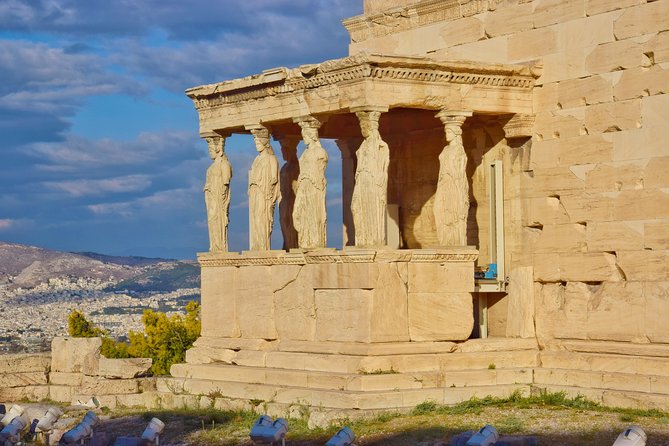
The tour opens at Syntagma Square, the central public square above which the old Royal Palace now houses the Hellenic Parliament. In Greek, the building is called the Voulí ton Ellínon. It is Greece’s supreme democratic institution, representing citizens through elected Members of Parliament.
The building gives you an immediate connection between ancient Athens and the country’s modern political life. You are not beginning with an isolated ruin. You are starting at a working center of Greek public life, where the square, Parliament, and ceremonial guards all form part of the city’s present-day identity.
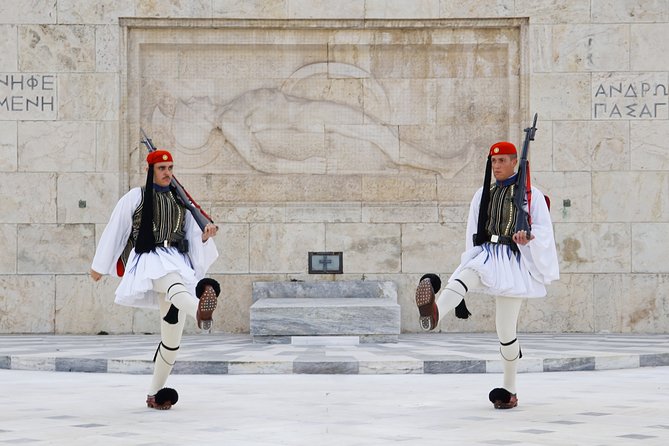
A key sight here is the changing of the guard by the Evzones, the ceremonial soldiers stationed in front of Parliament. Their uniforms and carefully controlled movements are among the most recognizable public sights in Athens. In person, this ceremony can be worth planning around. In a short virtual session, you get the useful context without needing to arrange your day around a visit to Syntagma Square.
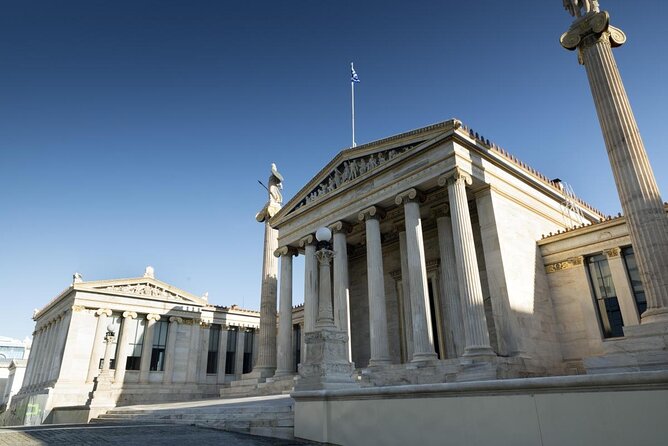
The nearby neoclassical buildings add another layer. The National and Kapodistrian University of Athens was designed by Danish architect Christian Hansen and completed in 1864. The National Library of Greece, designed by Theophil Hansen, was built toward the end of the nineteenth century as part of Athens’ neoclassical architectural group, along with the Academy and University.
You also see the Academy Building, one part of that architectural trio. It was founded in 1926 as an academy for sciences, humanities, and fine arts. These buildings are easy to rush past when you are walking through Athens, so their inclusion is useful. They show how nineteenth and early twentieth-century Greece used classical forms to express its new national identity.
Lycabettus Hill and Athens from above
The next major section moves to Lycabettus Hill, the highest hill in Athens. The view reaches from the Acropolis across the city toward the Aegean Sea, giving you the broad setting that individual ruins cannot provide.
I particularly like this stop because it helps you understand Athens as a whole. The Acropolis is not just a famous stone hill in isolation. From Lycabettus, you can place it within the city, see the scale of Athens, and appreciate why the Acropolis has such a strong visual role.
The presentation describes the route as going up the hill, but remember that you are experiencing it online. This is useful if steep streets, long walks, or general mobility concerns would make a physical hilltop visit difficult. You get the viewpoint without having to climb.
The Lycabettus section is listed at five minutes, so the view will be brief. That is enough to orient yourself, but not enough for an extended discussion of every district or distant landmark. If you want a slow city survey with detailed geography, this tour will feel quick. If you want the broad picture before a trip, it does its job well.
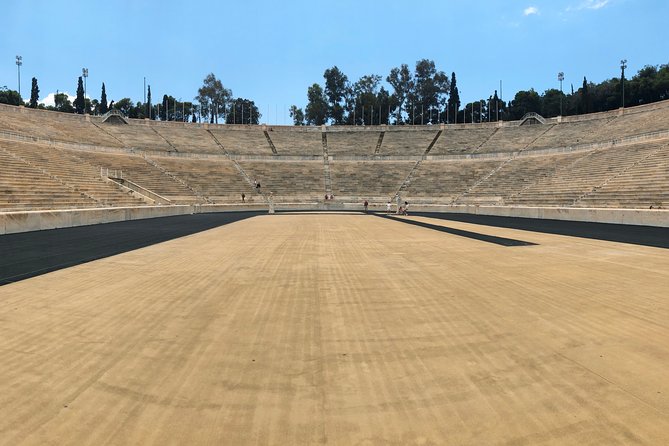
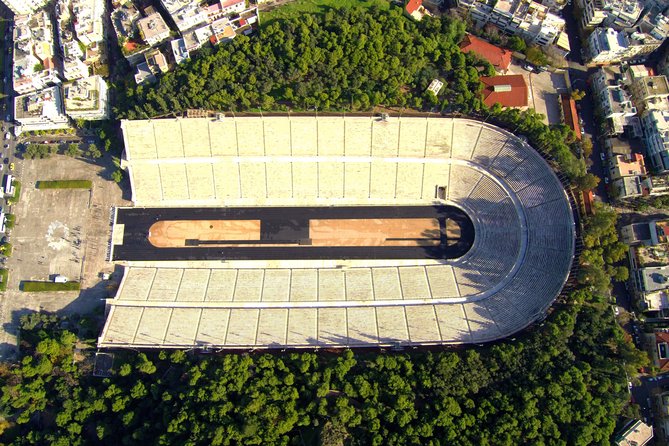
The Panathenaic Stadium is also included in this part of the route. Built from marble, it hosted the first modern Olympic Games in 1896. Its importance is not only architectural. It links ancient Greek athletic traditions with the modern Olympic movement, giving the tour another example of how Greece connects its past to its national story.
The Acropolis in a ten-minute sweep
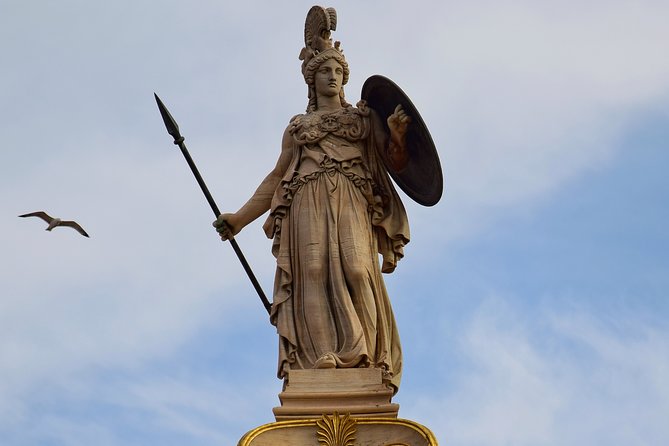
The Acropolis is the heart of the experience, but the scheduled time is only 10 minutes. You should expect a brisk introduction to the hill’s major monuments rather than a room-by-room archaeological explanation.
The route includes the Odeon of Herodes Atticus, the Temple of Athena Nike, the Propylaea, the Erechtheum, and the Parthenon. It also touches the Theatre of Dionysus and a site described as the Temple of Poseidon and Athena.
The Propylaea was the monumental entrance to the sacred area dedicated to Athena, the city’s patron goddess. Designed by Mnesicles in Pentelic marble, it was an ambitious entrance for an already ambitious hilltop. The Temple of Athena Nike sits to the southwest of the gateway, on a rampart protecting the main entrance. Its Ionic form differs from the heavier mass of the Parthenon and gives you a quick reminder that the Acropolis was a group of buildings, not one monument.
The Parthenon needs little introduction, but a good guide can help you see it as more than a familiar photograph. It was the main temple dedicated to Athena and has become a symbol of Athenian democracy and Western civilization. A live guide can point out its role within the wider Acropolis complex rather than treating it as the only reason to look at the hill.
The Erechtheum adds a different mood. Its unusual design and sacred associations make it an important counterpoint to the Parthenon. The itinerary also includes the Theatre of Dionysus Eleuthereus, considered the world’s first theater, at the foot of the Acropolis. That is a valuable inclusion because it shifts the story from temples and political power to drama and public performance.
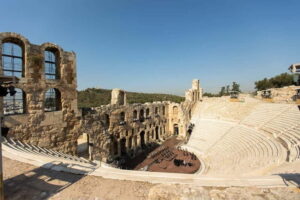
The Odeon of Herodes Atticus is a Roman theater on the southwest slope. Completed in 161 AD and renovated in 1950, it shows how the Acropolis continued to matter long after classical Athens. This sequence, from the Propylaea to the Parthenon and down toward the theaters, gives you a strong sense of the hill’s layered history.
The short timing is the main limitation here. You will see the names and roles of many major monuments, but you should not expect detailed explanations of construction, sculpture, restoration, or the controversies surrounding the Acropolis. Use the question time wisely. If the Parthenon matters most to you, ask the guide to spend a little longer there.
Hadrian’s Arch and the Temple of Olympian Zeus
The final stop is the Temple of Olympian Zeus, reached by way of Hadrian’s Arch. The temple is described as the biggest temple in antiquity and was dedicated to Zeus, king of the gods.
Only two minutes are allotted to this stop, so it functions as a closing glimpse rather than a full visit. That is enough to place the columns and the arch within the city’s ancient center, but not enough for a detailed account of the temple’s long construction or later history.
Hadrian’s Arch is a fitting transition point. It helps mark the relationship between the old Greek city and the Roman period under Emperor Hadrian. Even in a fast tour, that contrast gives you a useful final thought: Athens was not frozen in one golden age. Its monuments reflect several periods of building, reuse, and change.
If you plan to visit Athens in person, make a note of this area for a longer stop. The virtual tour gives you the basic orientation, while a physical visit lets you take in the scale of the columns and their setting at your own pace.
You can also read our reviews of more historical tours in Athens



How much value do you get for $115.64?
The price is $115.64 per group, with up to 15 people included. That makes the arithmetic important. For a full group of 15, the cost works out to about $7.71 per person. For five people, it is about $23.13 each. For one person, the full group rate is much harder to justify.
I see the strongest value for families, school groups, friends planning a trip together, and people who want a private introduction rather than a public online lecture. A group can split the cost while keeping the session focused on its own questions.
The 30-minute length also helps the value equation. You are not paying for a long virtual event that demands an entire morning. You get a concentrated route through the city’s main historical sights. That can work well before booking a physical Athens holiday, after returning home, or when you need a short cultural activity that fits around other plans.
Still, the price is not a bargain for a solo customer. You are paying for the private guide and group access, not for admission to the monuments. The tour does not provide physical entry to the Acropolis, Parliament, or Temple of Zeus. Think of it as a live presentation and orientation, not a replacement for admission tickets or an on-site guide.
Who will get the most from this experience?
I would recommend it most to people who cannot easily visit Athens at the moment. The format is also suitable for people with mobility challenges, since you can see the main sights without walking the Acropolis hill or climbing Lycabettus.
It is a practical choice if you are preparing for a future visit. Seeing the route in advance can help you decide which monuments deserve more time once you arrive. The session may also help children or first-time visitors recognize the major names before encountering them in person.
The private format suits anyone who dislikes asking questions in a crowded group. Since only your group participates, you can use the interactive element to clear up details as they arise. Be realistic about the short schedule, though. If your main goal is advanced archaeology, architectural analysis, or a slow look at every Acropolis monument, you will need a longer experience.
The 9:00 a.m. start is fixed in the supplied details. Check the local time carefully if you are joining from another country. Confirmation is provided at booking, and the experience accepts service animals. It is near public transportation in Athens, although that matters mainly if you later continue the route in person.
How to decide before you click book
Book this tour if you want a short, private, live introduction to Athens, especially if your group can share the $115.64 cost. The combination of Joanna Gryllaki’s warm response to participants, the question-and-answer format, and the broad route gives the experience a personal touch that a video cannot offer.
Skip it if you want a full virtual museum-style lecture or a detailed replacement for walking through the Acropolis. The tour moves quickly, and its greatest strength is coverage. You see the city’s essential landmarks in one compact session, then decide what deserves more attention.
Free cancellation is available if you cancel at least 24 hours before the 9:00 a.m. start time. Cancellations made less than 24 hours ahead, along with late changes, are not refunded or accepted. That is worth noting before you commit to the appointment.
FAQ
Where does the Athens virtual tour start?
The stated starting point is Syntagma Square, Plateia Syntagmatos, Athens, Greece. The activity ends back at the meeting point.
What time does the tour start?
The tour starts at 9:00 a.m. The details do not specify a different start time option.
How long does the experience last?
The experience lasts approximately 30 minutes.
Is the tour private?
Yes. Only your group participates in the private activity.
How many people can join one booking?
One group can include up to 15 people.
What sights are covered?
The route includes the Hellenic Parliament, the Evzones’ guard change, the University of Athens, the National Library, the Academy Building, Mount Lycabettus, the Panathenaic Stadium, the Acropolis, the Propylaea, the Temple of Athena Nike, the Parthenon, the Erechtheum, the Theatre of Dionysus, the Odeon of Herodes Atticus, Hadrian’s Arch, and the Temple of Olympian Zeus.
Can I ask questions during the tour?
Yes. The experience is live and interactive, so you can ask questions during the session.
Is the tour suitable for people with mobility challenges?
Yes. Since it is a virtual experience, it is suitable for people who may find Athens’ hills and monuments difficult to visit physically. Most people can participate, and service animals are allowed.
What is the cancellation policy?
You can cancel at least 24 hours before the experience start time for a full refund. Cancellations or changes made less than 24 hours before the start are not accepted, and the amount paid is not refunded. Cutoff times use Athens local time.