REVIEW · ATHENS
The Acropolis Walking Tour with a French Guide
Book on Viator →Operated by Athens Walks Tour Company · Bookable on Viator
The best reason to choose this tour is simple: the Acropolis makes far more sense when someone explains how its buildings, gods, politics, and theater fit together. A French-speaking archaeologist and licensed guide leads you through the citadel, from the Theatre of Dionysus to the Parthenon, with admission tickets included.
I like the skip-the-line entrance and the fact that the tour goes beyond the famous Parthenon. I also like the French focus, especially when guides such as Anna connect ancient Greek history with ideas familiar to French visitors. The main caution is the heat, steep walking, and lecture-style format, which may not suit young children or anyone who prefers a relaxed, highly interactive visit.
In This Review
- Key points at a glance
- Why a French guide changes the Acropolis visit
- Starting near the south entrance
- Entering the Acropolis without the long wait
- The Theatre of Dionysus and the beginning of public performance
- The Propylaea, the gateway that frames the hill
- The Parthenon and the missing marbles
- The Erechtheion and the Temple of Athena Nike
- Is $80.64 a fair price?
- Who should book this French-language visit?
- Booking, weather, and practical details
- Should you book the Acropolis Walking Tour with a French Guide?
- FAQ
- How long does the Acropolis walking tour last?
- What language is the tour conducted in?
- Are Acropolis entrance tickets included?
- What is the price of the experience?
- What sites are covered?
- Where does the tour begin?
- Where does the tour finish?
- How many people can join the tour?
- Is the tour suitable for all fitness levels?
- Can EU citizens under 25 enter for free?
- Can I cancel for a full refund?
- What happens if bad weather cancels the tour?
Key points at a glance
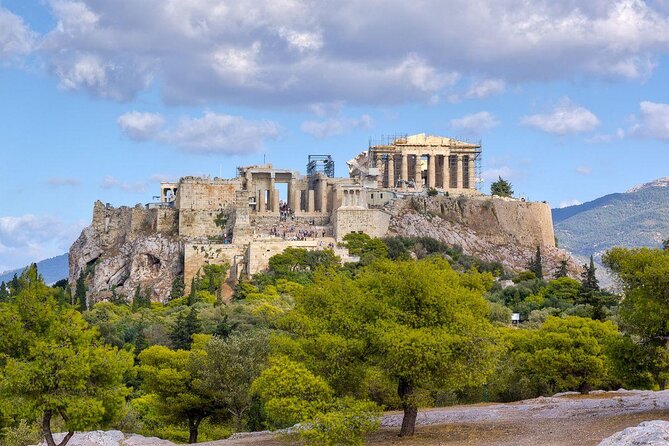
- French archaeological guidance: Expect a serious historical visit in French, with guides such as Anna praised for clear, detailed explanations and a lively presentation.
- Tickets included: Your Acropolis admission is part of the $80.64 price, so you do not need to arrange a separate ticket.
- Fast access: The tour is designed to avoid the standard entrance wait, a useful advantage at Athens’ busiest ancient site.
- A full Acropolis circuit: You see the Parthenon, Propylaea, Temple of Athena Nike, Erechtheion, and Theatre of Dionysus.
- Small-to-medium group size: The maximum is 20 people, with one reported group of about 14 and microphones supplied for easier listening.
- Best timing tip: An evening slot can mean slightly less heat and fewer people, though the site remains exposed and demanding.
Why a French guide changes the Acropolis visit
The Acropolis is not just one building with a famous roofline. It is a hilltop complex shaped by religion, public life, war, art, and centuries of change. Without context, you can admire the columns and still miss why each structure was placed where it is.
A good guide gives you a map in your head. You learn that the Parthenon was dedicated to Athena, the patron goddess of Athens, while nearby temples served different religious purposes. You also begin to understand how the gateways, terraces, shrines, and theaters worked as parts of one sacred and civic center.
This French-language option is particularly useful if you want more than a short set of basic facts. The strongest guide experiences here have included detailed explanations, cultural links that made sense to French visitors, humor, and time for photographs. Anna is singled out by name in the available feedback, and several visitors praised her ability to choose subjects that connected ancient Athens with the modern world.
The tone can be academic. That is a benefit if you enjoy archaeology and historical detail, but it can feel heavy if you want a quick photo stop. One poor experience described a guide who seemed to recite a prepared text, offered little room for questions, and gave too much information for a child’s attention span. That is worth keeping in mind: the quality of the experience depends strongly on the individual guide assigned that day.
You can also read our reviews of more walking tours in Athens



Starting near the south entrance
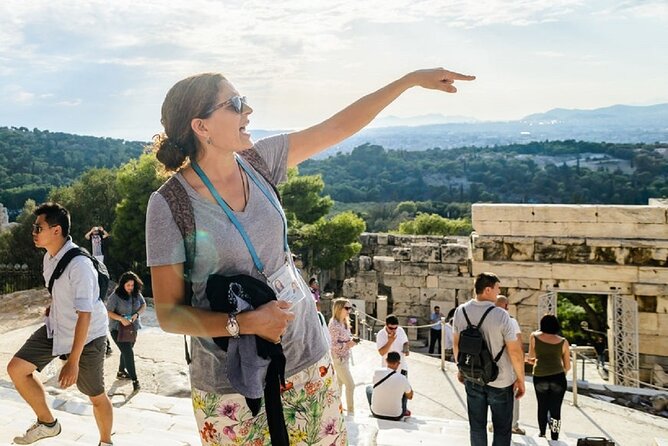
The meeting point is at Porinou 5, in the Athens neighborhood near the Acropolis. A French-speaking group has met at the tour company’s office, which was described as about three minutes on foot from the Acropolis south entrance.
That short walk matters. You are not spending the first part of a two-hour tour trying to find a distant meeting place, and you can reach the ancient site quickly after checking in. The area is near public transportation, so it works well as part of a sightseeing day in central Athens.
The tour ends at Areopagus, the rocky hill near the Acropolis. This is a useful finishing point rather than an inconvenient return to the start. You can continue on foot into central Athens, pause for the views, or make your own way toward the Plaka area. The tour does not include a return transfer, but none is needed for a walking visit in this part of the city.
A group can include up to 20 people. That is not a private tour, but it is still small enough for a guide to keep the group together on the hill. One group was about 14 people and used microphones, an important detail because wind, distance, and surrounding conversation can make a guide difficult to hear at the Acropolis.
Entering the Acropolis without the long wait
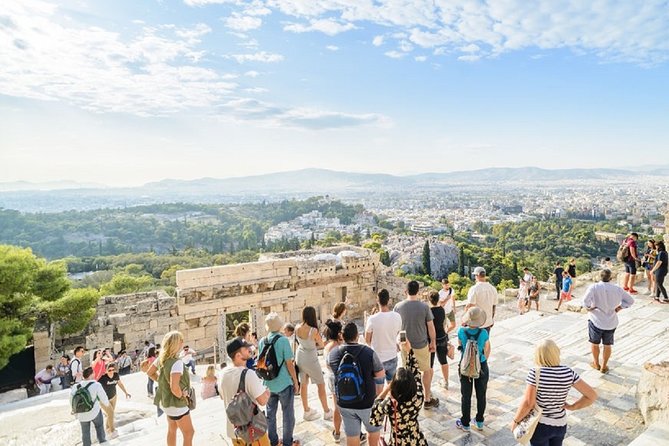
The included admission ticket is one of the tour’s practical strengths. The Acropolis is one of Athens’ most sought-after sights, and waiting at the entrance can drain time and patience before the visit even begins.
Skip-the-line access does not mean you walk straight through every security or ticket control without stopping. It means the tour is arranged to avoid the ordinary ticket-buying queue. Your guide handles the entry process as part of the visit, leaving you free to focus on the site.
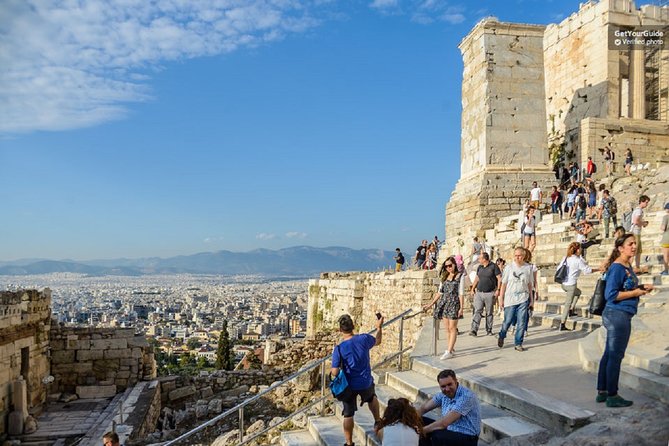
Once inside, expect uneven ground, stone surfaces, steps, and an uphill route. The tour information calls for a moderate level of physical fitness, and that is sensible advice. Good walking shoes are essential. Bring water as well, especially in warm weather, because several stops may take place in full sun.
The exposed setting is the biggest practical issue. One visitor found repeated stops in direct sunlight unbearable for children. Others recommended the evening time slot because it is a little cooler and less crowded. If you have a choice, I would favor a later departure during hot months, while remembering that the best time depends on the date and available schedule.
The Theatre of Dionysus and the beginning of public performance
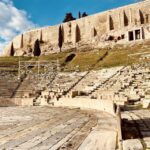
The Theatre of Dionysus is one of the tour’s most distinctive stops because it adds a human and cultural layer to the Acropolis. This is where your guide introduces the origins of theater and explains how performances were tied to ancient religious and civic life.
It is easy to spend an entire Acropolis visit looking only upward at the temples. Starting with the theater helps correct that. Ancient Athens was not simply a place of worship. It was also a society that gathered to watch drama, discuss ideas, honor gods, and express its identity in public spaces.
The scheduled stop at the Acropolis lasts about an hour overall, and the Theatre of Dionysus forms part of that wider visit. Do not expect a separate long lecture on every row of seating. Instead, the guide uses the theater as one piece of the wider story, helping you see that the Acropolis was linked to the life of the city below.
This section should appeal to anyone who enjoys literature, drama, politics, or the origins of Western theater. It may be less satisfying if you want only architectural details, but that broader approach is one reason to choose a guided visit instead of walking through with a map.
The Propylaea, the gateway that frames the hill
The Propylaea is the monumental gateway to the Acropolis. It is not as famous as the Parthenon, yet it shapes your first impression of the sacred hill and gives the site a sense of ceremony.
The tour allocates about 15 minutes to this part of the visit. That is enough time for a guide to explain its role and design, point out how the entrance controlled movement, and help you notice details that might otherwise blur into the surrounding ruins.
This is also where the physical demands of the site become clear. The approach is not a flat museum path, and the stone can be uneven. Stay close enough to hear the guide and take the pauses offered by the group. One highly rated experience specifically praised a guide for making frequent stops so the group could keep pace.
The Propylaea is a good example of the value of expert commentary. On your own, you may register it as a grand set of weathered columns. With an explanation of its purpose as the entrance to the Acropolis, it becomes part of the planning and power of the whole complex.
You can also read our reviews of more guided tours in Athens


The Parthenon and the missing marbles
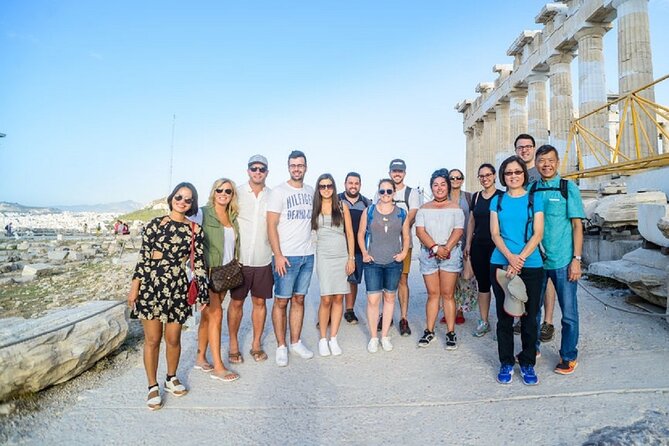
The Parthenon receives about 45 minutes, making it the main event of the tour. Construction began in 447 BC, when the Athenian Empire was at the height of its power, and the temple was dedicated to Athena.
You will not enter the temple itself as though it were an intact building. The experience is about reading the surviving structure, its scale, its placement, and the traces of the work that once covered it. A guide can explain why the Parthenon matters beyond its postcard appearance, including its religious role and its connection to Athenian confidence and political power.
The discussion of the missing marbles adds a modern point of tension. As you look at the temple, you also confront the fact that important sculptures and architectural pieces are no longer in Athens. A French archaeologist can place that dispute within the wider story of archaeology, collecting, preservation, and cultural ownership.
This is where the guide’s language skills matter most. You will hear specialized terms, dates, and competing historical ideas. A microphone is helpful in a group, and a clear French delivery makes it easier to follow while looking around instead of staring at the guide.
Several highly positive experiences praised the amount of detail and the accuracy of the explanations. One guide also took time to photograph each person in front of the Parthenon. That is a small service, but it can be useful when the site is crowded and you want a proper group photograph without asking a stranger.
The Erechtheion and the Temple of Athena Nike
The tour also covers the Erechtheion and the Temple of Athena Nike, two buildings that keep the Acropolis from becoming a one-monument visit.
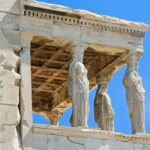
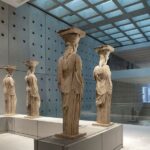
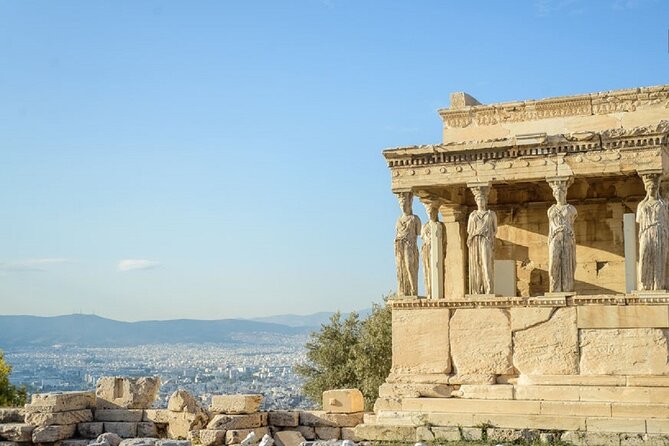
The Erechtheion is described as a vast part of the complex and is especially useful for understanding the varied religious life of ancient Athens. Its unusual form and multiple sacred associations make it a natural place for a guide to explain why the Acropolis was not designed around one simple building plan.
The Temple of Athena Nike was built around 420 BC and is the earliest fully Ionic temple on the Acropolis. Its dedication to Athena Nike links the goddess with victory, while its smaller scale gives you a useful contrast with the Parthenon.
I appreciate this range. You get the large, commanding temple, the ceremonial gateway, smaller religious structures, and the theater. The visit gives you enough pieces to understand the Acropolis as a working sacred complex rather than a single photo opportunity.
The official two-hour duration is tight but sensible. It gives you time to cover the principal monuments without turning the experience into an all-day archaeological seminar. If you want every inscription, every restoration phase, and long time for private photographs, you will need more time on your own.
Is $80.64 a fair price?
At $80.64 per person, this is not the cheapest way to see the Acropolis. The price makes more sense when you count the included entrance ticket, the licensed French-speaking guide, and the time saved by avoiding the standard entrance line.
You are also paying for interpretation, not simply access. The Acropolis entrance gives you the ruins, but it does not automatically explain how the Theatre of Dionysus, Propylaea, Parthenon, Erechtheion, and Temple of Athena Nike relate to one another. If you would otherwise buy a guidebook or audio guide and still feel unsure about the site, this package can offer good value.
The value is strongest for French-speaking adults who enjoy history and want a structured explanation. It is less clear for a family with very young children, a visitor who dislikes long spoken explanations, or someone content to take photographs and read signs independently.
The rating is 4.8 from 22 reviews, with 91 percent recommending the experience. That points to a strong overall result, while the lower scores reveal a useful warning: guide style, pacing, and the amount of information can make or break the visit.
Who should book this French-language visit?
I would choose this tour if you want the Acropolis to feel understandable rather than simply impressive. It is a good match for:
- French-speaking visitors who want a specialist explanation
- First-time visitors to Athens
- History, archaeology, architecture, and theater enthusiasts
- Couples and adults who prefer a structured two-hour visit
- Anyone who values included tickets and faster entry
- Visitors who want the main monuments covered in one session
I would think twice if your children struggle with long explanations, if you need shade and frequent rest, or if you prefer a private tour with constant questions. The tour can be detailed and lecture-like, and not every guide will have the same warmth or spontaneity.
For the best chance of a comfortable visit, choose an evening time if available, wear solid walking shoes, carry water, and bring your passport if you are an EU citizen under 25. Admission is free for EU citizens in that age group when they show a passport, so check how that affects the booking arrangements before paying the full ticket-inclusive rate.
Booking, weather, and practical details
Confirmation is provided when you book. The tour requires good weather, and poor conditions can lead to a new date or a full refund. It also requires a minimum number of participants, so a cancellation for that reason brings the same choice of another date or experience, or a full refund.
Free cancellation is available up to 24 hours before the start time. Cancellations or changes made inside that 24-hour window are not accepted for a refund, and the cut-off follows local Athens time.
The meeting and ending points are fixed, so plan your day around them. Start at Porinou 5 and finish at Areopagus. Since the tour involves open stone areas and an uphill archaeological site, allow yourself enough time to arrive without rushing.
Should you book the Acropolis Walking Tour with a French Guide?
Book it if you want French-language interpretation, included entry, and a serious look at more than the Parthenon. The strongest experiences come from guides such as Anna, who explain clearly, add humor, make cultural connections, and give the group time to keep pace.
The $80.64 price is fair for a guided visit with admission included, especially when fast entry saves valuable Athens sightseeing time. Just set the right expectations. This is an educational walking tour, not a casual stroll. Pick an evening slot when possible, bring water and good shoes, and avoid it if your group needs a child-focused or highly flexible format.
FAQ
How long does the Acropolis walking tour last?
The tour lasts approximately two hours.
What language is the tour conducted in?
The tour is conducted in French by a licensed French-speaking guide.
Are Acropolis entrance tickets included?
Yes. Skip-the-line entrance tickets are included in the tour price.
What is the price of the experience?
The listed price is $80.64 per person.
What sites are covered?
The visit covers the Acropolis, Parthenon, Propylaea, Temple of Athena Nike, Erechtheion, and Theatre of Dionysus.
Where does the tour begin?
The meeting point is Porinou 5, Athens 117 42, Greece.
Where does the tour finish?
The tour ends at Areopagus, Athens 105 55, Greece.
How many people can join the tour?
The maximum group size is 20 people.
Is the tour suitable for all fitness levels?
No. A moderate level of physical fitness is recommended because the visit takes place on an uneven, uphill archaeological site.
Can EU citizens under 25 enter for free?
Yes. EU citizens under 25 can receive free admission when they show their passport. Check the booking details before paying for an included ticket.
Can I cancel for a full refund?
Yes, if you cancel at least 24 hours before the experience begins. Cancellations or changes made less than 24 hours before the start time are not accepted for a refund.
What happens if bad weather cancels the tour?
You will be offered a different date or a full refund if poor weather causes cancellation.
![Full-Day Discover Ithaka (Ithaca) Bus Tour [from Kefalonia] - The road to Kioni is scenic but takes time](https://1.greeceescapes.com/wp-content/uploads/full-day-discover-ithaka-ithaca-bus-tour-from-kefalonia-400x267.jpg)