REVIEW · THESSALONIKI
Thessaloniki Walking Tour
Book on Viator →Operated by MTM Experiences · Bookable on Viator
Thessaloniki’s story is easiest to grasp on foot, where Roman ruins, Byzantine churches, Ottoman-era traces, and modern café life sit close together. This two-hour walking tour links the city’s major sights from the White Tower to Saint Demetrius, giving you a useful first look at the historic center.
I like the small maximum group of 15, which leaves room for questions and personal attention. I also like the practical advice on where to eat, drink, and explore after the walk. The main consideration is the price, $72.10 per person, for a short tour, and the walk may cover substantial ground. One participant counted 12,000 steps.
In This Review
- Key points at a glance
- Why this walk is a smart first look at Thessaloniki
- Starting beside the White Tower
- The Galerian Complex and the shape of Roman power
- The Greek Agora and Roman Forum
- Saint Demetrius, Thessaloniki’s patron saint
- Aristotelous Square and a look toward the sea
- What $72.10 gets you
- Timing, walking effort, and group size
- Who should book this Thessaloniki walking tour?
- Should you book it?
- FAQ
- Where does the Thessaloniki walking tour begin?
- Where does the tour end?
- How long does the walking tour last?
- What sights are included?
- Is the tour offered in English?
- How many people can join the tour?
- What is the cancellation policy?
Key points at a glance
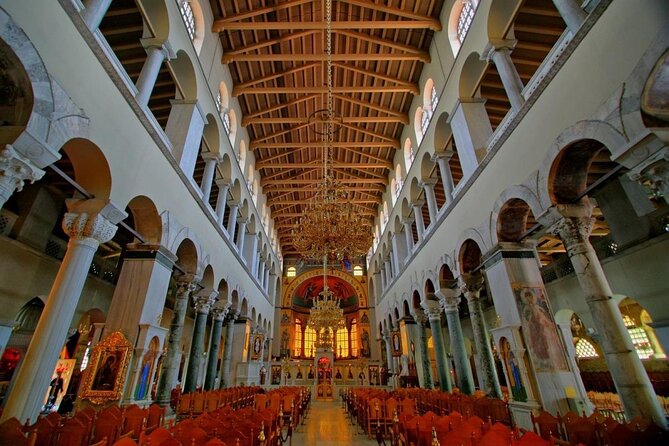
- A clear route through central Thessaloniki: Start at the White Tower and finish at the Church of Saint Demetrius.
- Five important stops: See the White Tower, Galerian Complex, Roman Forum, Saint Demetrius, and Aristotelous Square.
- A guide-led history lesson: Guide Nikos Chatzziioannou is praised for strong knowledge of Greece and Thessaloniki, clear explanations, and good attention to group needs.
- A small group setting: The tour accepts no more than 15 people, and a smaller booking may allow plenty of questions.
- Useful local orientation: You receive suggestions for places to eat, drink, and continue exploring.
- Early start and free cancellation: Meet at 9:00 a.m., and cancel at least 24 hours before the start for a full refund.
Why this walk is a smart first look at Thessaloniki
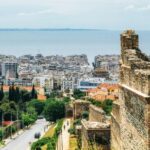
Thessaloniki can feel spread out when you first arrive. Its best-known sights are not all in one formal museum complex, so a guide helps connect them. This walk moves from the waterfront to the upper part of the central city, showing how different periods overlap.
You begin at the White Tower, the city’s best-known landmark, then move toward the Galerian Complex and Roman Forum. The route ends near Saint Demetrius, giving you a strong base for further sightseeing in the city center.
I like this arrangement because the tour is not just a sequence of photo stops. The guide can explain why a Roman palace was built here, how public life worked around the forum, and why Saint Demetrius remains central to local religious life.
The walk is offered in English. Nikos Chatzziioannou is specifically praised for his knowledge of Greece and nearby countries, his friendly manner, and his ability to explain the city clearly. The guide is also described as attentive to the needs of a small group, a useful quality on a walking tour with several stops.
You can also read our reviews of more walking tours in Thessaloniki


Starting beside the White Tower
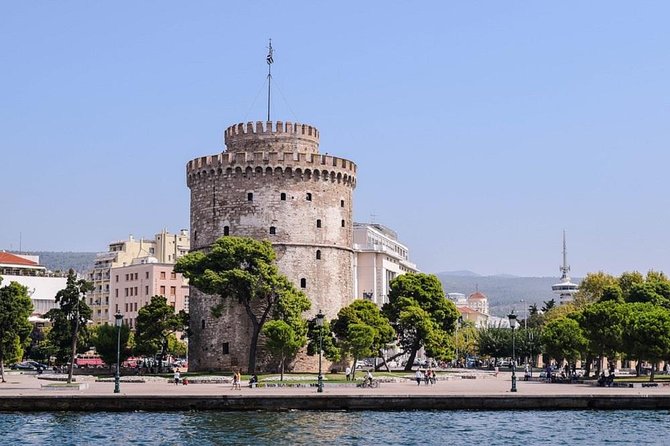
Meet your guide at the White Tower at 9:00 a.m. This is an easy place to find and a useful landmark if you are staying near the center or coming by public transportation.
The tower once formed part of Thessaloniki’s fortifications. It also served as a prison, which gives the polished waterfront landmark a darker past than its bright name suggests. The stop lasts about 10 minutes, so expect an introduction rather than a full interior visit.
The White Tower works well as a starting point because it immediately places you in the city’s story. You can see how Thessaloniki’s waterfront relates to the old defensive city, then begin walking inland toward its Roman and Byzantine remains.
Bring water and comfortable shoes. The published duration is about two hours, but one participant reported walking 12,000 steps. That figure may reflect the person’s full morning or the pace of that particular outing, so it should not be treated as a fixed distance. Still, it is a useful warning: this is an active city walk, not a short stroll between nearby monuments.
The Galerian Complex and the shape of Roman power
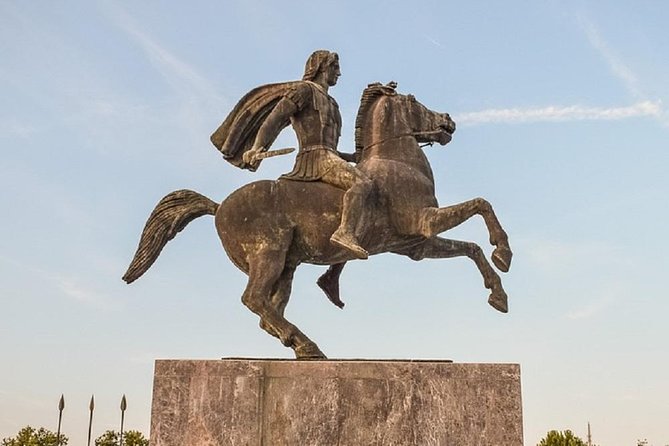
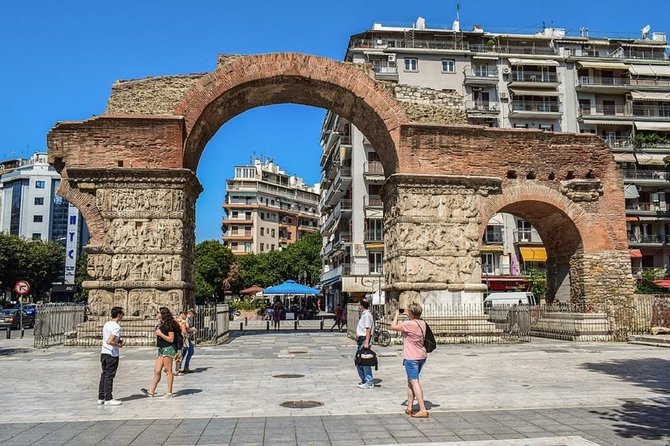
The next major stop is the Galerian Complex, including the Apsidal Hall. You will hear about the palace, hippodrome, Arch of Galerius, and Rotunda, all connected to Caesar Galerius and his decision to make Thessaloniki a residence.
This is one of the most valuable parts of the walk because the remains make more sense when seen as one large imperial project. Instead of looking at an arch or a ruined wall in isolation, you can understand the area as a center of government, ceremony, and public display.
The Apsidal Hall provides a particularly useful point of reference. The complex shows how Roman rulers used architecture to announce power. The palace and public spaces were not merely practical buildings. They helped place Thessaloniki within the political world of the Roman Empire.
The planned stop lasts about 25 minutes. That is enough time for a focused explanation and photographs, but not enough for a slow examination of every surviving detail. If you want to study the architecture closely, you will need to return on your own.
The tour’s value here comes from connection and context. A guide can help you picture the relationship between the palace, hippodrome, arch, and Rotunda, which is difficult to do from a quick solo glance at a street-side ruin.
The Greek Agora and Roman Forum
The route continues to the Greek Agora and Roman Forum, once the center of financial and administrative activity. This was a working public area, not simply a ceremonial monument. It was where civic business, money, and public life came together.
I find this stop important because it shifts the focus from emperors and churches to ordinary city systems. Thessaloniki was not only a strategic place on a map. It was also a city where people handled business, made decisions, and gathered in public spaces.
The tour allows about 25 minutes here. Expect the guide to explain what the forum was used for and how it fitted into Roman Thessaloniki. You will also have time for photographs and questions, though the exact amount of discussion depends on group size and interest.
This is where the small-group format can make a real difference. If you want to know how the forum differed from the Greek Agora, or how the surviving remains fit into the modern streets, you can ask directly. One person who joined alone found it especially easy to raise questions, and that is a fair advantage of a guide-led walk with no large crowd.
Do not expect a full archaeological excavation visit with extended time inside every section. The tour is designed as an overview of the city’s main historic core. It gives you the framework, then you can choose which sites deserve a longer return visit.
Saint Demetrius, Thessaloniki’s patron saint
The Church of Saint Demetrius is the longest scheduled stop, at about 25 minutes. It is dedicated to Thessaloniki’s patron saint, and people visit daily to pay their respects.
This stop adds a different layer to the tour. The Roman Forum explains civic life and imperial administration. Saint Demetrius shows the continuing religious identity of the city and the role of a major church in local life.
Your guide can help you notice the church as more than a place to take photographs. You will learn why Saint Demetrius matters to Thessaloniki and why this church remains an active place of worship. The stop is especially useful if you prefer understanding the meaning of a building rather than simply collecting another impressive interior.
The church is also the tour’s endpoint, at Ag. Dimitriou 81-83. That gives you a practical advantage. You finish near a major historic sight instead of being returned to the starting point, so you can continue exploring from a different part of central Thessaloniki.
Because this is an active religious site, respectful behavior is important. The supplied information does not specify a dress code or interior photography rules, so follow posted instructions and your guide’s advice.






Aristotelous Square and a look toward the sea
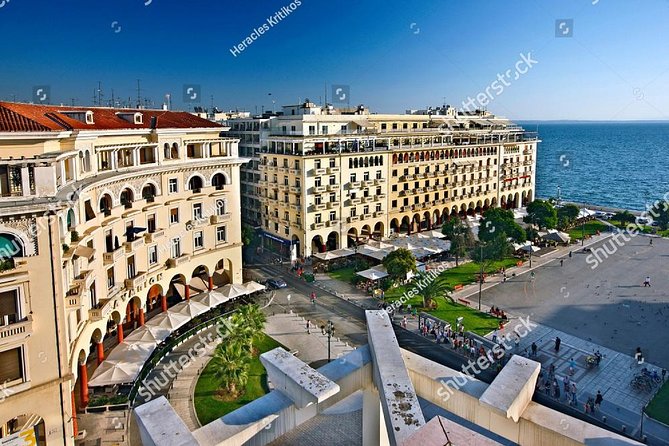
The final listed stop is Aristotelous Square, with about 30 minutes set aside. Surrounded by neoclassical buildings, the square opens toward the sea and offers one of the city’s most pleasant places to pause.
This is a welcome change of mood after the ruins and church. You can take in the architecture, watch city life around the square, and understand how Thessaloniki works as a modern place as well as an archaeological one. It is also a natural setting for a coffee break or a plan for the rest of your day.
The square is described as a place to relax and enjoy the city’s atmosphere. I like having this kind of stop on a history walk. A good city tour should not leave you with only dates and stones. It should show you where the city’s present-day rhythm happens.
There is one point to clarify. The listed route places Aristotelous Square before Saint Demetrius, while the stated endpoint is Saint Demetrius. Your guide will manage the exact walking order, but you should expect the finish at the church rather than at the square.
What $72.10 gets you
At $72.10 per person, this is not the cheapest way to see Thessaloniki’s major landmarks. The fee pays for an English-speaking guide and a small group, not for entrance tickets, personal expenses, or tips.
The value depends on how much help you want making sense of the city. If you already know Thessaloniki well and plan to read about each monument yourself, the price may feel high for roughly two hours. If this is your first visit, the tour can save time and prevent the common problem of seeing major ruins without understanding their purpose.
The strongest value comes from the route and the guide’s role. You are not paying for transportation or an elaborate attraction. You are paying for interpretation, local orientation, and the chance to ask questions while moving through the city.
The small-group limit also matters. A group of up to 15 is not private, but it is more manageable than a large coach group. If attendance is low, you may receive much more direct attention. One booking had only one participant, making it easy to shape the discussion around personal questions.
You should also budget for tips and any personal spending. Entrance fees are not included. The supplied details identify admission as free at the listed stops, but the tour terms still exclude entrance fees, so confirm any planned interior visits before booking.
Timing, walking effort, and group size
The 9:00 a.m. start is useful if you want to see the city before a full day of sightseeing. It also leaves time afterward for lunch, museums, shopping, or a return visit to a site that caught your attention.
The tour lasts approximately two hours. Because it includes five stops and crosses central Thessaloniki, the pace is likely purposeful. You will not spend half an hour at every monument. The walk is best for someone who wants a broad introduction, clear historical commentary, and several photo opportunities.
The group maximum is 15 people. Most people can participate, and the meeting point is near public transportation. No special mobility information is supplied, so ask the provider directly if you have concerns about walking distance, pavement, stairs, or the church interior.
Good shoes matter more than fancy equipment. You will be walking between monuments, standing during explanations, and moving through busy central streets. Water is sensible, especially in warm weather.
The tour requires good weather. If poor weather causes cancellation, you will be offered another date or a full refund. You can cancel free of charge up to 24 hours before the start time, but cancellations or changes inside that window are not accepted.
Who should book this Thessaloniki walking tour?
I would choose this tour for a first visit, especially if you want the city’s main historic areas explained in one morning. It suits people who enjoy Roman and Byzantine sites but do not want to spend hours researching before arrival.
It is also a good match for independent visitors who want local suggestions after the walk. The guide can point you toward places to eat, drink, and explore, giving you a better starting point for the rest of your stay.
The tour may be less suitable if you dislike walking, want long interior visits, or expect a private experience. The itinerary covers a lot in two hours, so the emphasis is on orientation and explanation rather than exhaustive sightseeing.
Families and older visitors should judge the walking distance carefully. The information says most people can participate, but it does not give a precise route length or accessibility details. Ask before booking if anyone in your party has difficulty walking for extended periods.
Should you book it?
Book this Thessaloniki walking tour if you want a well-organized introduction to the city’s Roman, religious, and waterfront landmarks and value a guide who can answer questions. The strongest features are the sensible route, the 15-person limit, and the praised guiding of Nikos Chatzziioannou.
At $72.10, I would book it for a first morning in Thessaloniki, not as a budget sightseeing option. You receive the most value when you use the walk to plan the rest of your visit. Take notes on the places you want to revisit, ask for food and drink suggestions, and treat the tour as your orientation to the city rather than the complete Thessaloniki experience.
FAQ
Where does the Thessaloniki walking tour begin?
The tour begins at the White Tower of Thessaloniki, Thessaloniki 546 21, Greece. Meet your English-speaking guide there at 9:00 a.m.
Where does the tour end?
The tour ends at the Holy Church of Saint Demetrius, Ag. Dimitriou 81-83, Thessaloniki 546 33, Greece.
How long does the walking tour last?
The tour lasts approximately two hours.
What sights are included?
The route includes the White Tower, the Galerian Complex and Apsidal Hall, the Greek Agora and Roman Forum, the Holy Church of Saint Demetrius, and Aristotelous Square.
Is the tour offered in English?
Yes. The tour includes an English-speaking guide.
How many people can join the tour?
The maximum group size is 15 people. Availability can vary, and some departures may be smaller.
What is the cancellation policy?
You can cancel at least 24 hours before the start time for a full refund. Cancellations or changes made less than 24 hours before the start time are not accepted. If poor weather causes the tour to be canceled, you will be offered a different date or a full refund.