REVIEW · ATHENS
Acropolis and Museum Tour With Early Entry Ticket
Book on Viator →Operated by Athens Walking Tours · Bookable on Viator
The best reason to book this tour is simple: early entry matters at the Acropolis. You reach the hill before the 9:00 a.m. rush, when the heat and crowds begin to press in. The route covers the Theatre of Dionysus, Odeon, Temple of Athena Nike, Erechtheion, Parthenon, and Acropolis Museum in about three and a half hours.
I like the clear audio headsets, which make it easier to follow a guide while standing among large groups. I also like the local storytelling. Guides such as Rina, Pan, Marguerite, and Helene have been praised for making the stones feel connected to real Athenian myths, plays, politics, and daily life.
The main drawback is the uphill walking and exposure to the sun. You also need to check carefully if you are booking the option with entrance tickets or without them, since the base price does not always cover every admission.
In This Review
- Key points to know before booking
- Why early entry changes the Acropolis visit
- The Theatre of Dionysus and the beginning of drama
- The Odeon, Athena Nike, and the first views
- The Erechtheion and its Caryatid maidens
- The Parthenon and one hour on the Acropolis
- The Acropolis Museum puts the stones in context
- Guide quality and the value of the headsets
- Is $59 a fair price?
- Who will get the most from this tour
- Booking details worth keeping in mind
- Should you book it?
- FAQ
- How long does the Acropolis and Museum Tour take?
- What sites are included on the Acropolis?
- Are entrance tickets included in the $59 price?
- Where does the tour start and finish?
- Is the tour suitable for someone with limited mobility?
- Can I cancel for a full refund?
Key points to know before booking
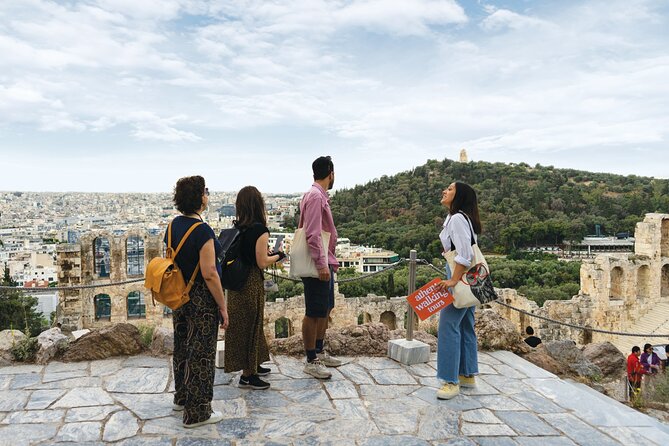
- Early access before the 9:00 a.m. rush: The cooler, quieter start is the strongest feature of this tour.
- Six major Acropolis stops: You see the Theatre of Dionysus, Herod Atticus Odeon, Temple of Athena Nike, Erechtheion, Parthenon, and the Acropolis grounds.
- A licensed local guide: Guides including Rina, Pan, Marguerite, and Helene are praised for lively, clear explanations.
- Museum time is built in: The Acropolis Museum follows the hilltop visit and gives you time to see its displays at your own pace.
- Headsets make a difference: Earsets help you hear the guide without crowding around her.
- Maximum group size of 24: This is not a private tour, but it is more manageable than a very large group.
Why early entry changes the Acropolis visit
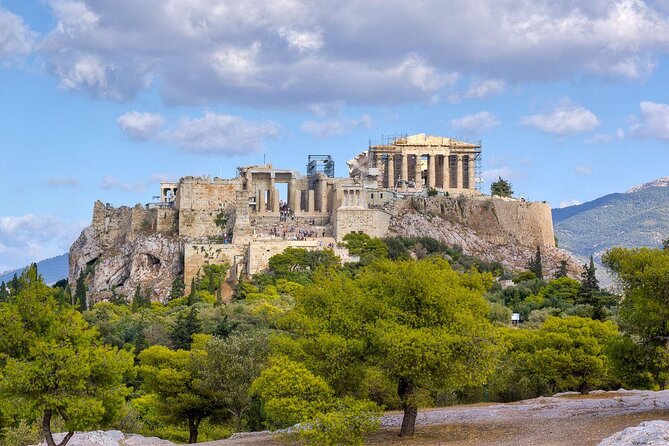
The Acropolis is not a place I would save for the middle of the day. The hill has little shade, the stone can reflect the heat, and the main paths become much harder to enjoy once large groups arrive. This tour is built around getting you there early, before the reported 9:00 a.m. rush.
That timing is useful in two ways. First, you spend less time waiting at the entrance if you select the ticket option. Second, the monuments are easier to take in when you are not constantly stopping to let another group pass.
Early entry does not turn the Acropolis into a private site. You will still share the hill with other visitors, and the tour is capped at 24 people rather than limited to a handful. Still, an early start gives you a better chance to hear the guide and take in the views without the full midday crush.
The start point is the Acropolis Canteen in Athens. You make your own way there because hotel pickup and drop-off are not included. The tour ends at the Acropolis Museum on Dionysiou Areopagitou, a useful arrangement if you want to continue your museum visit after the guided portion.
A few more Athens tours and experiences worth a look


The Theatre of Dionysus and the beginning of drama
The first stop is the Theatre of Dionysus, with about 15 minutes set aside for it. The theater is cut into the lower slope of the Acropolis, and its stone seating gives you a direct sense of how an Athenian audience watched performances from the hillside.
This is more than a quick photo stop. The theater connects the Acropolis to the development of drama, including the tragedies and comedies associated with ancient Athens. A good guide can make the space easier to picture by explaining how the seating, stage area, and hillside setting worked together.
Admission to this stop is listed separately from the tour timing, so your entrance arrangement matters. If you select the option that includes the Acropolis ticket, the guide handles the skip-the-ticket-line service described for the tour. If you select without tickets, follow the instructions on your voucher and purchase the required Acropolis admission yourself.
The Odeon, Athena Nike, and the first views
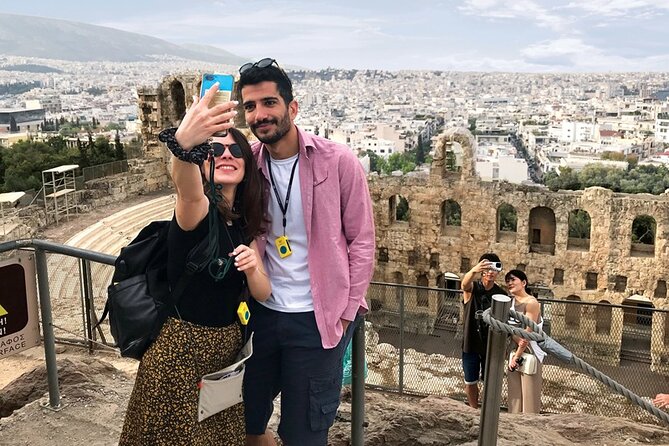
The Herod Atticus Odeon gets a shorter stop of about 10 minutes. This Roman-era theater is built into the Acropolis rock and still hosts music concerts and performances. Its continued use gives the ruins a useful link to modern Athens, rather than leaving them as a silent monument to the past.
The tour also includes the Ionic Temple of Athena Nike. The temple honors Athena as the goddess of victory and is known for its friezes and open views across Athens. The stop is a good reminder that the Acropolis was not designed as one single building. It is a collection of sanctuaries and monuments, each with its own purpose and visual character.
You should expect short pauses here rather than long independent exploration. The guide keeps the group moving toward the main temples, and the headsets let you listen while looking around instead of standing shoulder to shoulder with the guide.
The Erechtheion and its Caryatid maidens
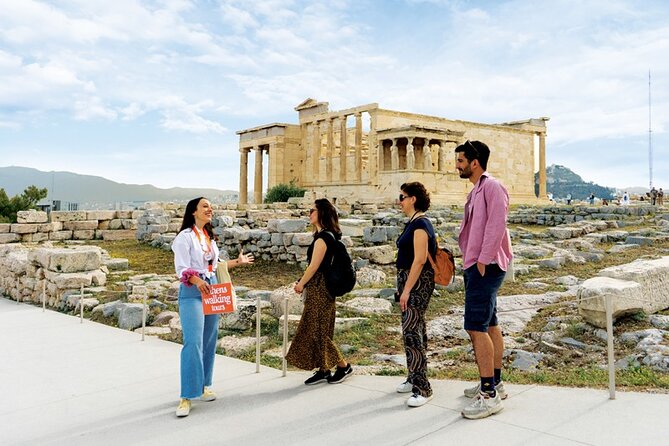
The Erechtheion receives roughly 15 minutes, but it deserves your attention. Its unusual design and connection to Athenian legends make it a different experience from the more symmetrical Parthenon.
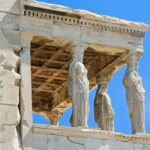
The most famous feature is the porch supported by the Caryatids, sculpted female figures that serve as architectural supports. The guide can help explain why this temple feels less orderly than the Parthenon and how its myths fit into the sacred identity of Athens.
The Caryatids you see on site are copies, while the original sculptures are protected in the Acropolis Museum, with one famous connection to the British Museum. The supplied tour information specifically promises the museum’s collection of Acropolis artifacts, so the museum visit is important if you want to see the surviving sculpture and objects in a more controlled setting.
The Parthenon and one hour on the Acropolis

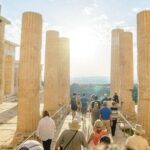
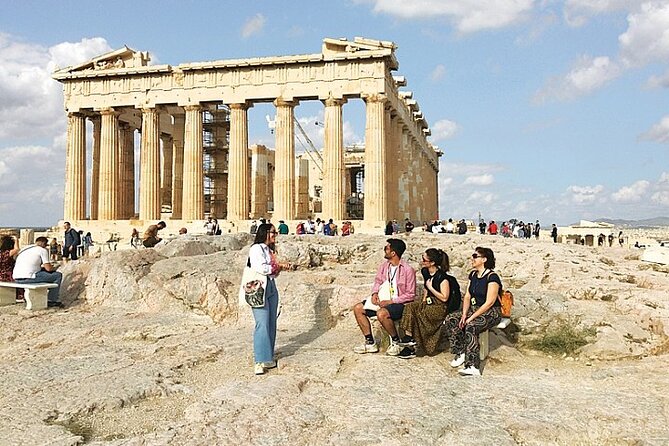
The Parthenon is allotted about 20 minutes as a focused stop, followed by about 1 hour and 15 minutes devoted to the Acropolis itself. In practice, the hilltop portion combines guided explanations, walking between monuments, pauses for views, and some time to look around on your own.
I like this balance. You are not simply marched past the Parthenon for a quick photograph, but you are also not left to face the huge site without a plan. The guide points out the Doric columns, friezes, and key architectural details, then gives you room to absorb the setting.
The Parthenon is the visual centerpiece, but its impact grows when you understand its place among the other buildings. From the hill, you can look out across Athens while the guide explains how the Acropolis functioned as a sacred center and a symbol of the city.
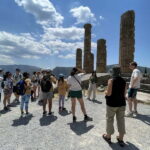
Do not underestimate the walking. One review specifically notes a fair amount of uphill movement, and another points out that the day was hot with lots of walking. You should have a moderate level of fitness and be ready for uneven stone surfaces, steps, and sun. Wear practical shoes and bring water, even though food and drinks are not part of the tour.
You can also read our reviews of more museum experiences in Athens


The Acropolis Museum puts the stones in context
The final major stop is the Acropolis Museum, with about 1 hour and 15 minutes scheduled for the visit. The museum presents Athenian material in chronological order and displays objects found on and around the Acropolis.
This is where the tour gains depth. On the hill, you see columns, temples, and open sky. In the museum, you can look closely at sculpture, architectural fragments, and other objects that show how the site changed over time. The transition from the outdoor ruins to the indoor galleries helps you understand details that are easy to miss while standing in bright sun.
The guided portion ends at the museum, and you are left to continue exploring at your own pace. That is a real advantage for anyone who dislikes being hurried through a museum. You can stay with a favorite display or move on when you have had enough.
There is one important admission detail. The standard museum entry connected with this tour does not include the archaeological ruins beneath the museum. Seeing those remains requires another museum admission. If you are watching your spending, decide in advance if that extra visit is worth the cost, since one full additional entry may feel high for a relatively focused underground area.
Guide quality and the value of the headsets

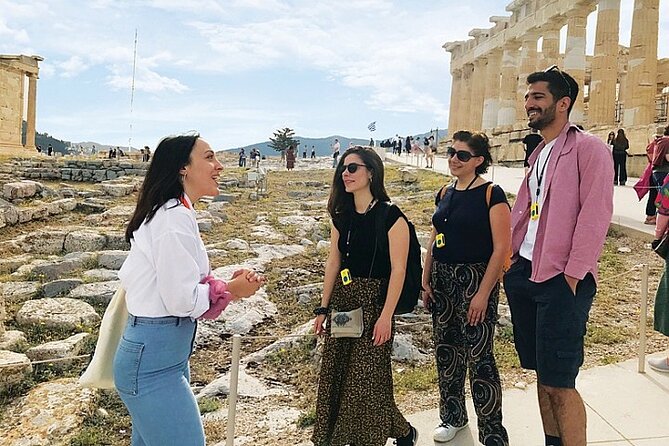
The guide is the heart of this experience. The tour is conducted in English by a professional local licensed guide, and several guides have been singled out for different strengths.
Rina is praised for her wealth of knowledge and for making the early visit memorable. Pan is described as an excellent guide during a particularly crowded day. Marguerite is noted for her enthusiasm and ability to hold attention for more than four hours without relying on a script. Helene helped one delayed group sort out meeting problems and kept the mood light.
You should not expect every departure to have the same guide, but these examples show what the operator aims for: local context, clear English, and a lively presentation rather than a list of dates. The audio headsets are especially helpful at the Acropolis, where wind, stone walls, and nearby groups can make normal conversation hard to follow.
A group of up to 24 people is still large enough that you may not get much personal time with the guide. The headsets partly solve that problem. You can stand a little apart, look at the monument, and still hear the explanation.
Is $59 a fair price?
The listed price is $59 per person, but you need to read the ticket choice carefully. Entrance fees are not included in every booking option, while the with-ticket option includes the skip-the-ticket-line service. The price is also adjusted on days when Acropolis admission is free, since the entrance cost is deducted.
That makes the value depend on what you select. If your booking includes the tickets, you are paying for a licensed guide, early access planning, audio equipment, and a structured route through both the hill and museum. If it does not, you must add the admission costs yourself and follow the voucher instructions.
I think the tour is a reasonable use of money for a first visit, particularly if you have only one morning in Athens. The guide saves you from spending your limited time working out the order of the monuments, and the early start can be worth more than the modest price difference between a guided visit and a basic admission ticket.
Independent visitors who enjoy reading signs and setting their own pace may find the cost less appealing. You can see the Acropolis without a guide, and the museum can be explored on your own. The strongest value here comes from the combination of timing, explanation, and a planned transition from the hill to the museum.
Who will get the most from this tour
I would choose this experience for a first-time visitor who wants the essential Acropolis sights without spending half the morning in a queue. It also suits anyone who prefers a guide to explain the myths, architecture, and role of each building as the site appears in front of you.
It is a good fit for travelers who want structure but still like some personal time. The hilltop portion includes guided viewing and some time to explore, while the museum is yours to continue at your own pace after the tour ends.
I would think twice if you have trouble with uphill walking, hot weather, or uneven ground. The tour requires moderate physical fitness, and the total day can run longer than the advertised approximate duration depending on the pace of the group. The experience is offered in English only, so you should be comfortable listening to a full guided explanation in that language.
Service animals are allowed, and the meeting point is near public transportation. There is no hotel transfer, so plan your route to the Acropolis Canteen before the start time.
Booking details worth keeping in mind
You receive confirmation at booking. The maximum group size is 24, and the tour runs in English. Gratuity is not included, with around 10 percent of the service cost given as a general Greek guideline if you feel the guide provided good service.
Free cancellation is available up to 24 hours before the start time for a full refund. Changes or cancellations inside that window are not accepted for a refund. The tour can also be canceled if poor weather affects the experience or if the minimum number of participants is not reached. In those cases, you are offered another date or experience, or a full refund.
The most useful practical choice is to reserve an early departure, select the correct ticket option, and arrive ready for sun and uphill walking. That simple preparation addresses the main difficulties before they become problems.
Should you book it?
Book this tour if you want the Acropolis explained in context, prefer an early start, and plan to see the museum on the same morning. The combination of local guiding, headsets, skip-the-ticket-line service with the proper ticket option, and flexible museum time makes it a strong introduction to Athens.
Skip it if you want complete freedom, already know the ancient sites well, or do not want to pay for a guide and museum arrangement. For most first visits, though, I would choose the early entry option. The heat and crowds only grow as the morning advances, and a good guide such as Rina, Pan, Marguerite, or Helene can turn a group visit into a much clearer and more memorable look at the Acropolis.
FAQ
How long does the Acropolis and Museum Tour take?
The scheduled duration is approximately 3 hours and 30 minutes. The Acropolis portion and museum visit each include about 1 hour and 15 minutes, with additional time for the individual monument stops.
What sites are included on the Acropolis?
The route includes the Theatre of Dionysus, Herod Atticus Odeon, Temple of Athena Nike, Erechtheion, Parthenon, and the wider Acropolis site.
Are entrance tickets included in the $59 price?
Entrance fees depend on the option you select. The with-ticket option includes skip-the-ticket-line service. If you choose without tickets, follow the voucher instructions to purchase Acropolis admission. The museum entrance should also be checked carefully when booking.
Where does the tour start and finish?
The tour starts at the Acropolis Canteen in Athens. It finishes at the Acropolis Museum on Dionysiou Areopagitou, where you can continue exploring on your own.
Is the tour suitable for someone with limited mobility?
The experience requires a moderate level of physical fitness and includes uphill walking at the Acropolis. You should be prepared for the physical demands of the site before booking.
Can I cancel for a full refund?
You can cancel up to 24 hours before the start time for a full refund. Cancellations or changes made less than 24 hours before the start time are not accepted for a refund. If poor weather or insufficient bookings cancel the tour, you are offered another date, another experience, or a full refund.