REVIEW · GREECE
Advanced Workshop
Book on GetYourGuide →Operated by Xylo Wood Design Santorini · Bookable on GetYourGuide
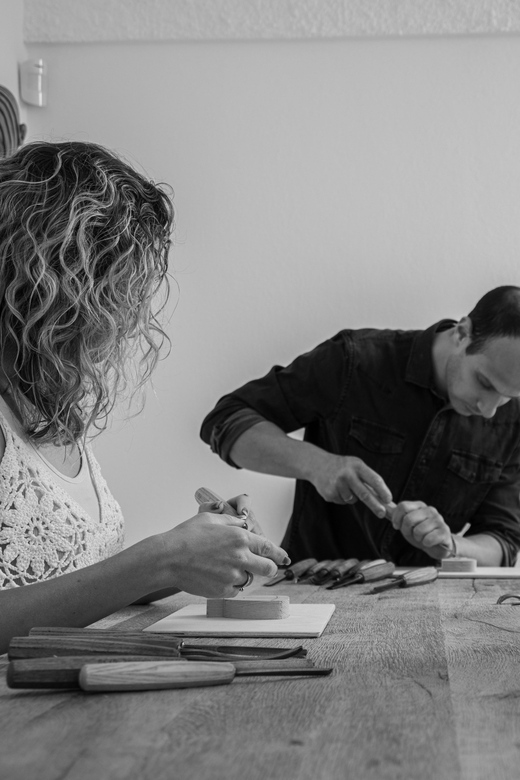
The most memorable part of this Santorini workshop is that you do not simply buy a souvenir. You carve one. Under Michael’s guidance, you shape wood into a small three-dimensional object inspired by the Ancient Theraic, or Cycladic, civilization. The result is personal, with every cut showing a little of your hand.
I like the hands-on pace and the connection to Santorini’s church woodcarving tradition. I also like that beginners are welcome, and that the session can produce several pieces to take home. The main consideration is time: two hours gives you a focused introduction, not enough time to master fine carving or complete a large object.
In This Review
- Key points
- Why carve a souvenir in Santorini?
- Meeting Michael and learning the local craft
- The first stage: a short history of woodcarving
- The second stage: learning how wood responds
- The third stage: making a Cycladic-inspired object
- What makes the keepsake different
- Is $94 per person a fair price?
- Who should book this workshop?
- Practical timing and booking advice
- How this compares with buying local woodwork
- A balanced look at the experience
- Should you book the Megalochori woodcarving workshop?
- FAQ
- How long does the woodcarving workshop last?
- Where does the activity take place?
- How much does the workshop cost?
- Is the workshop private?
- Who teaches the workshop?
- What languages are available?
- Do I need previous woodcarving experience?
- What will I make?
- Can children join the activity?
- Can I cancel the booking?
Key points
- Create your own Cycladic-inspired object: The finished piece is made by you, not selected from a shop shelf.
- Work with instructor Michael: He teaches in Greek or English and guides beginners through each stage.
- Learn Santorini’s woodcarving traditions: The workshop connects local churches, chapels, and carved iconostases with modern craft.
- Private group format: Your session is arranged for a private group rather than a large class.
- Possible to make several pieces: One recent session produced three objects per person, though results depend on your pace and design.
- Good for ages 12 and up: Children under 12 cannot take part.
Why carve a souvenir in Santorini?
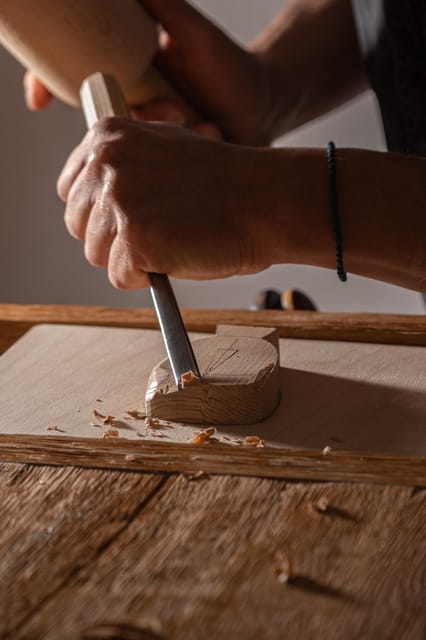
Santorini is full of objects you can buy and carry home. This workshop gives you a different option: spend two hours making something with your own hands, then keep the marks of that effort.
The activity takes place in Megalochori, a village known here as the setting for the workshop. The work is not presented as a quick tourist craft with a finished trinket waiting on the table. You learn basic principles, handle the tools, and take part in the process from prepared wood to carved form.
That matters because woodcarving rewards patience. A painted souvenir can look polished in seconds, but carving forces you to slow down and pay attention to pressure, direction, and shape. You will feel the wood resist the blade, then give way in a small slice. The sound and smell of the material become part of the memory.
I also like the clear local connection. Santorini has many churches and chapels with traditional architecture and ornate carved iconostases. These carved screens, along with carved furniture and religious woodwork, help explain why the instructor’s approach is tied to the island rather than being a generic craft lesson.
A few more Greece tours and experiences worth a look



Meeting Michael and learning the local craft
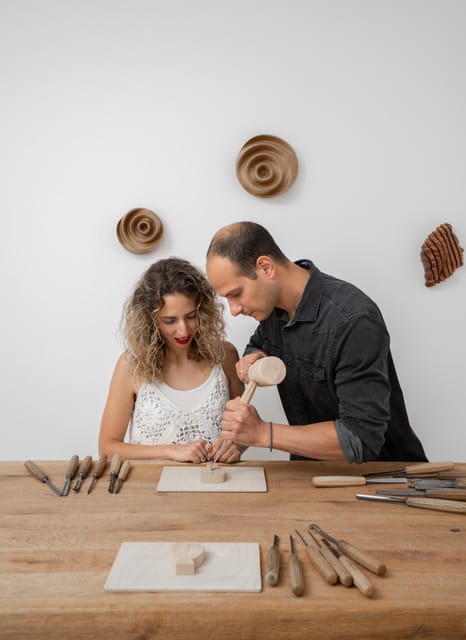
Michael has worked as a woodcarver since 2013. His training includes study with Panagiotis and George Thanos, who specialize in carved furniture, as well as the influence of Bekos Panagiotis, a church woodcarving artist.
You do not need prior carving experience. Michael first explains the stages of the work, then helps you apply the basic techniques. A recent session with complete beginners resulted in beautiful finished pieces, which tells you something useful about the teaching style: you can expect active guidance rather than a lecture followed by a difficult solo task.
His work covers a wide range of subjects. He has carved traditional and modern designs, realistic images and playful forms, lettering, relief work, ornament, and sculpture. That range is useful for beginners because it suggests you are not being pushed into one narrow style. Your own object will be inspired by Ancient Theraic civilization, but the process still leaves room for personal expression.
The instruction is available in Greek and English. If you want to ask questions about tools, wood, or design, the private format should make that easier than a crowded group class.
The first stage: a short history of woodcarving

The workshop begins with a brief historical review of woodcarving. This gives the practical work some context without turning the two-hour session into a museum talk.
You will also receive a theoretical explanation of how wood is treated, from the start of the process to the completion of a carved object. That may include the nature of the material, its preparation, and the way its structure affects the cut. The supplied details do not specify every tool or wood species, so you should not expect a fixed list of materials before booking.
This introduction is valuable because wood is not a blank, lifeless surface. Different woods present different challenges, and the grain can help or fight your design. The goal is not only to impose a shape but also to work with the character of the material.
For you, the history section will be most useful if you enjoy understanding how a craft develops. It also helps connect the session to Santorini’s chapels and churches, where carved iconostases show the importance of woodwork in local religious spaces.
The second stage: learning how wood responds
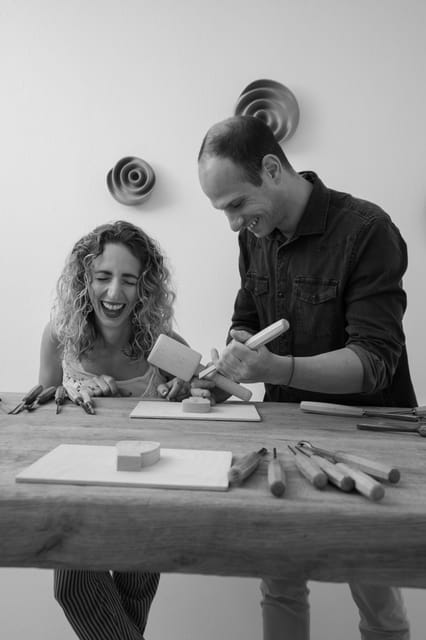
After the introduction, you move into the basic principles of carving and the plasticity of wood. Here, plasticity means the way the material can be shaped and altered through cutting.
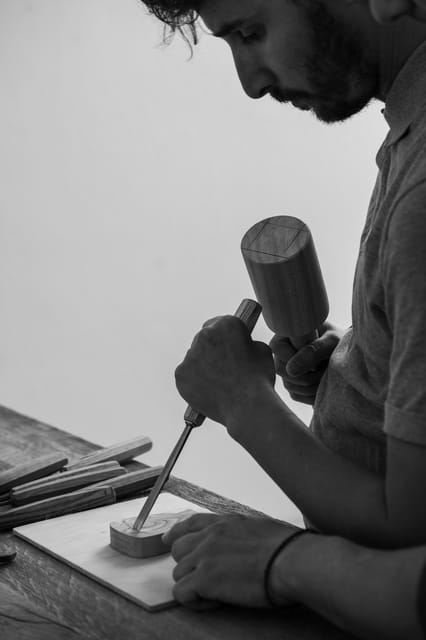
You will begin to see why the instructor describes carving as a meeting between steel and wood. A carving tool is precise, but it cannot do all the work by itself. You have to control the direction, force, and depth of each cut.
For a first-timer, this is where Michael’s help matters most. A beginner can easily press too hard, cut across the grain, or remove too much material. Guided practice lets you understand the movement before you commit to the final object.
Do not judge the activity only by the size of the finished piece. The useful part is learning how a solid block becomes a form through a series of small decisions. You may find the process calming, but it still requires concentration.
The third stage: making a Cycladic-inspired object
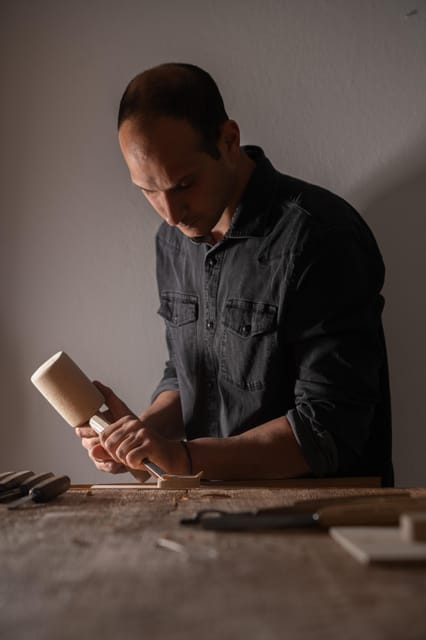
The main project is a three-dimensional woodcarved object inspired by the Ancient Theraic, or Cycladic, civilization. This gives the workshop a firm artistic direction and ties the finished piece to Santorini’s ancient past.
The project is not described as a replica of a specific archaeological object. Instead, the inspiration comes from the period and its forms. That leaves room for a souvenir that feels connected to the island without pretending to be an ancient artifact.
You will work through the stages with Michael’s guidance. The exact amount you complete depends on your pace, design, and comfort with the tools. One recent session produced three pieces per person, so several small objects may be possible, but you should not treat that as a guarantee.
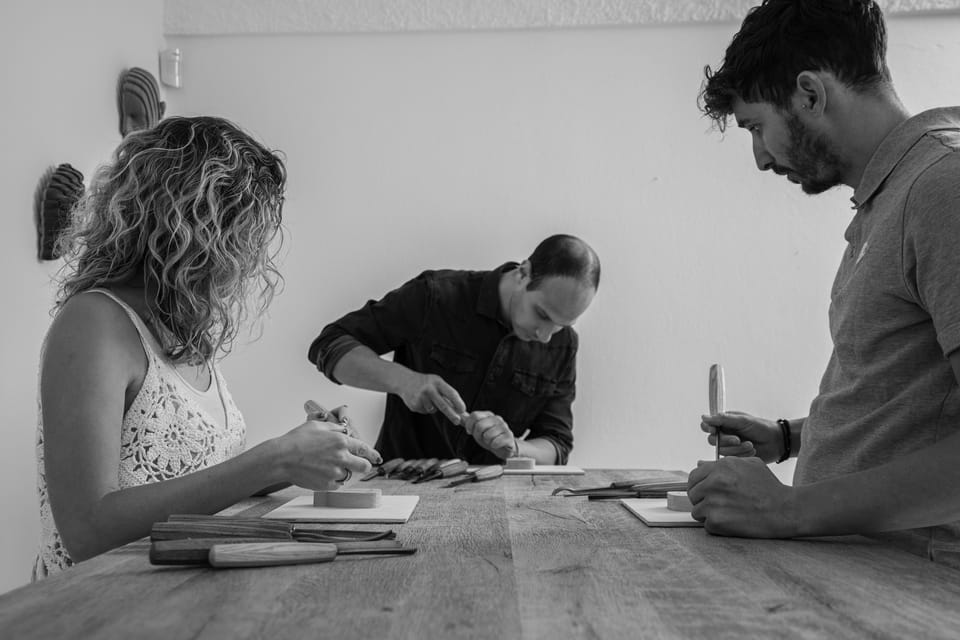
This is one of the strongest parts of the activity for a couple or private group. You can each make something different, then compare the results. Since the work is handmade, small differences are not flaws. They are proof that the pieces were made by people rather than stamped out by a machine.




What makes the keepsake different
A Santorini souvenir often carries the image of a blue dome, a whitewashed building, or a sunset. A carved object from this workshop can carry something less obvious: the memory of learning a local craft.
You will take home the object or objects you create. The information provided does not state the exact size, type of wood, finish, or packaging, so ask Michael if those details matter to you, especially if you are flying with limited luggage.
The keepsake should suit people who prefer a personal memento over a decorative purchase. It may not look perfectly uniform, and that is part of the appeal. A hand-cut edge, slight variation, or uneven mark can remind you that you made it during your time in Megalochori.
You may also find the activity useful if you are trying to reduce shopping time on Santorini. Instead of visiting several stores for a small object, you spend the time creating one. The cost includes instruction and the workshop itself, not just a finished item.
Is $94 per person a fair price?

At $94 per person, this is not a budget activity if you measure value by hours alone. Two hours works out to roughly $47 per person per hour, before considering the materials and private instruction.
The comparison changes if you value the teaching and the finished work. You are paying for a craft lesson, a local cultural explanation, guided use of carving tools, and a handmade object created during the session. A recent booking resulted in three pieces per person, which can make the price feel more reasonable, though your output will depend on your pace and project.
The private format also matters. You are not paying for a seat in a large class where the instructor must divide attention among many people. You can ask questions directly and receive help with your own cuts. For a couple, family group with older children, or a small group of friends, that personal attention adds value.
I would consider the price fair for someone who wants an activity rather than another sightseeing stop. If you only want a cheap souvenir, a shop will cost less. If you want to learn a skill and leave with something made by hand, the fee is easier to justify.
Who should book this workshop?

This is a good choice for adults and children aged 12 or older who enjoy making things. You do not need previous carving experience, and the teaching is designed to take you through the basics.
It also suits people who have already seen the main Santorini sights and want a slower activity. The workshop gives you a break from looking at churches, cliffs, and villages. You use your hands instead.
Art students, furniture enthusiasts, and anyone curious about traditional crafts may get the most from the historical material and the discussion of wood. The experience is also suitable for a private group that wants a shared project without being folded into a large class.
I would think twice if you dislike close, careful work or expect a polished professional sculpture after two hours. Woodcarving is controlled and physical. You may enjoy the process more than the final shape, particularly if this is your first attempt.
Children under 12 are not suitable for the activity. The supplied information does not specify other physical requirements, so ask the provider if you have concerns about handling tools or standing during the session.
Practical timing and booking advice
The workshop lasts two hours, and starting times depend on availability. Build the rest of your day around that fixed block rather than trying to squeeze it between two tightly timed excursions.
Because the group is private, confirm the number of people in your party when booking. The information identifies the format as a private group but does not provide a maximum group size.
You can cancel up to 24 hours before the activity for a full refund. You can also reserve now and pay later, which is useful if you are arranging several Santorini plans before your schedule is settled.
The activity is offered in Greek and English. If you have a strong preference, select or confirm the language when arranging your place.
How this compares with buying local woodwork
A finished piece from Michael’s shop will be more polished than anything you can make in a first session. It will also require no time, concentration, or tool handling.
The workshop gives you something a shop purchase cannot: an understanding of how the object takes shape. You learn about wood treatment, basic carving, and the relationship between tool and material. You also leave with a piece that records your own decisions.
That makes the two options serve different purposes. Buy a finished item if you want a refined work of art. Book the workshop if you want a memory that includes effort, instruction, and a few imperfect cuts.
The activity may also deepen your appreciation of Santorini’s carved church interiors. Once you understand how difficult it is to make clean relief or ornamental work, carved iconostases no longer seem like background decoration. You begin to notice the labor in the details.
A balanced look at the experience
The strongest feature is the combination of practical teaching and local artistic context. You are not merely shaping wood with no explanation. You learn why carving matters in Santorini and how the instructor’s training connects furniture making, church carving, and modern personal expression.
The other major strength is accessibility for beginners. The first-time participants who made several pieces show that the workshop can produce tangible results even when you arrive with no experience.
The limits are just as clear. Two hours is short, the cost is fairly high for the duration, and the final object may depend heavily on your natural patience and hand control. The project is inspired by Ancient Theraic civilization, but the information does not promise a detailed archaeology lesson or a recreation of a museum piece.
You should also keep your expectations sensible about the finished work. Michael can guide you, but he cannot replace years of practice in one afternoon. The pleasure comes from taking part in the craft and seeing wood change under your hand.
Should you book the Megalochori woodcarving workshop?
Book it if you want a creative Santorini memory, prefer private instruction, and like the idea of taking home something you made yourself. It is especially appealing after you have spent enough time sightseeing and want a quieter, more focused activity.
Skip it if your priority is the lowest-cost souvenir, a large finished sculpture, or a fast activity with little concentration. At $94 per person, the value depends on your interest in learning, not just on the object.
For most suitable participants, I would call this a worthwhile choice. Michael’s practical guidance, the Cycladic inspiration, and the chance to make several small pieces give the two hours real substance. Just remember that you are booking a craft lesson, not a shop visit with a guaranteed professional result.
FAQ
How long does the woodcarving workshop last?
The workshop lasts two hours.
Where does the activity take place?
The activity takes place in Megalochori, on Santorini in the South Aegean region of Greece.
How much does the workshop cost?
The price is $94 per person.
Is the workshop private?
Yes. The activity is offered as a private group experience.
Who teaches the workshop?
The instructor is Michael, a woodcarver who has worked in the craft since 2013.
What languages are available?
Instruction is available in Greek and English.
Do I need previous woodcarving experience?
No. Beginners can join, and the workshop covers basic woodcarving principles and techniques.
What will I make?
You will create a three-dimensional woodcarved object inspired by the Ancient Theraic, or Cycladic, civilization. One recent session produced three pieces per person, but the number you complete may vary.
Can children join the activity?
Children under 12 cannot take part. The activity is suitable for participants aged 12 and older.
Can I cancel the booking?
Yes. You can cancel up to 24 hours in advance for a full refund. You can also reserve your place and pay later.