REVIEW · ATHENS
Ancient Corinth And Corinth Canal Half Day Tour From Athens
Book on Viator →Operated by Transfer To Athens · Bookable on Viator
The Corinth Canal is the star of this half-day outing. Cut through towering limestone walls, it links the Aegean and Ionian Seas and turns the narrow Isthmus of Corinth into a dramatic meeting point of engineering, trade, war, and myth. From there, you move through ancient sanctuaries, fortresses, temples, and a museum beside the ruins.
I like two things right away: private transportation saves you from wrestling with Greek roads, and the flexible format lets you look around without trailing after a large guided group. The air-conditioned vehicle, Wi-Fi, and bottled water are useful extras, especially in warm weather.
The main consideration is that your driver is not a licensed guide permitted to accompany you inside the archaeological sites. You will get historical background during the drives, but a licensed guide costs extra and must be requested in advance, depending on availability.
In This Review
- Key points to know before you go
- Why Corinth makes a smart half-day trip from Athens
- The Corinth Canal and Isthmia: a dramatic start
- Temple of Apollo: Corinth’s oldest major landmark
- Akrokorinthos: huge views and a serious climb
- Ancient Corinth: the center of the visit
- The Archaeological Museum: the objects behind the ruins
- The Diolkos: ancient engineering at ground level
- What the private vehicle adds to the day
- Timing, walking, and the best type of visitor
- Is the $163.22 price good value?
- Should you book this Corinth tour?
- FAQ
- How long does the Ancient Corinth and Corinth Canal tour last?
- Is hotel pickup in Athens included?
- Can I start the tour from Piraeus Port?
- Are entrance tickets included?
- Is a licensed tour guide provided?
- What happens if I need to cancel?
Key points to know before you go
- The canal is more than a photo stop: it is a major engineering work with roots in ancient attempts to cross the Corinthian Isthmus.
- You visit six historic places: Corinth Canal, Isthmia, Temple of Apollo, Akrokorinthos, Archaeological Museum of Corinth, Ancient Corinth, and the Diolkos area.
- The tour is private: only your own party rides in the vehicle, with sedans for one to three people and minivans for four to seven.
- The driver provides context, not site guiding: English-speaking drivers have historical knowledge but are not licensed to lead tours inside the ruins.
- Budget for the Ancient Corinth ticket: the archaeological site and museum cost €15 per person and are paid directly on the day.
- An early start is smart: Paul, one of the named drivers, specifically recommends going early to enjoy the sites with fewer people.
Why Corinth makes a smart half-day trip from Athens
Athens gives you the Acropolis, ancient Agora, and superb museums. But Corinth shows you how geography shaped Greek history. The narrow isthmus between mainland Greece and the Peloponnese was a shortcut, a toll point, a military prize, and a religious center.
That makes this trip feel more varied than a simple temple excursion. You see a modern canal, then the remains of an ancient city, then a fortress high above the plain. The places are connected by the same strip of land, but each tells a different story.
The drive also gives you an efficient way to cover several sites in about five hours. Public transport would make this much harder, especially if you want to include Akrokorinthos and the Diolkos. A private car removes that problem and gives you pickup at an Athens hotel, Airbnb, or Piraeus Port.
The $163.22 per person price needs to be viewed in context. It is not simply an admission ticket with a ride attached. You are paying for private round-trip transport, an English-speaking driver, fuel, vehicle comfort, pickup and drop-off, and the ability to shape the pace around your own group.
Still, the price is easier to justify for two or more people sharing the experience than for a solo visitor. A larger party of four to seven uses a minivan, while one to three people ride in a private sedan. Group discounts may also apply, so check the final rate for your party size before booking.
You can also read our reviews of more tours and experiences in Athens.



The Corinth Canal and Isthmia: a dramatic start
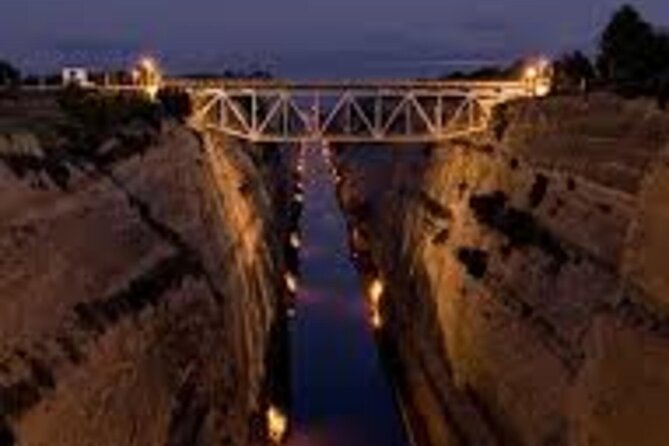
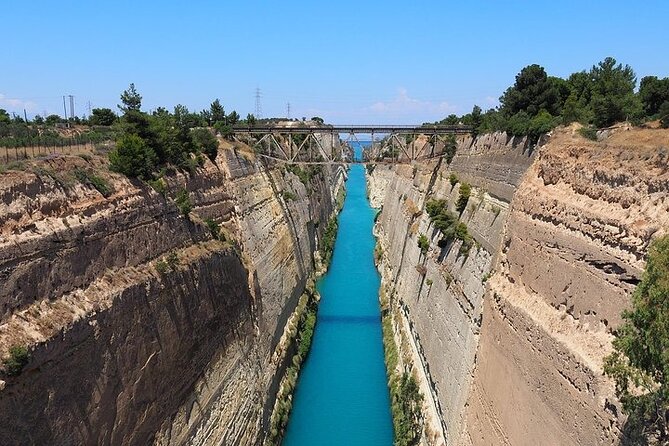
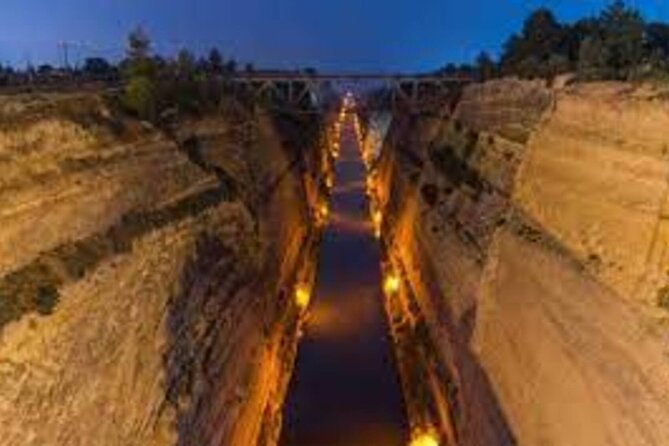
The first stop takes you above the Corinth Canal, where steep limestone walls frame a narrow strip of water. The canal connects the Aegean and Ionian Seas, saving ships from sailing around the Peloponnese.
You get about 20 minutes here. That is enough for photographs and a quick explanation of the canal’s strategic role, but not enough for a long walk or a detailed engineering study. Think of it as a sharp opening scene rather than a full morning visit.
The canal is modern in its present form, but the idea behind it reaches back to antiquity. Corinth’s position made the isthmus valuable for merchants and armies, and ancient efforts focused on moving ships or cargo across land rather than sending them around the peninsula.
The nearby Isthmia connection adds an important religious layer. This was the site of the Panhellenic Isthmian Games, held in honor of Poseidon and second in prestige only to the Olympics. The Sanctuary of Poseidon brought athletes, worshippers, and city-states together.
The supplied time here is brief, and the stop is described as including the canal and Isthmia area. If you are especially interested in the games or the sanctuary, ask your driver how much time can be given to each. The visit is best for seeing the setting and getting the basic story, not for a slow archaeological study.
Temple of Apollo: Corinth’s oldest major landmark
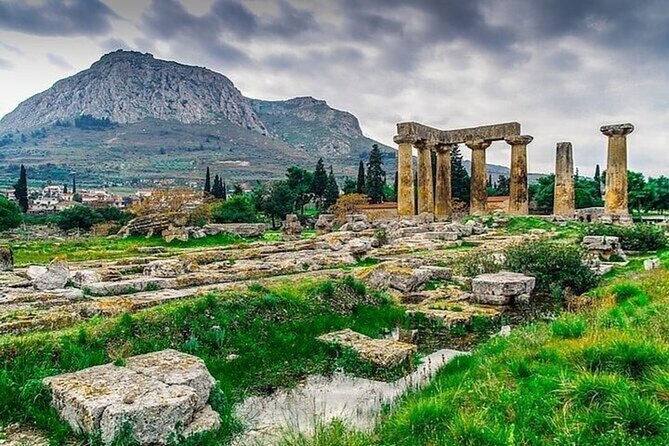
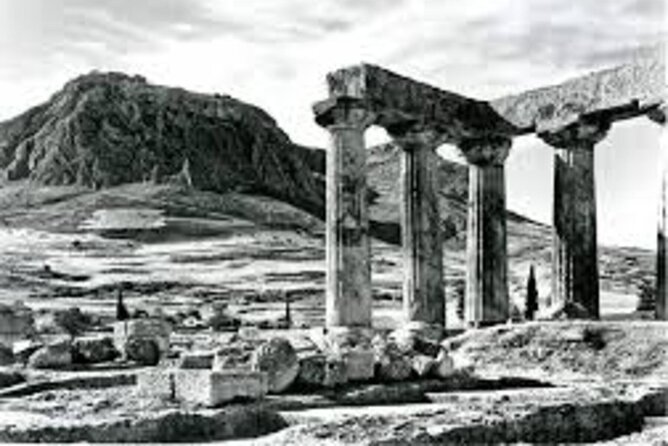
The Temple of Apollo gives you one of the clearest images of ancient Corinth. Several large monolithic limestone columns remain from the 6th century BC, when this Doric temple dominated the city’s religious center.
You have about 20 minutes at this stop. The short visit works because the columns are immediately striking, but the site deserves more time if you want to examine the surrounding buildings, public spaces, and remains in detail.
Apollo was linked with light, music, and prophecy. In Corinth, the temple formed part of a city center filled with religious and civic activity. From the surviving columns, you can begin to picture the scale of the ancient city, even though most of it now survives as foundations and broken walls.
The temple stop also shows why a driver with historical background can be helpful. Without a licensed guide, you will need to read the signs or bring your own guidebook for fuller detail. Your driver can explain the broader setting during the ride, but cannot legally accompany you through every part of the archaeological site.
The Temple of Apollo is listed separately from the entrance charge for Ancient Corinth and the Archaeological Museum. The €15 fee applies to those paid attractions and must be paid directly on site. Confirm the current payment arrangements with your driver on the day, since ticket procedures can change.
Akrokorinthos: huge views and a serious climb
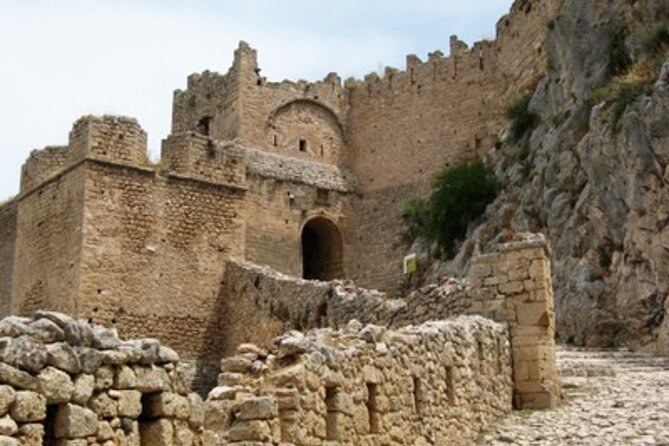
Akrokorinthos rises above ancient Corinth, a rocky fortress built and rebuilt by Greeks, Romans, Byzantines, Franks, Venetians, and Ottomans. Its walls show how important this high point remained long after the classical city changed hands.
You get about 30 minutes here. That allows for a taste of the fortress and its views, but not a complete exploration of the gates, walls, paths, and upper sections. The site is large and steep, so your physical condition and footwear will affect how much you can see.
The reward is the panorama. From the slopes, you look across the Corinthian Gulf, the Peloponnese, and the fertile plains below. You also gain a clear sense of why this acropolis mattered: anyone controlling the height could watch and defend the routes through the isthmus.
The site also carries mythological associations. A sanctuary dedicated to Aphrodite once stood here, adding another layer to a place that already combines military history, religion, and natural drama.
Akrokorinthos is one of the places where a private vehicle makes the schedule possible. You do not have to arrange a separate connection from Ancient Corinth, and the entrance fee is included. Even so, do not expect to cover the whole fortress in half an hour. If the fortress is your main interest, ask about adjusting the plan and reducing time elsewhere.
Ancient Corinth: the center of the visit
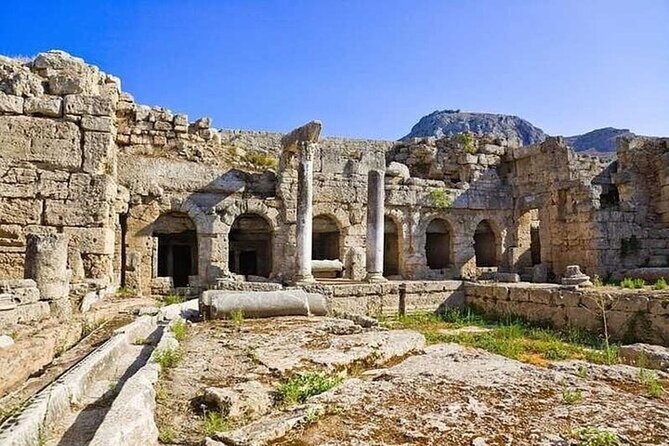
Archaia Korinthos, or Ancient Corinth, is the main archaeological experience. You have about one hour to see the ancient agora, Temple of Apollo, Roman fountains, public buildings, and traces of the city walls.
This was not a small rural settlement. Corinth became a major commercial and political power because it controlled the isthmus and its traffic. Its position brought wealth, visitors, and outside influences, which helps explain the mixture of classical, Hellenistic, and Roman remains.
The open site can be read in layers. The Temple of Apollo points to the older Greek city. The agora and fountains reveal civic life. Roman additions show how the city continued to matter after Roman control reshaped the eastern Mediterranean.
The setting adds to the experience without distracting from it. Akrokorinthos rises nearby, while the Corinthian Gulf and surrounding plain help you understand the city’s location. You are not just looking at isolated ruins. You are seeing the relationship between the city below, the fortress above, and the narrow route between two seas.
The drawback is the limited time. One hour sounds generous until you account for the temple, agora, fountains, walls, signs, and photographs. If you like reading every plaque, you will need to choose carefully or arrange a longer private visit.
- All Day Cruise -3 Islands to Agistri,Moni, Aegina with lunch and drinks included
★ 5.0 · 4,958 reviews





The Archaeological Museum: the objects behind the ruins
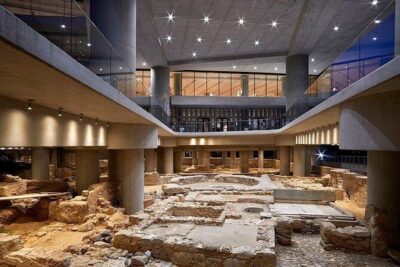
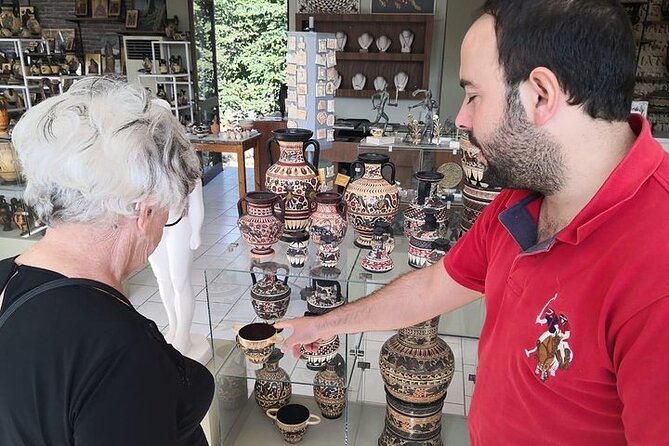
The Archaeological Museum of Corinth sits beside the archaeological site, which makes it easy to pair with Ancient Corinth. Its displays include sculptures, mosaics, pottery, inscriptions, and ordinary objects from prehistoric times through the Roman period.
You have about 30 minutes inside. That is enough to see major pieces and get useful context, but it is not a full museum visit. The collection helps explain details that are difficult to understand from foundations alone, including religious practice, household life, Roman rule, and Corinth’s role as a commercial crossroads.
Roman mosaics and statues of gods and emperors are among the major highlights. The museum also brings together finds from the agora and nearby sanctuaries, so it helps you connect the separate pieces of the outdoor site.
The entrance fee is not included in the tour price. Ancient Corinth and the museum cost €15 per person, paid directly on site. This is the most important extra cost to plan for, since the headline price does not cover every admission.
I would not skip the museum simply because the visit is short. If you have just walked through the ruins, even half an hour indoors can make the broken remains easier to understand. On a hot day, it also gives you a useful break from the sun.
The Diolkos: ancient engineering at ground level
The Diolkos is one of the most unusual stops because it shows how ancient people solved the same transport problem later addressed by the canal. This stone-paved roadway allowed ships or cargo to be hauled across the isthmus, avoiding the dangerous journey around the Peloponnese.
The surviving limestone tracks retain grooves from repeated use. You get about 20 minutes here, enough to see the remains and understand the basic method, though not enough for an extended archaeological visit.
The Diolkos mattered to trade, military movement, and communication. It also helps you connect the modern canal with the ancient world. At the canal, ships pass through water cut into rock. At the Diolkos, ships were moved over land by force and planning.
This stop is especially valuable for anyone interested in practical history. It is not as visually grand as Akrokorinthos or as famous as the Temple of Apollo, but it explains why Corinth became powerful. Control of the crossing meant control of movement.
What the private vehicle adds to the day
Pickup and drop-off are available in central Athens and at Piraeus Port without an extra charge. At a hotel, you wait in the lobby. At an apartment or Airbnb, you wait outside the main entrance or gate. At Piraeus, the driver meets you at the arrival pier or cruise terminal exit, holding a sign with the lead passenger’s name.
Keep the mobile number used for booking switched on around pickup time. The driver may need to reach you if the vehicle is delayed or has trouble finding the address, and a local emergency number appears on the booking confirmation.
Groups of one to three use a luxury sedan. Groups of four to seven use a minivan. All vehicles have air conditioning, Wi-Fi, and bottled water, details that matter when you are packing several historic stops into one warm Greek morning.
Airport, Rafina Port, and Laurio Port pickup are available for an added vehicle-dependent charge. Lunch is not included, and there is no planned meal stop in the five-hour schedule. Bring water and a small snack if you need one between Athens and Corinth.
The driver is described as an English-speaking professional with extensive historical knowledge. That is useful for orientation and questions during the road time, but it is different from having a licensed guide inside the site. You can request one for an extra charge, subject to availability.
Timing, walking, and the best type of visitor
The tour is a good match for you if you want to see Corinth without renting a car or committing to a full-day Peloponnese trip. It also suits cruise passengers at Piraeus who have enough time for a private excursion and want a direct return to the port.
Start early if your schedule allows. Paul, a named driver associated with the experience, advises an early morning departure so you can enjoy the places with fewer people. Early timing also gives you the best chance of keeping the six-stop plan comfortable.
Wear practical shoes. Akrokorinthos has rocky slopes and uneven surfaces, while the archaeological sites require walking outdoors. The tour data says most people can participate, but it does not promise step-free access or easy movement across every ruin.
History fans may find the half-day format too compressed, especially at Ancient Corinth and Akrokorinthos. If you want a slow, detailed study, ask about adding a licensed guide or extending the private service. If you prefer a strong overview with efficient transport, the pace is more appealing.
Is the $163.22 price good value?
At $163.22 per person, this is not the cheapest way to see Corinth. The value comes from convenience and privacy rather than from a long guided lecture or a large number of included admissions.
The price includes private transportation, an English-speaking driver, hotel or Piraeus pickup and drop-off, air conditioning, Wi-Fi, bottled water, and entrance fees for the Corinth Canal and Akrokorinthos. You also avoid the time and uncertainty of organizing several separate connections.
You should add €15 per person for Ancient Corinth and the Archaeological Museum. Lunch, gratuities, airport transfers, and pickup from Rafina or Laurio are extra where applicable. A licensed guide is also an additional cost.
For a group sharing a vehicle, the arrangement becomes more attractive. Solo visitors should compare it with public transport or a larger group tour, while families and small groups may value the door-to-door service enough to make the premium worthwhile.
Should you book this Corinth tour?
Book it if you want a private, efficient introduction to Corinth from Athens, especially if you are staying in the city center or leaving from Piraeus. The combination of canal, ancient city, museum, fortress, and Diolkos gives you a clear picture of why this narrow part of Greece mattered for so long.
Think twice if your priority is detailed guiding, long walks through ruins, or a leisurely museum visit. The driver can explain the sites but is not licensed to guide inside them, and the schedule gives each stop a firm time limit.
For the best version of the day, request an early departure, budget the €15 site and museum fee, wear sturdy shoes, and ask in advance about a licensed guide if you want more than roadside context. Free cancellation is available up to 24 hours before the start time, which gives you some useful flexibility when arranging an Athens itinerary.
FAQ
How long does the Ancient Corinth and Corinth Canal tour last?
The tour lasts approximately five hours, including transportation from Athens and visits to the Corinth Canal, Isthmia, Ancient Corinth, Akrokorinthos, the Archaeological Museum of Corinth, and the Diolkos.
Is hotel pickup in Athens included?
Yes. Pickup and drop-off from Athens city center hotels and Airbnb residences are included without an extra charge. You should wait in the hotel lobby or outside the entrance of a private residence.
Can I start the tour from Piraeus Port?
Yes. Pickup and drop-off from Piraeus Port are included without an extra charge. Cruise passengers are met at the cruise terminal exit after security and customs.
Are entrance tickets included?
The Corinth Canal and Akrokorinthos entrance fees are included. Ancient Corinth and the Archaeological Museum cost €15 per person and must be paid directly on site. Other extras, such as lunch and a licensed guide, are not included.
Is a licensed tour guide provided?
No. The English-speaking drivers have historical knowledge but are not licensed to accompany you inside the sites. A licensed guide can be requested for an additional charge, subject to availability.
What happens if I need to cancel?
You can cancel up to 24 hours before the experience start time for a full refund. Cancellations or changes made less than 24 hours before the start time are not accepted for a refund.