Porto Rafti is only a short distance from Athens, yet this cruise quickly leaves city life behind for rocky coves, small islets, old ruins, and beaches reached from the sea. The route’s most unusual landmark is the ancient Seated Tailor statue, a battered marble figure that gave the harbor its name.
I like the family-run feel and the crew’s reported friendly, energetic approach. I also like the generous inclusions: Greek pastries, coffee or tea, bottled water, soft drinks, up to two beers for adults, and snorkeling equipment. The main consideration is that this is a boat-based outing, so it is not a good choice if you get seasick or feel uneasy at sea.
In This Review
- Key points to know before you book
- Why this four-hour cruise works as an Athens side trip
- Porto Rafti and the statue that named the harbor
- Spider Cove and the quiet water near Hamolia
- Aspronisia, a small Aegean refuge
- Agios Alexandros and the bay of Vravrona
- Vravrona, Artemis, and the wetland beside the ruins
- Erotospilia, the Cave of Love
- What is included, and what you should pack
- Who will get the most from this cruise
- Is $62.72 a fair price?
- Should you book East Attica Hidden Gems?
- FAQ
- Where does the cruise start?
- How long does the cruise last?
- What drinks are included?
- Is food included?
- Is snorkeling equipment provided?
- How many people can join the cruise?
- What happens if bad weather cancels the cruise?
Key points to know before you book
- Porto Rafti’s Seated Tailor statue is an ancient marble colossus that has watched over the bay since the second century AD.
- Spider Cove and Aspronisia offer calm water, rocky scenery, and the best chance to use the included snorkeling equipment.
- Vravrona combines archaeology and nature, with the remains of a sanctuary to Artemis beside wetlands and bird habitat.
- Erotospilia Beach is a small, shaded cove with a natural rock cave linked to local romantic folklore.
- The four-hour cruise costs $62.72 per person and includes food, drinks, a restroom, and snorkeling gear.
- The group is capped at 33 people, a useful middle ground between a private boat and a large party vessel.
Why this four-hour cruise works as an Athens side trip
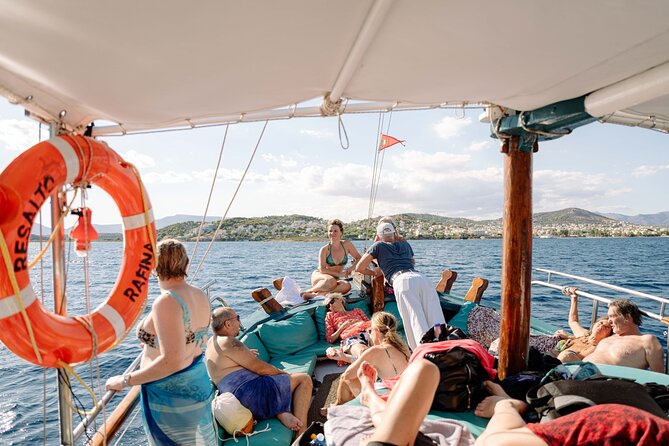
The East Attica coast is easy to overlook when you are focused on the Acropolis and central Athens. That is part of the appeal here. You meet at the Resalto Terminal in Porto Rafti at 10 a.m., spend roughly four hours on the water, and return to the same meeting point.
This is not a long island-hopping voyage. It is a compact coastal trip built around several short stops, each with a different character. You get a harbor with ancient stories, a narrow cove, small bird-friendly islets, a chapel on a rocky island, the archaeological area of Vravrona, and a popular beach.
The boat carries no more than 33 people. That size should make it easier to hear the crew and move around than on a large sightseeing vessel, while still keeping the price well below what you would normally pay for a private charter. The company is family owned, and the available feedback gives particular credit to the friendly, energetic crew and the strong price-to-inclusions balance.
At $62.72, the value depends on how much use you make of the included extras. If you drink the coffee, enjoy the Greek pastries, have a beer or soft drink, and use the mask and snorkeling equipment, the package feels more complete than a basic harbor cruise. If you mainly want a short boat ride and do not plan to swim, the price is still reasonable, but less of a bargain.
You can also read our reviews of more boat tours in Athens
- All Day Cruise -3 Islands to Agistri,Moni, Aegina with lunch and drinks included
★ 5.0 · 4,958 reviews

Porto Rafti and the statue that named the harbor
Porto Rafti is officially called Mesogaia Port. Its better-known name comes from an ancient statue positioned on the largest island at the entrance to the bay. From the water, the weathered figure is easy to connect with the harbor’s name.
The marble statue is more than four meters tall when its base is included. It was carved from white Pentelic marble in the second century AD, but centuries of wind, salt, and broken features have made its original identity hard to establish.
Local tradition says the figure is a petrified girl, turned to stone while fleeing someone who pursued her. Another interpretation identifies the statue as a goddess. The story that stuck with the people of the port imagines a seated tailor holding stolen golden scissors. Rafti means tailor in Greek, hence Porto Rafti, or Tailor’s Port.
The harbor has an older role than its modern beach-town appearance suggests. It was inhabited as early as the Proto-Hellenic period, around 3000 BC, and served as a gateway from Attica toward the northeastern Aegean and the Black Sea region. During the later Byzantine collapse and the period of pirate raids, people moved inland. Under Ottoman rule, the port was valued as one of the safer harbors on eastern Attica.
You will not need a museum visit to appreciate the statue. Its damaged form is the point. Seen from the boat, it gives the opening minutes of the cruise a strong sense of place, rather than treating the coast as a string of anonymous swimming spots.
Spider Cove and the quiet water near Hamolia
The first timed stop is Παραλία Γουλανδρή, or Goulandri Beach, near Hamolia. The coast here folds into a hard-to-reach inlet known as Spider Cove. Its rock walls form a narrow, rugged recess, with a sandy beach at the far end.
The cove is compared to a fjord because of its enclosing rock formation. That description should not be taken too literally, but it does capture the feeling of entering a protected pocket of sea. The water inside is sheltered from stronger winds and can be calmer than the open coast.
The published timing allows about 30 minutes here, with no admission charge. That is enough for a swim or a quiet look at the rock formations, but not enough for a long beach stay. You should think of this as a scenic pause, not a full beach day.
The practical upside is access. A beach that is awkward to reach overland becomes simple to appreciate from a boat. The limitation is that the experience depends on the day’s sea conditions and on how the crew handles the stop. Bring a swimsuit if you want to swim, and remember that towels and sunscreen are not provided.
Aspronisia, a small Aegean refuge
Aspronisia is a cluster of small islets near Hamolia. Their shape and position protect the water between them, forming a calm blue-green pool that has the feel of a natural lagoon.
The appeal is not only visual. Small, dry islands can be poor places for people but useful shelter for wildlife. Seabirds can nest away from mainland disturbance, then fly to larger islands or the coast to feed. The islets can also provide resting and breeding areas for Mediterranean monk seals, which seek quiet beaches and caves.
You may not see wildlife during a short cruise, and the trip does not promise a wildlife encounter. Still, the setting gives the stop more meaning than a simple photo pause. You are looking at a small coastal habitat shaped by isolation, wind, and the needs of animals that depend on undisturbed places.
This is another useful point for snorkeling. The protected water may be easier for a relaxed swim than an exposed section of coast, though you should follow the crew’s instructions about where and when it is safe to enter the water. Snorkeling equipment is included, but a towel is not.
Agios Alexandros and the bay of Vravrona
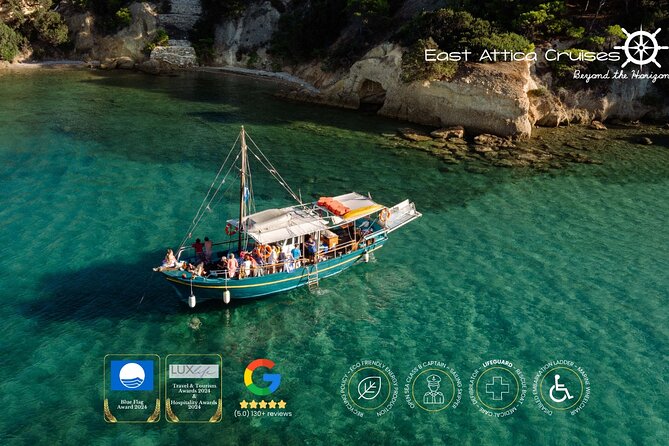
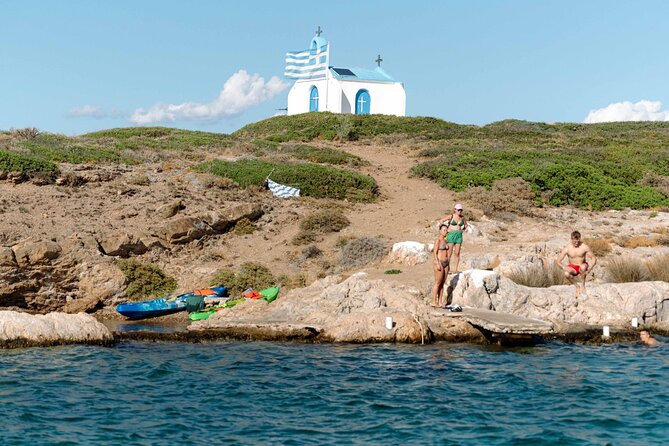
The next stop is in the peaceful bay of Vravrona, where the islet of Agios Alexandros rises from the sea. A small chapel and a windmill built in a Cycladic style give the rocky island an appearance more associated with the central Aegean than with the coast near Athens.
The scene is a good reminder that East Attica is not just an extension of the city. You get a compact mix of sea, stone, white architecture, and open horizon. Around the islet, the seabed is said to support fish, shellfish, octopuses, and sponges. Sea turtles have also been seen in the area.
The cruise allows about 30 minutes here. That is enough time for a swim or snorkeling if conditions permit. The water may be calm inside the bay, but do not assume every stop means a long swim. The crew decides the practical details based on weather, sea state, and safety.
The chapel has its own local story. One version says residents built it overnight to stop plans for a hotel or casino on the islet. At the end of August, a service is held there, with local boats carrying worshippers to the island. You will not be attending that event on this cruise, but the story helps explain why the tiny building matters to the local community.
- All Day Cruise -3 Islands to Agistri,Moni, Aegina with lunch and drinks included
★ 5.0 · 4,958 reviews





Vravrona, Artemis, and the wetland beside the ruins
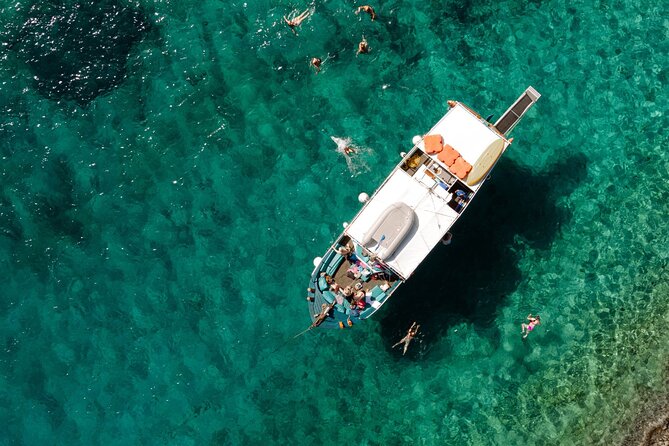
Vravrona adds the strongest cultural element to the route. The area was inhabited in Neolithic times and later became one of the municipalities linked to Athens under Theseus. Its best-known story reaches back to the Mycenaean age and the figures of Orestes and Iphigenia.
According to legend, Orestes and Iphigenia took a wooden image of Artemis from the land of the bulls and brought it to a sacred place here. Iphigenia remained as a priestess and was buried at the sanctuary. The ruins today include white marble columns in a quiet meadow beside the Erasinos River.
The archaeological area also includes a museum with finds from the wider Mesogaia region. However, the cruise information does not include a museum admission or promise a shore visit. You should therefore treat this portion as a view of Vravrona and its setting from the cruise route, unless the crew explains otherwise on the day.
That distinction matters. If your main goal is to walk through the sanctuary, read museum displays, and study the ruins at close range, you should plan a separate land visit to Vravrona. If you value seeing the ancient site in relation to its water, wetlands, and surrounding countryside, the boat gives you a different kind of perspective.
The wetland is part of a Natura 2000 protected area and supports birdlife. A short cruise cannot replace a dedicated birdwatching outing, but it shows why the sanctuary was not placed in an empty patch of land. Nature remains an important part of the site.
Erotospilia, the Cave of Love
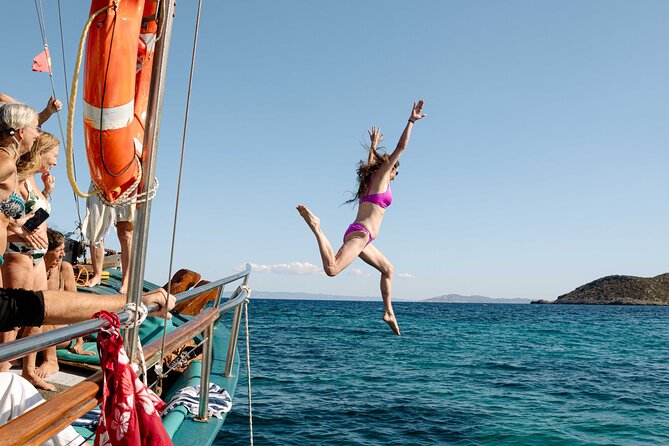
The final named stop is Erotospilia Beach, whose name translates as Cave of Love. It is a small cove rather than a broad, open beach. Trees and rocks provide natural shade, and a small cave forms where the rock meets the sand.
The local explanation for the name is simple: couples once used the secluded cave to escape public attention. You can enjoy the story without expecting a grand cavern. The attraction is the combination of a compact beach, shade, rock, and clear coastal setting.
The scheduled time is about 30 minutes, with no admission fee. That makes it a pleasant last swim or a chance to sit in the shade before heading back to Porto Rafti. It also means you should not expect a full afternoon here. The cruise is designed to give you several tastes of the coast, not to park at one beach for hours.
If you want a quiet beach break, this may be your favorite stop. If you prefer a wide beach with room to walk, it may feel small. The cove’s size is part of its charm, but it can also make the stop feel limited when the group is enjoying the same stretch of shore.
What is included, and what you should pack
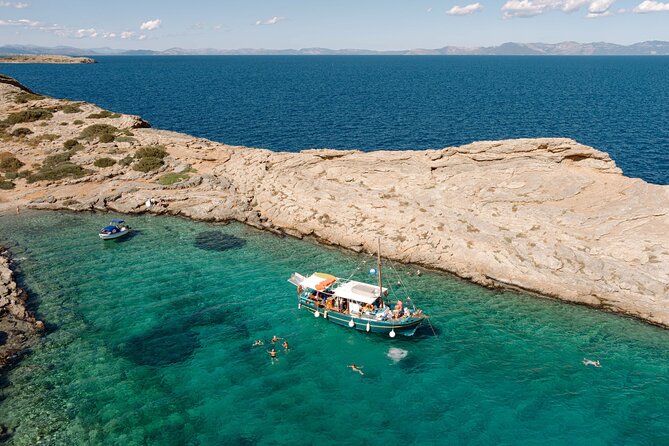
The included food and drinks are a real part of the value. You receive bottled water, coffee or tea, Greek pastries such as spanakopita and tiropita, and up to two soft drinks. Adults aged 18 and over can also have up to two beers. Additional drinks can be bought.
You also get a restroom on board, which matters on a four-hour outing with several stops. Snorkeling equipment is provided, so you do not have to pack your own mask and gear.
Bring the items the package leaves out:
- Swimsuit and a towel
- Sunscreen
- A hat or light cover-up
- Dry clothing for the ride back
- A phone or camera with a secure grip
The tour is offered in English. The provided details do not name individual guides, so you should not book expecting a particular captain or host. The crew is described as friendly and energetic, which suits a short, social cruise with swimming and snacks.
Who will get the most from this cruise
I would recommend this outing to anyone who has already seen central Athens and wants a half-day change of pace without committing to a full island trip. It also suits families, couples, and small groups looking for a simple mix of swimming, local stories, and coastal scenery.
Families may appreciate the short duration, food, drinks, restroom, and equipment included in the price. The maximum of 33 people keeps the group from becoming enormous, though this is still a shared cruise rather than a private boat.
It is a good match for people who enjoy variety. In four hours, you move from an ancient statue to rocky coves, islets, a chapel, an archaeological setting, and a beach. The tradeoff is that every stop is brief, generally around 30 minutes. You will see more places, but you will not have much time to linger at any one of them.
You should reconsider if you get seasick easily or fear the sea. The company specifically warns that the activity is not recommended for those passengers. The cruise also depends on good weather, and the provider may offer a different date or a full refund if conditions force a cancellation.
Most people can participate, and service animals are allowed. The available information does not provide detailed mobility guidance for the boat or shoreline stops, so anyone needing specific assistance should confirm those details before booking.
Is $62.72 a fair price?
For a four-hour boat experience, $62.72 is a solid price when you count the food, drinks, snorkeling equipment, restroom, and several coastal stops. You are not paying just for transport. The route has enough variety to make the cruise feel like a planned East Attica experience rather than a short ride around the harbor.
The strongest value comes from the included refreshments and equipment. A family can avoid separate purchases for bottled water, snacks, soft drinks, and basic snorkeling gear. Two beers are included for each eligible adult, which makes the package especially straightforward for a relaxed afternoon on the water.
The price is less attractive if you want a private outing, long swimming sessions, or a guided archaeological tour. This is a shared cruise with short pauses and a focus on viewing the coast from the sea. Set your expectations that way and the cost makes sense.
Should you book East Attica Hidden Gems?
Book it if you want an easy four-hour escape from Athens with calm coves, swimming, snacks, and local stories. The Seated Tailor statue, Spider Cove, Aspronisia, Agios Alexandros, Vravrona, and Erotospilia give the route a useful mix of nature and culture.
Skip it if you need a long beach stay, a formal archaeological tour, or a private boat. Also skip it if the sea makes you uncomfortable. For everyone else, this is a well-priced way to see a side of Attica that many Athens itineraries leave out, with the practical bonus of drinks, Greek pastries, snorkeling gear, and a manageable four-hour schedule.
Free cancellation is available until 24 hours before the 10 a.m. start time. Changes or cancellations inside that window are not refunded, and the cruise may be rescheduled or refunded if weather or low demand prevents departure.
FAQ
Where does the cruise start?
The cruise starts at East Attica Cruises, Resalto Terminal, Porto Rafti 190 03, Greece. The listed start time is 10 a.m.
How long does the cruise last?
The experience lasts approximately four hours and ends back at the same meeting point in Porto Rafti.
What drinks are included?
Bottled water, coffee or tea, and up to two soft drinks are included. Adults aged 18 and over can also receive up to two beers. Additional drinks can be purchased.
Is food included?
Yes. Greek pastries such as spanakopita and tiropita are included.
Is snorkeling equipment provided?
Yes. Snorkeling equipment is included. Towels and sunscreen are not provided.
How many people can join the cruise?
The activity has a maximum of 33 travelers.
What happens if bad weather cancels the cruise?
If poor weather causes a cancellation, you will be offered a different date or a full refund. You can also cancel for a full refund if you do so at least 24 hours before the experience starts.
You Might Also Enjoy




More Boat Tours & Cruises in Athens
- All Day Cruise -3 Islands to Agistri,Moni, Aegina with lunch and drinks included
★ 5.0 · 4,958 reviews