REVIEW · METEORA
Meteora: Self-Guided App-Based Driving Tour
Book on Viator →Operated by History with Action · Bookable on Viator
Meteora’s monasteries cling to tall stone pillars above Kalambaka, and this self-guided driving tour lets you see them without joining a bus group or following a fixed schedule. The app supplies the history as you drive, then pauses while you take photos, visit a monastery, or stop for a break.
I like the one-price-per-car setup, which makes $16.99 a strong deal for a group of up to four. I also like the offline maps and automatic audio, since you can keep your eyes on the road instead of handling your phone at every turn.
The main drawback is setup. You must download the separate Action’s Tour Guide app and tour content while you have strong Wi-Fi or cellular service. One user had trouble getting started, though the tour worked well once it was running.
In This Review
- Key points to know before you go
- Why a self-guided drive works well at Meteora
- Starting at Saint Stephen Monastery
- The Geological Formations Museum
- The first monastery and the pilgrim route
- Roussanou and the smaller monastery feel
- Varlaam and the need for defense
- Great Meteoron, the largest monastery
- The monastery with an uncertain timeline
- What the app includes, and what it does not
- Is $16.99 good value?
- Setup tips that prevent the main problem
- Who should book this Meteora tour?
- Should you book it?
- FAQ
- How much does the Meteora self-guided driving tour cost?
- How long does the tour take?
- Where does the tour start and end?
- Is a guide present at the meeting point?
- What language is the tour offered in?
- Does the tour work without mobile service?
- Which monasteries are included?
- Are monastery entrance tickets included?
- How do I start the audio?
- Does the tour expire?
Key points to know before you go
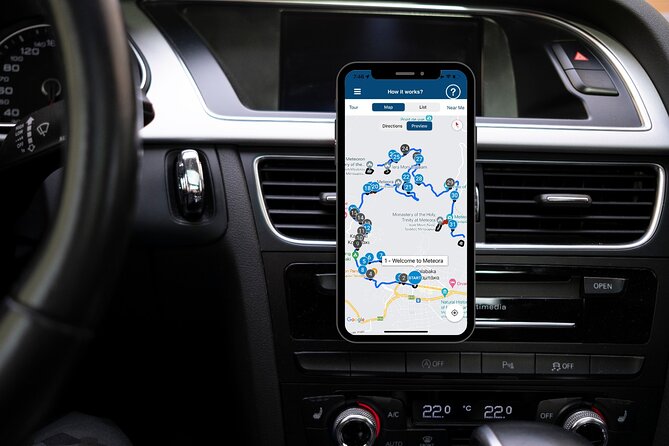
- Six important Meteora stops: Follow a route that includes Roussanou, Varlaam, Great Meteoron, Saint Stephen, and other historic monastery sites.
- More than 25 audio stories: The route covers over two miles and generally takes about two to three hours to complete.
- $16.99 per car: Up to four people can share one purchase, making it cheaper than paying for four seats on a guided excursion.
- No guide meets you: You start at the Holy Monastery of Saint Stephen and follow the app on your own.
- Works offline after setup: Download everything before arriving, then use the GPS-triggered stories without Wi-Fi or mobile signal.
- Lifetime access: The tour has no expiry date, so you can pause it, finish later, or use it again on another trip.
Why a self-guided drive works well at Meteora
Meteora is best appreciated at a measured pace. The road links monasteries, viewpoints, stone formations, and the town of Kalambaka, but a standard group tour can leave you watching the clock. This format gives you more control.
You can begin when you like during the operating period, stop for photos, take a snack break, or skip a story that does not interest you. You can also pause the route and continue on another day because access does not expire.
The audio plays automatically when you reach each location. That hands-free design matters here. The roads and turns deserve your attention, and you do not want to keep checking a map while driving through unfamiliar mountain roads.
The experience is not a private guided tour in the traditional sense. No person meets you, answers questions in the car, or adjusts the plan on the spot. Instead, you get a prepared route, narration, directions, and background stories through your own phone.
You can also read our reviews of more guided tours in Meteora


Starting at Saint Stephen Monastery
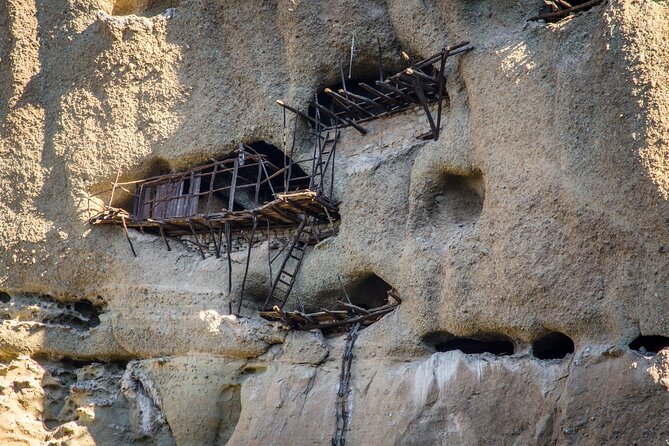
The official start and end point is the Holy Monastery of Saint Stephen, marked in Greek as Αγία Μετέωρα, near Kalambaka. The tour’s listed operating hours are 9 a.m. to 5 p.m., Monday through Sunday, for the stated period.
Starting here gives you a clear place to begin, but you should not expect a guide or tour vehicle waiting in the parking area. Once you are onsite, open the Action’s Tour Guide app, choose the version with your planned starting point and direction if more than one appears, and go to the first story point.
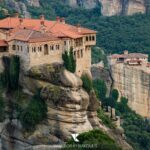
Saint Stephen is the easiest monastery to reach. Instead of climbing a long flight of steps, you cross a sturdy stone bridge. That makes it a practical first stop for anyone who wants to avoid beginning with a demanding climb.
The monastery has an unusual time span in its story. It is described as both one of the oldest and one of the newest monasteries in Meteora, reflecting the way buildings and religious sites changed over many centuries. You get a good first sense here of how access, preservation, and daily religious life shaped the area.
Because Saint Stephen is also the end point, you can return here when the route finishes. Keep in mind that the audio route and monastery opening times are not the same thing as guaranteed entry. Admission tickets and attraction access are not included.
The Geological Formations Museum
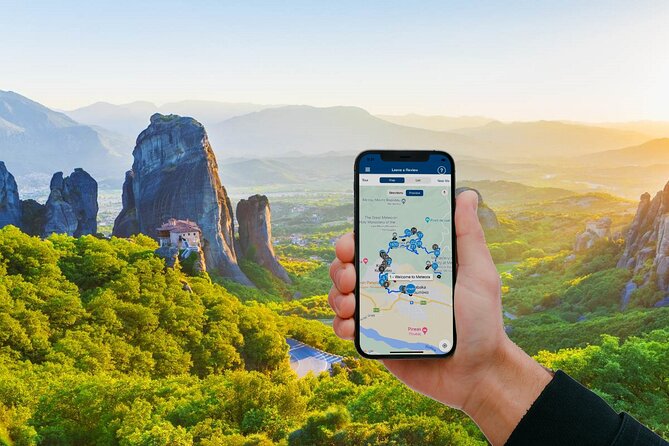
The Geological Formations Museum is a useful extra stop after the main route. It focuses on the stone formations that give Meteora its strange and dramatic appearance.
The museum is open from 8 a.m. to 3 p.m., and entry is free. That schedule makes it better for the morning or early afternoon rather than a late stop after visiting monasteries.
The tour information places this stop at about one hour, while the full driving route is described as taking roughly two to three hours. Treat the timing as flexible. The app lets you pause, and the museum may add time depending on how closely you read the displays.
I like this stop because the monasteries make more sense when you understand the rock beneath them. The religious buildings are not simply perched on ordinary hills. Their location depends on the unusual geological formations, which helped make Meteora such a powerful place for retreat and worship.
The first monastery and the pilgrim route
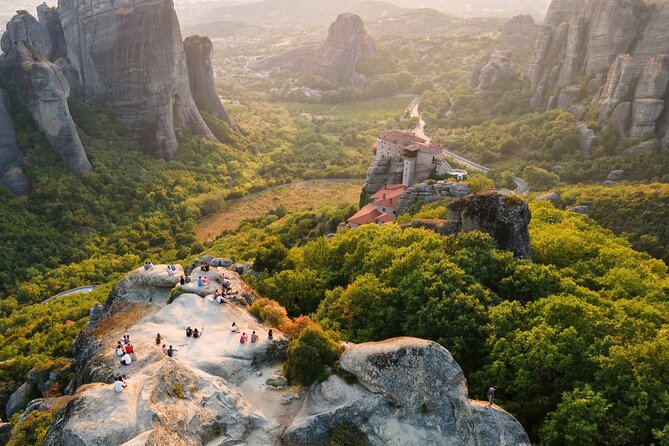
The route then introduces one of Meteora’s early monasteries, built in the late 14th century. It served as a resting place for pilgrims who traveled to the region.
That detail gives the route a human scale. Meteora can look like a collection of impossible buildings in the sky, but people had to reach them, supply them, and find shelter along the way. A resting place for pilgrims shows that the region was not only home to isolated monks. It was also part of a wider religious journey.
The supplied tour details do not identify this stop by name, so use the audio narration and map to confirm exactly where you are when it appears. That is one reason to download the route before you start. You can follow the app’s direction rather than trying to match every monastery from memory.
Roussanou and the smaller monastery feel
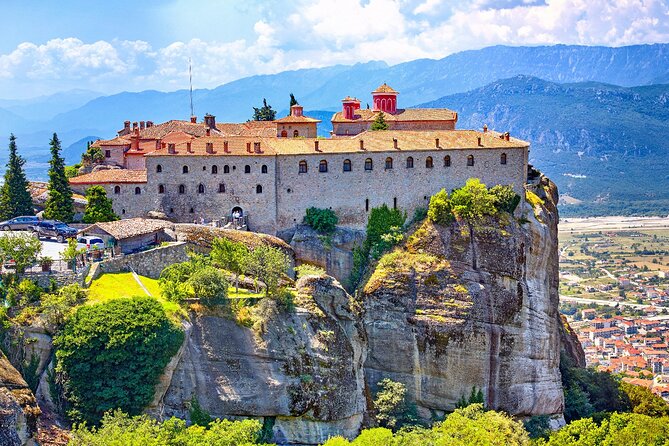
The Holy Monastery of Saint Barbara Roussanou, often called Roussanou, is one of the six functioning monasteries in the Meteora region. It is a Greek Orthodox monastery near Kalambaka and part of the UNESCO World Heritage Site.
Roussanou gives you a different scale from Great Meteoron, the largest monastery on the route. The tour places it within the wider story of Meteora’s functioning religious communities, rather than treating every stop as just another viewpoint.
The app is especially useful here because the road approach, the stone towers, and the monastery buildings can blur together if you only rely on quick photo stops. The narration helps you connect the site to the larger religious story while you are looking at the buildings in front of you.
Entry is not included in the $16.99 price. If you plan to go inside any monastery, check the current admission arrangements and opening conditions separately. The audio tour supplies information, not entrance reservations.

Varlaam and the need for defense
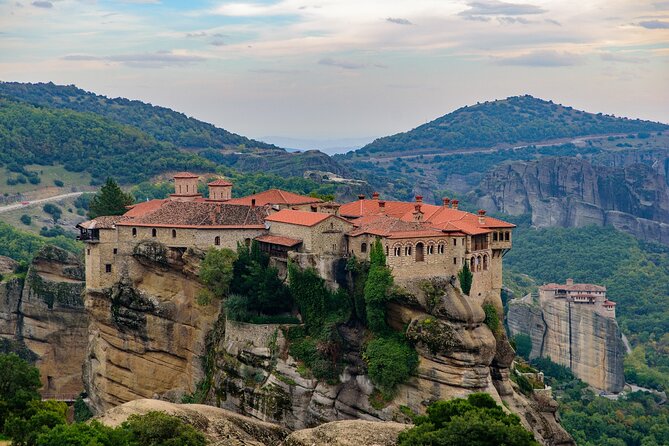
The Holy Monastery of Varlaam is the second-largest monastery in Meteora. Its position and construction show how important defense was to the monks who established these communities.
That defensive purpose is easy to miss if you only see the buildings from the road. A monastery on a high rock was not placed there for convenience. Height offered separation, protection, and control over access, even though it also made everyday life difficult.
Varlaam is one of the stops where the spoken story adds real value. You can see the stone walls and elevated setting, but the app gives you the reason behind the design. I would let the audio finish before moving on, since this is a place where context changes the way you read the building.
The route does not force you to rush through. Stop the audio if you want to study the view or take pictures, then resume when you are ready. This is a better arrangement than trying to listen while walking quickly behind a guide.
Great Meteoron, the largest monastery
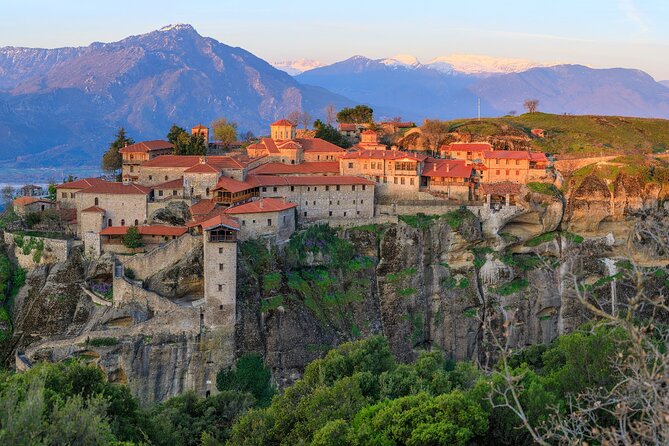
The Holy Monastery of Great Meteoron is the largest monastery in Meteora. It is also known as the Monastery of the Metamorphosis of the Saviour.
The tour presents Great Meteoron as more than the biggest stop. Its founding helped lead to the growth of the other remarkable monasteries in the region. In other words, this is a central chapter in Meteora’s story, not merely the largest building on the route.
The scale can make it tempting to spend all your time taking pictures. I would give the audio room to explain why the monastery became so important before moving on. The route is built to connect individual buildings into one story, and Great Meteoron is one of its key points.
Again, entrance is not part of the purchase. The app can guide you to the site and explain what you are seeing, but you must handle tickets and any entry rules yourself. If you want to visit interiors, leave enough time in your day rather than treating the advertised two to three hours as a strict schedule.
The monastery with an uncertain timeline
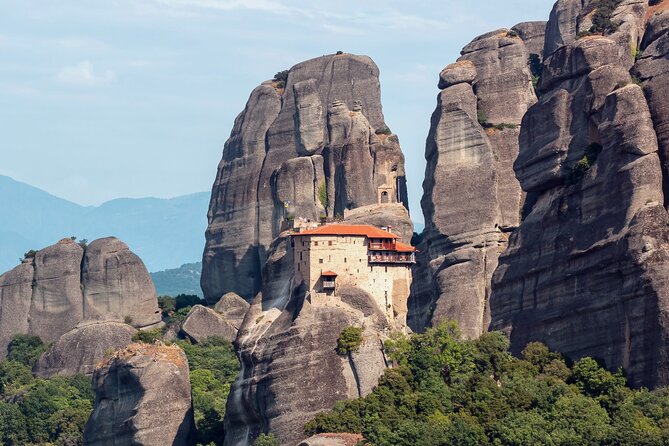
Another stop focuses on a monastery whose construction history is not fully clear. Some evidence points to work beginning in the mid-1300s, while much of the existing monastery likely dates from around the 1470s.
That uncertainty is worth hearing because old buildings rarely come with one neat construction date. Different founders, rebuilding campaigns, and later changes can produce a site that looks unified today but grew in stages.
The audio format suits this kind of story. You can hear the competing dates while looking at the actual setting, without needing to read a long panel or follow a guide’s fixed explanation. It also gives you permission to linger if the architecture interests you, or move on if you prefer the broader views.
The supplied information does not name this stop directly, so rely on the app’s location marker and narration. Do not assume every point is a monastery entrance. Some stops may be designed for viewing and storytelling from the road.
What the app includes, and what it does not
The Action’s Tour Guide app includes audio stories, route directions, offline maps, and location-triggered playback. You receive a password by email and text after booking, then use that password to access the separate app.
Download the app and tour content while you have strong Wi-Fi or cellular service. This is the most important practical step. Once the content is downloaded, the route works without a signal.
You can connect your phone to the car stereo by Bluetooth, USB, or AUX. Apple CarPlay supports audio playback, while navigation features are still coming soon. Android Auto support is also listed as forthcoming, so do not count on those features unless your setup confirms them.
For navigation, the recommended devices are an iPhone with iOS 15 or later, an Android device with version 9 or later, or an iPad or tablet with GPS and cellular connection. Headphones may be useful for walking portions, but the car stereo is the better choice while driving.
The tour is offered in English. It is a private activity for your own group, but it is not a live private guide. That distinction matters if you want personal explanations or help with local decisions.
Is $16.99 good value?
At $16.99 for up to four people, the price is the clearest strength. One purchase covers everyone in the car, so a full group pays about $4.25 each. Even for two people, it can be a low-cost way to get structure and historical narration without booking a larger excursion.
The value becomes stronger if you use the lifetime access. You can start and pause the tour, spread it across multiple days, or use it again on a later trip. You are not paying for a one-time appointment with a fixed departure.
The price does not cover monastery admission, reservations, or attraction tickets. It also does not include transportation, so you need your own car or another way to reach the starting point. Those extra costs should be part of your comparison with a bus or guided tour.
The best value comes when you want freedom. If you prefer someone else to drive, manage timing, and explain the sites in person, a live tour may suit you better. If you already have a car and like choosing your own pace, this is an economical option.
Setup tips that prevent the main problem
The one clear trouble spot is getting the app ready. Follow these steps before you arrive:
- Search your email and text messages for the setup instructions and password.
- Download the separate Action’s Tour Guide app, not just the booking confirmation.
- Download the tour while you have strong Wi-Fi or cellular service.
- Open the app before driving to make sure the route appears.
- Connect the phone to your car stereo with Bluetooth, USB, or AUX.
- Select the tour version that matches your starting point and direction.
- Arrive at the first story point at Saint Stephen, where playback should begin automatically.
The system is designed to be hands-free, but a short test saves frustration. One person in your group should handle the phone while another drives.
Who should book this Meteora tour?
I would choose this for independent visitors with a rental car, couples, families, and small groups who want a clear route without surrendering the day to a guide. It also suits repeat visitors because the access does not expire.
It is a good fit if you want to stop for photos, take breaks, or explore at different speeds. The audio can be paused, skipped, or resumed, and bonus content may be available through the app.
I would think twice if you dislike app setup, have unreliable phone access before arrival, or want a live expert beside you. The tour also requires you to manage tickets and monastery entry yourself.
The listed rating is 4.6 from 11 ratings, and the experience is marked as recommended by 100 percent of those who rated it. The most useful practical lesson is simple: the tour works well once it is downloaded and started, so handle that task before you reach Meteora.
Should you book it?
Book it if you have a car and want an affordable, flexible way to connect Meteora’s monasteries, geology, and religious past. The strongest reasons are the low group price, offline operation, automatic audio, and lifetime access.
Skip it if you expect a person to meet you, answer questions, or provide monastery tickets. For the right kind of independent visitor, this is a smart companion for a self-planned day at Meteora. Just download it early, test the audio, and leave room for the sites themselves.
FAQ
How much does the Meteora self-guided driving tour cost?
The tour costs $16.99 per group, with up to four people included in one purchase.
How long does the tour take?
The driving route is described as taking about two to three hours and covering more than two miles. The general tour duration is also listed as approximately one to two hours, so your exact timing depends on stops, photos, breaks, and monastery visits.
Where does the tour start and end?
The tour starts and ends at the Holy Monastery of Saint Stephen near Kalambaka, Greece.
Is a guide present at the meeting point?
No. This is a self-guided activity, so no person meets you at the starting point.
What language is the tour offered in?
The tour is offered in English.
Does the tour work without mobile service?
Yes. You must download the tour in strong Wi-Fi or cellular service first. After downloading, the audio and offline maps work without Wi-Fi or cellular service.
Which monasteries are included?
The route includes Roussanou, Varlaam, Great Meteoron, and Saint Stephen, along with other monastery stops and the Geological Formations Museum.
Are monastery entrance tickets included?
No. Attraction passes, entry tickets, and reservations are not included.
How do I start the audio?
Open the Action’s Tour Guide app onsite, choose the correct tour version if more than one is shown, and go to the first story point. The audio should begin automatically when you reach it.
Does the tour expire?
No. The tour provides lifetime access with no expiry date. You can use it on any trip, pause it, and return to it later.