REVIEW · ATHENS
Mystical Delphi & Hosios Loukas Byzantine Wonder Luxury Day Tour
Book on Viator →Bookable on Viator
Delphi feels big even before you arrive. I really like the central Athens hotel pickup and the onboard Wi-Fi that makes the long day easier, plus you get time to wander Delphi your way. One possible drawback: you’re exploring mostly on your own once you’re there, and you’ll still need to pay site and museum entry fees.
This tour strings together three very different flavors of Greece: a UNESCO Byzantine monastery, a classic mountain town stop in Arachova, and the archaeological giants of Delphi. It’s not just a bus to ruins. It’s a guided drive plus hands-on exploring time, which can work great if you like setting your own pace.
With an 8-hour timeline, you’ll want to keep your expectations realistic. You’ll see a lot, but it’s a day trip, not a multi-day deep study. Plan for a smooth ride, then prioritize what you want to linger on once you’re at Delphi.
In This Review
- Key points that make this day trip worth your attention
- The ride from Athens to Delphi: comfort that actually helps
- Hosios Loukas: a UNESCO monastery stop with real spiritual weight
- Arachova mountain town break: where to shop and refuel
- Delphi Archaeological Site: explore Apollo, treasuries, and the theater
- Temple of Apollo: the oracle story in stone
- Treasuries of city-states: victory monuments that held offerings
- Ancient Theater: watching the valley, not just the stage
- Tholos of Athena Pronaia and the photo zone: what to do with your time
- Delphi Archaeological Museum: where the finds make sense
- Extra Delphi highlights: polygonal wall, Serpentine Column, and the old hippodrome
- Polygonal wall: contracts carved into sacred stone
- Serpentine Column replica: remembering Plataea through a bronze symbol
- Hippodrome site of chariot races: a modern archaeological find
- Price and value: luxury transport, self-guided ruins, and paid entry fees
- Who should book this Delphi and Hosios Loukas day tour
- Should you book it
- FAQ
- FAQ
- What sites does this day tour include?
- Is pickup from Athens hotels and ports included?
- How long is the tour?
- Is Wi-Fi provided during the drive?
- Are archaeological site and museum entry fees included?
- Do you get a licensed guide inside Delphi’s archaeological sites?
- Is this tour private or small-group?
Key points that make this day trip worth your attention
- Hotel pickup and drop-off: reduces stress, especially if you’re staying centrally or need a port-friendly schedule.
- Wi-Fi, A/C, and bottled water onboard: helpful for the drive and for quick map checks during free time.
- Hosios Loukas (UNESCO) on the itinerary: Middle Byzantine architecture plus the shrine tied to St. Luke’s relics.
- Delphi time set for walking at your pace: you can focus on Apollo, treasuries, theater, or the museum without being rushed.
- Small-group luxury mini van (2–4 guests): easier conversation with your driver than a large group bus.
- Site entry fees not included: budget for Delphi archaeological site admission and the Delphi Archaeological Museum.
The ride from Athens to Delphi: comfort that actually helps
The best part of any long day trip is how quickly it stops feeling like a chore. Here, you start with pickup from your Athens hotel, Airbnb, apartment, or even Piraeus port. That door-to-door convenience matters in Athens, where traffic and finding your meeting point can eat up precious morning time.
The vehicle is a luxury mini van for a small group (2–4 guests). You also get Wi-Fi, A/C, and bottled water. That means you can do the practical stuff during the drive: load offline maps, check opening times, and decide what you most want to see at Delphi before you arrive. It also makes it less painful if the ride feels long, because you can stay productive or just relax.
Your driver is an English-speaking history commentator, but they are not a licensed guide who will walk with you through the archaeological sites. This is a key mindset shift. Think of the drive as the context-builder, and Delphi as your self-guided walk with background help from your driver in the car and at pickup drop-off points.
A few more Athens tours and experiences worth a look



Hosios Loukas: a UNESCO monastery stop with real spiritual weight
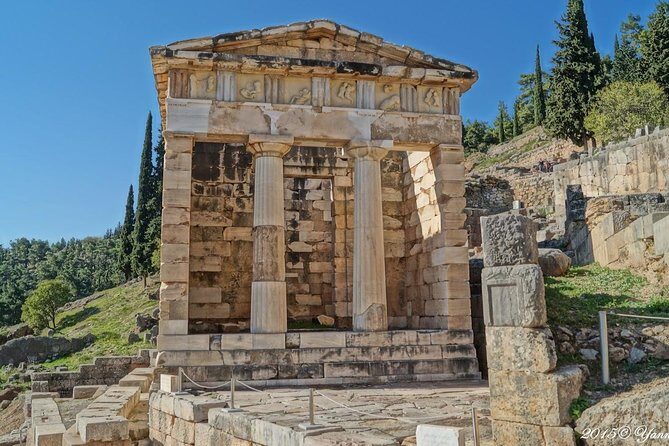
Hosios Loukas is the kind of stop that changes how you picture time in Greece. Delphi is ancient and open to the sky. Hosios Loukas is walled, cool, and built to last—Middle Byzantine art and architecture, and a UNESCO World Heritage Site.
The monastery is located near Distomo in Boeotia, on the slopes of Mount Helicon. It was founded in the early 10th century by Venerable Luke of Steiris. The story most tied to the monastery is the relic tradition: the relics of St. Luke are kept here, and they were said to exude myron, a perfumed oil linked with healing miracles.
Inside, the main shrine is the tomb of St. Luke. It originally sat in the vault and later shifted to the junction of the two churches—an architectural detail that helps you understand how the site evolved around devotion.
This stop is usually about 30 minutes, so you won’t have time for a slow, museum-style study. But it’s a smart inclusion because Hosios Loukas gives you a second layer of meaning for your day. You go from ancient prophecy and civic games at Delphi to Byzantine faith and sacred architecture here.
Practical tip: wear shoes you can stand in. Even in a short visit, monastery floors and steps can add up.
Arachova mountain town break: where to shop and refuel
Arachova is a mountain town near Delphi, known for its traditions, its views, and its closeness to the archaeological site. It’s also the kind of stop that feels good because it breaks the day into a human rhythm: walk the streets, grab a coffee or something sweet, then reset.
You’ll get around 45 minutes here. That time is short, so focus on the essentials:
- The cobbled streets and uphill small houses give you instant atmosphere.
- There’s a steep cliff area in the center with the Bell Tower covered with dense ivy, plus a large clock near the top.
- The town is known for black wine and for handmade goods: colorful textiles, carpets and rugs, handicrafts, and woodcut items.
This is also where the tour places your chance for lunch time later in the day plan (either at a tavern in the Arachova/Delphi area, depending on the flow). If you’re sensitive to hunger on long drives, Arachova is a good place to handle that before Delphi’s site walking takes over your appetite.
One consideration: 45 minutes is enough for browsing and a snack, not enough for a long lunch with slow service. If you want a full meal, aim for a place that’s fast and close to the center paths.
Delphi Archaeological Site: explore Apollo, treasuries, and the theater
Arriving at Delphi is where the day clicks into place. You’ll reach the archaeological area after roughly a 2.5-hour drive from Athens, and then you get dedicated time for walking.
Delphi can feel overwhelming because so many famous names belong to the same general sacred zone. The payoff is that you can pick what you want to see first:
- Sanctuaries connected to Apollo and Athena Pronaia
- The ancient stadium and theater
- The Sacred Way and the treasuries area
The tour gives you a window of free time for walking (about 30 minutes in one block), which is designed for independent exploration. That independence can be a plus if you like to move at your own speed, take photos, and read a few plaques without feeling tethered to a group schedule.
Here are the Delphi stops that matter most and what to watch for:
Temple of Apollo: the oracle story in stone
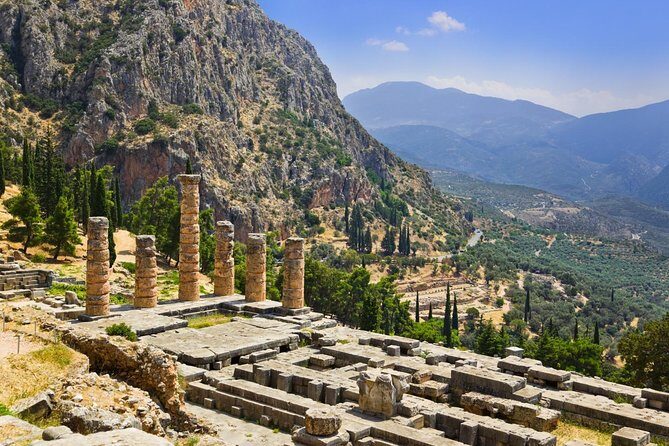
The Temple of Apollo is the star. The visible structure today dates to the 4th century BC (as a partially restored colonnade), and it’s the third temple built on the same site. The big idea is the oracle—inside the sacred context of Delphi, the Pythia was the figure associated with prophecies.
If you like myth and history together, this is the spot for you. The tradition tied to the oracle describes a sacred chasm beneath the site emitting vapors, which the Pythia would inhale. Ancient writers also describe her possibly entering a delirious state, with priests later shaping the final oracle messages into more intelligible statements.
Even if you don’t read everything on-site, standing near the temple remains helps you imagine why Delphi mattered so much to Greek city-states.
- All Day Cruise -3 Islands to Agistri,Moni, Aegina with lunch and drinks included
★ 5.0 · 4,958 reviews




Treasuries of city-states: victory monuments that held offerings
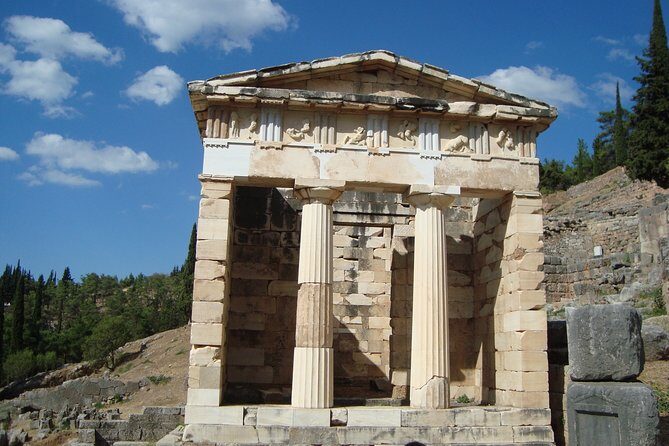
As you move around, you’ll encounter treasuries—small buildings created by various Greek city-states to store offerings to Apollo, often tied to a tithe of battle spoils and grateful thanks after victories.
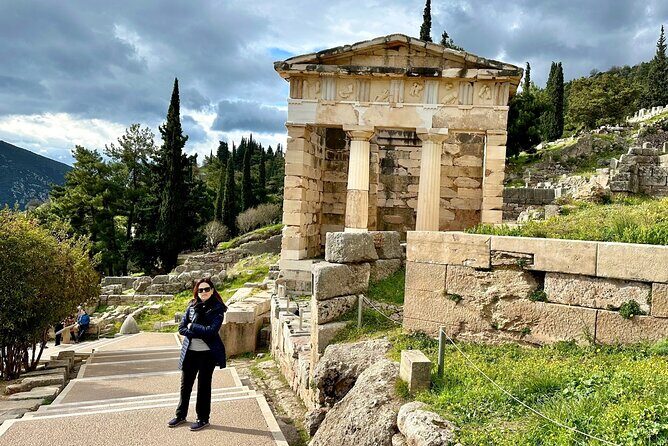
The highlight here is the restored Athenian Treasury, built to commemorate the Battle of Marathon (490 BC). There are also other treasuries mentioned in the tour flow, like the Siphnian Treasury and one for Argos.
What I find useful to remember: these aren’t random ruins. They were political statements. Delphi was both religious center and a place where states demonstrated power and influence.
Ancient Theater: watching the valley, not just the stage
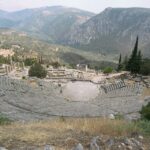
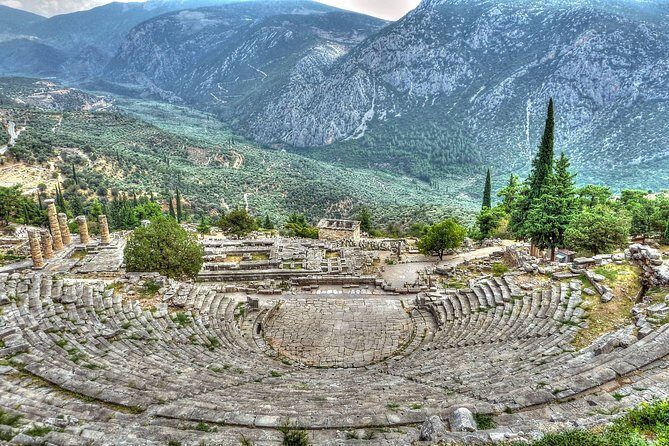
Delphi’s ancient theater sits higher up the hill, giving spectators a view of the sanctuary and valley below. It was built in the 4th century BC and could hold around 4,500 people.
If you want a mental picture, focus on how the theater shape interacts with the mountain slope. The koilon leans against natural ground, and the theater’s design includes features tied to drainage and water flow.
The theater also connects to the Pythian Games. In antiquity, performances and contests (vocal and musical) were part of those proceedings connected to the oracle.
This stop can be quick (about 15 minutes), so prioritize one thing: either the viewpoint for photos, or a short read of the main interpretation signs.
Tholos of Athena Pronaia and the photo zone: what to do with your time
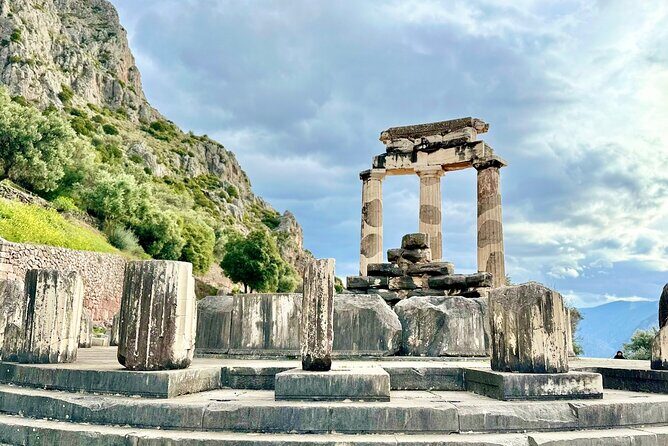
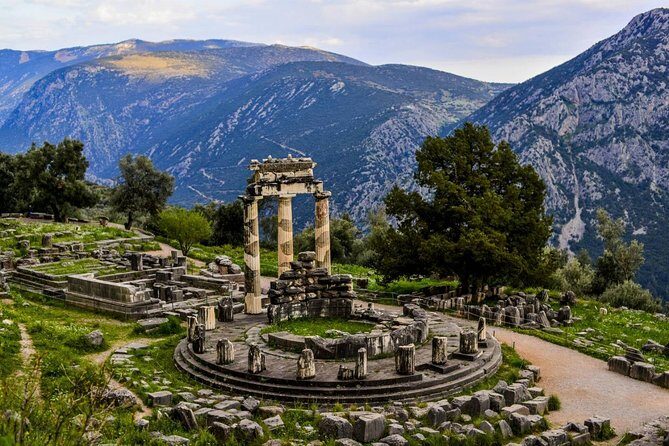
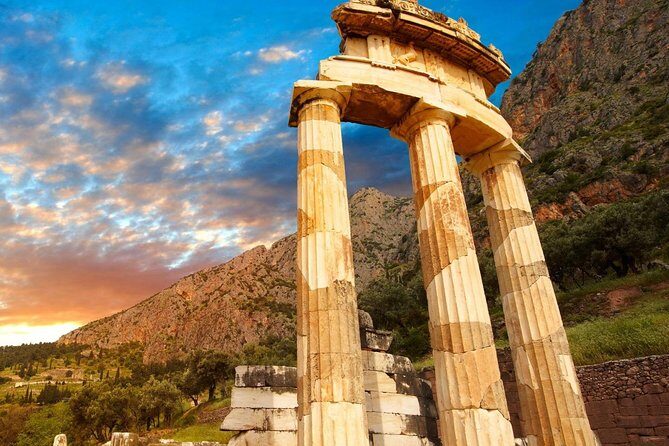
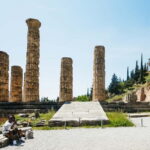
The Tholos of Athena Pronaia is one of Delphi’s most interesting architectural moments because it’s circular and technically specific. It was constructed between 380 and 360 BC and featured 20 Doric columns arranged around it, with 10 Corinthian columns in the interior. Today, only three Doric columns remain restored, which is why it’s become a favorite photography point.
One practical note: it’s about half a mile (roughly 800 meters) from the main ruins area. That distance is why timing matters. If you’re in a hurry, you might skip it. If you like architectural details, it becomes a highlight because circular design is less common than straightforward temples.
The tour includes time around the Tholos area (with blocks noted in the schedule). Since archaeological site admissions are not included in the tour price, make sure you don’t lose time thinking about ticket logistics on arrival.
Practical tip: bring a small water bottle habitually. You’ll walk in sun, and you’ll likely be moving between zones.
Delphi Archaeological Museum: where the finds make sense
The Delphi Archaeological Museum is one of Greece’s key museum stops, and it’s often the difference between seeing ruins and understanding what you’re looking at.
The museum was founded in 1903 and arranged across fourteen rooms on two levels. It holds discoveries from the Panhellenic sanctuary, ranging from Late Helladic (Mycenean) times through early Byzantine era. That broad range matters. Delphi wasn’t one era. It was a long-running sacred site that kept reinventing itself.
What you’ll likely see includes:
- Statues, including the Charioteer of Delphi
- Architectural elements, like the frieze of the Siphnian Treasury
- Ex-votos dedicated to the sanctuary of Pythian Apollo, including the Sphinx of Naxos
The museum is about a 1-hour visit in the tour plan, and admission isn’t included in the price. Because your total time at Delphi is limited, I suggest choosing the museum over one extra exterior photo stop if you care about context.
If you hate museums: focus on the big named statues first, then do a quicker scan. The museum is the easiest place to connect story to object.
Extra Delphi highlights: polygonal wall, Serpentine Column, and the old hippodrome
A well-run Delphi day trip doesn’t treat the site like one straight line. You want small set pieces that make the Sacred Way feel alive.
Here are three that the tour includes, each with a different kind of significance:
Polygonal wall: contracts carved into sacred stone
The polygonal wall supports a terrace linked to construction of the second Temple of Apollo in 548 BC. Its name comes from its polygonal masonry.
Then, from around 200 BC onward, stones on the wall were inscribed with manumission contracts for slaves consecrated to Apollo. The notes tied to this wall say about a thousand manumissions are recorded.
That’s a surprising detail. Delphi wasn’t only about kings and battles. It also held the everyday legal and social changes of people living under sacred systems.
Serpentine Column replica: remembering Plataea through a bronze symbol
You’ll also see the replica of the Serpentine Column (Tripod of the Plataeans), erected in 2015. The original bronze column commemorated Greeks who defeated the Persian Empire at the Battle of Plataea in 479 BC.
In AD 324, Constantine the Great removed it. Today, the original is said to live at the Hippodrome of Constantinople in modern Istanbul.
Even as a replica, it’s a useful reminder that Delphi’s symbols spread far beyond Greece over time.
Hippodrome site of chariot races: a modern archaeological find
The tour touches on Delphi’s hippodrome area, once used for chariot races during the Pythian Games. Archaeologists searched for its location for centuries.
The supplied notes include a major update: in 2012, Professor Panos Valavanis announced the likely discovery of the hippodrome site at Gonia. It’s described as being at the west end of the olive grove at Delphi, about 1.5 km northeast of Itea, running near the Kefali mountain range between Agioi Anargyroi and Gla hills.
This is the kind of detail that makes you feel connected to the living work of archaeology, not only a fixed museum-like past.
Price and value: luxury transport, self-guided ruins, and paid entry fees
At $225.85 per person (for an approx 8-hour day), you’re paying primarily for:
- Pickup and drop-off in Athens and port-friendly access if needed
- A small-group luxury mini van (2–4 guests)
- Wi-Fi, A/C, bottled water
- Fuel and tolls
- An English-speaking driver who adds historical context during the drive
You are not paying for a licensed guide who walks you through archaeological interiors. The information also notes that archaeological site entry fees for Delphi (listed as €20 per person) and the Delphi museum admission are not included.
So the value question becomes personal:
- If you like driving-time commentary and then prefer to explore ruins at your own pace, this can feel like a good deal—especially in a small vehicle versus large coach chaos.
- If you want someone with you inside the archaeological spaces to explain every doorway, temple detail, and inscription, then the lack of a licensed guide may feel like you’re doing more of the work yourself.
One more value angle: the tour’s high rating trend suggests that many people feel the day is well organized. The best version of this experience seems to come from a driver who’s punctual, communicative, and genuinely helpful with logistics and story context.
Who should book this Delphi and Hosios Loukas day tour
I’d point this tour toward you if:
- You want a one-day hit of Delphi plus a UNESCO Byzantine monastery.
- You like small-group comfort and a calmer schedule than big bus tours.
- You’re okay with self-guided time inside the ruins and museum, as long as you have admission tickets lined up.
I’d hesitate if:
- You want a guided walk-through with a licensed guide in the archaeological sites.
- You’re very sensitive to paying extra on the ground. Delphi’s admissions and the museum admission can add up, and your exploration time depends on that.
A practical sweet spot is a couple or small group who likes to wander, take photos, and then ask your driver questions during the drive. The ride structure supports conversation—some drivers are specifically praised for excellent English and for keeping the long journey feeling shorter.
Should you book it
Book this day trip if you want the easiest route to Delphi that still feels comfortable and thoughtful, with Hosios Loukas included as a UNESCO anchor stop. The combination of hotel pickup, Wi-Fi onboard, and small-group mini van makes the whole day easier to manage than doing public transport plus timed entries on your own.
Skip it (or look for a more guided format) if you strongly prefer an official guide accompanying you inside Delphi’s archaeological spaces. In this setup, you’re paying for transport plus driver commentary, then using your own eyes and reading time for the monuments.
FAQ
FAQ
What sites does this day tour include?
You’ll visit Delphi (including time at key areas like the Temple of Apollo and the theater area), the Tholos of Athena Pronaia, the Delphi Archaeological Museum, and Hosios Loukas monastery. You also stop in Arachova for a mountain town break.
Is pickup from Athens hotels and ports included?
Yes. Pickup and drop-off are offered from Athens hotels, Airbnb/apartments, and also Piraeus port.
How long is the tour?
It’s about 8 hours (approx.), including travel time from Athens to Delphi and time at each stop.
Is Wi-Fi provided during the drive?
Yes. The vehicles include Wi-Fi, along with A/C and bottled water.
Are archaeological site and museum entry fees included?
No. Delphi archaeological site admission and the Delphi Archaeological Museum admission are not included. The Delphi site admission is listed as €20 per person, and museum entry is not included.
Do you get a licensed guide inside Delphi’s archaeological sites?
No. Drivers are not official tour guides and will not enter the archaeological sites with you. They can provide historical commentary and answer questions, but you explore the sites independently.
Is this tour private or small-group?
It’s a private tour/activity with an exclusive small-group experience using a luxury mini van for 2–4 guests.