Athens becomes more memorable when its streets are tied to the gods, heroes, and wild stories that shaped Greek culture. This small-group walking tour connects the Academy of Athens, the National Garden, Syntagma Square, and Plaka through myth rather than museum labels.
I like the gentle pace and the way the route uses ordinary city sights as story prompts. I also like the small maximum of 10 people, which should make it easier to hear the guide and ask questions. The main consideration is that this is a storytelling walk, not a full tour of the Acropolis or a major archaeological site.
In This Review
- Key points at a glance
- Why this Athens myth walk works
- Starting with the gods at the Academy of Athens
- Trojan heroes near the Numismatic Museum
- Myths among the trees in the National Garden
- A mysterious god at Syntagma Square
- Finishing in Plaka, close to the Acropolis
- A steady walk rather than a strenuous city march
- What the price means at $41.70
- Who will get the most from this experience
- Booking, cancellation, and practical details
- Should you book the Athens myths walking tour?
- FAQ
- Where does the Myths and Legends of Athens Walking Tour start?
- Where does the tour end?
- How long does the walking tour last?
- What language is the tour offered in?
- How many people can join the tour?
- Are entrance tickets included?
- Is the tour suitable for children?
- What happens if the weather is poor?
Key points at a glance

- Creation myths at the Academy: Begin with the Greek gods and the story of how the world came to be.
- Trojan War stories by the Numismatic Museum: Link famous heroes and gods to a central Athens setting.
- A playful National Garden stop: Hear myths about hunters, missing goddesses, and lunar mysteries, then join a light improv game.
- A slow, manageable route: The walk lasts about 2 hours 15 minutes, with no major climbing described.
- A useful first or last activity: It can help you get your bearings early, or tie together the city’s myths at the end of a stay.
- A small English-language group: The tour is capped at 10 people and includes a mobile ticket.
Why this Athens myth walk works
This tour gives you a different way to read central Athens. Instead of moving from monument to monument with a list of dates, you follow stories about gods, heroes, fate, desire, war, and the origins of the world.
That approach is especially useful if you are visiting Athens with children or with people who lose interest during a standard history lecture. The guide uses storytelling, modern buildings, statues, and city streets to show how Greek mythology still appears in the city around you.
The route also avoids the pressure of a major archaeological visit. You will not be climbing the Acropolis or spending hours inside a museum. You will be outdoors, walking at a steady pace through central neighborhoods. For many people, that makes this a good first-day activity, when you want an introduction without exhausting yourself.
The group limit matters. With no more than 10 people, you should have a better chance of hearing the stories clearly and joining the discussion than you would on a large city walk. The guide is listed in tour comments under the names Kara, Cara, and Chiara, so you may want to check the name attached to your departure when booking.
You can also read our reviews of more walking tours in Athens



Starting with the gods at the Academy of Athens

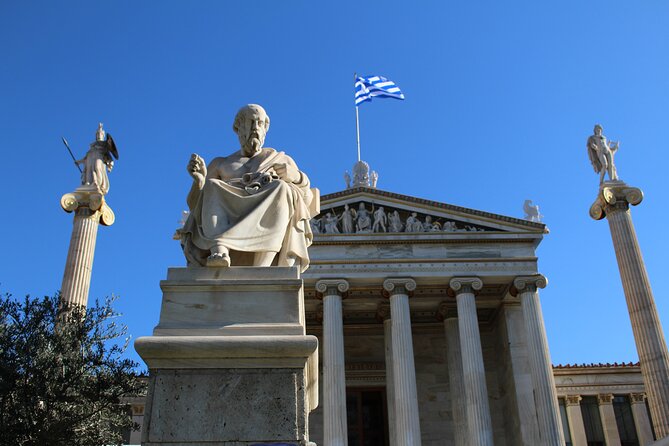
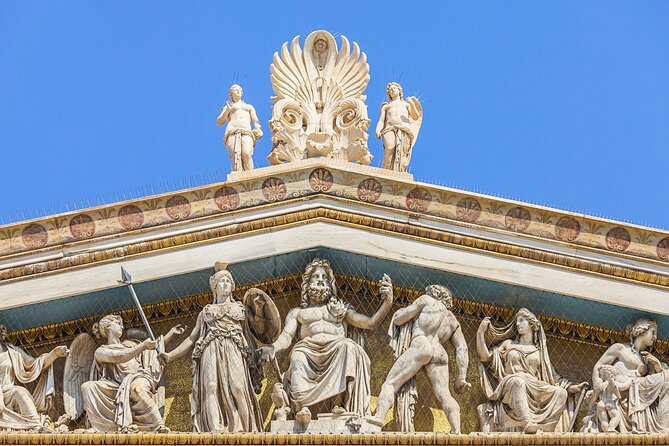
The walk begins at Korai 4, close to public transportation, and spends about 50 minutes around the Academy of Athens. This is the longest stop, and it sets the tone for everything that follows.
Here, the guide introduces the main gods and goddesses and explains the Greek account of creation. That means you are not simply memorizing names such as Zeus, Athena, Aphrodite, or Apollo. You are getting the basic framework that helps later stories make sense.
Greek myths can feel confusing when you encounter them one at a time. Gods change shape, family relationships overlap, and a single character can be helpful in one story and dangerous in another. Starting with creation and the main divine figures gives you a simple map for the rest of the walk.
The Academy is also a useful place to begin because the setting connects modern Athens with classical ideals. You can look at the architecture while hearing about ideas and figures that still shape Western art, literature, language, and popular culture.
This stop may appeal most to first-time visitors who want context before visiting other ancient sites. It is not an admission-based visit to the Academy, so do not expect an indoor tour or a formal architectural presentation of the building. The focus is the mythology, with the city as your backdrop.
Trojan heroes near the Numismatic Museum
The next stop is the Numismatic Museum, where you spend about 30 minutes hearing about the Trojan War, its heroes, and the gods involved.
The choice of setting is interesting. Even if you are not visiting the museum itself, the location gives the guide a central Athens point from which to explain one of the most famous story cycles in Greek mythology. You will hear about the people and divine forces tied to the war, and the guide can show how heroic tales are connected to the wider mythic world.
This section should work well for anyone who knows the broad outline of Troy but has forgotten who was involved. The stories include the sort of rivalries, loyalties, choices, and divine interference that make mythology easier to remember than a list of historical events.
The stop also adds variety. The first section is about the origins of the world and the gods. This one shifts to human heroes and conflict. That change keeps the walk from feeling like one long lecture about the same group of deities.
You should keep your expectations clear. The experience does not include a stated museum admission or an extended indoor collection visit. Think of this as a myth-focused stop near the Numismatic Museum, not a coin museum tour.
Myths among the trees in the National Garden

The National Garden provides the quietest part of the route. The tour spends about 15 minutes here, exploring the connection between nature and myth.
The guide turns to divine hunters, vanished goddesses, and lunar mysteries. These themes fit the setting well. Shade and trees offer a break from the streets, while the stories shift toward the natural world, the moon, and the forces that people once used to explain what they could not control.
This is also where the tour adds a light improv storytelling game. You can step into the myths for a moment, using the whims of the gods and the chaos of fate as inspiration. That sounds playful rather than demanding, and it may be particularly useful for families with children.
The game is also a small warning for shy participants. If you prefer to listen quietly from start to finish, this is the one part that may ask you to take part. The description calls it light, so you should not expect a performance or a serious acting exercise, but the experience is more interactive than a standard walking tour.
The stop is short, which is sensible. The National Garden is a pause in the route rather than the main subject. You get a calmer setting and a change of pace without spending too much of the tour away from the central streets.
A mysterious god at Syntagma Square
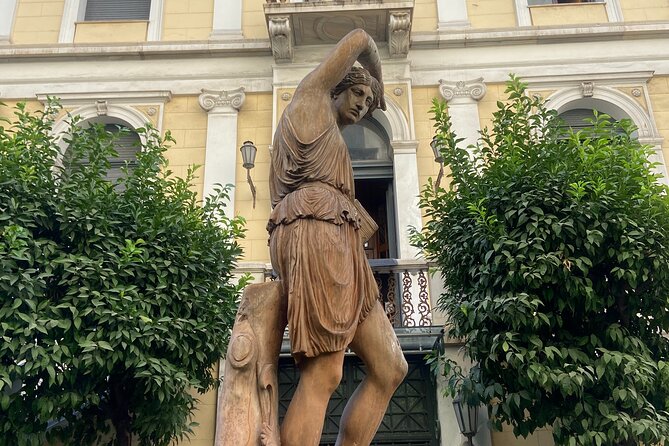
The tour then reaches the fountain at Syntagma Square for about 10 minutes. Here, you will see a statue, learn about a mysterious god, and connect Greek mythology with modern Athens.
This is the briefest stop, but it serves a useful purpose. It shows that myth is not confined to ruins or ancient temples. Statues, public spaces, building details, and civic decorations can still carry old ideas into the present day.
Because the stop lasts only 10 minutes, expect a focused story rather than a long explanation of Syntagma Square. You will have time to look, listen, and understand the link between the statue and the myth before moving on.
Syntagma is also practical as a route point. It is one of central Athens’s best-known public areas, and the square’s transit connections make the tour easy to pair with other sightseeing. The meeting point is near public transportation, and the walk ends in Monastiraki, so you can continue exploring on foot afterward.






Finishing in Plaka, close to the Acropolis
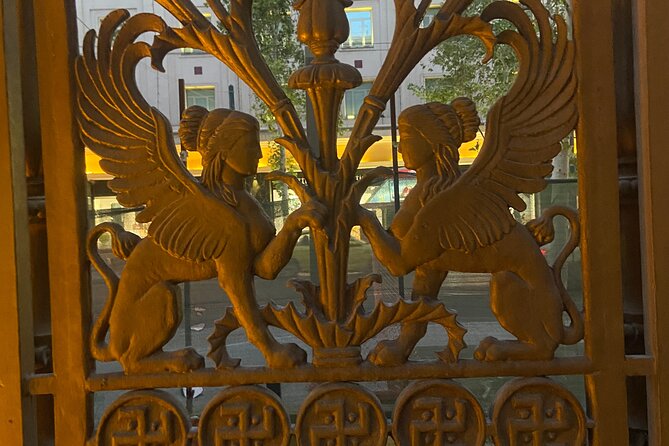
The final 30 minutes take you through Plaka, the old neighborhood near the Acropolis. This is where the guide discusses myths connected specifically to Athens.
Plaka is a fitting finish because the neighborhood puts you close to the city’s most famous ancient landmark without turning the walk into an Acropolis tour. You can absorb the narrow streets and old-city atmosphere while hearing stories rooted in Athens itself.
This section should be especially useful after you have learned about the wider Greek mythic world. The earlier stops introduce the gods, creation, heroes, and nature. In Plaka, those ideas narrow toward the city and its own legends.
The tour ends in Monastiraki Square. That gives you a convenient place to continue your evening, find food, or walk toward other central sights. It also means the experience functions well as a gentle orientation walk. You finish in one of Athens’s most useful central areas rather than returning to the starting point.
Do not confuse proximity to the Acropolis with entry. The route discusses Athens and its myths from the surrounding streets, but no Acropolis admission is included in the information provided.
A steady walk rather than a strenuous city march
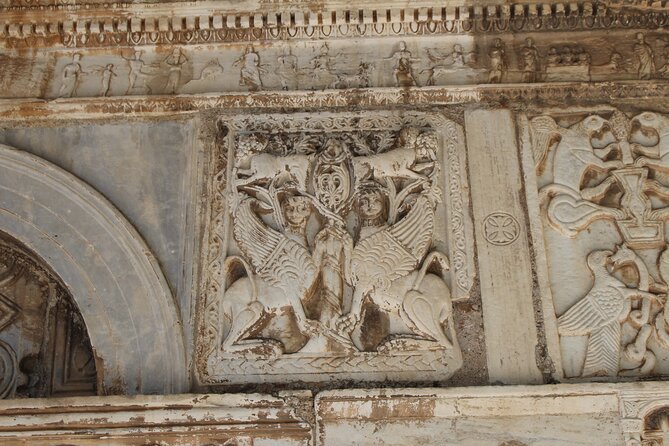
The full experience lasts about 2 hours 15 minutes. The listed stop times add up to the same length, so the schedule is fairly clear: 50 minutes at the Academy, 30 minutes near the Numismatic Museum, 15 minutes in the National Garden, 10 minutes at Syntagma, and 30 minutes in Plaka.
The route is described as slow and steady, with no major walking or climbing required. That makes it a reasonable choice if you want a city walk without the physical demands of a hilltop archaeological visit.
You still need comfortable shoes. Athens streets can be uneven, and you will be outdoors for more than two hours. The tour requires good weather, so plan a backup activity in case rain or poor conditions cause a cancellation.
The English-language format is useful for people who want to follow detailed stories without relying on translation. Since the group is limited to 10, the guide can likely keep the pace together more easily than on a large open-enrollment walk.
What the price means at $41.70
At $41.70 per person, the value depends on what you want from an Athens tour. You are paying for a guided interpretation of central Athens, not entrance tickets to major monuments.
I think the price is reasonable if you want a focused introduction to Greek mythology, a small group, and a route that covers several central areas in one sitting. The guide’s storytelling is the main product. If you already know the myths well, or if you mainly want archaeological facts and interior visits, the value will be weaker.
The route also saves you from planning a mythology-themed walk yourself. You could visit the same general areas independently, but you would need to research which stories fit each location and build your own sequence. Here, the guide connects creation, the Trojan War, nature myths, a public statue, and Athens-specific legends into one evening or morning.
I would see it as a companion to, not a replacement for, the Acropolis and major museums. If your budget allows only one paid activity, compare it with a tour that includes an important site admission. If you have already arranged those visits, this walk adds a lighter, more imaginative layer to your time in the city.
Who will get the most from this experience
I would recommend this tour to:
- First-time visitors who want a clear introduction to Greek mythology.
- Families with children who enjoy stories and a small amount of participation.
- People who prefer a gentle walk to a long climb or museum-heavy outing.
- Visitors looking for an activity near public transportation.
- Anyone who wants to finish in Monastiraki and continue exploring central Athens.
- Returning visitors who have seen the main monuments and want a different way to understand the city.
It may be less suitable if you want a detailed archaeological tour, a visit inside the Academy or Numismatic Museum, or admission to the Acropolis. It also may not suit someone who wants to avoid any interactive storytelling at the National Garden.
The guide’s ability to hold attention is important here. The supplied comments specifically describe the storytelling as engaging for children aged 10 and 12, and note that the guide connected myths to modern buildings and architecture. That suggests the walk works best when you enjoy the guide’s personality as much as the subject.
Booking, cancellation, and practical details
You receive confirmation at booking, and the tour uses a mobile ticket. It is offered in English, service animals are allowed, and the activity is near public transportation.
The experience is commonly booked about 28 days ahead, so do not leave it until the final day if the timing matters to your plans. The maximum group size is 10 people, another reason an early reservation may be sensible.
You can cancel for a full refund up to 24 hours before the local start time. Changes or cancellations inside that 24-hour window are not refunded or accepted. The tour also needs good weather and a minimum number of participants. If the operator cancels for either reason, you are offered another date or experience, or a full refund.
Should you book the Athens myths walking tour?
Book it if you want stories, atmosphere, and a manageable pace more than formal site entry. The route covers several useful central locations, the group is small, and the guide turns Greek mythology into something you can connect with streets, statues, gardens, and buildings.
I would choose it early in an Athens stay if you want to understand the myths before visiting more ancient sites. I would also choose it at the end of a trip if you want a relaxed recap that links the city’s modern life with its legendary past.
Skip it if your priority is the Acropolis, museum collections, or detailed archaeology. At $41.70, the tour earns its value through storytelling and organization, not admission tickets. For the right audience, especially families and first-time visitors, that is a fair trade.
FAQ
Where does the Myths and Legends of Athens Walking Tour start?
The tour starts at Korai 4, Athina 105 64, Greece.
Where does the tour end?
The tour ends in Monastiraki Square in Athens.
How long does the walking tour last?
The experience lasts approximately 2 hours and 15 minutes.
What language is the tour offered in?
The tour is offered in English.
How many people can join the tour?
The maximum group size is 10 people.
Are entrance tickets included?
The listed stops show free admission, and the experience information does not include paid entry to the Academy, Numismatic Museum, or Acropolis.
Is the tour suitable for children?
Most people can participate, and the storytelling format has held the attention of children aged 10 and 12. A light improv storytelling game is included in the National Garden.
What happens if the weather is poor?
The experience requires good weather. If it is canceled because of poor weather, you are offered a different date or a full refund.