REVIEW · ATHENS
Private 4-hour Walking Tour of Acropolis and Acropolis Museum in Athens
Book on Viator →Operated by Tour Travel & More · Bookable on Viator
The clever part of this private four-hour tour is the order: you begin in the Acropolis Museum, then walk uphill to the monuments themselves. That lets you see the sculptures first, understand what they meant, and then recognize the temples and old foundations outside.
I like the included admission, which saves you from sorting out separate tickets and long queues. I also like the private format. Your guide can adjust the pace, explain a confusing myth more than once, or slow down when the climb and heat begin to bite.
The main drawback is the price: $383.55 per person is a serious spend, especially since at least two people must book. You are paying for a private guide, convenience, and four focused hours, not a budget sightseeing walk.
In This Review
- Key points at a glance
- Why the museum-first route works so well
- Walking up to the Acropolis
- The Beulé Gate and the western entrance
- The Parthenon, Athens’ great symbol
- The Propylaea and Temple of Athena Nike
- Artemis, Augustus, and the overlooked remains
- The Erechtheion and its famous Caryatids
- What four private hours are worth
- Timing, crowds, and practical details
- Should you book this Acropolis tour?
- FAQ
- Where does the tour begin?
- How long does the experience last?
- Are admission tickets included?
- Is this a private tour?
- What language is offered?
- Is transportation or food included?
Key points at a glance
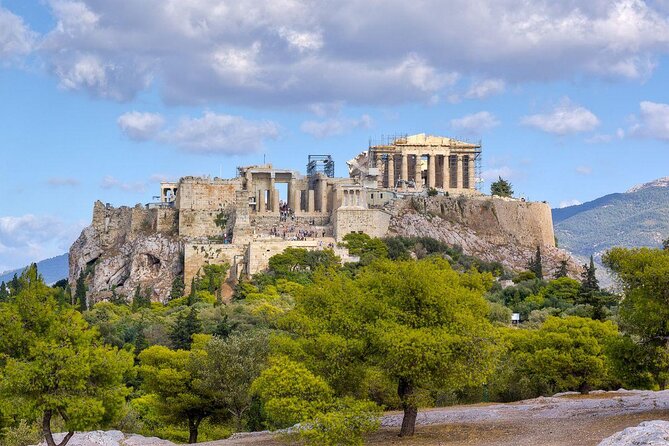
- Museum first, monuments second: The Acropolis Museum gives the outdoor ruins a clearer meaning.
- A genuinely private experience: Only your group takes part, with room to set the pace.
- Major sites included: See the Parthenon, Erechtheion, Propylaea, Temple of Athena Nike, and more.
- English-speaking guide: Guides such as Anna, Kathy, Ioanna, Maria, and Nikos have led highly praised tours.
- Tickets are included: Admission covers both the Acropolis and Acropolis Museum.
- Plan for a climb: Bring water and expect uneven walking on the Acropolis hill.
Why the museum-first route works so well
Meet your guide in front of the Acropolis Museum on Dionysiou Areopagitou Street. The museum sits near the Acropolis, so the meeting point is central and easy to reach by public transportation. Pickup can be arranged at the museum or a nearby place, but confirm the exact spot in advance. One past guest found the meeting instructions unclear, and a precise location would have saved time and worry.
The first hour takes place inside the Acropolis Museum, one of Athens’ best places for making sense of the hill above you. The building holds stone and bronze works found on the Acropolis and its slopes, arranged by location and period.
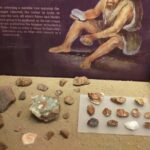
Your guide can connect ordinary objects, votive offerings, pottery, and reliefs from the Acropolis slopes to the more famous sculpture galleries. That matters because the Acropolis was not only a collection of grand temples. It was also a sacred place filled with daily rituals, gifts to the gods, and layers of use over many centuries.
The Archaic collection is especially useful before you see the Parthenon. It includes works from before the Persian Wars, including the Moskophoros, the well-known korai, pediment figures, and votive statues. You get to see how Greek sculpture changed from the stiff, patterned figures of the early period toward the more natural forms of the Classical age.
The museum’s Parthenon gallery is the heart of the visit. It holds parts of the temple’s frieze, metopes, pediments, and inscriptions. Your guide can explain how the decoration told stories of gods, heroes, and civic pride, rather than treating the sculpture as a row of disconnected marble fragments.
One particularly fine detail is the building itself. Its layout follows the orientation and proportions of the Parthenon, and excavated ruins beneath the museum are visible through sections of glass floor. This gives you a direct link between the modern museum, the ancient sanctuary, and the rock of the Acropolis.
The collection also covers the Propylaea, Temple of Athena Nike, and Erechtheion. Later galleries show objects from the Classical, Hellenistic, and Roman periods, including inscriptions, portraits, statues of gods and heroes, and other remains. The exact amount of time spent in each area depends on your guide and your group, but the private format makes it easier to focus on the objects that interest you most.
You can also read our reviews of more walking tours in Athens



Walking up to the Acropolis
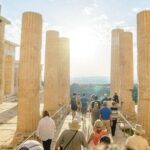
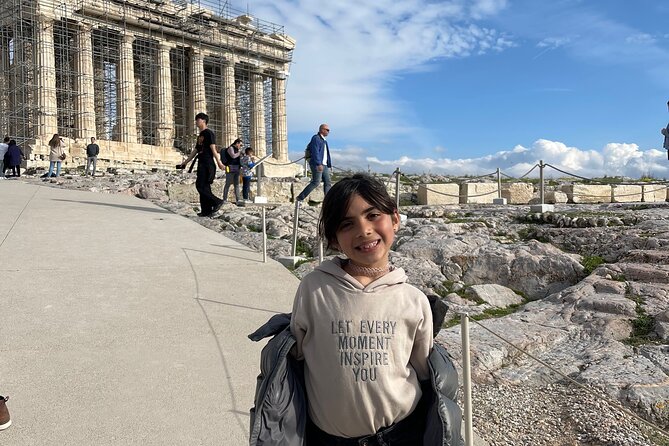
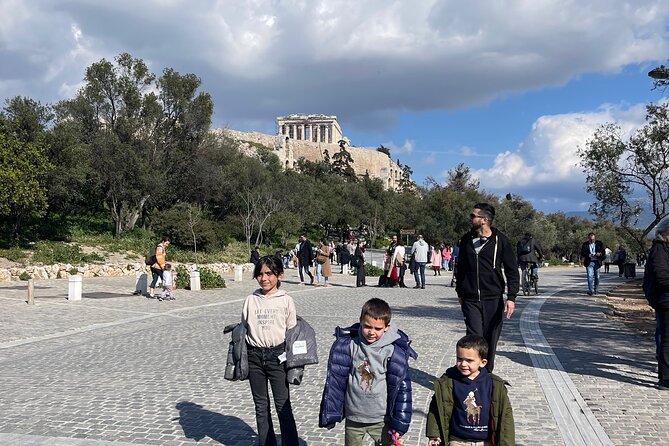
After the museum, you head toward the Acropolis. The hill rises 156 meters above sea level and dominates the center of Athens. The route involves a climb, steps, uneven surfaces, and open exposure to the weather. One useful piece of advice is simple: carry water. You can buy some on the hill, but having your own bottle is easier.
The tour is designed to include several sites on the slopes and summit. You will not simply walk straight to the Parthenon, take a photo, and leave. Your guide can point out less obvious remains along the route, helping you understand how the sanctuary worked as a whole.
The Acropolis has been under repair since modern Greece became independent, so you should expect restoration work and reconstructed areas. That does not lessen the impact of the visit, but it does mean the site is an active archaeological monument rather than a perfectly untouched ruin.
The Beulé Gate and the western entrance
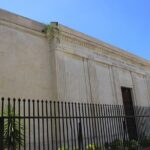
The Beulé Gate is the current access point to the Acropolis, west of the Propylaea. Built in the third century AD, it helped protect the sacred area and later became part of a strong western fortification wall.
The gate is framed by two rectangular towers. Its building material was reused from earlier monuments, including the Choregic Monument of Nikias, which once stood on the southern slope. A victory inscription connected with Nikias Nikodemos is set into the wall above the gate.
This is a small stop, but it prepares you for one of the most interesting facts about the Acropolis: the hill was altered and reused repeatedly. Greek, Roman, Byzantine, Frankish, Ottoman, and modern layers are not all equally visible, yet the site is full of such changes.
The Parthenon, Athens’ great symbol
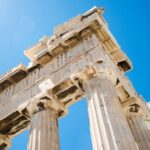
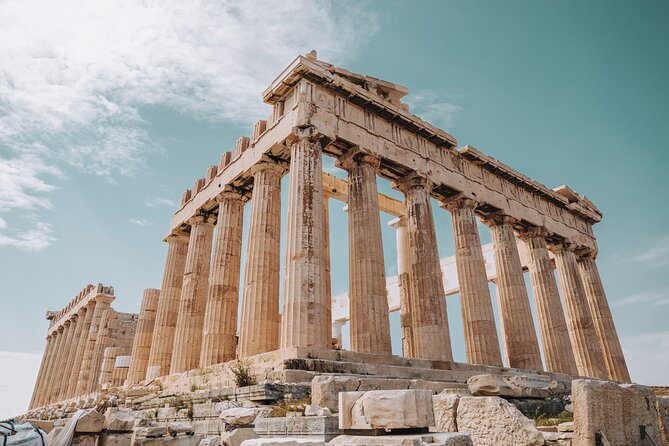
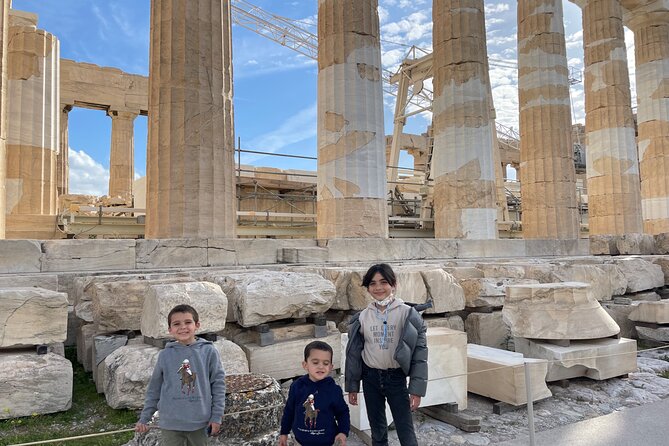
The Parthenon receives only about 20 minutes in the stated schedule, but it is the sight most people have come to see. Built between 447 and 432 BC, it was the main temple of the Acropolis and was dedicated to Athena.
The building was designed in the Doric order and once held a huge statue of Athena Parthenos, made of wood, ivory, and gold. The statue rose about 12 meters high. It has disappeared, but the temple still gives you a sense of the wealth and ambition of Classical Athens.
Your guide’s value here is not simply naming the columns. You can learn how the temple’s sculpture related to Athenian identity, religious practice, and the city’s political power. The museum visit makes the outdoor view stronger because you have already seen pieces of the Parthenon’s decoration up close.
The Parthenon is also where crowds and photography can slow the group. A private guide cannot remove the other people from the hill, but can help you find better moments for listening and explain what you are seeing while the group moves around the monument.
The Propylaea and Temple of Athena Nike
The Propylaea were the monumental gateways to the Acropolis. Built under Pericles between 437 and 431 BC, they replaced an earlier entrance from the time of Peisistratus.
Architect Mnesicles designed the porticoes to echo Doric temples. The outer portico had Ionic columns on raised platforms and a blue-marble roof decorated with stars. Five openings in the access wall guided people toward the sacred precinct, with the central opening made wider for vehicles.
The Propylaea are impressive even in their incomplete condition. They show that arriving at the Acropolis was meant to feel ceremonial. You passed from the ordinary city into a carefully designed sacred zone.
Beside the stairway is the small Temple of Athena Nike. Built between 426 and 421 BC, it replaced earlier temples whose remains survive inside the bastion. Its Ionic frieze showed gods and battles, including the Greek victory over the Persians at Marathon.
The Temple of Athena Nike is compact, so a guide helps you notice the details without spending too long in one crowded spot. About 15 minutes is allowed here, enough for an explanation and a good look, but not enough for a leisurely architectural study.
You can also read our reviews of more private tours in Athens




Artemis, Augustus, and the overlooked remains
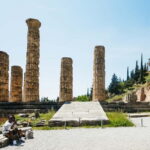
The Sanctuary of Artemis Brauronia lies south of the Propylaea. Artemis was honored here as a protector of women before and after childbirth. The sanctuary probably worked as a smaller counterpart to the goddess’s larger center at Brauron in Attica.
Today, you mainly see cuts in the bedrock where the walls once stood. That can be hard to picture on your own, but a guide can explain the former pi-shaped Doric stoa, its columns, enclosed wings, and courtyard. The head of a second statue of Artemis is now displayed in the Acropolis Museum, giving you another useful connection between the two halves of the tour.
The Temple of Rome and Augustus is a much later addition, built near the end of the first century BC. It was a small circular temple with nine Ionic columns, dedicated by Athens to the goddess Roma and the emperor Octavian Augustus.
Only foundations and scattered architectural elements remain. This is not a headline sight, but it shows how Athens adapted the Acropolis for Roman power as well as Greek worship. The scheduled stop is about 10 minutes.
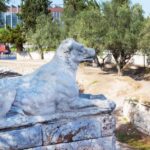
Nearby, the Monument of Agrippa rises on a tall stone pedestal. It was first built in 178 BC to honor Eumenes II of Pergamon after a chariot-race victory at the Panathenaic Games. Around 27 BC, the city dedicated a replacement chariot to Marcus Agrippa.
The original bronze quadriga is gone, leaving the 8.91-meter pedestal. This is another place where the guide’s explanation makes a plain block of stone worth your attention. Without context, it is easy to walk past.
The Erechtheion and its famous Caryatids
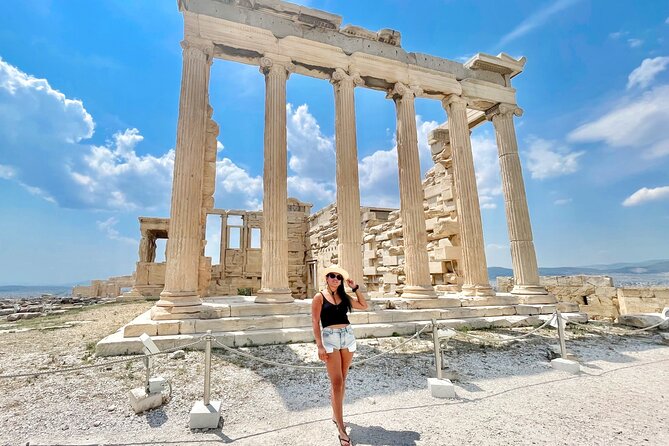
The Erechtheion is one of the most unusual buildings on the Acropolis. Unlike the Parthenon, it had to fit uneven ground and preserve several older sacred places.
The temple was linked with Poseidon-Erechtheus, Athena, Hephaestus, and Boutes. Tradition also connected the site with Poseidon’s trident strike and other foundational myths of Athens. Its irregular plan reflects the need to protect these older shrines rather than force everything into a tidy rectangle.
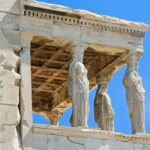
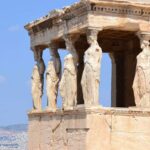
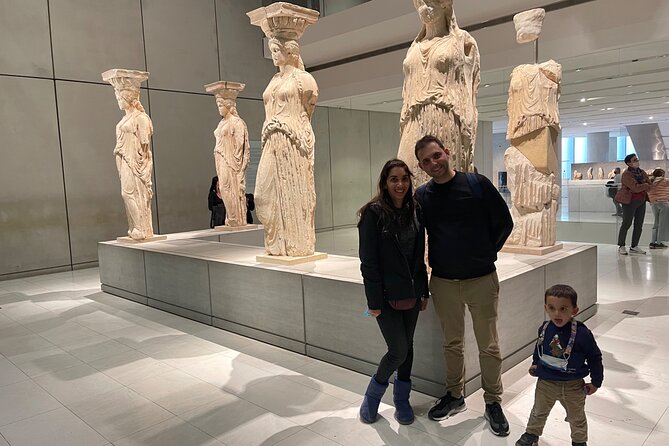
The northwestern porch uses tall Ionic columns. The southern porch is carried by six female figures, the famous Caryatids. Their calm poses make the heavy stone above them look almost effortless, though the originals are protected indoors and the figures outside are copies.
You have about 15 minutes at the Erechtheion. That is enough for a clear explanation and a look at the architecture, but the timing remains brisk if you want to linger over every angle. Tell your guide if this is your favorite monument, since a private tour gives you more say than a large scheduled group.
The itinerary also identifies an older Temple of Athena Polias, probably built in the sixth century BC on the site of an earlier Geometric temple and Mycenaean palace. The Persians damaged it in 480 BC, and it was never rebuilt. Its surviving traces and altar remains help explain why the Erechtheion was designed around older sacred places.
What four private hours are worth
The listed price is $383.55 per person, with a minimum of two people. That makes the experience expensive for a couple, and the total rises quickly for a larger party. Group discounts are offered, so the value improves when several people share the private guide.
The price includes local taxes, a private official guide for four hours, Acropolis admission, and Acropolis Museum admission. Food, drinks, and transportation are not included. Since pickup is only offered at the museum or a nearby place, you still need to arrange your own way to the meeting point.
I see the main value in the guide rather than the ticket bundle. The Acropolis can be confusing, the monuments are partly ruined, and many important details are easy to miss. A good guide turns the hill into a connected story instead of a series of marble fragments.
The private setting is also useful for families, couples, and small groups with mixed walking speeds. The guide can adjust the pace, and one group specifically appreciated help with physical limitations. Still, four hours is a long walking session, so this is not a low-effort sightseeing option.
The tour is offered in English. The guides named in the feedback include Anna, Kathy, Ioanna, Maria, and Nikos. Individual assignments can vary, but the repeated praise centers on friendly explanations, clear communication, patience, and the ability to let the group move at a relaxed pace.
Timing, crowds, and practical details
The experience is often reserved about 66 days ahead, which suggests booking early if your Athens dates are fixed. Confirmation is provided at booking, and free cancellation is available until 24 hours before the start time. Changes or cancellations inside that window are not refunded.
Start at the Acropolis Museum, where your guide will meet you in front or at a nearby place. Because the meeting details have caused some confusion, check your confirmation carefully and arrange a precise meeting location with the operator.
Most people can take part, and the tour is near public transportation. The data does not promise wheelchair access or a step-free route, so ask before booking if anyone in your group has mobility limits. You should expect walking uphill and over ancient surfaces.
The route is best for someone who wants context, not just photographs. If you prefer to wander alone and read labels at length, the four-hour structure may feel too directed. If you want the major sights explained in a logical order, the format is much more useful than relying on a guidebook while trying to navigate crowds.
Should you book this Acropolis tour?
Book it if you want a private, guided introduction to Athens’ two essential ancient sites and value a flexible pace. It is especially well suited to first-time visitors, couples, families, and small groups who want the museum and hill explained as one experience.
Skip it if $383.55 per person feels too high, if you only want a quick look at the Parthenon, or if you prefer independent visits. The tour covers a lot in four hours, but the schedule leaves limited time for lingering at individual monuments.
For the right group, I think the museum-first plan is the strongest feature. You see the sculptures, learn the myths and setting, then climb to the temples they came from. Add water, sensible shoes, and a confirmed meeting point, and you will get far more from the Acropolis than a hurried walk to the famous viewpoint.
FAQ
Where does the tour begin?
The tour begins at the Acropolis Museum, at Dionysiou Areopagitou 15 in Athens. Your guide will meet you in front of the museum or at a nearby place.
How long does the experience last?
The walking tour lasts approximately four hours. It includes time at the Acropolis Museum and the Acropolis site.
Are admission tickets included?
Yes. Admission to both the Acropolis and the Acropolis Museum is included in the tour price.
Is this a private tour?
Yes. Only your own group takes part in the activity. At least two people are required per booking.
What language is offered?
The tour is offered in English.
Is transportation or food included?
No. Transportation, food, and drinks are not included. Pickup may be offered at the Acropolis Museum or a nearby place, but you must arrange your own way to the meeting point.