REVIEW · ATHENS
Walk through the history of Athens
Book on Viator →Operated by Greca Travel · Bookable on Viator
Athens reveals itself in layers on this 2.5-hour walk, moving from grand nineteenth-century buildings to Parliament, Olympic landmarks, Roman ruins, and the Acropolis. You begin on Panepistimiou Avenue and finish near the Acropolis Metro Station, so the route gives you a useful north-to-south introduction to central Athens without requiring an Acropolis admission ticket.
I like the compact route and the way it connects places that are often visited separately. I also like the guide choice in Spanish or English, plus the small maximum group of 14 people. The main caution is that the tour only gives you outside views of several major sites, and the operator’s overall service record includes complaints about missed appointments and organization.
In This Review
- Key points at a glance
- Starting among Athens neoclassical buildings
- Syntagma Square and the Hellenic Parliament
- Kallimármaro, the marble stadium of the modern Olympics
- Zappeion and Athens’s Olympic ambitions
- The Temple of Olympian Zeus and Hadrian’s mark
- Ending below the Acropolis
- What the guide can add
- Is $31.13 a fair price?
- Timing, group size, and practical comfort
- Who should book this Athens walk?
- Should you book it?
- FAQ
- Where does the Athens history walk begin?
- Where does the tour end?
- How long does the experience last?
- How much does the tour cost?
- Is the Acropolis admission ticket included?
- Is the Acropolis Museum included?
- What languages are available?
- What sights are included in the route?
- How many people can join the group?
- Can I cancel for a refund?
Key points at a glance
- A city-changing route: Follow Athens from neoclassical Panepistimiou Avenue through modern Greek state buildings, Olympic landmarks, Roman ruins, and the Acropolis.
- A practical Acropolis finish: End at Acropolis Metro Station, close to Dionysiou Areopagitou pedestrian street, Plaka, and the Acropolis Museum.
- Guiding in two languages: Select a Spanish or English assistant when booking.
- Small-group format: The group is limited to 14 people, which should make questions and street crossings easier to manage.
- Strong historical range: In one outing, you see the Neoclassical Trilogy, the Hellenic Parliament, Kallimármaro Stadium, Zappeion, and the Temple of Olympian Zeus.
- A modest price with clear limits: At $31.13 per person, the walk can be good value for orientation, but entrance tickets are extra.
Starting among Athens neoclassical buildings

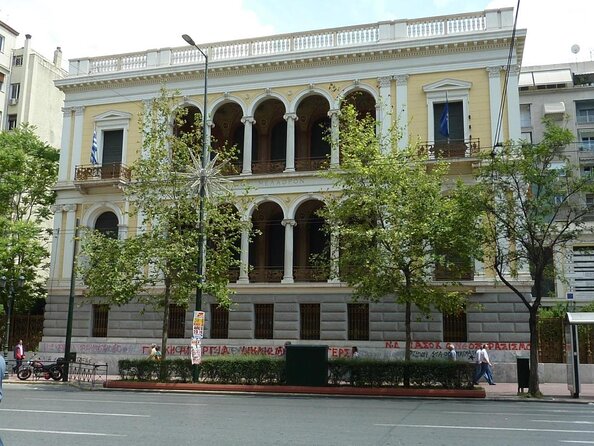
The walk begins outside the Titania Hotel at Panepistimiou 52. This puts you on one of central Athens’s most important avenues, where the city’s nineteenth-century identity comes into view through a line of formal public buildings.
The first section is not about ancient ruins. That is part of its value. Athens is often treated as a gateway to the Acropolis, but modern Greece also has its own architectural story. Along this avenue, you can admire the Numismatic Museum, the Archaeological Company Building, the Catholic Church of St. Dionysius, the Athens Ophthalmological Hospital, and the Central Bank of Greece.
The Numismatic Museum is the named first stop, though admission is not included. You should expect to admire it from the outside unless you arrange a separate visit. The same applies to the other buildings in this opening stretch. The assistant can help explain how these institutions fit into Athens today, but this is not an interior architecture tour.
The route gives you a useful visual contrast. Classical Athens is usually associated with columns, marble, and temples. The buildings here show the later capital using classical ideas for schools, banks, churches, and government institutions. I find that context helpful because it prevents the ancient city from feeling like an isolated archaeological island.
The first stop is listed for about 10 minutes. That is enough for a short introduction and photographs, but not enough for a serious visit inside the Numismatic Museum. If you want to see its collections, plan a separate visit and do not assume the walking tour covers admission.
You can also read our reviews of more walking tours in Athens



Syntagma Square and the Hellenic Parliament
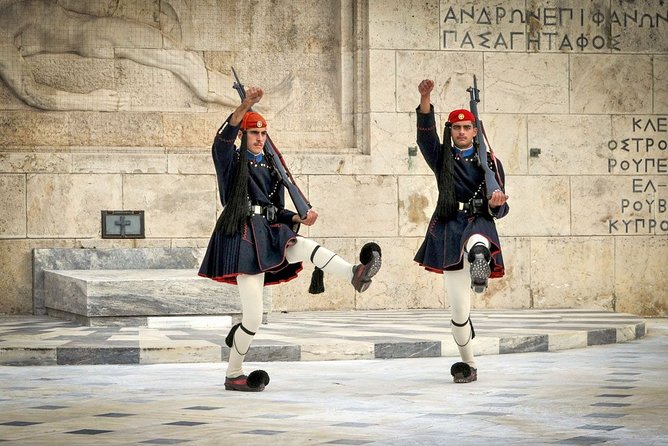
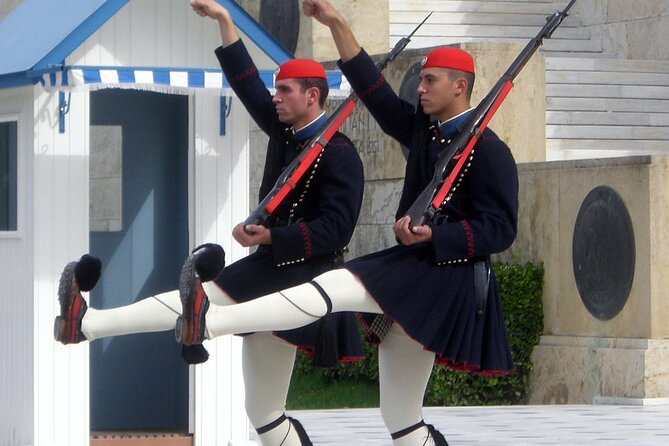
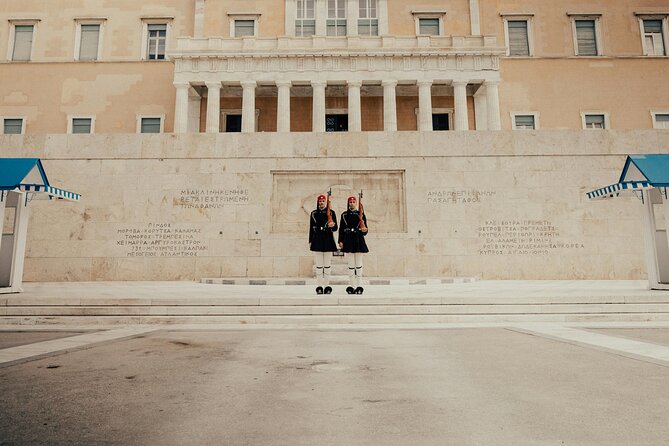
From Panepistimiou Avenue, the route reaches Syntagma Square, the civic heart of present-day Athens. Here you see the Hellenic Parliament, housed in the former royal palace, and have time to watch the traditional guard ceremony.
The guards are known for their distinctive uniforms and measured movements. This is one of those moments when a short stop can be more memorable than a long lecture. Your guide can place the ceremony within the modern Greek state, while you watch a living public ritual rather than another silent monument.
The stop lasts about 10 minutes and is free. That timing matters. The change of guard itself can vary, so you should treat this as a chance to see the guards and their formal routine rather than a promise of a full ceremony at a particular minute. The tour description specifically includes time to watch the changing of the guard, but it does not give a schedule.
Syntagma is also a useful orientation point. It links the commercial center, Parliament, the National Garden area, and routes toward the Acropolis. If you are new to Athens, you will quickly understand how the modern city moves around its historic center.
One practical detail deserves attention: arrive at the Titania Hotel with enough time to find the meeting point. The published start is precise, and one separate Greca Travel complaint described a confirmed booking where no guide appeared. The company apologized for that case, but I would still keep your confirmation available and check the meeting details before setting out.
Kallimármaro, the marble stadium of the modern Olympics
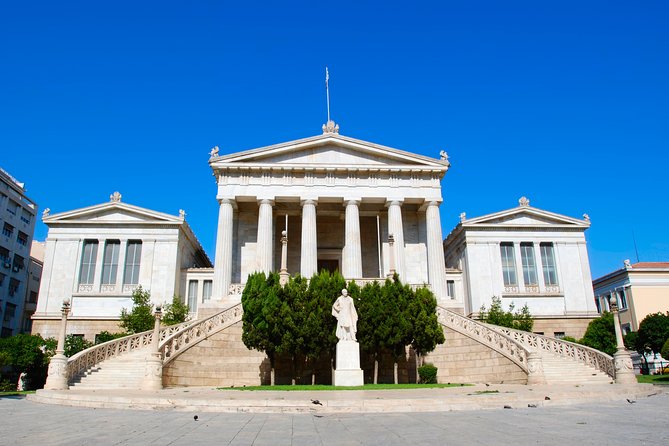
The walk continues toward Kallimármaro Stadium, also called the Panathenaic Stadium. You see it from a panoramic viewpoint rather than entering the stadium. Admission is not listed as part of the tour, and the stop is about 10 minutes.
Kallimármaro means good marble, an apt name for a stadium built entirely from white marble. It hosted the first modern Olympic Games in 1896, giving the site a direct link to the revival of the Olympics in the nineteenth century.
This is a particularly good stop for understanding how Athens connected ancient ideals with the modern Greek nation. The shape recalls the athletic contests of antiquity, yet the stadium also belongs to the era of modern international sport. From the outside, you can appreciate its long, pale seating tiers and unusual horseshoe form.
The drawback is simple: a panoramic look cannot replace walking inside. If you have a strong interest in Olympic history or stadium architecture, you may want to return on your own. The tour is designed to show you the site as part of a larger city walk, not to spend an hour exploring every corner.
The outdoor format does keep the day moving. You get a clear sense of where the stadium sits in relation to the National Garden, Zappeion, and the Acropolis area. That spatial understanding is one of the better reasons to choose this tour early in your stay.
Zappeion and Athens’s Olympic ambitions
Next comes the Zappeion, a grand neoclassical building in the National Garden area. It was the first building constructed specifically for the modern Olympic Games and is now used for official and private ceremonies and meetings.
This stop adds a useful layer to the Olympic story. Kallimármaro was built for competition, while Zappeion served the wider civic and ceremonial world around the Games. Together, the two sites show that the modern Olympics required more than a stadium. They also needed formal spaces for public events and national presentation.
The visit lasts about 10 minutes. You should expect an exterior look and a short explanation, not a full tour of the building or its event rooms. Because Zappeion may be in use for ceremonies or meetings, access can depend on the day, and no interior admission is included in the tour details.
I like this stop because it breaks up the sequence of temples and government buildings. It also gives you a chance to notice the relationship between formal architecture and open garden space. The route is not just a checklist of famous names. It shows how Athens developed a ceremonial center around its public institutions and Olympic sites.
The Temple of Olympian Zeus and Hadrian’s mark
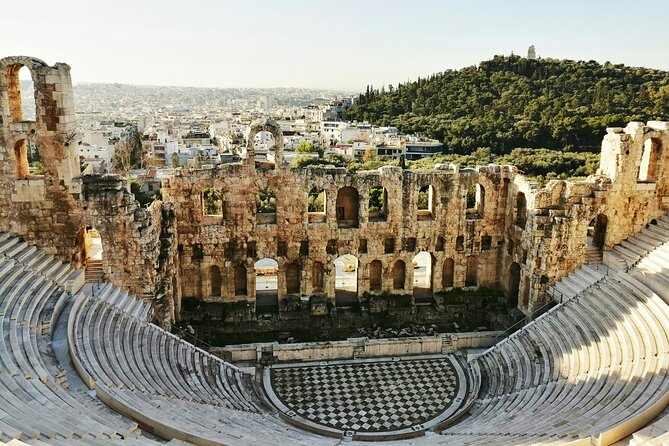
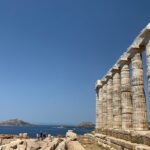
Near the end of the walk, you pass the Temple of Olympian Zeus. This vast ancient temple is one of the clearest reminders that Athens was important long before it became the capital of modern Greece.
The temple was dedicated to Zeus and later completed under the Roman Emperor Hadrian. Hadrian had a statue of himself placed next to the monumental statue of Zeus, which was said to be 13 meters high and decorated with gold and ivory, based on the famous work by Phidias.
The details matter because the site tells two stories at once. It reflects Greek religious tradition, and it shows Rome claiming a place within that tradition. Hadrian’s connection with Athens is especially visible here, where imperial power and admiration for Greek culture meet.
The stop is listed for about 10 minutes, and admission is not included. You should be prepared to view the temple area from outside unless you buy a separate ticket. The tour does not include a guided archaeological-site visit, so do not expect extended time among the columns.
That limitation is also what keeps the walk affordable. At $31.13, you are paying for a guided introduction across a broad section of Athens, not for entry to every monument. If you already hold an archaeological-site ticket, the tour’s route can help you decide what deserves more time afterward.
You can also read our reviews of more historical tours in Athens



Ending below the Acropolis
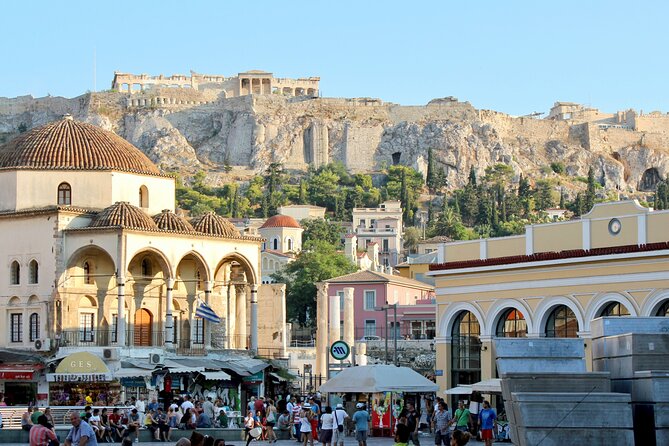
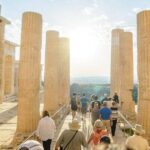
The walk finishes at Acropolis Metro Station, close to Dionysiou Areopagitou pedestrian street. From here, you get a view toward the Acropolis crowned by the Parthenon, and you are well placed to continue exploring.
This is a smart ending point. You are not dropped in an obscure corner after the final explanation. Instead, you finish beside one of Athens’s main pedestrian routes and within easy reach of several next steps: the Acropolis archaeological site, the Acropolis Museum, Plaka, nearby tavernas, and local shops.
The Acropolis itself is not included. The same is true of the museum. If you plan to visit either, you need a separate admission ticket and enough time after the walk. The description presents this ending as an opportunity to continue independently, not as part of the guided experience.
You might choose the Acropolis immediately if your ticket and schedule allow. You might also prefer lunch in Plaka, a stroll along Dionysiou Areopagitou, or a museum visit when you have more energy. Ending here gives you control, which is useful after a route that provides many short stops.
The guide may also help you make sense of Plaka’s position below the Acropolis. One highly positive account specifically praised a guide named Magdalene for bringing the historical setting to life and giving a broad view of Plaka. That sort of city context is more useful than simply pointing toward the next monument.
What the guide can add
The experience includes an assistant in the language you select, Spanish or English. Since much of the value comes from connecting buildings and historical periods, language choice matters. A clear explanation can turn a row of handsome facades into a readable part of Athens.
The available comments also point to the difference a guide can make. One English-language account praised the guide as a good historian who answered questions and added stories that were not obvious from the sites alone. Another Spanish-language account singled out Magdalene’s way of explaining events and making the past feel immediate. Jenni was also praised for sharing many city details and adapting well to a family with a 16-month-old child.
Those comments do not guarantee that you will receive one of those guides. They do show what to look for: a guide who explains connections, answers questions, and adjusts the pace when needed. The maximum group size is 14, which is small enough to support some interaction, though it is not a private tour.
The route itself has several short 10-minute stops. That makes it suitable if you want a clear framework before exploring more deeply. It may feel too brief if you prefer long periods at one monument or detailed archaeological discussion.
Is $31.13 a fair price?
I see the $31.13 price as reasonable for a guided orientation walk, especially if you are visiting Athens for the first time and want to understand how its ancient, Roman, neoclassical, Olympic, and modern political layers fit together.
You are not paying only to be led from one attraction to another. The route covers a useful stretch of central Athens, and the guide’s explanations are meant to connect places that could otherwise seem unrelated. The small-group limit adds value compared with a large coach-style outing.
Still, the price needs to be judged against what is not included. There are no tickets for the Numismatic Museum, Temple of Olympian Zeus, or Acropolis, and the stadium and Zappeion are presented as exterior or panoramic stops. If you want interior visits, your total spending will rise.
The tour is strongest as a first-day or early-stay activity. It can help you choose where to return, how the center is arranged, and which sights deserve a separate ticket. If you have already visited the Acropolis, Parliament, stadium, and Zeus temple, the walk may offer less new material unless you especially want historical interpretation.
Timing, group size, and practical comfort
The duration is approximately two and a half hours. The named stops each receive about 10 minutes, with the remaining time used for walking and explanations. Wear comfortable shoes and expect a steady urban walk, even though the route is not presented as a strenuous hike.
The meeting point is the Titania Hotel on Panepistimiou Avenue. The end point is Acropolis Metro Station at Athens 117 42. Because the tour starts and ends in different parts of the city, it works well as a way to move toward the Acropolis rather than as a return trip to your hotel.
Most people can take part, and service animals are allowed. The tour is near public transportation, which helps with both arrival and onward plans. The information does not specify a detailed accessibility assessment, so you should confirm any mobility needs directly with Greca Travel before booking.
The tour requires good weather and a minimum number of participants. If poor weather or low enrollment cancels it, the stated options are another date, another experience, or a full refund. You can cancel for a full refund up to 24 hours before the start time, but changes or cancellations inside that window are not accepted.
The overall published score is 3.3 out of 5 from six ratings, so I would not book this as a completely risk-free choice. Alongside strong praise for guides and historical explanations, there are complaints about poor organization, hotel-related service, and one case in which a confirmed appointment reportedly had no guide available. Those complaints concern Greca Travel service more broadly and do not describe every detail of this particular walk, but they are worth weighing.
Who should book this Athens walk?
I would recommend it most to a first-time visitor who wants a short, guided introduction before tackling the Acropolis alone. It suits people who enjoy historical connections, city architecture, and seeing several landmarks without spending the full day inside one site.
It also works well for families who benefit from a flexible guide. Jenni’s reported adaptation to a parent traveling with a 16-month-old suggests that the company can respond thoughtfully in some cases, though no tour can promise the same guide or pace.
Spanish-speaking visitors may find the language option especially useful, as one Spanish-language account praised the guide’s storytelling and city overview. English speakers also have evidence of strong historical explanations and question handling.
I would hesitate if your main goal is a full Acropolis visit, interior access to museums, or a slow architectural study. You will need separate tickets and additional time. I would also confirm the appointment shortly before the walk because of the service complaints attached to the operator.
Should you book it?
Book this tour if you want breadth before depth. For $31.13, you get a guided path through Athens’s neoclassical center, Parliament, Olympic landmarks, Roman-era ruins, and the Acropolis approach, with a small maximum group and a Spanish or English assistant.
Skip it if you only want ancient monuments or if you already know central Athens well. The outside views and short stops are useful for orientation, but they will not replace the Acropolis, museum, stadium, or archaeological-site visits themselves.
My practical choice would be to schedule it near the start of your Athens stay, keep the rest of the day flexible, and continue from Acropolis Metro Station into Plaka or the Acropolis area. Confirm the meeting point, arrive early, and treat the walk as a city introduction rather than a complete sightseeing day.
FAQ
Where does the Athens history walk begin?
It begins at Titania Hotel Athens, Panepistimiou 52, Athens 106 78, Greece.
Where does the tour end?
The walk ends at Acropolis Metro Station in Athens 117 42, near Dionysiou Areopagitou pedestrian street.
How long does the experience last?
The tour lasts approximately 2 hours and 30 minutes.
How much does the tour cost?
The listed price is $31.13 per person.
Is the Acropolis admission ticket included?
No. Tickets to the Acropolis archaeological site are not included.
Is the Acropolis Museum included?
No. The tour ends near the Acropolis area, but admission to the Acropolis Museum is not included.
What languages are available?
You can select an assistant in Spanish or English.
What sights are included in the route?
The route includes the Numismatic Museum area, Panepistimiou Avenue, Syntagma Square and the Hellenic Parliament, Kallimármaro Stadium, Zappeion, the Temple of Olympian Zeus, and the Acropolis area.
How many people can join the group?
The activity has a maximum of 14 participants.
Can I cancel for a refund?
Yes. You can cancel at least 24 hours before the start time for a full refund. Cancellations or changes made less than 24 hours before the start time are not accepted for a refund.