REVIEW · ATHENS
Acropolis Of Athens & The Acropolis Museum Private Guided Tour
Book on Viator →Operated by CRISPY LOCAL MONOPROSOΡΙ Ι.Κ.Ε. · Bookable on Viator
The best part of this Athens tour is the way it links the Acropolis ruins with the objects now protected inside the Acropolis Museum. You see the temples on the hill, then examine surviving sculpture and architectural pieces in a modern setting where the story becomes easier to follow.
I like the private format, since your guide can slow down for questions or adjust the pace for your group. I also like the unhurried four-hour schedule, which gives you two hours at each major site instead of treating the Acropolis as a quick photo stop. The main drawback is that admission costs extra, and one booking had a mismatch between the tour start time and the timed entry ticket.
In This Review
- Key points to know
- Why this private Acropolis visit works well
- Meeting at Dionysos Zonar’s
- Walking up the Sacred Rock
- Propylaea, the Acropolis gateway
- The Parthenon and the view over Athens
- Erechtheion and Athena Nike
- Theater of Dionysus and the Herod Atticus Odeon
- Inside the Acropolis Museum
- The guides and the private pace
- Price, tickets, and overall value
- Who should book this experience
- Should you book the Acropolis and museum tour?
- FAQ
- How long does the private Acropolis and museum tour last?
- What time does the tour begin?
- Where do I meet the guide?
- Where does the tour finish?
- Are entrance tickets included?
- Is this a private tour?
- What happens if poor weather closes the site?
Key points to know
- A private licensed guide leads only your group, so the visit can feel more personal than a large walking tour.
- The Acropolis portion covers the Parthenon, Propylaea, Erechtheion, Athena Nike, Theater of Dionysus, and Herod Atticus Odeon.
- The Acropolis Museum displays original surviving pieces with natural light and visible excavations beneath glass floors.
- Plan on an extra €35 per person for admission, €20 for the Acropolis and €15 for the museum.
- Meet at Dionysos Zonar’s on Rovertou Galli Street at 9:00 a.m., then return to the same meeting point.
- Confirm the exact ticket time in advance, especially if the guide or operator is arranging your entries.
Why this private Acropolis visit works well
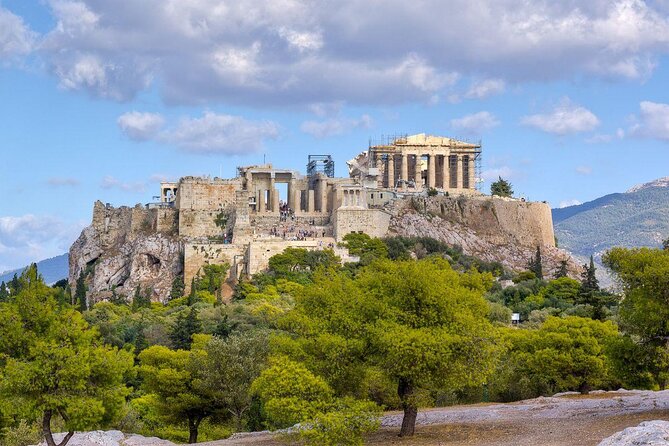
The Acropolis is not just a collection of marble columns. It is a hilltop complex shaped by religion, politics, war, rebuilding, and the changing needs of Athens. Without some explanation, it is easy to see the Parthenon, take a few pictures, and miss what makes the site important.
This tour gives you a guide for the full visit and pairs the open-air ruins with the Acropolis Museum. That pairing matters. On the hill, you see the buildings in their original setting. In the museum, you can look closely at sculpture and architectural details without standing on an exposed archaeological site.
The private arrangement is especially useful if your group has different interests. You can ask about Greek gods, construction methods, mythology, or daily life in ancient Athens. A guide can also pause when the site feels crowded or when someone needs a breather.
The experience lasts about four hours, beginning at 9:00 a.m. It is designed as a leisurely half-day outing, not a rushed checklist. That leaves you time later for lunch, another museum, or a walk through central Athens.
You can also read our reviews of more guided tours in Athens



Meeting at Dionysos Zonar’s
The meeting point is Dionysos Zonar’s at Rovertou Galli 43, near the foot of the Acropolis. This is a useful location because you are close to the main archaeological site rather than spending the first part of the tour waiting for transport from a distant hotel.
The activity ends back at the same meeting point. Public transportation is nearby, and the location is practical for combining the tour with other plans in central Athens.
At booking, you receive confirmation. The tour is offered in English, and only your own group participates. That can mean a couple, a family, or a larger private party, but the supplied information does not give a maximum group size.
Arrive with enough time to find the meeting point and be ready for the 9:00 a.m. start. The site can become crowded, so an early beginning is useful even though the tour itself is not advertised as a special early-access visit.
Walking up the Sacred Rock
The Acropolis sits on a steep, rocky hill above Athens. The ruins date back as early as 510 BC, and the site remains the city’s clearest link to ancient Athens. You get wide views over the modern capital as you move between monuments.
This is an archaeological site, not a smooth museum floor. The ground can be uneven, and the climb requires care. The supplied information says most people can participate, but the experience is more demanding in rain or for anyone recovering from a hip or knee operation.
One group completed the visit in poor weather while one member needed extra care after recent surgery. The guide, Anda, adjusted the pace and focused on safety. That does not remove the physical demands of the hill, but it shows why a private guide can be helpful for groups that need pauses or a slower walk.
Rain also matters for scheduling. The experience requires good weather, and the site may close to incoming visitors during poor conditions. If that happens, you are offered another date or a full refund.
Propylaea, the Acropolis gateway
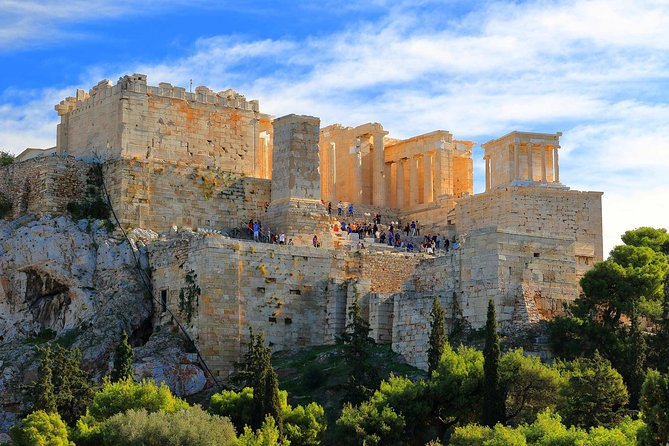
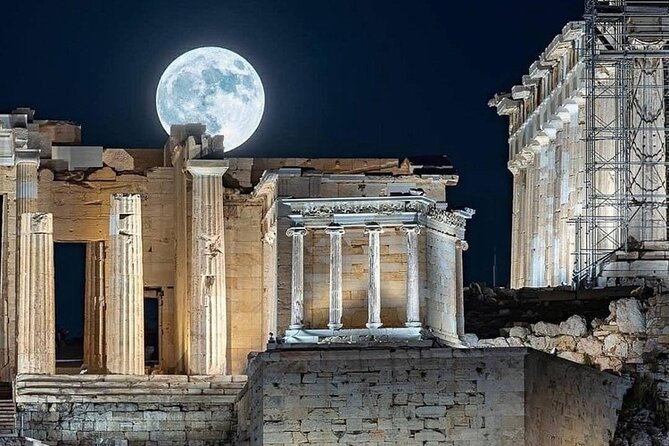
Your first major sight on the hill is the Propylaea, the monumental entrance to the Acropolis. It frames the approach to the central monuments and helps you understand that this was planned as a sacred precinct, not a random pile of surviving ruins.
A guide can explain how the entrance shaped the visitor’s first view of the hilltop temples. That kind of context is one of the main reasons to choose a private tour. You are not simply being pointed toward the next column. You are shown how the site was meant to be experienced.
The Propylaea is also a useful place to get your bearings before the Parthenon. Your guide can connect the entrance with the larger religious role of the Acropolis and explain the place of Athena in the city’s identity.
The Parthenon and the view over Athens
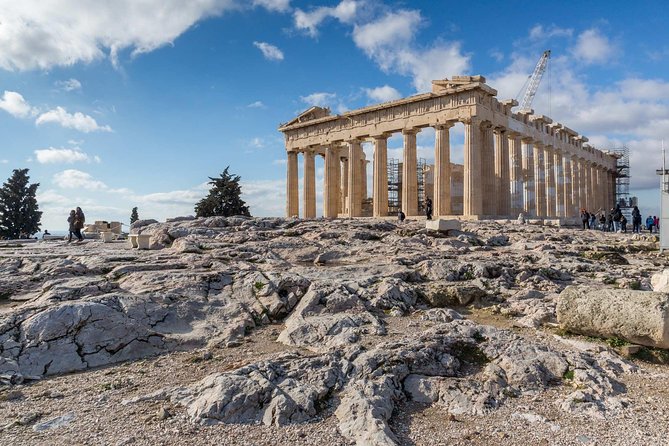
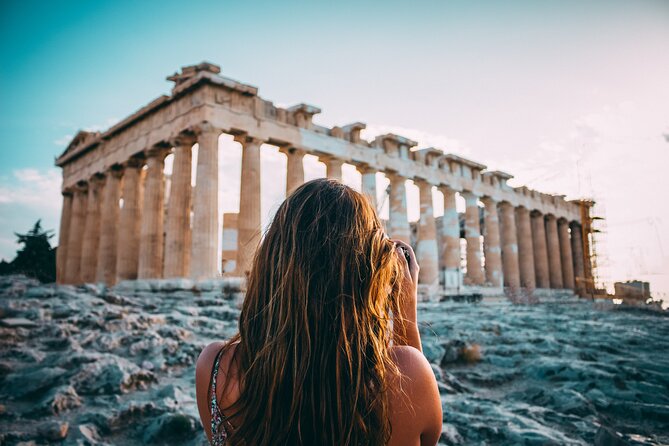
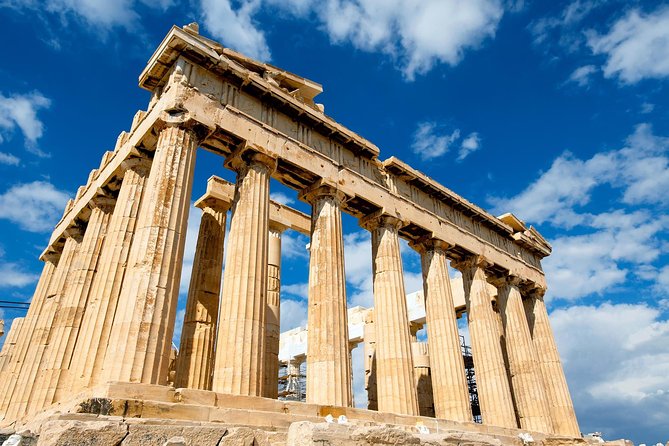
The Parthenon is the center of attention for most people, and rightly so. Its scale, position, and surviving details make it one of the most recognizable ancient buildings in the world.
A guide can help separate the building’s original purpose from the many later changes that affected it. You can ask about the temple’s connection to Athena, the meaning of its sculptures, and the way ancient builders handled proportion and visual balance.
The setting adds much of the drama. The temple sits on the highest part of the hill, with Athens spreading below it. I would allow time here for both explanation and quiet looking. A good guide should not fill every moment with words, since the view and the surviving architecture deserve attention on their own.
Crowds are the practical concern. The Acropolis is a major attraction, and narrow areas can feel busy. A private guide may help your group move through the site with less confusion, but no guide can guarantee an empty Parthenon.
You can also read our reviews of more private tours in Athens





Erechtheion and Athena Nike
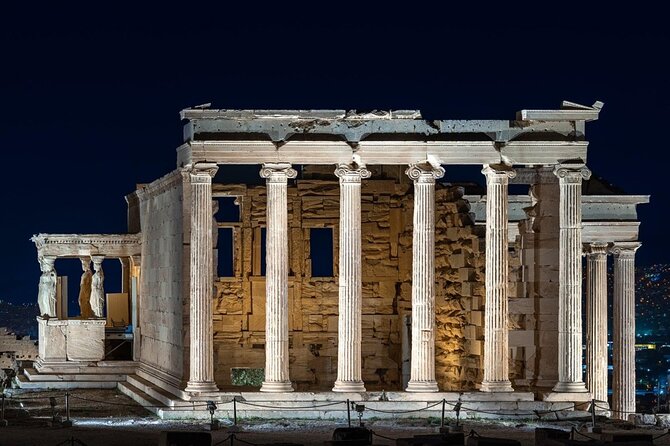
The Erechtheion offers a different mood from the Parthenon. Its unusual design and multiple sacred associations make it one of the most interesting stops on the hill. The famous Caryatid porch is an especially important detail, though the surviving originals are connected with the museum’s protected collection rather than being left fully exposed on the building.
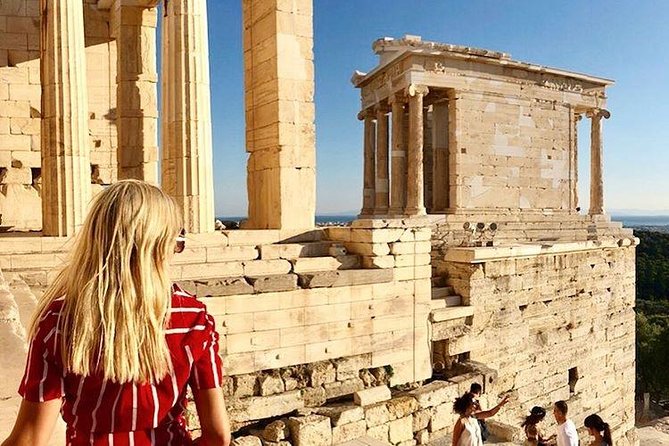
Nearby, the Temple of Athena Nike adds another piece to the story of Athens and its patron goddess. It is smaller than the Parthenon, but its position near the entrance gives it a strong visual role.
These stops reward explanation. To a first-time visitor, the Acropolis can look like a series of pale marble remains. A guide helps you see how each building had its own function and place in the sacred complex.
Theater of Dionysus and the Herod Atticus Odeon
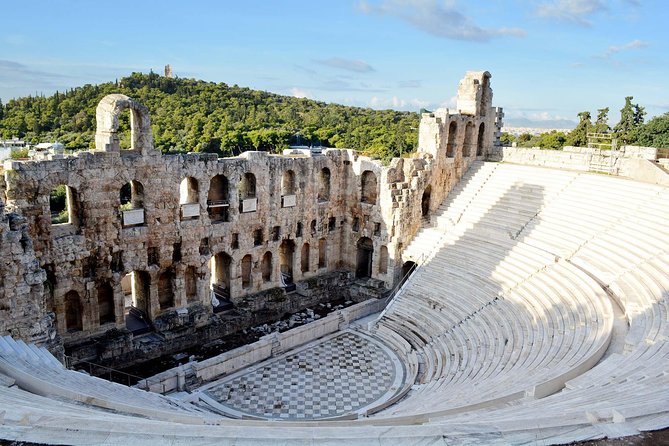
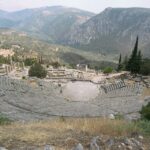
The Theater of Dionysus sits on the southern slope of the Acropolis. It connects the hill with the theatrical traditions of ancient Athens and gives you a sense of how performance, religion, and public life overlapped.
The Herod Atticus Odeon is another reminder that the Acropolis was not only about temples. This large performance structure shows the importance of music and public spectacle in the ancient city.
The itinerary allows about two hours for the Acropolis. That is enough time to cover the listed monuments with a guide, but the exact pace depends on crowds, weather, questions, and how much time your group spends looking around. If you want lengthy stops at every location, tell your guide early so expectations are clear.
Inside the Acropolis Museum
After the hill, the tour continues to the Acropolis Museum for about two hours. The museum was designed by Bernard Tschumi with Greek architect Michalis Photiadis, and its layout makes strong use of natural light.
The museum’s main value is its connection to what you have just seen. Original surviving masterpieces from the Acropolis temples are displayed indoors, where you can study them at close range. Instead of trying to understand sculpture from a distance on the hill, you can see details of faces, clothing, carving, and architectural decoration more clearly.
Glass floors and walkways reveal excavations below the museum. This gives the building another layer of interest. The museum is not simply a storage space for objects removed from the Acropolis. The structure itself keeps the archaeological story visible under your feet.
I like the order of this tour. Seeing the ruins first gives the museum a clear purpose. You recognize the buildings and decorations, then your guide can connect the objects to their original setting. An excellent guide will also tie the two halves together rather than treating the museum as an unrelated second stop.
The guides and the private pace
Several guide names are associated with especially strong experiences on this activity, including Maria, Irene, and Anda. Your assigned guide may be someone else, so do not book on the assumption that one particular person is guaranteed.
The praised qualities are useful clues about what to expect from the best version of this tour. Maria was described as skilled at moving through heavy crowds, explaining Greek gods and ruins through stories, and taking breaks at sensible times. She also stayed beyond the planned finish to answer questions.
Irene was noted for her enthusiasm and strong grasp of Greek history and culture. Anda was praised for clear explanations, patience with an older group, and concern for safety in bad weather. She also offered suggestions for local restaurants and other things to do in Athens.
Those details point to the private tour’s strongest feature: conversation. You can ask follow-up questions that might not fit a fixed group script. If your group includes children, older adults, or people with limited stamina, tell the guide at the start and agree on a comfortable rhythm.
The tour is advertised for about four hours, but one visit lasted five hours because the guide continued explaining and answering questions. That generosity is welcome, but you should not rely on extra time if you have a fixed lunch reservation or another timed activity.
Price, tickets, and overall value
The listed price is $240.82 per person. Entrance tickets are not included, adding €20 per person for the Acropolis and €15 per person for the Acropolis Museum. That makes the published admission cost €35 per person on top of the tour price.
This is not a budget sightseeing option. You are paying for a private licensed guide, a half-day commitment, and the ability to shape the conversation around your own group. The value improves when two or more people share the private format, especially if you care about detailed explanations and a slower pace.
Group discounts are available, though the exact savings are not provided. Check the final price for your party before booking. Also confirm who is purchasing the admission tickets and when you will use them.
One important timing issue deserves attention. A 9:00 a.m. tour had timed Acropolis tickets set for 8:40 a.m., and the guest did not receive that detail clearly in advance. If tickets are arranged for you, confirm the entry time, meeting time, and whether you need to enter before the guide arrives.
Who should book this experience
I would choose this tour for a first visit to Athens when you want the Acropolis explained rather than simply photographed. It suits couples, families, and private groups that prefer direct access to a guide instead of joining a large party.
It is also a good match for people who want both major stops in one morning. The Acropolis gives you the setting, while the museum supplies close views and extra context. The four-hour schedule keeps the day manageable without reducing the visit to a quick walk past the Parthenon.
Groups with mobility concerns should think carefully about the rocky hill, weather, and climb. The guide may be patient and flexible, but the site itself remains physically demanding. Good weather is required, and poor conditions can lead to a changed date or a full refund.
If you already know ancient Athens well, the private format may still appeal if you want focused questions or a guide who can move at your pace. If you mainly want entry tickets and a short introduction, the extra cost may not be worthwhile.
Should you book the Acropolis and museum tour?
Book it if you value clear storytelling, private attention, and a calm half-day pace. The combination of the Acropolis and museum is well chosen, and the guide’s explanations can turn familiar monuments into places with purpose and human stories.
Before paying, confirm the separate admission costs and exact ticket times. I would also mention any mobility limits, ask about the planned walking pace, and leave flexibility after the tour in case your guide spends extra time answering questions.
Skip it if you want the cheapest possible way onto the hill or prefer to explore entirely on your own. For everyone else, this is a strong choice for making sense of Athens’ most important ancient site without rushing through it.
FAQ
How long does the private Acropolis and museum tour last?
The scheduled duration is approximately four hours, with about two hours at the Acropolis and two hours at the Acropolis Museum.
What time does the tour begin?
The stated start time is 9:00 a.m.
Where do I meet the guide?
Meet at Dionysos Zonar’s, Rovertou Galli 43, Athina 117 42, Greece, at the foot of the Acropolis.
Where does the tour finish?
The activity ends back at the meeting point.
Are entrance tickets included?
No. Acropolis admission costs €20 per person, and Acropolis Museum admission costs €15 per person.
Is this a private tour?
Yes. Only your own group participates in the activity.
What happens if poor weather closes the site?
The experience requires good weather. If it is canceled because of poor weather, you are offered a different date or a full refund.