REVIEW · ATHENS
Athens Private Day Tour Best place to visit
Book on Viator →Operated by Happy Car Rental · Bookable on Viator
The clever idea here is seeing Athens by private car, with the Acropolis, Olympic landmarks, Parliament, and Lycabettus Hill tied into one compact route. Guide Teo can also adapt the outing to your interests, which matters when your time in Athens is short or your ferry schedule has gone sideways.
I like the hotel pickup and drop-off, especially in the heat, and I like the chance to see everyday Athens alongside the famous monuments. Teo has also helped visitors find local coffee, Greek pie, markets, and takeaway food rather than keeping the experience only at the postcard sights.
The main drawback is time. Four hours is enough for an overview, but not enough for a slow Acropolis visit plus several museums and old neighborhoods. Entrance tickets are not included, and the supplied details give mixed information about Acropolis admission, so confirm the ticket arrangement before you pay.
In This Review
- Key points at a glance
- What this Athens tour is really designed to do
- Starting with the Acropolis and Parthenon
- Passing the Temple of Olympian Zeus and National Gardens
- The Panathenaic Stadium and Athens’ Olympic story
- Herod of Atticus Street and the modern state
- Syntagma Square and the Change of Guard
- Lycabettus Hill for the big city view
- The custom options: choose carefully
- The Teo factor and local touches
- Price, group size, and what you receive
- Pickup, timing, and practical planning
- Who should book this private Athens route?
- Should you book Athens Private Day Tour Best Place to Visit?
- FAQ
- How long does the Athens private tour last?
- How many people can join the private tour?
- Where does pickup take place?
- Is transportation included?
- Are entrance tickets included?
- Can I customize the itinerary?
- Is the tour suitable for most people?
- What is the cancellation policy?
Key points at a glance
- A private route for up to four people: You ride together in an air-conditioned vehicle instead of following a large group.
- Acropolis plus city highlights: The plan links the Parthenon with Syntagma Square, the Panathenaic Stadium, the National Gardens, and Lycabettus Hill.
- Teo adds practical local help: He has taken people for fredo espresso, Greek pie, local shopping, markets, and traditional food.
- Hotel pickup is flexible: You define where you want to be collected and returned, rather than using one fixed departure point.
- You choose the emphasis: Add Plaka, the Acropolis Museum, the Ancient Agora, Filopappou Hill, or one of several museums if time allows.
- Best for a short stay: This works well as a first look at Athens, but less well if you want long visits inside several monuments.
What this Athens tour is really designed to do
This is not a slow archaeological walking tour. It is a practical city sampler that uses a car to cover ground, then gives you time to stop, look, and take photographs.
That distinction matters. Athens spreads beyond the Acropolis, and the city’s major sights do not all sit in one neat cluster. A private vehicle lets you connect the ancient center, the modern political heart, the Olympic sites, and a high viewpoint without spending your limited hours working out taxis, buses, and directions.
The standard route takes about four hours. The description also allows a four-to-five-hour custom plan, depending on what you choose. Since the stated duration can range from one to four hours, I would settle the length and stops clearly before departure.
The vehicle is air-conditioned, and bottled water, coffee or tea, private transportation, and taxes are included. That is useful in Athens, where a hot afternoon can make a packed sightseeing schedule feel harder than it looked on paper.
You can also read our reviews of more private tours in Athens



Starting with the Acropolis and Parthenon
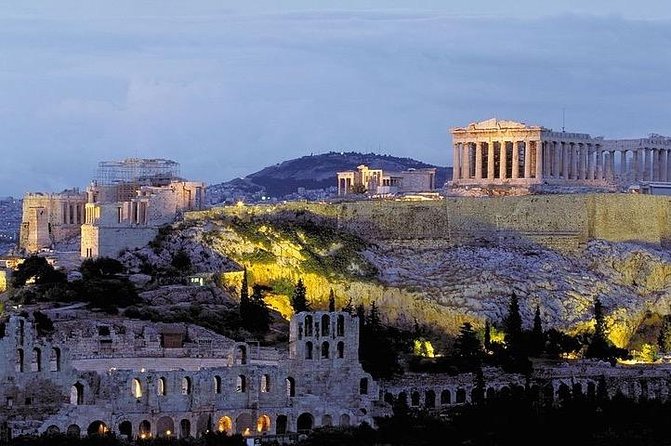
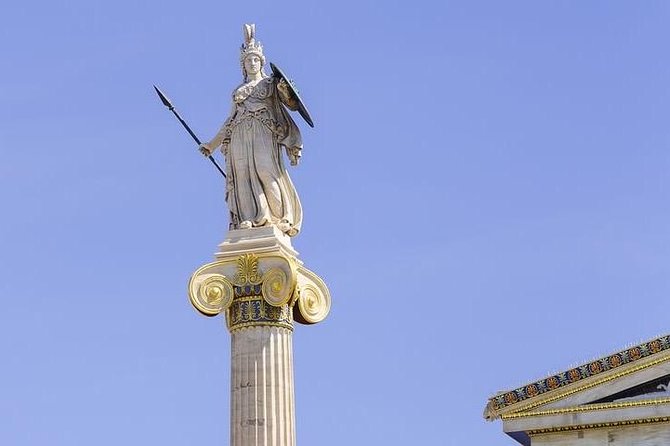
The Acropolis is the main event. The route takes you to the hill crowned by the Parthenon, the fifth-century BC temple built in honor of Athena, the goddess associated with Athens.
You should treat this stop as more than a quick photo break. The Parthenon is the place where Athens’ ancient political and religious identity comes into focus, and it deserves time to look closely at the temple, the setting, and the city below.
The car gets you near the main sight, but the Acropolis itself requires walking. The supplied details do not give an exact amount of time at the monument, so ask how long you will have before finalizing the rest of the route. If you want the Acropolis Museum as well, you will need to protect enough time for it.
There is an important ticket point here. The itinerary labels the Acropolis admission ticket as free, while the included services say entrance tickets are not included. Those statements do not line up neatly. I would ask the operator exactly what is covered, what you must buy, and if the tour price changes when you add the museum.
Passing the Temple of Olympian Zeus and National Gardens
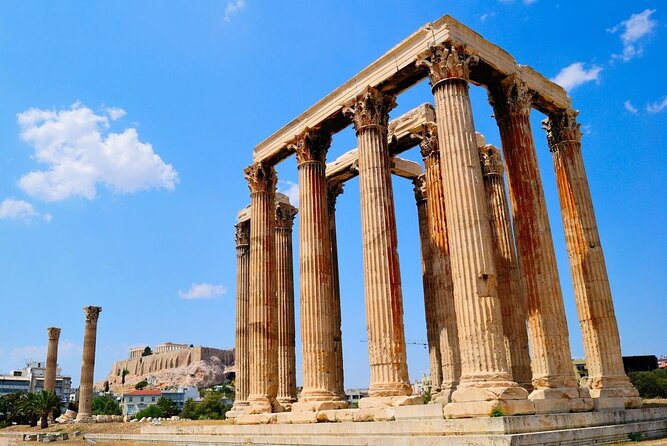
After the Acropolis, the route passes the Temple of Olympian Zeus and the Zappeion building in the National Gardens.
The Temple of Olympian Zeus gives you a sense of scale. Even from a passing view, its surviving columns suggest how grand the sanctuary once was. Since this is listed as a pass-by stop, do not assume you will enter or have time for a full examination.
The Zappeion adds a different note. It is a neoclassical building connected with the first modern Olympic Games, and it sits within the National Gardens. This part of the drive helps connect ancient Athens with the city’s nineteenth-century revival.
I like this section because it keeps the route from becoming a single ancient-site checklist. You see how Athens layers temples, public gardens, ceremonial buildings, and modern streets in a fairly small area.
The Panathenaic Stadium and Athens’ Olympic story

The Panathenaic Stadium, also called Kallimarmaro, is a planned stop. It hosted the first modern Olympic Games in 1896.
The stadium is made of marble, and its shape gives the Olympic story a physical setting rather than leaving it as a date in a guidebook. You can stop for photographs and take in the long sweep of the seating and track.
The listing does not promise admission to the stadium. It describes the stop but also says entrance tickets are excluded, so ask if you will enter or simply view it from outside. That small detail can change how much time the stop takes and how you plan the rest of your visit.
For a short Athens introduction, this is a strong inclusion. It gives you a modern national symbol alongside the ancient Acropolis, and the two sights tell very different parts of the city’s story.
Herod of Atticus Street and the modern state

The vehicle passes Herod of Atticus Street, where you see the old palace that was later donated to the Greek government. Today, the building serves as the political office and residence of the President of the Republic.
This is primarily a driving view, not a palace tour. Its value comes from seeing the formal side of present-day Greece, especially when paired with the next stop at Parliament and Syntagma Square.
I appreciate this kind of context on a city tour. Athens is not only ruins and museums. It is also a working capital, and these government buildings show where national ceremony and daily politics continue.
- All Day Cruise -3 Islands to Agistri,Moni, Aegina with lunch and drinks included
★ 5.0 · 4,958 reviews






Syntagma Square and the Change of Guard
At Syntagma Square, the route includes the Greek Parliament and the Tomb of the Unknown Soldier. You can see the Change of Guard, a ceremonial tribute to soldiers of the nation.
The timing of the guard ceremony is important, but no exact schedule is provided here. Ask the guide how the stop will fit your departure time. If the ceremony is a priority, it should shape the route rather than being treated as a lucky extra.
Syntagma is also a useful orientation point. From here, Athens feels less like an archaeological site and more like a living capital, with public buildings, streets, shops, and transport connections all meeting in one place.
Expect some standing and walking during the stop. The tour is private, so you can ask for a little more time or move on when you have seen enough, within the limits of the overall schedule.
Lycabettus Hill for the big city view
The final major sightseeing stop is Lycabettus Hill. From this high point, you can see across Athens toward Piraeus and the islands in the Saronic Gulf.
This is the place that helps you understand the city’s size. After seeing monuments close up, you get a broad view of Athens spreading toward the water. The view also gives you a useful mental map for the rest of your stay.
The hill is a strong choice for a first visit, though the exact access and viewing time are not specified. If you have mobility concerns or simply prefer not to spend time at a high viewpoint, you can ask to replace it with another option.
I would keep Lycabettus on the route if clear weather is expected. The view depends heavily on conditions, and the cancellation terms note that poor weather can lead to a different date or a full refund.
The custom options: choose carefully
The standard route already fills four hours. The extra choices are appealing, but you should not try to force all of them into one half-day.
Possible additions include:
- Acropolis Museum
- Filopappou Hill
- Theater of Dionysus, also called the Herodion
- Stavros Niarchos Foundation Cultural Centre
- Plaka old city
- Ancient Agora
- Benaki Collection of Museums
- Museum of Cycladic Art
- National Archaeological Museum
The Acropolis Museum pairs naturally with the Parthenon. The Ancient Agora and Plaka also fit the central Athens route well, but each deserves enough time to feel worthwhile.
The National Archaeological Museum is a larger commitment. It is a fine choice if ancient art is your main interest, but adding it to the Acropolis and Lycabettus in four hours would make the day feel rushed.
The museums of the Benaki Collection and Cycladic Art suit a more focused art plan. The Stavros Niarchos Foundation Cultural Centre gives you a different side of Athens, but it may pull the route away from the central sights.
My advice is to choose one main theme:
- First-time Athens: Acropolis, Syntagma, Panathenaic Stadium, Lycabettus.
- Ancient Athens: Acropolis, Acropolis Museum, Theater of Dionysus, Ancient Agora.
- Local streets and food: Acropolis, Plaka, markets, coffee, and a food stop.
- Art and museums: Acropolis plus one museum, not three.
- A broad city introduction: Keep the drive-heavy plan and accept that some stops are views from outside.
The Teo factor and local touches
The most personal part of this experience comes from guide Teo. He has helped visitors find places where locals buy coffee, including fredo espresso, and has offered suggestions for food and shopping.
One especially useful detail is his flexibility in a travel emergency. When a couple missed a ferry and had six hours to fill, Teo picked them up quickly, brought a traditional Greek pie and cold water, stopped for coffee, kept their luggage safely in the car, and finished by helping them get traditional food before returning them to the ferry.
That story does not mean every booking will include the same sequence. It does show the practical value of a private guide when plans change. If you are arriving from a port, have luggage, or need to make a later ferry, tell the operator your exact timing before booking.
The local food and coffee angle also makes the tour more than a transport service. You can ask for recommendations and use the guide’s knowledge of the city to make the short visit feel more connected to everyday Athens.
Price, group size, and what you receive
The price is $297.85 per group of up to four people. That is not a low-cost sightseeing option, but the comparison should be with four individual taxis, separate transfers, and the time lost arranging each move.
For four people, the per-person cost is about $74.46 before any entrance tickets. For two people, it is about $148.93 each. The value improves when you need door-to-door transport, want privacy, or have only a few hours in Athens.
The price includes private transportation in an air-conditioned vehicle, bottled water, coffee or tea, and all fees and taxes. Entrance tickets are not included. Because the Acropolis ticket information is unclear, I would get a written answer about admissions before the tour date.
The group limit of four is a useful size. You avoid a large coach, yet you can still share the cost with family or friends. The tradeoff is that the experience depends heavily on your chosen plan. A short drive-by tour will feel less valuable than a well-planned route with enough time at your priority sights.
Pickup, timing, and practical planning
Pickup and drop-off are arranged according to your preferred location. The meeting information lists Amalia Hotel Athens as a starting point, but it also says you must define where you want to be picked up and dropped off.
That flexibility is useful, but do not leave the details vague. Give the operator the name and address of your hotel, port, or other pickup point, then confirm the return location.
The experience has mobile tickets, and confirmation is received at booking. It is near public transportation, though the point of the private car is to reduce your need to use it during the tour.
Most people can participate, according to the supplied information. Still, the Acropolis, Lycabettus Hill, and city stops involve some walking and standing. If anyone in your group has a limitation, discuss the route in advance and ask which stops can be viewed without extended walking.
The weather policy deserves a quick note. If bad weather cancels the experience, you are offered another date or a full refund. You can cancel for a full refund up to 24 hours before the start time. Cancellations or changes within 24 hours are not refunded or accepted.
Who should book this private Athens route?
I would recommend it most for four kinds of people.
First, it suits a first visit when you want to see the main Athens sights before deciding where to return on foot. The car gives you orientation quickly, and the Acropolis, Parliament, stadium, and hill provide a useful first framework.
Second, it fits people with a tight schedule. A ferry connection, cruise stop, or short layover can make private transport worth the cost, especially if you have luggage or need to return to a specific place.
Third, it works well for families and small groups who want to set their own pace. You can choose the stops and ask for a simpler day rather than following a fixed large-group schedule.
Finally, it suits visitors who want some local help with coffee, food, and shopping, not only monument facts. Teo’s strongest contribution appears to be his willingness to adjust the outing to real needs.
I would be cautious if your main goal is a detailed archaeological tour. You may prefer spending most of your time inside the Acropolis, the Acropolis Museum, or the Ancient Agora rather than using a car to connect many sights.
Should you book Athens Private Day Tour Best Place to Visit?
Book it if you want a flexible private overview and value pickup, air conditioning, and local help more than a long visit at every monument. It is especially practical for a small group, a hot day, or a short gap between transport connections.
Before booking, confirm three things: the exact tour length, the stops you want, and which entrance fees you must pay. If you make those choices in advance, the experience can give you a broad, comfortable introduction to Athens without wasting half the day on transport.
FAQ
How long does the Athens private tour last?
The experience is listed as lasting from one to four hours, with the custom Athens route described as approximately four hours. A customized plan may take four to five hours depending on the selected stops.
How many people can join the private tour?
The price covers one private group of up to four people. Only your group participates in the activity.
Where does pickup take place?
Amalia Hotel Athens is listed as a starting point, but pickup and drop-off locations are defined by you. You must provide the desired pickup and return locations.
Is transportation included?
Yes. Private transportation in an air-conditioned vehicle is included, along with bottled water, coffee or tea, and all fees and taxes.
Are entrance tickets included?
The included services say entrance tickets are not included. The Acropolis section separately labels the admission ticket as free, so confirm the exact ticket arrangements with the provider before your tour.
Can I customize the itinerary?
Yes. You can select from options such as the Acropolis Museum, Filopappou Hill, the Theater of Dionysus, Plaka, the Ancient Agora, several museums, and the Stavros Niarchos Foundation Cultural Centre.
Is the tour suitable for most people?
The supplied information says most people can participate. The route includes the Acropolis, Lycabettus Hill, and sightseeing stops, so ask about walking and standing needs when planning your private route.
What is the cancellation policy?
You receive a full refund if you cancel at least 24 hours before the local start time. Cancellations or changes made within 24 hours are not accepted or refunded. If poor weather causes the operator to cancel, you are offered another date or a full refund.