REVIEW · ATHENS
Kerameikos: Self-Guided Audio Tour on Your Android/iOS Phone
Book on GetYourGuide →Operated by Clio Muse Tours · Bookable on GetYourGuide
Kerameikos gives you a quieter, more personal look at ancient Athens, with city gates, tombs, grave markers, and a small museum spread across an open archaeological site. This self-guided audio tour lets you explore at your own speed rather than follow a guide waving a flag.
I like the offline maps and narration, since you can listen without using mobile data. I also like the freedom to stop at the grave of Hegeso, the Pompeion, or the museum as long as you wish. The main tradeoff is simple: you must bring a charged phone and headphones, and the experience lacks the questions and conversation you get with a live guide.
In This Review
- Key points to know
- Why Kerameikos rewards a slower visit
- Getting to the entrance from central Athens
- The opening view and first sense of the site
- The Sacred Gate and the road beyond Athens
- The Pompeion and the public side of Kerameikos
- Grave markers that bring individual lives into view
- The Lacedaemonians Tombs and other ancient markers
- Tritopatreion and the beliefs behind the stones
- Inside the Archaeological Museum of Kerameikos
- What the $11.28 price really buys you
- How to make the audio tour work well
- Who should book this Kerameikos experience
- Should you book the Kerameikos audio tour?
- FAQ
- Where does the Kerameikos audio tour start?
- How can I reach Kerameikos?
- Is an entry ticket included?
- What languages are available?
- Does the tour work offline?
- What phone do I need?
- Do I need to bring headphones?
- How much storage space does the tour require?
- How long is the audio tour valid?
Key points to know
- Start beside Kerameikos’ entrance and a small hill: Get a broad view of the ancient site before following the route.
- Listen offline: Text, maps, and audio are downloaded to your phone, so roaming charges are not a concern.
- See major monuments: The route includes the Sacred Gate, Pompeion, Lacedaemonians Tombs, and notable grave markers.
- Visit the Archaeological Museum of Kerameikos: Objects found at the site help make sense of the stones and tombs outside.
- Choose entry with the audio tour: The optional ticket provides skip-the-line access, while the audio-only option requires you to buy admission separately.
- Use your own pace: The tour is valid for 365 days from first activation, making it useful for flexible Athens plans.
Why Kerameikos rewards a slower visit
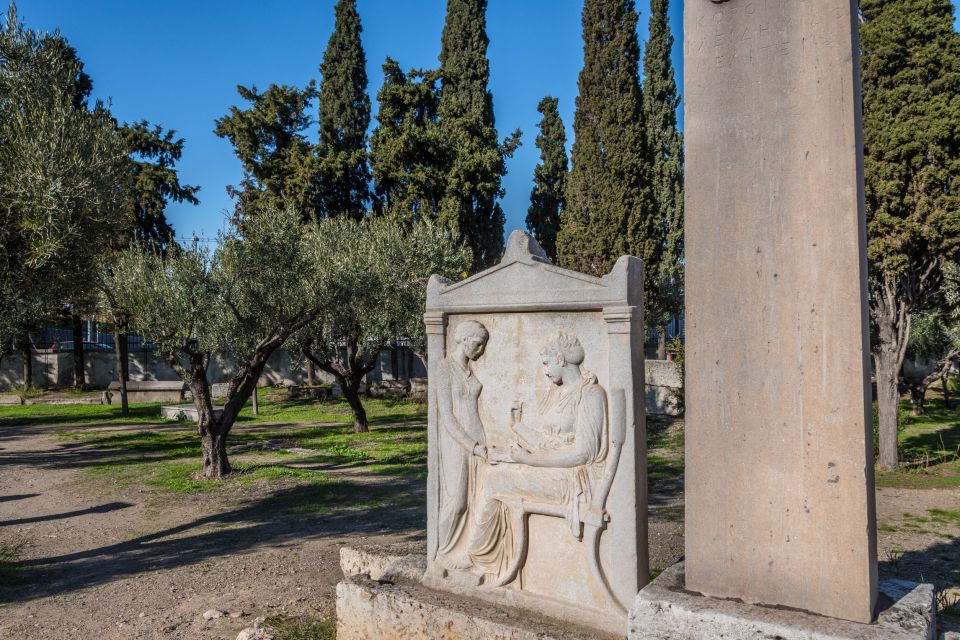
Kerameikos was once one of the most important approaches to ancient Athens. Today, it is an archaeological site where roads, gateways, graves, and foundations share space with modern city streets.
The site is not the sort of place you rush through while checking off one giant monument. Its appeal comes from the way the pieces fit together. You see where people entered and left the city, where public processions passed, and where Athenians honored their dead along the roads outside the walls.
That makes an audio tour a sensible format. You can pause beside a monument, look around, and then continue when you are ready. A clear narration also helps you understand why an apparently modest stone or foundation matters.
The supplied experience has a rating of 4.1 from eight ratings, and its clearest praise focuses on the narration being good and clear. That is important here. Kerameikos depends on explanation, since much of what you see consists of partial walls, foundations, stones, and fragments rather than complete buildings.
You can also read our reviews of more guided tours in Athens



Getting to the entrance from central Athens

The tour begins at the entrance to the Kerameikos archaeological site. You can reach it by train on the green line, getting off at Thiseio, or by metro on the blue line, using Kerameikos station.
You should have your phone, headphones, and activation details ready before you arrive. The confirmation voucher contains the instructions and activation link for downloading the tour.
Allow time to prepare before entering. The content requires roughly 100 to 150 MB of storage, and you need an Android phone running version 5.0 or later, or a supported iPhone. The tour does not work with Windows phones, iPhone 5 or 5C models and older, older iPod Touch devices, iPad 4 or older, or the first-generation iPad Mini.
That compatibility list matters. Do not wait until you are standing at the entrance to discover that your older device will not run the app. Charge your phone fully and download the material before setting out if possible.
The audio is available in English, Greek, German, Italian, French, and Spanish. You do not receive a phone or headphones, so bring both yourself. Large bags and luggage are not allowed, which is another reason to visit with a light day pack or no bag at all.
The opening view and first sense of the site
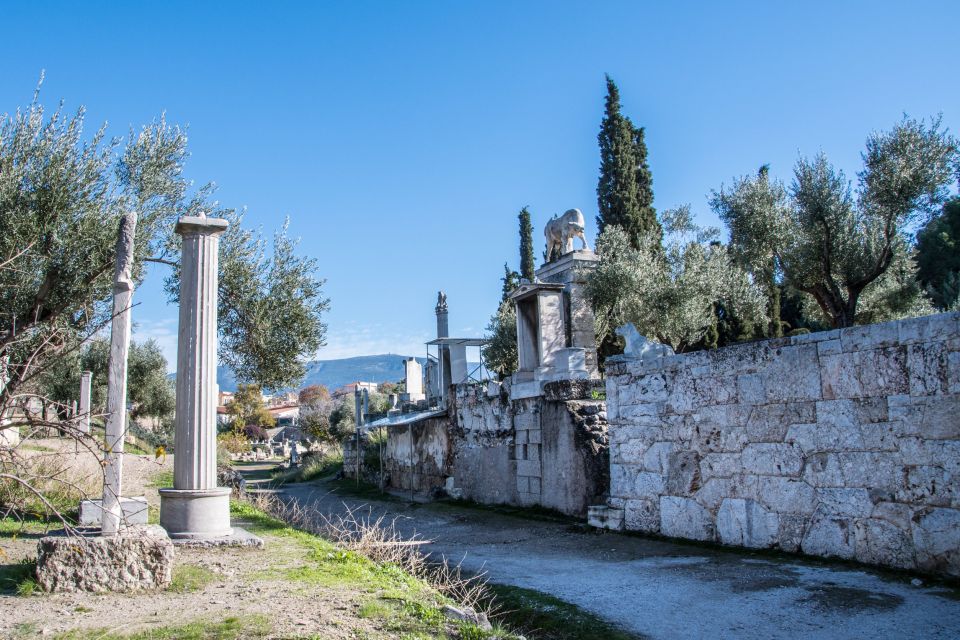
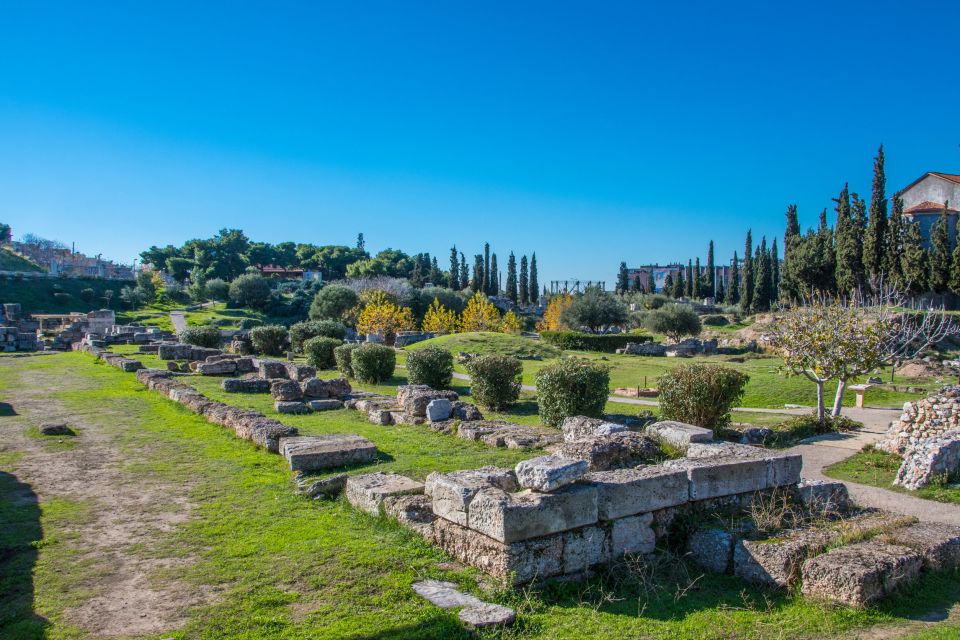
The route starts near the entrance and a small hill that provides a panoramic view of Kerameikos. This is a useful opening stop because it lets you see the site as a whole before you move among the individual monuments.
From above, the remains are easier to read as part of an ancient district rather than a collection of unrelated stones. The audio narration can give you the broad setting first, then guide you toward the specific places that deserve closer attention.
I recommend not rushing this first viewpoint. Use it to get your bearings, check the map on your phone, and adjust your volume. Once you begin walking, you will want enough sound to hear the narration without losing awareness of the ground around you.
The site is wheelchair accessible, though you should still expect an archaeological setting rather than a modern museum floor. Comfortable shoes are a good idea, along with a hat, sunscreen, and comfortable clothing. The supplied information does not provide a route length or a fixed visit time, so your total duration depends on how carefully you stop at each point.
The Sacred Gate and the road beyond Athens
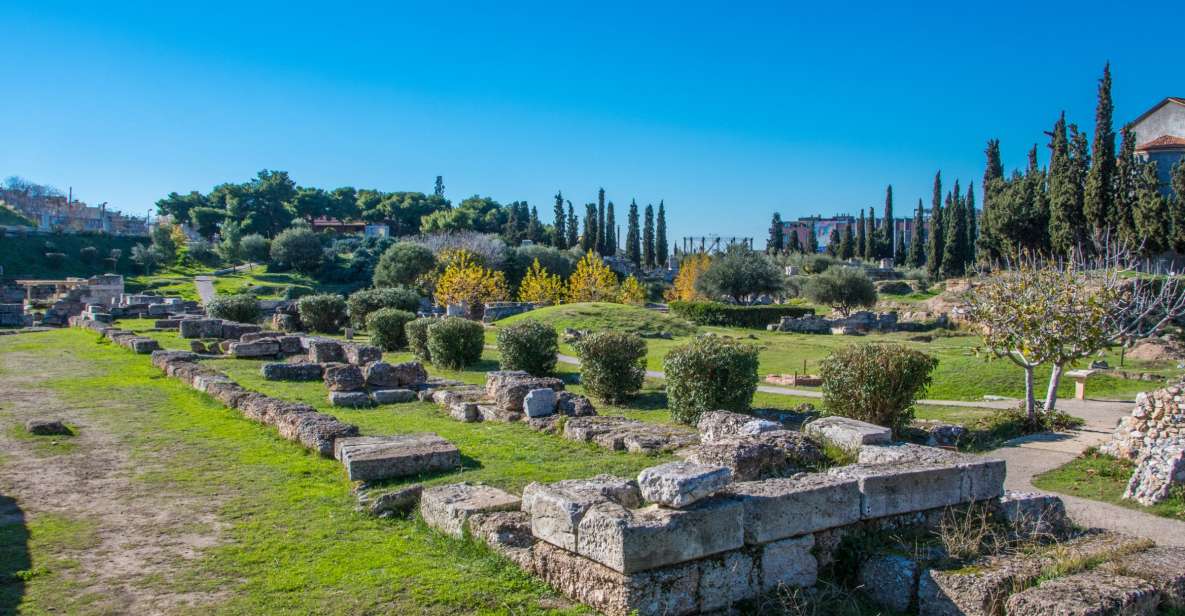
The Sacred Gate is one of the key places on the route. Gates are rarely just openings in a wall. They control movement, mark the edge of a city, and connect public roads with civic and religious life.
Here, the narration helps you picture the movement that once passed through the area. You can listen while looking at the surviving remains and then pause the audio if you want more time with the site itself.
This is one of the places where a self-guided format works well. A live group may need to move on, but you can remain beside the gate for another few minutes. You can also replay a section if the surrounding noise or your own wandering attention causes you to miss a point.
The audio is built around an award-winning storytelling concept, according to the tour information. In practical terms, you should expect more than a list of dates and names. The goal is to connect the places you see with the people, ceremonies, and customs associated with them.
The Pompeion and the public side of Kerameikos
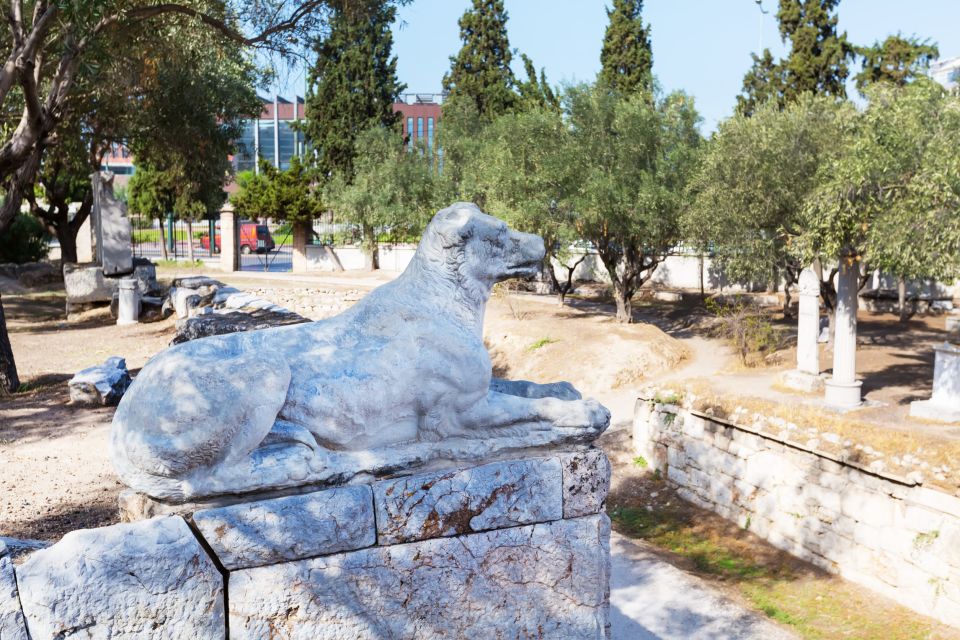
The Pompeion is another central stop. Its remains are tied to the public and ceremonial life of ancient Athens, and its position near the city’s routes helps explain why Kerameikos was more than a burial ground.
This part of the route gives the site a broader civic context. You are not only looking at tombs outside the city walls. You are also seeing an area connected with public movement and major events.
The value of the narration here depends on your willingness to look closely. Pause the track, compare the map with the remains, and take a moment to work out the shape of the foundations. Kerameikos rewards that kind of attention.
The drawback is that audio cannot point with a hand or answer a follow-up question. If you are new to archaeology, some remains may still feel difficult to identify even after listening. The tour can explain what you are seeing, but you must stay engaged with the ground in front of you.
A few more Athens tours and experiences worth a look





Grave markers that bring individual lives into view
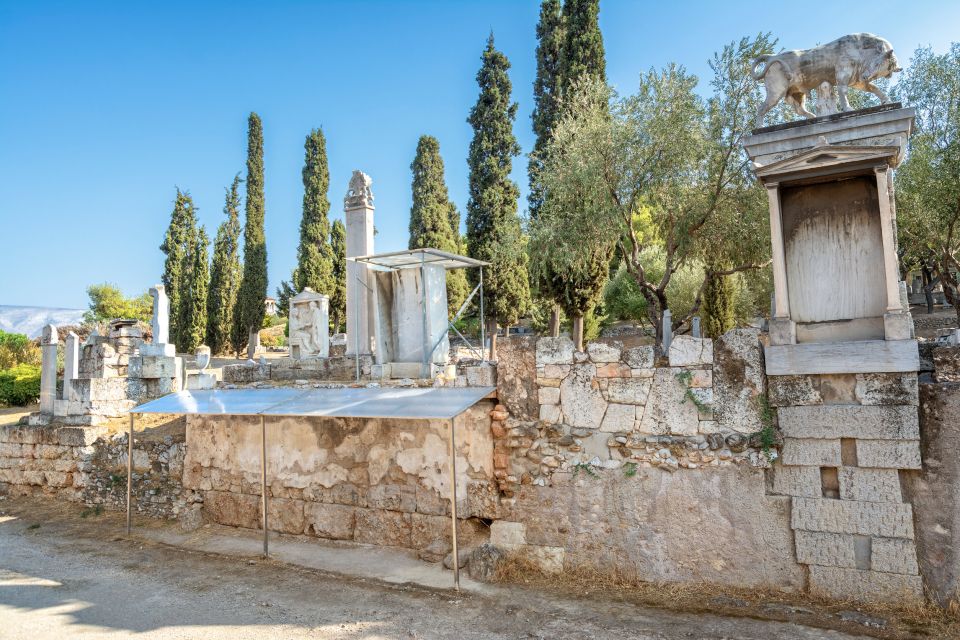
Kerameikos becomes more personal when you reach its grave monuments. The Grave Stele of Dexileos, the tomb of Dionysios, and the Grave Stele of Hegeso are among the named stops.
These monuments help shift your attention from ancient Athens as an abstract city to individual people and families. Grave markers can reveal how the living wanted the dead to be remembered, and the audio gives you the background needed to read them as more than carved stone.
The Stele of Hegeso is especially useful as a stop because it represents the kind of detailed funerary monument that makes the cemetery feel personal. You can study the sculpture at your own pace, then return to the narration if you want to catch a detail you missed.
The grave of Dionysios and the monument of Dexileos add further points of comparison. Listen for the differences in how the dead are presented and how the monuments fit into the wider cemetery setting. The tour is at its best when you use each stop to ask what it says about status, family, memory, and public identity.
Do not expect every monument to appear as a complete, untouched structure. Archaeological sites are often about fragments and surviving traces. The audio helps bridge that gap, but the experience still asks you to use your imagination.
The Lacedaemonians Tombs and other ancient markers

The Lacedaemonians Tombs form another named point on the route. Their inclusion adds a political and military layer to the visit, since the name connects the monuments with Lacedaemonian, or Spartan, identity.
This is the sort of detail that can be easy to miss without guidance. A bare structure rarely explains its own importance. The narration gives you a reason to stop and consider who was commemorated and why the tombs mattered in this location.
You will also encounter grave markers and other remains as you move through the site. Some are visually striking, while others are valuable because of their position within the ancient cemetery. The audio can help you understand how the markers relate to one another instead of treating each stone as an isolated object.
Wear shoes with good support. The tour calls for comfortable footwear, and that is practical advice for any open archaeological site. Bring sun protection as well, since the supplied information specifically recommends a hat and sunscreen.
Tritopatreion and the beliefs behind the stones
The Tritopatreion is one of the more unusual stops. Its name points to a religious setting connected with ancestral or family rites, giving you a glimpse of beliefs that are not always obvious from the surviving foundations.
This is where a well-structured audio guide earns its price. You can see the remains, but the meaning behind them is not self-evident. The narration provides the context that turns a quiet patch of ancient stone into a place connected with ritual and memory.
Take your time here rather than treating it as a quick pass between larger monuments. Kerameikos has several points where the subject shifts from city planning to burial customs to religion. The audio route helps tie those subjects together.
At the same time, you should know what this product is not. It is not a live archaeological lecture, and there is no guide present to adapt the explanation to your interests. If you want a free-flowing discussion, a group tour with a human guide may suit you better.
Inside the Archaeological Museum of Kerameikos
The Archaeological Museum of Kerameikos is an important part of the experience. It displays objects and artifacts found at the site, giving you a chance to see material connected with the tombs and structures outside.
I like the pairing of the museum with the archaeological grounds. Outside, you work out the scale and placement of the ancient cemetery. Inside, objects and artifacts provide a closer look at the people and practices connected with it.
The museum also gives you a break from the open site, especially on a hot day. You can use the audio narration and offline text to connect what you have seen outdoors with the items on display.
The supplied information does not provide a separate museum route or a list of specific objects. You should therefore treat it as an essential supporting stop rather than expect a long, highly specialized museum tour.
If you select the option that includes the entry ticket, admission is handled as part of your booking and skip-the-line access is offered. If you choose the audio tour without an entry ticket, you must buy admission before visiting. Check which option you are selecting, since the lower advertised price may not tell the whole story if you still need to purchase entry separately.
What the $11.28 price really buys you
At $11.28 per person, the audio tour is priced as a modest add-on to an Athens sightseeing day. Its value comes from the guidance and flexibility rather than from a long list of extras.
You are paying for a self-guided audio tour, offline text, narration, and maps. You are not paying for transportation, food, drinks, a live guide, a phone, or headphones. The entry ticket is included only if you choose that version.
For one person with a compatible phone, the price can make sense if you prefer exploring alone or want to avoid joining a fixed group. You can also activate the tour at a time that suits your wider Athens schedule.
Pay attention to the booking instruction: book per device to be used, not per participant. If two people plan to listen on separate phones, the practical question is how many devices need access. The supplied information is clear that the booking unit is the device, so check the purchase details carefully before paying.
The 365-day validity period, counted from first activation, is helpful if your plans change. You do not have to activate it immediately after purchase. Once activated, however, you should treat it as a tool for your visit rather than assume it remains unused indefinitely.
How to make the audio tour work well
Download the content and check that the narration, map, and text are present before you reach the entrance. Offline access is one of the strongest practical features, but it only helps if the material is stored on your phone.
Bring wired or wireless headphones that you know work. Keep your phone charged, and leave enough storage space for the 100 to 150 MB download.
You can listen in English, Greek, German, Italian, French, or Spanish. Select the language that lets you follow details without strain. If you are sharing a phone, remember that you may need to stay close together throughout the route.
Use the map as a companion, not as a substitute for looking around. Stop the narration when you want to examine a monument, then resume when you are ready. The ability to pause and replay is a major advantage over a fixed group explanation.
Plan for sun and walking. A hat, sunscreen, comfortable clothes, and comfortable shoes are specifically recommended. Leave luggage or large bags elsewhere, since they are not allowed at the site.
Free cancellation is available up to 24 hours before the scheduled visit for a full refund. That gives you some useful protection if your Athens plans shift.
Who should book this Kerameikos experience
I would choose this tour if you like to set your own pace, prefer listening in your own language, or want a low-cost way to add context to an archaeological visit. It is also a good fit if you already have a busy Athens schedule and do not want to commit to a fixed group departure.
It suits independent visitors who are comfortable using a phone app and following a map. The clear narration is especially useful at Kerameikos, where the importance of many remains is not immediately obvious.
Families may appreciate the ability to pause and move on when attention fades, though each user needs access to the audio device. Museum fans and archaeology enthusiasts may also like the combination of outdoor monuments and indoor artifacts.
I would hesitate if you dislike phone-based tours, need frequent personal explanations, or do not have a compatible Android or iOS device. The tour also loses much of its convenience if your phone is old, uncharged, short on storage, or paired with poor headphones.
Should you book the Kerameikos audio tour?
Book it if you want clear, flexible guidance at a reasonable price and you are happy to provide your own phone and headphones. The Sacred Gate, Pompeion, named grave monuments, Lacedaemonians Tombs, Tritopatreion, and museum give you enough variety for a thoughtful visit, while offline content keeps the practical side easy.
Choose the ticket-inclusive option if you want skip-the-line access and prefer to handle admission in advance. Choose audio only if you already have another way to buy entry.
This is not a substitute for a live expert who can answer questions. It is a useful companion for an independent visit, especially when you want to linger at Hegeso’s stele, replay a section about the tombs, or take the site at a pace that suits you.
FAQ
Where does the Kerameikos audio tour start?
The tour starts at the entrance of the Kerameikos archaeological site, near a small hill with a panoramic view of the area.
How can I reach Kerameikos?
You can take the green train line to Thiseio station or the blue metro line to Kerameikos station.
Is an entry ticket included?
An entry ticket is included only when you select the ticket-inclusive option. If you choose the audio tour without entry, you must buy an admission ticket before visiting.
What languages are available?
The audio guide is available in English, Greek, German, Italian, French, and Spanish.
Does the tour work offline?
Yes. Offline content includes the written text, audio narration, and maps, so you do not need mobile data while using the tour.
What phone do I need?
You need an Android phone running version 5.0 or later, or a supported iOS smartphone. The tour is not compatible with Windows phones, iPhone 5 or 5C models and older, older iPod Touch devices, iPad 4 models and older, or the first-generation iPad Mini.
Do I need to bring headphones?
Yes. Headphones are not included, so you need to bring your own, along with a charged smartphone.
How much storage space does the tour require?
You need approximately 100 to 150 MB of available storage on your phone.
How long is the audio tour valid?
The tour is valid for 365 days from the time you first activate it.