REVIEW · ATHENS
Private Luxury Tour: Unveiling the Sacred Mysteries of Eleusis
Book on Viator →Operated by Pericles Century · Bookable on Viator
Eleusis feels like a time machine with decent Wi-Fi. This private tour strings together the Sacred Way route, Byzantine Daphni, and the main Eleusinian sites so you see how pilgrimage, myth, and architecture connect. I like the easy communication with an English-speaking driver-guide and the way the driving segments set up what you’ll see next.
Two things I’d call out right away: the ride is comfortable (air-conditioned vehicle chosen for your group size, plus bottled water), and you get lots of meaningful stops without feeling dragged on forever. The main catch to consider is that entrance fees aren’t included (listed as €10 per person), and you won’t have a separate licensed guide walking you through every archaeological interior.
- Private door-to-door pickup (hotel/apartment or port) so you’re not piecing together transit
- Air-conditioned sedan or mini-van sized to your group of 1–7
- Wi‑Fi on board so you can plan ahead or look up context on the road
- Short, focused site stops along the route, not a marathon of rushed walking
- Eleusis highlights grouped logically: Telesterion, Propylaea, Kallichoron Well, and Ploutonion
- Museum time included to turn ruins into readable stories
In This Review
- Private luxury along the Sacred Way route: comfort and time well spent
- Stop 1 and the Iera Odos clue: what survived of a bridge to Eleusis
- Stop 2: walking the Sacred Way remnants in Aigaleo
- Monastery of Daphni: Byzantine mosaics on a pilgrimage route
- Sanctuary of Aphrodite in Skaramagkas: when access depends on the day
- Eleusis bridge in Roman limestone: a practical engineering marvel
- Telesterion and the Great Propylaea: where initiation met architecture
- Kallichoron Well and Ploutonion cave: Demeter’s story gets physical
- Archaeological site + museum of Eleusis: turn the monuments into context
- Price and logistics: what $192.23 per person buys you (and what it doesn’t)
- Should you book? Who this Eleusis Sacred Mysteries tour fits best
- FAQ
- FAQ
- How long is the Eleusis Sacred Mysteries private tour?
- What’s included in the tour price?
- Are museum and archaeological entrance fees included?
- Do I need a licensed guide to go inside the sites?
- Is pickup offered, and where does the tour start?
- Is the tour private?
- What vehicle do small and larger groups use?
- Is Wi‑Fi available during the tour?
- Is the tour dependent on weather?
Private luxury along the Sacred Way route: comfort and time well spent
This is a private Athens-to-Eleusis experience built around comfort and flow. You ride in an air-conditioned vehicle picked for your group size: a luxury sedan for groups of 1–4, or a comfortable mini-van for 5–7. That matters because the sites are spread out, and the route between them is part of the point.
I especially like that pickup and drop-off are handled for you. You can be met outside your hotel or apartment, or greeted at the port with a sign showing your name. If you’re cruising, this kind of setup saves the stress of coordinating taxis with limited time in port.
On board, you also get complimentary Wi‑Fi and bottled water. It sounds small, but it helps on a day like this: you can read quick background notes, check opening days for places with weekend limits, or just keep your phone charged and your brain calm.
One more practical note: the tour time is listed as 4 to 5 hours including travel. That’s a realistic window to cover several meaningful stops without turning it into a full-day grind.
Stop 1 and the Iera Odos clue: what survived of a bridge to Eleusis
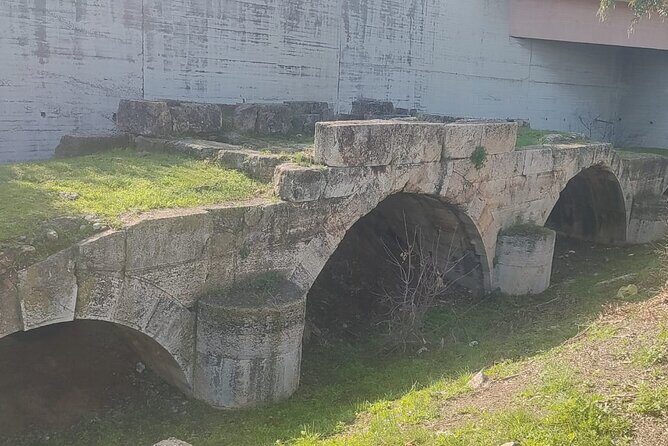
Your first taste of the Eleusinian journey comes near the modern city, where archaeology peeks through construction. At Iera Odos, you’ll see a fragment tied to the ancient Sacred Way—the road that connected Athens to Eleusis.
This specific spot is connected with the Kifisos River crossing, once marked by an arched stone bridge. Excavations during construction of the Eleonas Metro Station uncovered three surviving piers, pointing to a bridge that likely had at least five arches.
What makes this stop worth your time is how it turns the mythic into the physical. Pilgrims didn’t float from A to B on legend alone—they had to cross real rivers, navigate real roads, and keep moving even when the route was long. The guide’s job here is to connect those dots while you’re standing where the route mattered.
It’s a short stop (about 10 minutes), and the admission at this stop is listed as free.
You can also read our reviews of more private tours in Athens


Stop 2: walking the Sacred Way remnants in Aigaleo
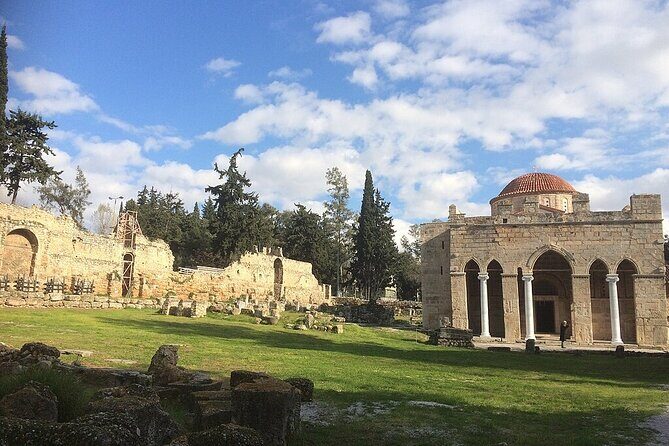
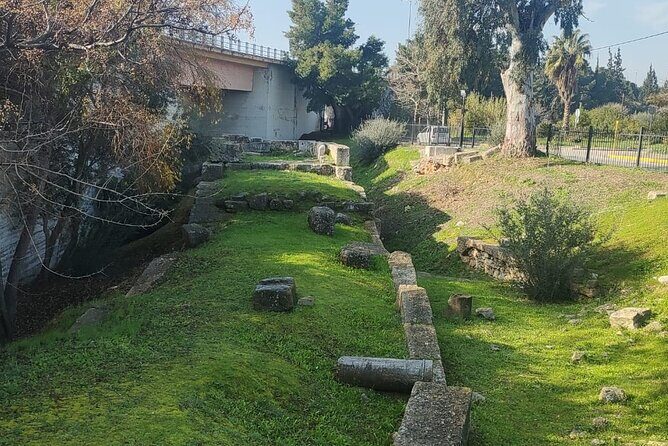
Next comes another section of Iera Odos, now in the Aigaleo area. This is one of those “pay attention” moments, because the Sacred Way isn’t a theme park reconstruction. You’re walking along remnants of a route where pilgrims once carried sacred items and participated in the festival in steps, rhythm, and ritual.
It’s tied directly to the Eleusinian Mysteries—one of the most respected religious festivals of the ancient world. If you like your history with a pulse, this stop gives you that: the road becomes a stage for hymns, devotion, and the story of Demeter and Persephone.
You’ll have only about 10 minutes here, so treat it like a directional walk. Slow down for photos and for the sense of place, then let the driver-guide explain the bigger meaning so you don’t just rush past “a few stones.”
Admission is listed as free, which is always a nice bonus.
Monastery of Daphni: Byzantine mosaics on a pilgrimage route
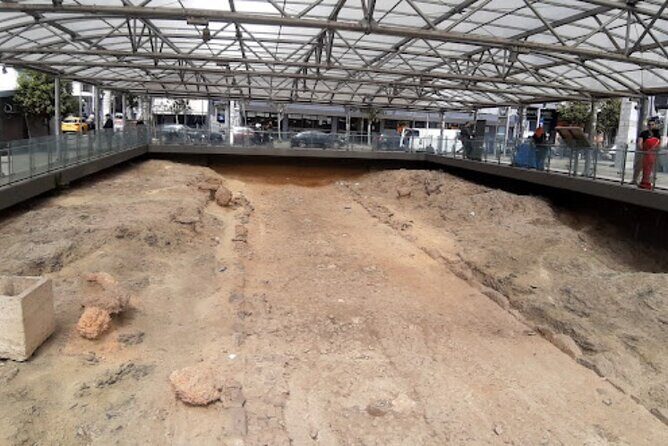
Now the route shifts from ancient pagan ritual space to Byzantine spiritual art, but it’s still tied to the same Sacred Way. The Monastery of Daphni is a UNESCO World Heritage Site built in the 11th century, and the star attraction is its mosaics.
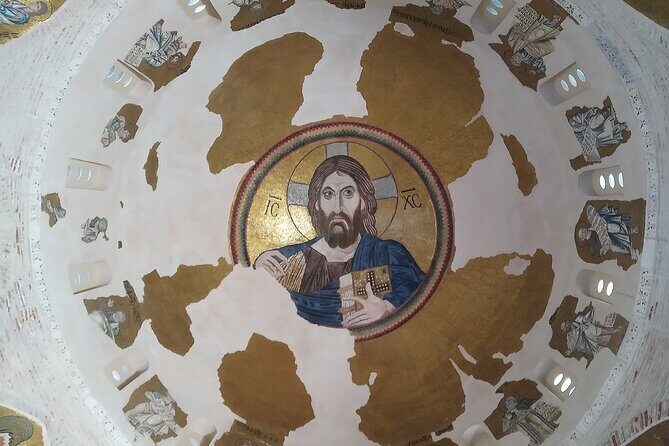
You’re guided to look for the dramatic image of Christ Pantocrator in the dome. That dome scene has a way of changing how you feel in a place like this. One minute you’re thinking about Demeter’s search; the next you’re inside the visual language of Byzantine Christianity, all framed by the monastery setting and cypress trees.
This stop runs about 30 minutes, with admission listed as free. That longer time compared with the road-side Sacred Way stops helps because mosaics need time. You can’t skim and expect the details to land.
Tip for your comfort: wear shoes you can stand in. Even when a stop is “only” half an hour, floor conditions and shaded vs. sunny spots can change how long you can happily hang around.
Sanctuary of Aphrodite in Skaramagkas: when access depends on the day
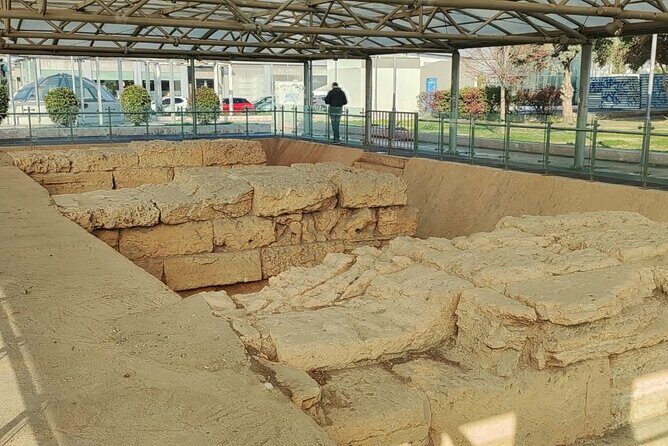
You’ll also make a stop near the Sanctuary of Aphrodite in Skaramagkas, close to the Sacred Way. In ancient times, this was a worship site for Aphrodite—love and beauty—with enough importance to be on pilgrims’ radar as they traveled between Athens and Eleusis.
Today, you see remnants, not a full indoor sanctuary. The key practical difference here is access timing: the sanctuary is open to the public on weekends so you can enter and explore. On weekdays, you’ll typically get only a brief stop to admire from outside.
What this means for your planning is simple: if you care about going inside, check your day of travel. If you’re just there to absorb the setting and photograph the remains, the outside stop still works well—especially if you like quiet corners where the modern world fades out for a few minutes.
This stop is designed for quick context. Think “photo + perspective,” not “full archaeological deep study.”
Eleusis bridge in Roman limestone: a practical engineering marvel
As you move closer to Eleusis itself, you’ll hit another “how did they build this?” moment: a well-preserved ancient Roman bridge just about one kilometer east of the Sanctuary of Demeter.
This bridge is described as built with Piraeus limestone, measuring 50 meters long and 5.30 meters wide. The structure has a central section with four arches—two wider in the middle and two narrower near the ends—with inclined approaches on both sides. It dates to Emperor Hadrian’s reign around 125 AD.
The best way to enjoy this stop is to read it as a link in the Sacred Way chain. This wasn’t decoration. It was transportation infrastructure tied to ritual movement, helping connect the route toward the Eleusinian Kephisos River.
It’s also quick (about 10 minutes), and admission for the stop is listed as free. If you’re the type who gets excited by stonework proportions, you’ll have fun here even without a long walk.
A few more Athens tours and experiences worth a look




Telesterion and the Great Propylaea: where initiation met architecture
Once you’re in Eleusis, the pace shifts into the heart of the story. The tour covers the main spaces connected with initiation rituals for Demeter and Persephone.
First up is the Telesterion, described as the grand hall central to the Eleusinian Mysteries. The Telesterion’s walls and sacred precincts create a strong sense of enclosure, which is exactly what you want to visualize when you’re thinking about what an initiation would feel like—audience, expectation, and controlled space.
Next, you’ll see the Great Propylaea, the monumental entrance built in the 2nd century CE under Emperor Marcus Aurelius. It’s compared in concept to the Acropolis’ Propylaea because it marked a transition from ordinary life into a more sacred realm. The ruins here matter because gateways aren’t neutral. In the ancient world, they told people how to behave once they passed through.
These stops are each timed at about 10 minutes (with the larger archaeological site time scheduled separately). That’s a good approach for most people: enough time to connect the ideas, not so long you feel like you’re on a school trip.
A practical consideration: the archaeological areas involve walking on uneven ground. Comfortable footwear isn’t optional here.
Kallichoron Well and Ploutonion cave: Demeter’s story gets physical
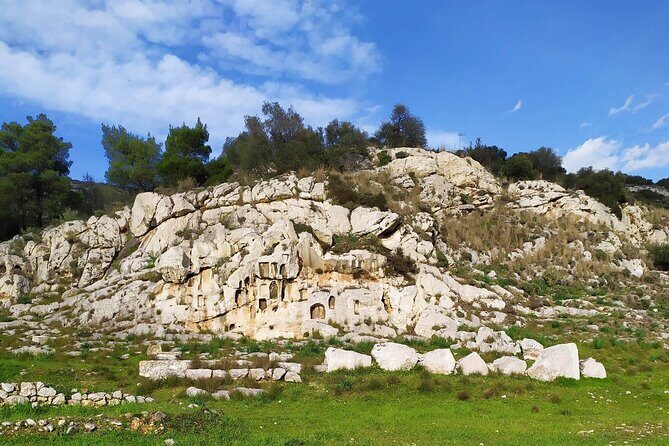
Two of the most myth-forward stops come near the end of the Eleusis sequence.
The Kallichoron Well is tied to Demeter searching for Persephone after her abduction by Hades. The name means well of the beautiful dances, and tradition says local women danced there to comfort Demeter while she grieved. It’s a small stop, timed around 10 minutes, but it’s the kind that helps you connect myth to place.
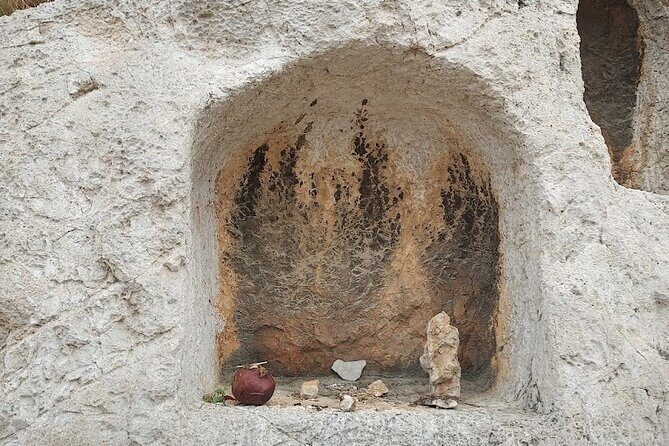
Then there’s the Ploutonion—the cave linked to Hades (Plouton), described as the mythical entrance to the Underworld. Again, this is short on time (about 10 minutes), but it’s unique because caves create a different kind of mood. If you like settings that feel shaped for storytelling, this is the spot.
For both locations, treat them as “imagination anchors.” You won’t leave with a full Roman novel in your head, but you’ll leave with clear mental images tied to real geography.
Archaeological site + museum of Eleusis: turn the monuments into context
The tour doesn’t stop at ruins. You get time for the Archaeological Museum of Eleusis at the Archaeologiko Mousio Elefsinas, timed around 30 minutes.
This museum is where the day starts clicking. Instead of only trying to interpret the meaning of temples and gateways from stone fragments, you see objects and reliefs tied to the Eleusinian Mysteries. Highlights include statues of Demeter and Persephone, sacred offerings, and intricate relief scenes depicting aspects of the cult.
Having museum time after seeing the main sites is a smart order. You’ve already been looking at the spaces where people believed, gathered, and moved through ritual. Now you can connect those spaces to what people actually left behind—art, offerings, and story.
There’s also a dedicated Archaeological Site and Museum segment earlier (about 30 minutes) that focuses on ruins such as gateways and temple remnants in a calmer setting with views toward the Saronic Gulf. Together, the site walk plus museum gives you both scale and detail.
If you’re deciding whether you care about the Eleusinian Mysteries beyond myth and name recognition, this museum portion is where the tour earns its keep.
Price and logistics: what $192.23 per person buys you (and what it doesn’t)
Let’s talk value in plain terms.
The price is $192.23 per person for a private tour around 4 to 5 hours, and it’s typically booked about 55 days in advance. For a private driver-guide experience that includes pickup/drop-off, a private vehicle, air-conditioning, Wi‑Fi, and bottled water, the base cost makes sense. You’re paying to remove friction: no transfers, no route figuring out, and less time wasted in transit.
But there are two costs to plan for.
First: entrance fees are not included. The data lists €10 per person for archaeological sites and museums. That’s a straightforward add-on, but it changes the real total.
Second: the tour does not include a licensed guide inside the archaeological sites. You do have an English-speaking driver-guide with historical knowledge who explains along the way and during stops, but once you’re in the ruins or museum spaces, you should expect to explore with that general guidance rather than a dedicated licensed walkthrough at every interior.
My advice: if you’re the kind of person who wants every inscription explained line by line, you may still enjoy this trip but you’ll feel the limit. If you’re more into big-picture understanding and comfortable movement between sites, this format is a good fit.
Also note that gratuities and tips aren’t included. That’s normal in Greece, but it’s worth keeping in mind so you don’t do math in your head at the end.
Should you book? Who this Eleusis Sacred Mysteries tour fits best
Book this tour if you want a private day that follows the pilgrimage logic from Athens toward Eleusis, with smart stops at Sacred Way segments, Daphni’s mosaics, and the main myth-linked Eleusis structures. It’s ideal for couples, friends, and small families who prefer comfort and clear explanations over long group bus chaos.
It’s also a great pick if you hate the idea of planning your own route, especially with places that have weekend vs. weekday access differences, like the Aphrodite sanctuary.
Skip it or consider an alternative if you’re hoping for a fully guided inside-the-ruins experience led by a licensed archaeologist at every location. Also, if your schedule is tight and you can’t handle a 4–5 hour window with multiple walking areas, you might feel compressed.
One small note on timing: this experience needs good weather. If weather turns, you may be offered a different date or a full refund.
FAQ
FAQ
How long is the Eleusis Sacred Mysteries private tour?
The tour lasts about 4 to 5 hours, and that includes the time spent traveling between stops.
What’s included in the tour price?
It includes private transportation, an air-conditioned vehicle, bottled water, Wi‑Fi on board, and pickup/drop-off at designated locations. It also includes an English-speaking driver-guide with historical knowledge.
Are museum and archaeological entrance fees included?
No. Entrance fees for archaeological sites and museums are listed as €10.00 per person.
Do I need a licensed guide to go inside the sites?
The tour does not include a licensed guide to accompany you into archaeological sites. You’ll have guidance from the driver-guide, but interior walkthroughs with a licensed guide are not included.
Is pickup offered, and where does the tour start?
Traveler pickup is available at designated locations, including hotel/apartment pickups and port pickups. The driver waits outside for hotel/apartment locations and meets port travelers with a name sign.
Is the tour private?
Yes. It’s private, so only your group participates.
What vehicle do small and larger groups use?
Groups of 1–4 are transported in luxurious sedan vehicles. Groups of 5–7 are transported in comfortable mini vans.
Is Wi‑Fi available during the tour?
Yes. There is complimentary Wi‑Fi on board.
Is the tour dependent on weather?
Yes. The experience requires good weather. If it’s canceled due to poor weather, you’ll be offered a different date or a full refund.
—
If you want a practical, comfortable way to trace the Eleusinian story without wrestling Athens logistics, this tour is a solid choice—just budget for the entrance fees and wear shoes for real walking on uneven ancient ground.