REVIEW · ATHENS
Private Tour of Epidaurus, Ancient Corinth & Isthmus Canal From Athens
Book on Viator →Operated by Ancient Greece Tours & Transfers · Bookable on Viator
The theater at Epidaurus is the day’s showstopper, but the route gives you much more: the Corinth Canal, a mountain fortress, Roman Corinth, and the old port of Kenchreai. You get a full Peloponnese sampler without changing hotels or figuring out regional buses.
I like the comfort of a private, air-conditioned car and the freedom to spend more time at the places that catch your eye. I also like the personal pickup at your Athens hotel and the small touches, including bottled water, refreshing wipes, Wi-Fi, and fresh Greek biscuits.
The main drawback is the price, $297.26 per person, before entry fees, food, and any added licensed guide. It makes the most sense for a small group that values door-to-door service and a flexible day, not for someone seeking the cheapest way to see one archaeological site.
In This Review
- Key points to know before booking
- From Athens to the Corinth Canal
- Acrocorinth, the fortress above Ancient Corinth
- Springs, mountains, and the old city of Corinth
- Lunch with a view and the port of Kenchreai
- The theater and sanctuary of Epidaurus
- What the private vehicle adds
- Is $297.26 per person a fair price?
- Who should book this day?
- Practical details that affect the day
- Should you book it?
- FAQ
- How long does the private tour last?
- What sites are included in the route?
- Is hotel pickup included?
- Can I be picked up at the airport or port?
- Are entrance fees included in the price?
- Is a licensed guide included?
- Is food included?
- What is the cancellation policy?
Key points to know before booking
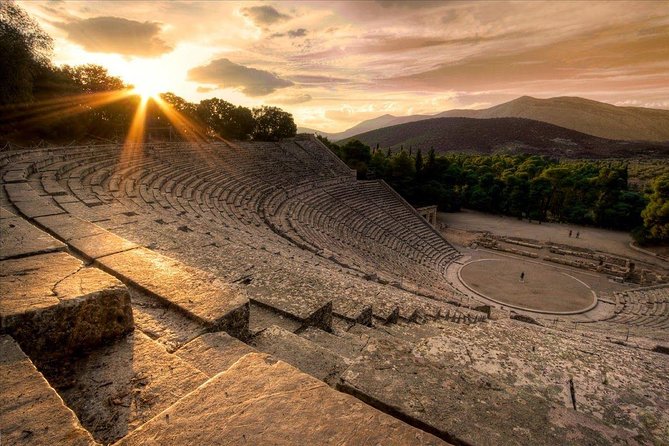
- Epidaurus brings the famous acoustic test: A small sound on the stage can carry to the highest seats.
- Ancient Corinth gets three hours: You have time for the museum, Temple of Apollo, Agora, Bema, theater, Roman remains, and a village-style lunch.
- Acrocorinth adds a dramatic fortress stop: Three circuit walls, towers, churches, mosques, cisterns, and a Frankish keep occupy the rock above Corinth.
- The Corinth Canal connects engineering with ancient transport: You see the 19th-century canal and the ancient Diolkos trackway.
- The ride is part of the service: Hotel or apartment pickup, an air-conditioned private vehicle, Wi-Fi, water, wipes, and handmade biscuits are included.
- Site admission is extra: A licensed guide can also be added if you want full explanations inside the archaeological areas and museums.
From Athens to the Corinth Canal
Your driver picks you up at your Athens hotel, Airbnb, or apartment and brings you back there at the end of the day. For an apartment, the driver contacts you on arrival at the building entrance. Airport and port pickup can be arranged for an extra charge, with the driver meeting you in the arrivals area with a sign bearing your name.
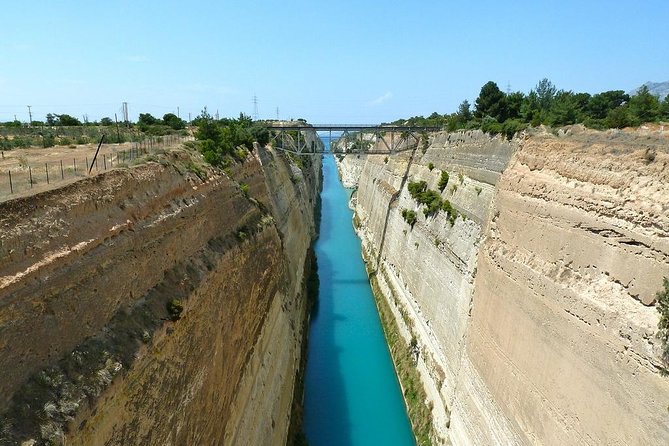
The first major stop is the Isthmus of Corinth, where the narrow canal cuts through the land between the Gulf of Corinth and the Saronic Gulf. The canal is a 19th-century engineering project and helped shape Mediterranean trade by giving ships a shorter route around the Peloponnese.
You have about 45 minutes here, including Ancient Diolkos. The Diolkos was a paved trackway used in ancient Greece to move boats overland across the isthmus. That detail gives the stop more weight than a quick photo break. Long before modern machinery, people were already solving the same transport problem with stone paving, manpower, and planning.
The canal stop is easy to enjoy because it requires no admission ticket. Your driver can give you background during the ride, and the onboard Wi-Fi is useful if you want to look up a place before you arrive. Do not expect a long museum visit here. This is a compact outdoor stop that works best as an introduction to the route.
You can also read our reviews of more private tours in Athens


Acrocorinth, the fortress above Ancient Corinth
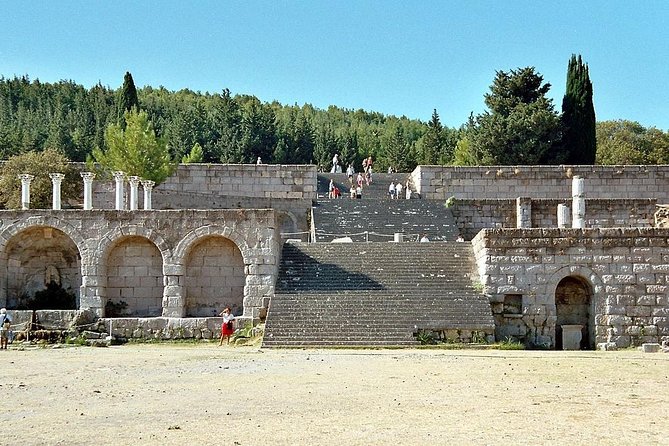
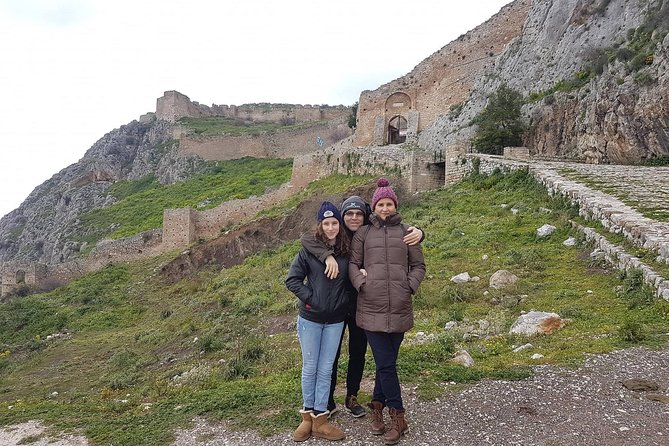
From the canal, the road continues to Acrocorinth, the acropolis of ancient Corinth. The rock rises above the old city and gives the site its commanding character. You are not just visiting one building. You are looking at a fortified summit shaped by several eras of Greek, Roman, Byzantine, Frankish, Ottoman, and other later use.
The tour allows about an hour. The entrance system includes three circuit walls reinforced by towers, leading toward the keep. Within the fortress area are remains of churches, mosques, houses, fountains, and cisterns. The mix is what makes Acrocorinth valuable: the site is not frozen in one period of ancient Greece.
At the highest of the two peaks, you can see traces of the Temple of Aphrodite. At the southwest edge, a Frankish tower forms part of the inner keep. These fragments require some imagination, so a driver with strong historical background can help you understand what you are seeing.
This is also one of the places where a private tour earns its keep. You can ask for context as you go, rather than relying only on signs. Still, remember that the included driver is not a licensed guide accompanying you inside the site. If you want detailed interpretation at the ruins and museum, request a licensed guide for an added fee.
Springs, mountains, and the old city of Corinth
The short stop at the Upper Peirene Fountain lasts about 15 minutes. The spring lies within the fortress walls and is tied to the ancient story of Asopus and Sisyphus. It is a small feature, but it helps you connect the practical needs of the settlement with its myths and monuments.
Another brief pause brings you views of Geraneia Mountain, the Corinthian Gulf, and the southwest coast of the Peloponnese. You have about 15 minutes for this viewpoint. The stop is free and gives you a change of pace between stone ruins and the larger archaeological area.
The heart of the day is Ancient Corinth, where you have roughly three hours. That is enough time to see the main remains without reducing the visit to a hurried walk past columns.
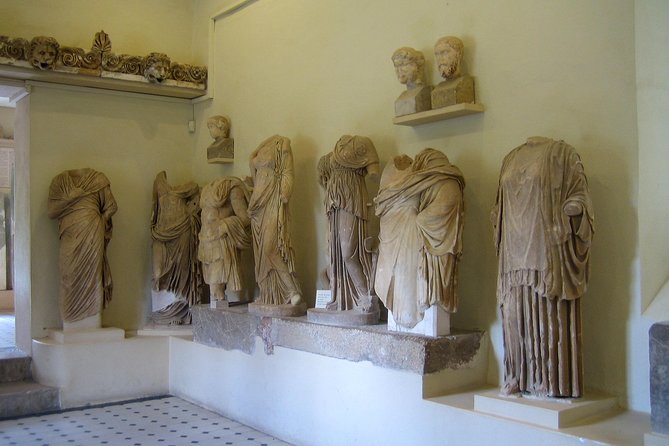
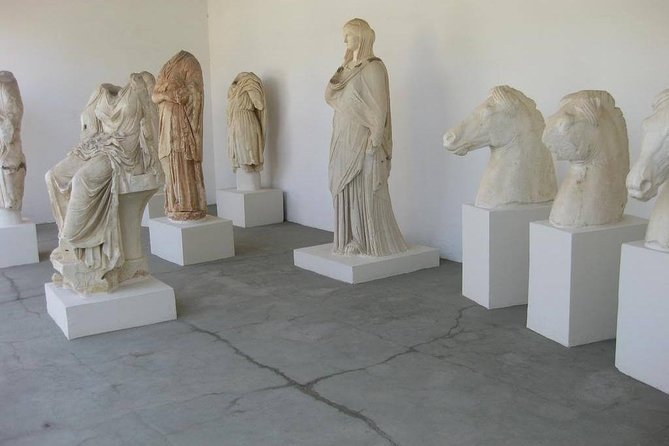
The Ancient Corinth Archaeological Museum holds objects from the local site and nearby smaller sites. The museum matters because the ruins outside are often partial. Objects, inscriptions, and reconstructed pieces help explain how the city functioned and what its buildings may have looked like.
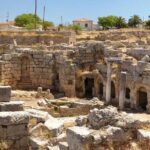
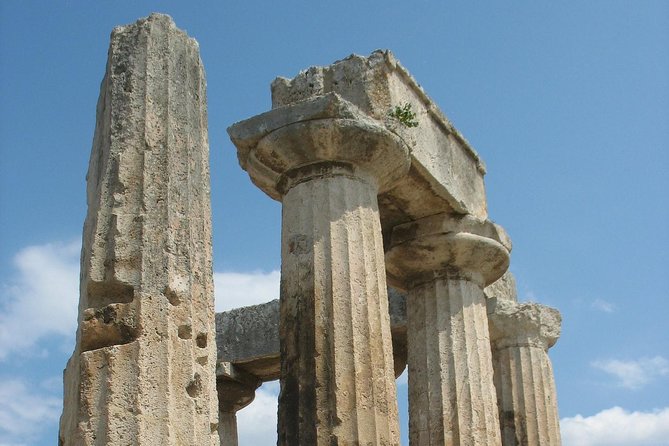
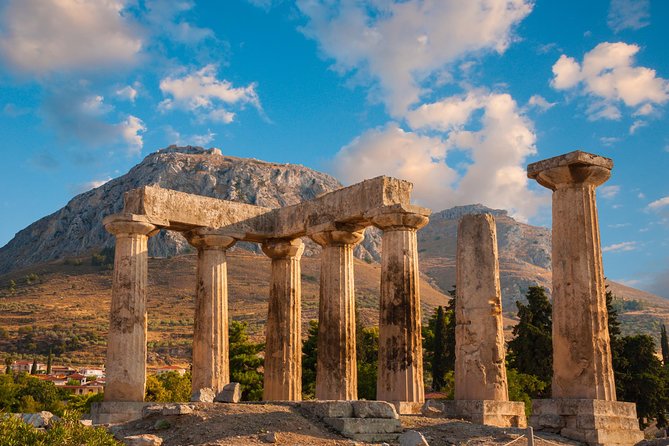
The Temple of Apollo is the visual anchor. Built around 560 BCE, it is one of the earliest Doric temples in the Peloponnese and on the Greek mainland. Its monolithic columns are unusual for the ancient world and give the temple a sturdy, severe look.
From there, the Agora opens out as a large rectangular public space, about 160 meters long and 70 meters wide. Shops, small temples, an altar, and the Bema occupied this area. The Bema, or speaker’s platform, is especially important in Christian history because Apostle Paul addressed the Corinthians here in 52 AD.
You can also see Roman buildings, the theater, the Odeon, and the Asklepieion. The Lechaion Road runs toward the Corinthian Gulf and the port of Lechaion, reminding you that Corinth was not simply a religious center. It was tied to trade, shipping, public life, and regional power.
The Hadgimoustafa spring adds a later layer, since it was built during the Ottoman period. St. Paul’s church contains a mosaic mural showing Saul’s vision of Christ while traveling to Damascus. These later and religious elements widen the visit beyond classical temples.
Lunch with a view and the port of Kenchreai
The schedule includes an authentic village-style lunch on a terrace overlooking the archaeological area and Temple of Apollo. Food and drinks are not included, so plan for that extra cost. The setting is part of the appeal, but you should still ask your driver about timing and menu choices if you have dietary needs or a firm budget.
A mixed grill and Greek salad were singled out as a satisfying choice after the morning’s sightseeing. That is practical advice for a long day: a substantial meal gives you a real break before continuing to Epidaurus. You also have time to stroll through the village shops and look for handmade souvenirs.
The route may also include Kenchreai, or Cenchreae, one of the two ports serving the inland city-state of Corinth. Its connection with Apostle Paul comes from Acts 18:18, which describes Paul stopping there during his second missionary journey and cutting his hair to fulfill a vow.
This is a quieter historical stop than Ancient Corinth. It is best for people who enjoy linking a major archaeological center with the ports and roads that supported it. Since the day already covers several sites, the exact feel of this part will depend on how long you spend at lunch and the earlier ruins.
The theater and sanctuary of Epidaurus
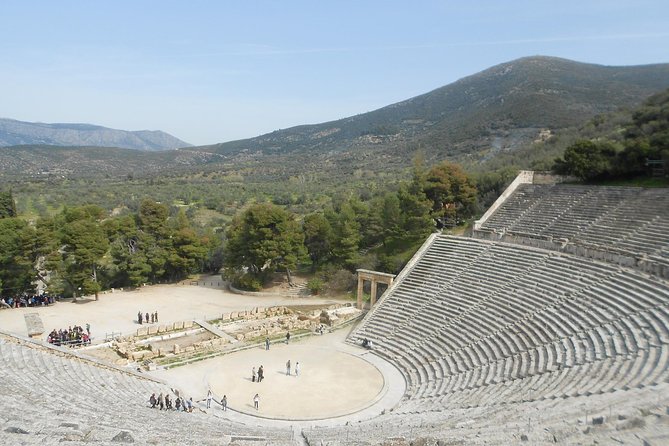
The final major destination is Epidaurus, in the Argolis region of the northeastern Peloponnese. The theater receives about 45 minutes, followed by another 45 minutes for the archaeological museum and sanctuary of Asclepius.
The theater is famous for its classical Greek design and remarkable acoustics. The standard test is simple: drop a small pin or coin on the stage, and the sound can reach the upper seats. The space was built for performances of works by Euripides, Sophocles, Aristophanes, and Aeschylus, so you are standing in a place designed for both public gathering and drama.
Forty-five minutes is enough to take in the theater and test its acoustics, but not enough for a slow, detailed study of every part of the wider site. If Epidaurus is your main reason for booking, tell the driver at the start of the day that you want to protect the scheduled time there.
The Sanctuary of Asclepius was an ancient medical retreat dedicated to the demi-god of medicine. The archaeological museum is noted for reconstructions of temples and columns with inscriptions. Together, the sanctuary and museum show how medicine, worship, architecture, and healing were connected in the ancient Greek world.
Admission fees are not included. The tour offers skip-the-line ticket service on request, but you should confirm the cost and arrangement before departure. The included driver provides transport and historical background, while a licensed guide inside the site and museum is an optional extra.
- All Day Cruise -3 Islands to Agistri,Moni, Aegina with lunch and drinks included
★ 5.0 · 4,958 reviews






What the private vehicle adds
Eight hours is a long day, and the private vehicle makes the schedule far more manageable than public transport. You do not have to coordinate buses between Athens, Corinth, the mountain fortress, and Epidaurus. You can also leave your hotel with only the group you booked.
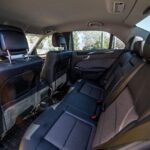
The vehicle is air-conditioned, and Wi-Fi is provided onboard. Bottled water, refreshing wipes, and handmade Greek biscuits are included. These details may sound minor, but they matter on a full day with several outdoor ruins and long stretches on the road.
The strongest practical advantage is the driver’s flexibility. A past booking with Peter described a comfortable car, no rushed stops, useful explanations during the drives, and careful attention to the group’s needs. That is the kind of service to hope for here, though the exact driver is not guaranteed unless confirmed when you book.
The private format also lets you ask questions as the day unfolds. You can connect Corinth’s ports with Paul’s travels, ask about the fortress walls, or get help deciding how to use your time at the museum. Just keep the distinction clear: a professional driver with historical knowledge is included, while a licensed guide entering the archaeological sites with you costs extra.
Is $297.26 per person a fair price?
At $297.26 per person, this is not a budget excursion. The value depends heavily on group size. For one or two people, the cost is substantial. For a small group sharing the private vehicle, hotel pickup, and driver service, the price can be easier to justify.
You are paying for more than transport. The package includes a fully private tour, pickup and drop-off in Athens, a first-class private vehicle, an English-speaking and multilingual driver, Wi-Fi, water, wipes, biscuits, and the ability to set the day’s pace within the planned route. Group discounts may also be available.
You still need to budget for entrance fees, lunch, drinks, tips, and possibly a licensed guide. Airport pickup and drop-off cost extra as well. Add those expenses before comparing this with a shared excursion or a self-guided route.
I would call the value strongest for a family, couple, or group that wants one efficient day covering several major sites. It is weaker for a solo visitor focused only on Epidaurus or Ancient Corinth. In that case, a shorter outing may offer better value, though it would not provide the same range.
Who should book this day?
I would choose this tour if you want to see Corinth and Epidaurus in one day without renting a car. It suits people who like archaeological sites but also want a driver to handle the roads and explain the region along the way.
It is a good fit for first-time visitors to Greece who have limited time in Athens. The route gives you engineering, mythology, classical architecture, Roman urban life, Christian history, Ottoman traces, mountain views, and a traditional meal in one long outing.
Families may appreciate the private setup because only your group participates. Most people can take part, and service animals are allowed. The vehicle, hotel pickup, water, and snacks make the day easier for mixed-age groups, though you should decide in advance how much walking and outdoor sightseeing everyone wants.
I would hesitate to book it if you dislike early starts, long road days, or paying extra at each archaeological site. The schedule is full, and the tour covers a lot of ground. It is designed for breadth, not a slow scholarly visit to one sanctuary.
Practical details that affect the day
Confirmation is provided at booking. Pickup is from your chosen Athens hotel, Airbnb, or apartment, with return service to the same area. Port pickup is available, while airport pickup costs extra.
The tour is offered in English, with multilingual drivers available. If you need a guide inside the sites, ask for the licensed guide option when booking rather than assuming it is part of the standard price.
Free cancellation is available up to 24 hours before the start time for a full refund. Cancellations or changes made less than 24 hours in advance are not accepted for a refund, and the cut-off follows local time.
Should you book it?
Book this private Corinth and Epidaurus tour if you value comfort, range, and personal timing more than the lowest price. The combination of Acrocorinth, Ancient Corinth, the canal, Kenchreai, and Epidaurus gives you a fuller picture of the region than a single-site outing.
Before paying, confirm the total cost of admission fees, lunch, and any licensed guide. If the added costs fit your budget, this is a strong choice for a small group wanting a smooth, history-filled day from Athens. If price matters most, or if you prefer to linger at one place, choose a shorter and simpler plan.
FAQ
How long does the private tour last?
The tour lasts approximately 8 hours, including pickup from and return to your Athens hotel, Airbnb, or apartment.
What sites are included in the route?
The route includes the Corinth Canal, Ancient Diolkos, Acrocorinth, the Upper Peirene Fountain, Geraneia Mountain views, Ancient Corinth, possible Kenchreai, Epidaurus, the Epidaurus Archaeological Museum, and the Sanctuary of Asclepius.
Is hotel pickup included?
Yes. Pickup and drop-off are included for hotels, Airbnbs, and apartments in Athens. The driver meets you in the hotel lobby or contacts you at the entrance of an apartment building.
Can I be picked up at the airport or port?
Port pickup is available, and the driver meets you in the arrivals area with a sign bearing your name. Airport pickup and drop-off are available for an additional cost.
Are entrance fees included in the price?
No. Entrance fees to the sites are not included. Skip-the-line ticket service is available on request, and you should confirm the extra charges when booking.
Is a licensed guide included?
No. The tour includes a professional driver with historical knowledge and English or multilingual service. A licensed guide to accompany you inside the sites and museum can be added for an extra fee.
Is food included?
No. Food and drinks are not included. The route includes time for a village-style lunch on a terrace overlooking Ancient Corinth, with local shops nearby.
What is the cancellation policy?
You can cancel at least 24 hours before the experience start time for a full refund. Cancellations or changes made less than 24 hours before the start time are not accepted for a refund.