REVIEW · ATHENS
St. Paul’s Footsteps: Biblical Ancient Corinth & Daphni Monastery
Book on Viator →Operated by Athens Taxi Travel · Bookable on Viator
Corinth gives this day real weight. You are not simply ticking off Greek ruins: you are following places tied to Saint Paul, from the Roman-era city of Corinth to its port at Kechries, then finishing among the Byzantine mosaics of Daphni Monastery. The biblical connection is the tour’s strongest thread.
I like the private vehicle and flexible pace, especially for a long day with several stops. I also like the mix of big sights and quieter ones, from the dramatic Corinth Canal to the modest harbor ruins at Kechries. The main thing to consider is that your driver is not a licensed guide and will not walk through the archaeological sites with you. You will need to explore Ancient Corinth and the museum independently unless you arrange a licensed guide in advance.
In This Review
- Key points at a glance
- Why this Corinth day trip is different
- Crossing the Corinth Canal
- Walking through Ancient Corinth
- The Temple of Apollo and the city’s oldest stones
- The Archaeological Museum of Corinth
- Climbing to Acrocorinth
- Quiet history at Kechries
- Byzantine art at Daphni Monastery
- What the private vehicle adds
- Is $425.85 good value?
- Who should book this day?
- Should you book it?
- FAQ
- How long does the tour last?
- Where can pickup and return take place?
- How many people can join the private tour?
- Is a licensed tour guide included?
- How much are the entrance fees?
- What is included in the vehicle?
Key points at a glance
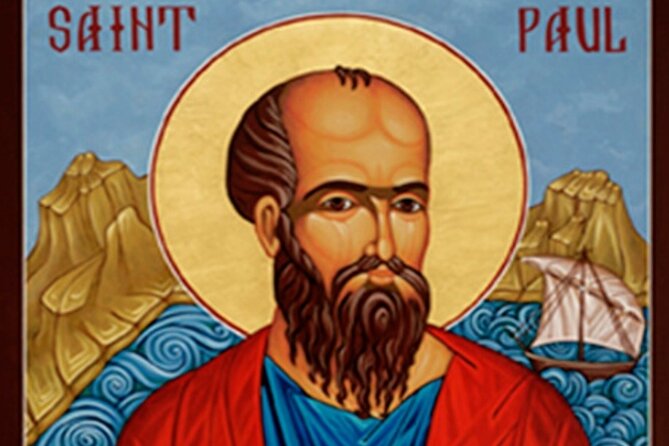
- Saint Paul’s Corinth: Connect Paul’s missionary work with the ancient city, its Bema Seat, and the port of Kechries.
- Private transport for up to four: Start at your Athens hotel, residence, or Piraeus port and travel in an air-conditioned vehicle.
- Seven distinct stops: The day covers the canal, ruins, museum, hilltop fortress, ancient harbor, and Byzantine monastery.
- Driver commentary, not guided touring: Drivers speak English and can explain the places, but they do not enter sites with you.
- €15 entrance cost: Ancient Corinth and the Archaeological Museum require a separate admission fee per person.
- A full eight-hour outing: Wi-Fi, bottled water, and pickup make the long drive easier, but the schedule remains active.
Why this Corinth day trip is different
Many Athens excursions to Corinth focus on the canal and the main ruins. This one adds a strong religious and historical arc. You see the city where Paul worked, the port associated with one of his departures, and Daphni Monastery, where Greek Orthodox art replaces the marble temples and Roman remains of the morning.
That range is useful. Ancient Corinth can feel like a collection of columns if you do not know how the pieces fit together. The visit becomes more meaningful when you connect the Temple of Apollo, the marketplace, the Bema Seat, and the city’s commercial role with the early Christian story.
The private format also changes the day. Your group can travel without waiting for a coach full of people, and pickup is offered from an Athens address or Piraeus port. For a family or small party of up to four, the $425.85 group price works out to about $106.46 per person when full. That is not a budget outing for one person, but it can be fair for a private eight-hour vehicle, especially if you value door-to-door service.
You should budget separately for the €15 per-person admission to Ancient Corinth and its archaeological museum. The other listed stops have no admission charge. A licensed guide is also extra, subject to availability.
You can also read our reviews of more tours and experiences in Athens.



Crossing the Corinth Canal
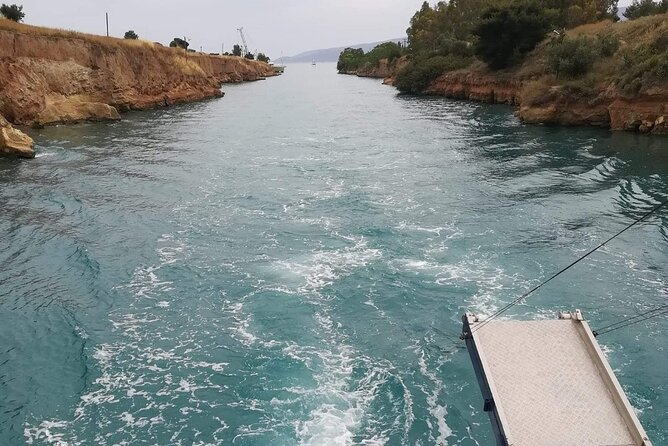
The first stop is the Corinth Canal, about 6.4 kilometers long and cut through the narrow Isthmus of Corinth. It links the Aegean Sea with the Ionian Sea, so this short photo stop introduces the geography that made Corinth important long before the modern canal was completed in the 19th century.
You get about 30 minutes here, with no admission fee. That is enough for photographs and a look at the canal, but not a long visit. The walls are the point. From above, the narrow waterway makes the scale of the engineering clear.
I would treat this as a useful orientation stop rather than the main event. The canal helps you understand why this strip of land mattered so much to Greek and Roman trade. It also gives you a quick change of pace before the archaeological sites.
Walking through Ancient Corinth
Ancient Corinth is the heart of the tour. You have about an hour among the remains of one of Greece’s major city-states, with the Temple of Apollo, ancient public spaces, fountains, sculptures, and the Bema Seat forming the main points of interest.
This is where the private format has both a strength and a limit. A driver can explain the basic story, suggest the best order, and answer questions before you enter. Inside, though, you are on your own unless you add a licensed guide. One detailed account praised driver Spiro for giving clear instructions on how to approach the ruins, including the Bema Seat, Pierene Fountain, Temple of Apollo, and Acrocorinth.
The Bema Seat matters for visitors following Paul’s story. It is associated with the ancient civic setting where Paul was brought before the authorities, giving the biblical connection a physical location rather than leaving it as a distant written account.
Allow yourself time to look beyond the most obvious columns. The remains show how religion, government, trade, and daily life shared one urban setting. The site can be more rewarding if you arrive with a short list of features to find instead of trying to absorb every stone.
The ticket is not included. The listed price for Ancient Corinth and the archaeological museum is €15 per person, payable on site. Since the schedule gives only an hour here before the separate Temple of Apollo stop, ask your driver how the timing will work. The stops overlap geographically, and the exact division may depend on your group’s interests.
The Temple of Apollo and the city’s oldest stones
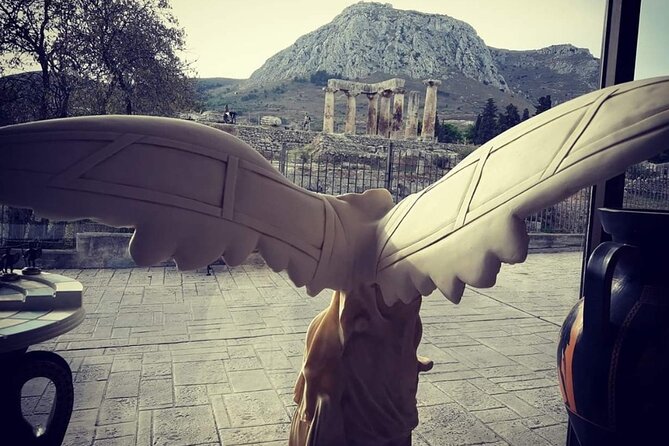
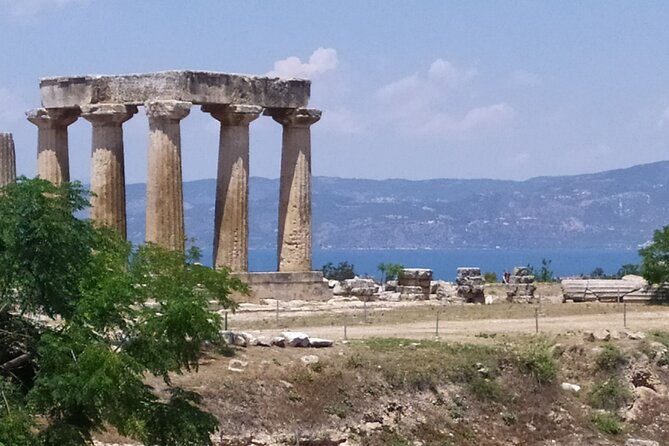
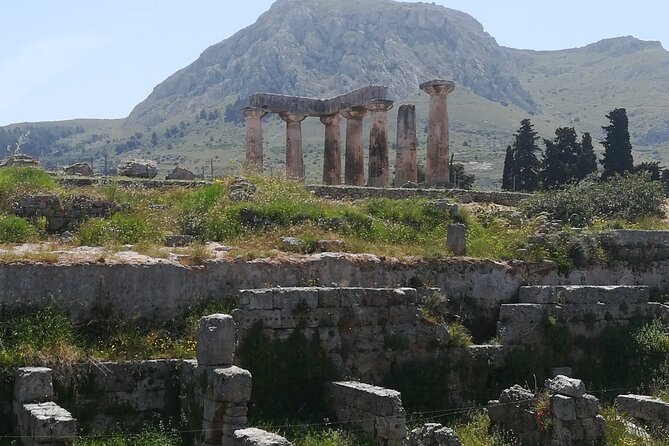
The Temple of Apollo receives a separate 30-minute stop, although it is part of the Ancient Corinth site. Its surviving Doric columns date to the 6th century BC, making it one of the oldest stone temples in Greece.
This is the sort of place where a little patience pays off. The remains are not a complete temple, so you need to use the surviving columns and foundation stones to picture the original structure. The setting also helps you understand Corinth’s importance before the Roman period and before Paul’s arrival.
I like that the tour gives this monument its own time instead of treating it as a quick photograph from a distance. Still, the 30 minutes will pass quickly if you want detailed explanations, photographs, and time inside the wider site. A licensed guide would be most useful here, since the driver does not accompany you into the ruins.
The Archaeological Museum of Corinth
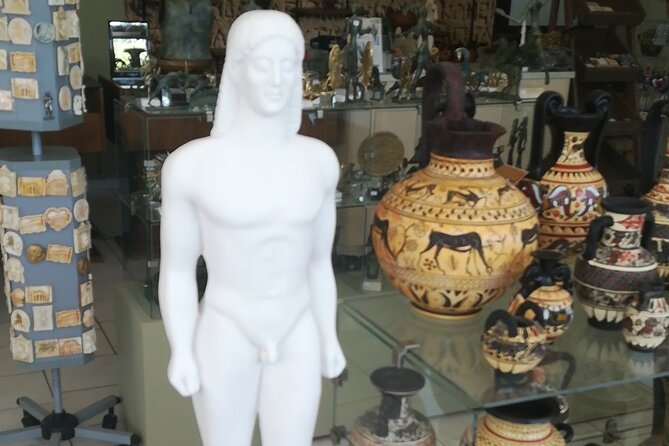
The museum gives you the missing pieces. After seeing columns, foundations, and open courtyards, you can look at pottery, sculpture, Roman mosaics, and ordinary objects that show how people used the city over time.
You have about an hour here. That is a good amount of time for a focused visit, though not enough for a slow study of every display. The museum is especially valuable if you are not familiar with archaeological sites. Objects in cases can explain what the ruins alone cannot: how people worshipped, worked, decorated homes, and moved through the city.
The museum also helps connect Greek, Roman, and early Christian periods. The Christian material is part of the reason this stop belongs on a Saint Paul themed day, but it should not be treated as a museum devoted only to Paul. You will see a broader account of Corinth across several centuries.
Admission is included in the same €15 charge listed for Ancient Corinth. Since the driver stays outside, make sure you understand where and when to meet after your visit. That simple step prevents a rushed exit.
- All Day Cruise -3 Islands to Agistri,Moni, Aegina with lunch and drinks included
★ 5.0 · 4,958 reviews





Climbing to Acrocorinth
Acrocorinth rises above Ancient Corinth and served as a defensive stronghold from ancient Greek times through Byzantine and Ottoman rule. Its walls, gates, remains of temples, and high position make it one of the most memorable parts of the day.
The scheduled visit lasts about an hour. That is enough for a taste of the fortress and its views, but this is not a leisurely full exploration of every section. The site’s scale and uphill setting mean you should be ready for uneven ground and walking. The supplied information does not promise special mobility arrangements, so ask before booking if anyone in your group has difficulty with slopes or rough surfaces.
Acrocorinth is valuable even if military history is not your main interest. From above, you can better grasp how the city controlled movement across the isthmus and why this location remained useful to different rulers. The views also give you a fresh sense of the connection between the city, the canal, and the two seas.
The listed admission is free. Your driver can point out the main route and explain the fortress’s long use, but again, you explore inside without an official guide.
Quiet history at Kechries
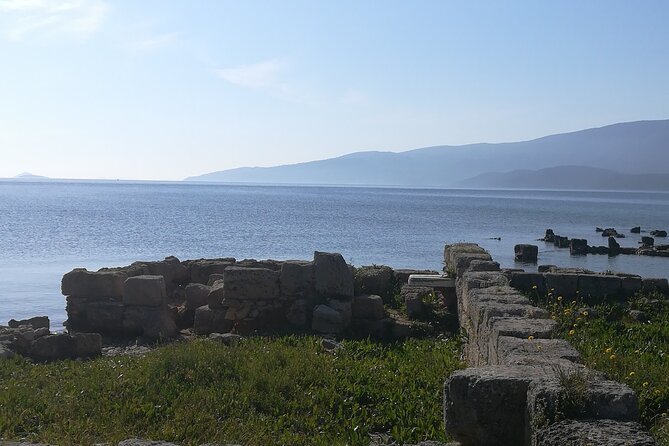
Kechries was Corinth’s eastern port and is linked with Paul’s departure on one of his missionary journeys. Compared with the main ruins and Acrocorinth, it is a modest, quieter stop, with remains of the ancient harbor, docks, and warehouses.
You get about 30 minutes here. That is enough to pause, look across the remains, and consider the practical side of ancient travel. Paul’s journeys were not only walks along roads. Ports such as Kechries connected Corinth with the wider Mediterranean world.
This stop will suit you if the biblical thread matters more than grand architecture. The ruins are less visually dramatic than the Temple of Apollo, and there may be less for you to examine, but the location gives the day a strong closing chapter before the return toward Athens.
One account described this visit as an important addition to the day, particularly because it connected Paul’s story with a real place of departure. I would not skip it simply because it lacks towering monuments.
Byzantine art at Daphni Monastery
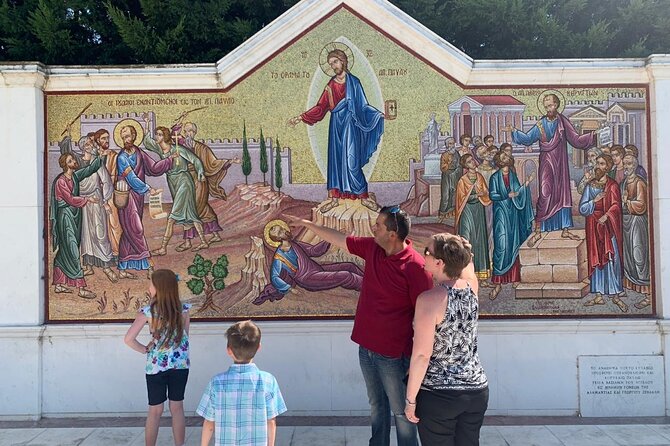
Daphni Monastery changes the mood completely. After ancient temples, civic ruins, and a hilltop fortress, you enter an 11th-century religious site known for its Byzantine mosaics and Greek Orthodox tradition.
The visit lasts about an hour and is listed as free. The main draw is the mosaic work inside the church, where religious scenes are rendered in detailed, formal compositions. This is not a repeat of Ancient Corinth. It gives you a look at a later period of Greek history and a different kind of sacred art.
The monastery is a fine choice for the final stop because it is quieter and more reflective than the open archaeological sites. The contrast helps you see Greece as more than classical marble and mythology. You get ancient Greek religion, Roman Corinth, early Christianity, Byzantine worship, and later military rule in one day.
Conditions at religious sites can change, and the supplied details do not specify dress requirements or opening hours. It is wise to confirm access when booking, especially since the monastery is an important part of the day rather than a minor roadside stop.
What the private vehicle adds
Pickup and return to your Athens hotel, residence, or Piraeus port remove the need to find a bus station or arrange separate transfers. That is particularly useful if you are arriving by cruise ship or staying outside central Athens, though the tour still lasts about eight hours, so allow room in your day.
The vehicle is air-conditioned and includes bottled water and onboard Wi-Fi. Wi-Fi is a practical perk on a long road day. You can stay connected without using roaming data, though I would still save maps and important information offline.
The English-speaking drivers provide commentary and have strong knowledge of the sites, but they are not licensed guides. This distinction matters. You receive transport, local insight, and help with the flow of the day. You do not receive a formal guided explanation inside each monument.
If you want detailed archaeology or biblical interpretation, request a licensed guide when booking. Availability is not guaranteed, and the guide fee is not included. If you are comfortable reading signs, following a suggested route, and asking questions before entering, the driver-only setup may be enough.
Is $425.85 good value?
At $425.85 per group of up to four, the price is easiest to justify when you fill the vehicle. Four people pay about $106.46 each before the €15 admission fee. For two people, the per-person cost rises sharply, but you still receive private transport, pickup and return, air conditioning, Wi-Fi, and a full day beyond Athens.
The value is less convincing if you mainly want one quick Corinth stop. This experience covers a lot of ground and includes seven stops, so you are paying for range and convenience. The day is best for people who want Corinth’s biblical associations, archaeological remains, the fortress, the port, and Byzantine art in one outing.
The main extra cost is clear and manageable: €15 per person for Ancient Corinth and its museum. A licensed guide costs more if available. Ask for the final total before confirming if you want guided visits.
Who should book this day?
I would recommend it for a small family, a group of friends, or a couple with a strong interest in Saint Paul, ancient Greece, or Orthodox art. It also suits cruise passengers who want pickup from Piraeus and a private return rather than a large shared coach.
You should be comfortable with a long day and several archaeological stops. Acrocorinth may involve uneven walking, and the schedule does not leave much room for extended exploration at every site. People who prefer a slow lunch, long museum visits, or plenty of unplanned time may find the pace too full.
The tour is offered in English. Most people can participate, but the information provided does not promise specific accessibility services. Ask about the walking conditions and site access before booking if that is important for your group.
Free cancellation is available if you cancel at least 24 hours before the local start time. Changes or cancellations inside that window are not accepted for a refund.
Should you book it?
Book this tour if you want a private, all-day connection between Corinth’s archaeology and Saint Paul’s story, with Daphni Monastery added for a strong Byzantine finish. The most praised part of the experience is the driver’s personal attention and clear explanations, with Spiro singled out in one account for helping the group make sense of the ruins.
Do not book it expecting a licensed guide to lead you through every site. The driver remains outside, and the €15 entrance fee is extra. For a small group that values flexibility, door-to-door transport, and a broad historical sweep, the price can make sense. For a solo visitor seeking the lowest-cost Corinth trip, a shared excursion may be better value.
FAQ
How long does the tour last?
The tour lasts approximately eight hours.
Where can pickup and return take place?
Pickup and return are offered from your Athens hotel, residence, or Piraeus port.
How many people can join the private tour?
The price covers one private group of up to four people.
Is a licensed tour guide included?
No. The professional drivers provide English commentary and can answer questions, but they are not licensed to accompany you inside the sites. A licensed guide may be requested, subject to availability, for an additional cost.
How much are the entrance fees?
Ancient Corinth and the Archaeological Museum of Corinth require a separate entrance fee of €15 per person, payable on site. The listed stops at the Corinth Canal, Temple of Apollo, Acrocorinth, Kechries, and Daphni Monastery have no admission fee listed.
What is included in the vehicle?
The tour includes bottled water, onboard Wi-Fi, an air-conditioned vehicle, private transportation, and pickup and return from your Athens address or Piraeus port.