REVIEW · ATHENS
Ancient Agora and Acropolis Private Tour with Licensed Expert
Book on Viator →Operated by WARMPENGUIN · Bookable on Viator
The best part of this Athens tour is the contrast between the Acropolis hill, where civic and religious power rose above the city, and the Ancient Agora below, where ordinary public life took place. In about three hours, you move from Parthenon grandeur to workshops, law, trade, and daily business.
I like the private format, which lets you ask questions and adjust the pace. I also like the early-start option, since one past morning tour reached the Acropolis before the heat and crowds grew thick. The main drawback is that admission tickets cost extra, and fitting the Acropolis, Agora, and Acropolis Museum into three hours may feel hurried.
In This Review
- Key points to know before booking
- Why combine the Acropolis and Ancient Agora?
- Meeting at Acropoli Metro Station
- Walking up through the Theater of Dionysus
- The Propylaia and Temple of Athena Nike
- The Parthenon and the heart of the Acropolis
- The Erechtheion and the Acropolis views
- The Odeon of Herodes Atticus
- The Acropolis Museum connection
- The Ancient Agora as Athens’ public square
- The reconstructed marketplace museum
- The Temple of Hephaestus
- What the private format adds
- Price, tickets, and timing
- Who should book this Athens walk?
- Should you book it?
- FAQ
- Where does the tour begin?
- Where does the tour end?
- How long does the private tour last?
- Are admission tickets included?
- Does the tour include the Acropolis Museum?
- Is the tour suitable for people with reduced mobility?
- Is this a group tour?
- Can I cancel for a refund?
Key points to know before booking
- See Athens from two very different angles: The Acropolis explains temples, power, and mythology, while the Agora shows how Athenian public life worked.
- Meet near the Acropolis Museum: Your guide waits at street level outside Acropoli Metro Station, at 7 Makrygianni Street.
- Expect a private walking tour: Only your group takes part, so questions and photo stops are easier than on a large group outing.
- Plan for a substantial walk: The route between the Acropolis and Agora is not suitable for anyone with reduced mobility.
- Budget for entry fees: Archaeological tickets and museum admission are not included in the listed $185.86 per person price.
- Confirm the exact plan: The published schedule describes the Acropolis, Acropolis Museum, and Ancient Agora, but the 3-hour timing is tight.
Why combine the Acropolis and Ancient Agora?
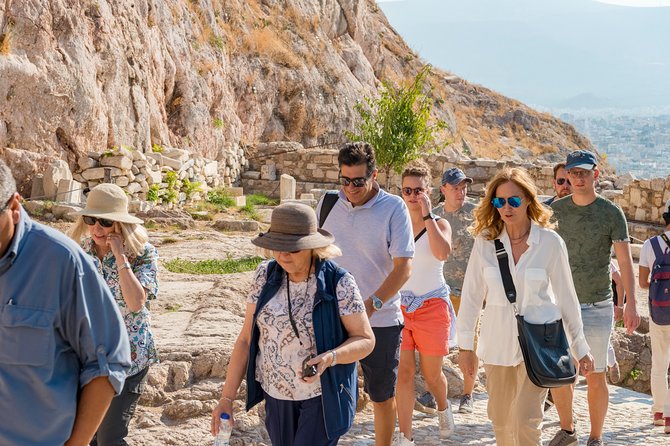
Athens makes more sense when you see its monuments as part of a working city, not as isolated ruins. The Acropolis was the high, sacred center, crowned by temples to Athena. The Agora sat below it as a place for commerce, politics, craft, debate, and religious activity.
I like this pairing because it answers two useful questions. First, how did Athens present itself to the gods and the wider Greek world? Second, how did people actually conduct business, meet, argue, worship, and go about their day?
A private guide can connect those pieces as you walk. Instead of reading a plaque and moving on, you can stop to ask why a temple was built in a certain place, how a theater worked, or what the surviving buildings reveal about Athenian society.
The tour is especially useful if this is your first visit to Athens. The monuments can blur together when you are looking at them under a hot sun, but a clear route and a strong story give the morning shape.
You can also read our reviews of more private tours in Athens


Meeting at Acropoli Metro Station
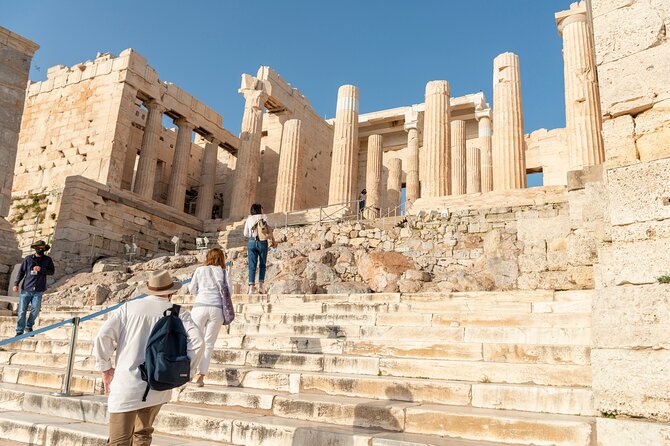
The meeting point is at street level outside Acropoli Metro Station, at 7 Makrygianni Street, close to the Acropolis Museum. This is a practical starting place, with public transportation nearby and an easy connection to the first part of the walk.
Your guide begins with the Acropolis walls and the earlier Mycenaean civilization. That opening matters. It places the Classical monuments in a much longer story, rather than treating the Parthenon as the beginning of Athens.
From this spot, you also get an introduction to the Acropolis as a religious, political, and symbolic center. It is a good moment to orient yourself before climbing toward the monuments, especially if you have arrived in Athens without much background.
I would arrive with comfortable shoes, water, and your entry arrangements settled. The guide can organize skip-the-line tickets after booking for an additional fee, but you need to answer the provider’s messages. If you do not, the assumption is that you have bought the correct tickets and time slots yourself.
Walking up through the Theater of Dionysus
The route commonly begins with the Theater of Dionysus, built into the southern slope of the Acropolis. Its setting makes the connection between landscape and performance easy to see, even before your guide explains the details.
The theater dates from the fourth and fifth centuries BC and could hold about 25,000 people. It is considered the world’s oldest theater, and famous Greek plays first appeared in settings like this one.
This is more than a quick photo stop. The theater helps you picture Athens as a place where drama was part of public and religious life. Tragedy and comedy were not simply private entertainment. They were performed before large audiences and tied to the city’s civic calendar.
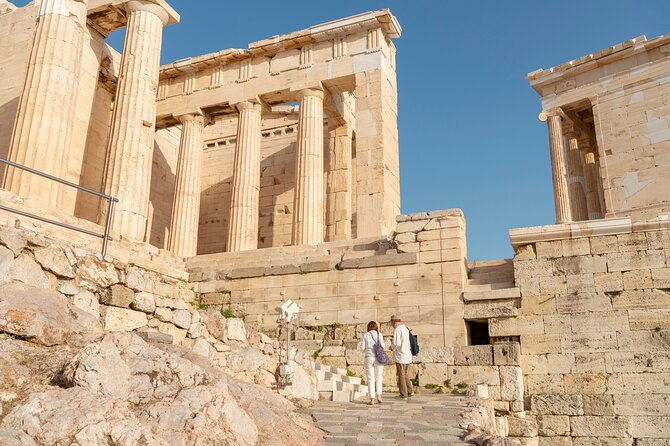
The route then climbs toward the Propylaia, the monumental gateway to the Acropolis. This uphill approach gives the visit a sense of arrival. The buildings do not all appear at once, and the gateway marks the shift from the lower city to the sacred summit.
The climb is one reason I would avoid treating this as a casual stroll. You will cover uneven archaeological ground and some inclines. Most people can participate, according to the tour information, but the route is specifically not suitable for people with reduced mobility.
The Propylaia and Temple of Athena Nike
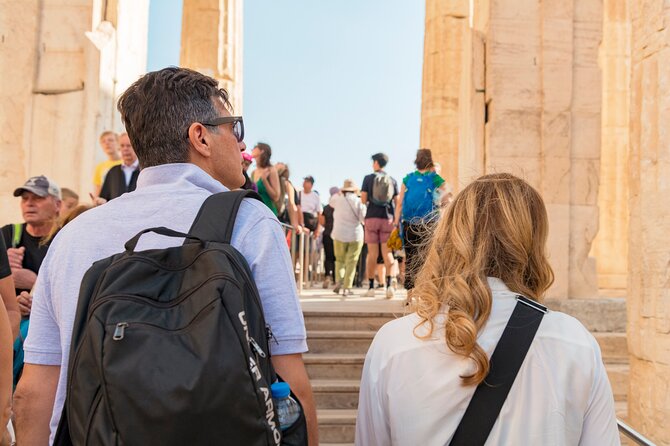
The Propylaia served as the grand entrance to the Acropolis. It was designed to make visitors feel the importance of the place before they reached the temples themselves.
The approach once included a huge bronze statue of Athena. The guide uses this setting to explain the goddess’s role and the visual power of the Acropolis for people arriving by land or sea. The story of the spear tip catching sunlight is a memorable detail, though the surviving site today is mainly about architecture, foundations, and views.
Near the gateway is the Temple of Athena Nike, an Ionic temple dating to about 420 BC. It was dedicated to Athena as a goddess of victory and held a prominent position overlooking Athens.
I like pausing here because the temple is smaller than the Parthenon, yet its location makes it feel important. It also gives you a chance to notice the Ionic style, including its more delicate proportions, before moving to the larger structures.
The Parthenon and the heart of the Acropolis
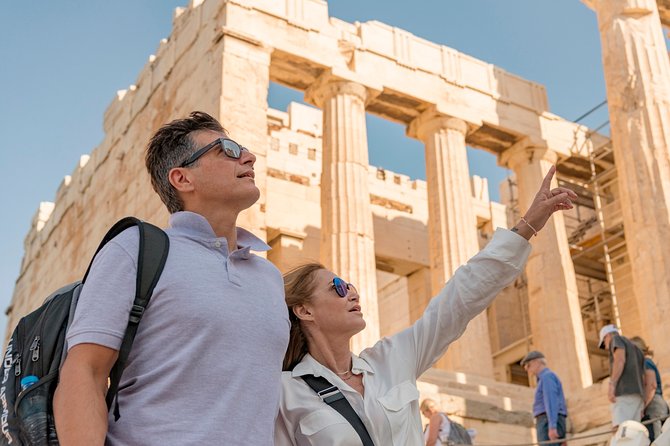
The Parthenon is the tour’s central moment. Built during the fifth century BC, it was dedicated to Athena and became the clearest expression of Athens during its Golden Age.
A good guide should help you look beyond the familiar front view. You can expect an explanation of the building’s construction, religious purpose, mythology, and place in Athenian history. The tour description also emphasizes its artistic and engineering achievements, which is useful because the Parthenon is not only a beautiful ruin. It was an ambitious statement about the city’s wealth, power, and devotion.
Your guide may also help you separate the Parthenon from the other buildings around it. First-time visitors often remember only the main temple, but the Acropolis is a larger complex with multiple monuments and changing functions.
The site is exposed, and the experience depends heavily on timing. One past morning group began early to avoid the worst heat and crowds. An early appointment is a sensible choice if offered, while a later option after lunch may bring warmer golden light and honey-colored tones across the marble.
- All Day Cruise -3 Islands to Agistri,Moni, Aegina with lunch and drinks included
★ 5.0 · 4,958 reviews






The Erechtheion and the Acropolis views
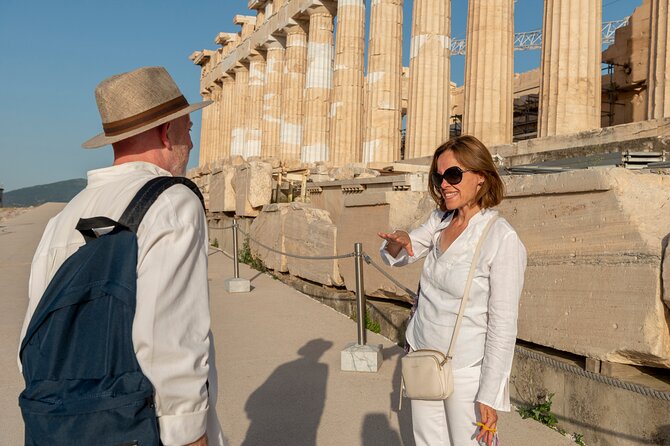
The Erechtheion is one of the most distinctive buildings on the Acropolis. It was dedicated to more than one divine figure, including Athena, and its design reflects the layered myths attached to the hill.
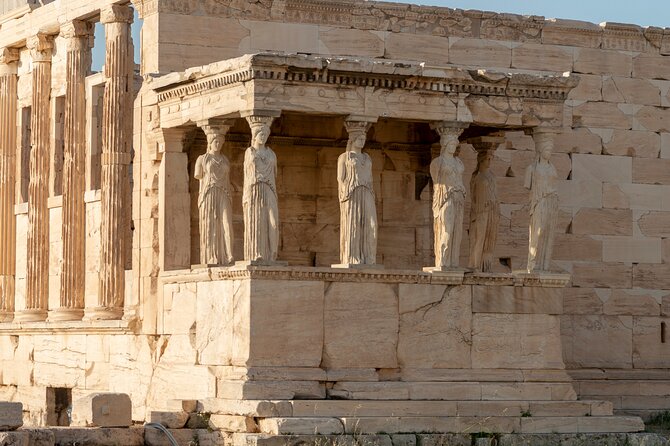
The caryatid statues are its best-known feature. The originals are now protected in the Acropolis Museum, while copies remain at the monument. That is one reason the museum portion can add real value, provided the schedule allows enough time.
The guide explains the myths and the building’s unusual arrangement rather than reducing it to a quick photograph. This is where a private format helps. You can ask about the statues, the competing sacred traditions, and why the building looks less regular than the Parthenon.
The Acropolis also gives you broad views across Athens. The tour uses these views as part of the historical explanation, not just as a backdrop. You see why the hill was such a powerful symbol and how the ancient city spread below it.
The Odeon of Herodes Atticus
On the southern slope, the Odeon of Herodes Atticus is a reminder that ancient Athens was also a city of music and performance. Built in AD 161 by Herodes Atticus in memory of his wife, the marble theater remains an active performance venue.
Its preservation makes it one of the easier ancient structures to picture as a functioning building. The steep seating, curved shape, and stage area show how a large audience could gather for performances.
You usually view the Odeon from outside rather than enter it as a separate attraction. Even so, it adds another layer to the Acropolis visit and helps you see that the hill was surrounded by civic and cultural buildings, not only temples.
The Acropolis Museum connection
The tour information includes roughly 80 minutes at the New Acropolis Museum, a short distance from the archaeological site. The museum houses original sculptures and other works, along with models, videos, and interactive installations.
This is where you see details that cannot remain on the exposed hill. The caryatids are a major example, and the museum’s displays can make the damaged or incomplete buildings outside easier to understand.
I like the idea of combining the museum with the Acropolis, but you should confirm exactly how it fits your booking. The overall experience is advertised as about three hours, with roughly 80 minutes at the Acropolis and 80 minutes at the Agora, while the museum is also described as an 80-minute stop. Those timings do not leave much room for walking between sites or for all three stops at a relaxed pace.
The selected option may affect what is included. Ask before paying if the Acropolis Museum is part of your exact schedule, and confirm which admission tickets you need. Museum and archaeological-site costs are not included.
The Ancient Agora as Athens’ public square
After the Acropolis, the walk continues to the Ancient Agora at the base of the hill. The distance between the two sites is part of the experience, but it also adds physical effort and time.
The Agora was the marketplace and public center of ancient Athens. Local workshops, temples, and important monuments occupied the area. This is where the tour shifts from grand religious architecture to the practical business of city life.
I find the Agora valuable because it gives you a more human-scale view of Athens. You can picture traders working, craftspeople producing goods, and citizens gathering in a shared public space.
The site also shows how much of ancient life depended on places that were not designed only for ceremony. The Acropolis tells you what Athens wanted to honor. The Agora helps explain how the city functioned day by day.
The reconstructed marketplace museum
One of the Agora stops is a recreation of an ancient commercial center. It offers a clearer picture of how traders might have worked and provides a window into ordinary activity around the marketplace.
The site museum holds artifacts found in the Agora. That makes it a useful companion to the outdoor ruins, since small objects can explain more about work, trade, and domestic life than a line of broken columns can.
The indoor portion also gives you a break from the sun. Still, the time is limited, so I would ask your guide to point out the pieces most relevant to the buildings and activities you have just seen.
The Temple of Hephaestus
The Temple of Hephaestus is described as the most complete surviving temple of Greek antiquity. It is one of the strongest reasons to include the Agora instead of spending all your time only on the Acropolis.
The temple’s better preservation helps you understand what an ancient Greek temple looked like as a complete structure. The Parthenon is more famous, but its damage and long history can make its original form harder to picture.
Your guide can use the Temple of Hephaestus to compare temple design, religious practice, and the different roles of the Acropolis and Agora. That comparison is one of the tour’s clearest educational benefits.
What the private format adds
The private arrangement means only your own group participates. You are not locked into the pace of a large party, and you can ask questions when something catches your attention.
Past guide names include Mandio, Manto, Shorty, and Vicky. The exact guide is not guaranteed, but the personal accounts connected with this tour repeatedly emphasize guides who kept the experience lively, answered unusual questions, and adjusted the explanation for adults and children.
That matters most at a site as familiar as the Acropolis. You can find basic facts in an audio guide, but a live guide can respond to what you are looking at right now. One family found the children stayed engaged, while another couple appreciated having time for photographs.
The communication system is included for groups of six or more. Since the tour is private, this is useful if your party is large enough that it would otherwise be difficult to hear on the open hill.
Price, tickets, and timing
The listed cost is $185.86 per person. That is a serious price for a three-hour walk, especially because entrance tickets are not included.
I see the value in the cost if you are a small group that wants a personal guide and a focused introduction to Athens’ two major ancient sites. A private tour can also save you from spending hours trying to sort out the monuments on your own.
The value is weaker if you already know Classical Greek history, prefer a slow independent visit, or want to spend a long time inside the museum. You are paying mainly for the guide’s time, route planning, and ability to explain the sites, not for admission.
Tickets may sell out days or weeks ahead and must be tied to a date and time. You can ask the provider to arrange skip-the-line tickets after booking for an additional cost, or buy the required tickets yourself. Either way, check the exact entry rules before arrival.
Free cancellation is available up to 24 hours before the start time. A cancellation inside that window is not refunded, and changes are not accepted.
Who should book this Athens walk?
I would choose this tour for a first visit, a family that wants history made understandable, or a couple that prefers a private guide over a large group. It also suits anyone with only one morning or afternoon in central Athens and a strong wish to see both the Acropolis and Agora.
The route is less suitable if you have limited mobility, dislike walking over archaeological surfaces, or want a leisurely museum visit. It may also be too compressed for visitors who want to linger at every temple and take extensive photographs.
For the best chance of a comfortable visit, request an early start if available. If you choose the Acropolis-only option, the provider suggests an after-lunch time for fewer crowds and softer golden light. A separate 1.5-hour Acropolis and Agora option is also available, with the guide meeting at the Ancient Agora entrance, so read the selected option carefully.
Should you book it?
Book this tour if you want the Acropolis explained by a licensed guide and you like the idea of adding the Ancient Agora in the same outing. The combination gives you both Athens’ grand public image and its everyday ancient life.
I would book with two conditions: confirm the exact stops in your chosen option, and budget separately for every required ticket. If those details are clear, the private format, flexible questions, strong guide personalities, and efficient route make the $185.86 price easier to justify.
FAQ
Where does the tour begin?
You meet your guide at street level outside Acropoli Metro Station, at 7 Makrygianni Street in Athens, near the Acropolis Museum.
Where does the tour end?
The activity ends back at the meeting point. You may also choose to remain in the area and continue exploring Athens.
How long does the private tour last?
The main private tour lasts approximately three hours. The schedule is roughly divided between the Acropolis and Ancient Agora, with each receiving about 80 minutes.
Are admission tickets included?
No. Archaeological-site entrance tickets and their cost are not included. Skip-the-line tickets can be arranged after booking for an additional charge, or you can purchase the required tickets yourself.
Does the tour include the Acropolis Museum?
The published tour plan describes an approximately 80-minute visit to the New Acropolis Museum, but the exact stops can depend on the option selected. Confirm this before booking, since the main tour also includes the Acropolis and Ancient Agora.
Is the tour suitable for people with reduced mobility?
No. There is walking between the Acropolis and Ancient Agora, and the activity is not suitable for people with reduced mobility.
Is this a group tour?
No. It is a private activity, so only your own group participates. A whisper communication system is included for groups of six or more.
Can I cancel for a refund?
Yes, if you cancel at least 24 hours before the experience start time. Cancellations or changes made less than 24 hours before the start are not accepted for a refund.