REVIEW · ATHENS
Ancient Olympia Full-Day Private Tour from Athens
Book on Viator →Operated by LS Tours · Bookable on Viator
Ancient Olympia is a long way from Athens, but that distance is exactly what makes this private day trip useful. In one very full day, you see the Corinth Canal, walk through the birthplace of the Olympic Games, visit its museums, and return to Athens without changing hotels.
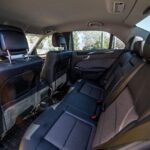
I like the comfort of a private, air-conditioned car with WiFi and bottled water, and I like the freedom to pause along the way. Drivers such as George have added local stories, handled hot-weather days thoughtfully, and adjusted stops when time allowed. The catch is the long 12-hour schedule and the fact that your driver does not enter the archaeological site as an official guide.
In This Review
- Key points to know before booking
- Why Ancient Olympia is worth the long ride
- Athens pickup and the road west
- Corinth Canal from the high viewpoint
- Walking through the sanctuary of Olympia
- The Temple of Zeus
- The Stadium at Olympia
- The Temple of Hera and the Olympic flame
- Nymphaeum, palaestra, and Philippeion
- Olympia’s two museums and the Archimedes collection
- Lunch and free time in Ancient Olympia
- The three-and-a-half-hour return to Athens
- Is $330.44 per person good value?
- Who should book this Olympia day trip?
- FAQ
- How long is the Ancient Olympia private tour from Athens?
- Is hotel pickup included?
- Is transportation private?
- Does the vehicle have WiFi and bottled water?
- Is the driver an official tour guide?
- Are entry tickets included?
- Is lunch included?
- What should I bring?
- Should you book it?
Key points to know before booking
- The drive takes roughly seven hours round trip: About one hour from Athens to Corinth Canal, 2.5 hours to Olympia, and 3.5 hours back to Athens.
- Corinth Canal makes a worthwhile first stop: From above, you can see the narrow waterway, steep limestone walls, and boats moving below.
- Olympia needs several hours: The site includes Zeus’s Temple, the stadium, Hera’s Temple, the palaestra, Philippeion, Nymphaeum, and more.
- Your driver is not a licensed guide: English commentary is provided, but the driver will not walk through the ruins with you unless you arrange a licensed guide separately.
- The private format gives you breathing room: Only your party rides together, and the driver can answer questions and make reasonable adjustments.
- The price needs careful calculation: At $330.44 per person, you still pay for site and museum admission and lunch separately.
Why Ancient Olympia is worth the long ride
Olympia is not a quick photo stop. It was a major religious center devoted to Zeus and the home of the ancient Olympic Games, traditionally dated to 776 BC. The sanctuary once held more than 70 important buildings, so even the surviving foundations cover a broad area.
The appeal is partly athletic, but the site is not just an ancient sports ground. It was a sacred center, a place where Greek city-states met under a religious truce, competed, worshipped, and displayed their wealth. You can feel that wider purpose as you move from the temples to the stadium and training buildings.
I would not choose this outing if you want a relaxed day. The driving alone takes most of the day. But if Olympia is high on your Greece list and you have no room for an overnight stay in the Peloponnese, this is a practical way to reach it.
The private car changes the feel of the journey. You are not tied to a large group or a fixed bus route, and you can ask about places you pass on the road. The experience is still tiring, but you control the company, the conversation, and some of the timing.
You can also read our reviews of more private tours in Athens


Athens pickup and the road west
Pickup is offered from your Athens hotel or apartment. At a hotel, the driver waits in the lobby. At an apartment, the meeting point is the building entrance, and the same driver returns you to that place or another point you arrange.
The first drive to Corinth Canal takes about an hour. After that stop, the road to Olympia takes another 2.5 hours. This is a lot of sitting, so the included bottled water and air conditioning matter, especially in summer.
The car includes WiFi, which is handy for checking maps, messages, or museum information during the long stretches. Your driver can point out places along the route and provide commentary in fluent English. The quality of the day depends in part on the driver’s personality, and George is specifically noted for his humor, stories, careful driving, and willingness to explain what you are seeing.
Do not mistake that commentary for a guided archaeological tour. The drivers are not official site guides and do not enter the ruins with you. If you want detailed explanations beside each monument, request a licensed guide in advance, subject to availability.
Corinth Canal from the high viewpoint
The Corinth Canal is a smart first stop because it breaks up the Athens to Olympia drive. You spend about 30 minutes looking down from above at a dramatic cut through the Isthmus of Corinth.
The canal links the Gulf of Corinth with the Saronic Gulf, joining the Ionian and Aegean seas. It is about 6.4 kilometers long, has no locks, and was dug at sea level. At its base, it is only about 21.4 meters wide, too narrow for many modern ships.
The best part is the viewpoint. From above, you see the steep limestone walls dropping sharply toward the water and, if timing cooperates, vessels passing through the channel below. It is a short stop, not a full visit to Corinth, so keep your expectations in check. You will not have time here for an extended archaeological tour or a leisurely waterfront break.
Still, the canal gives the day a strong start. It is easy to understand at a glance, photogenic, and different from the temples and museums that come later.
Walking through the sanctuary of Olympia
You have about three hours at the archaeological site and its main monuments. That sounds generous, but Olympia spreads out, and hot sun can quickly change your pace. Wear comfortable shoes, bring a hat, and use sunglasses and sunscreen during summer.
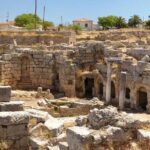
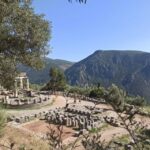
The sanctuary’s most important buildings are grouped around the Altis, the sacred area associated with Zeus and other gods. You will see broken columns, foundations, scattered drums, and reconstructed details rather than a standing city. That means a guide, printed map, or careful preparation can make a major difference.
One practical point deserves attention: the driver can explain how to approach the area, but he will not walk the site with you. A person who arrived expecting a guide beside the ruins found that the experience required more independent navigation than expected. If you want the story of each building explained as you go, pay for the licensed guide option if available.
The Temple of Zeus
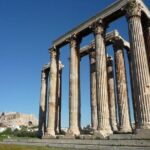
The Temple of Zeus is the central sight. Built in the second quarter of the fifth century BC, it was a model of the mature Doric temple. Earthquakes left it in ruins, but the scale of the fallen columns still gives you a sense of its power.
The temple once held the famous chryselephantine statue of Zeus by Phidias. Made of gold and ivory, the statue stood about 13 meters high and was counted among the Seven Wonders of the Ancient World. The statue is gone, but the Archaeological Museum of Olympia helps you understand the artistic ambition behind it.
Allow about 30 minutes for this monument within your wider site visit. Take time to look at the column drums and the temple’s footprint rather than rushing only toward the next named stop.
A few more Athens tours and experiences worth a look
- All Day Cruise -3 Islands to Agistri,Moni, Aegina with lunch and drinks included
★ 5.0 · 4,958 reviews



The Stadium at Olympia
The stadium lies east of the sanctuary of Zeus and hosted many events in the ancient games. This is the place where the athletic side of Olympia becomes easiest to picture.
The stadium is open and exposed, with little relief from strong sun. One person on a very hot day became too exhausted to walk the full stadium area, while her sister explored it and took photographs. That is useful advice: if heat is a concern, treat the stadium as optional rather than something you must force yourself to complete.
The site is more meaningful when you pause to consider its relationship to the sanctuary. Athletes did not arrive at an isolated sports arena. They competed within a religious center dedicated to Zeus.
The Temple of Hera and the Olympic flame
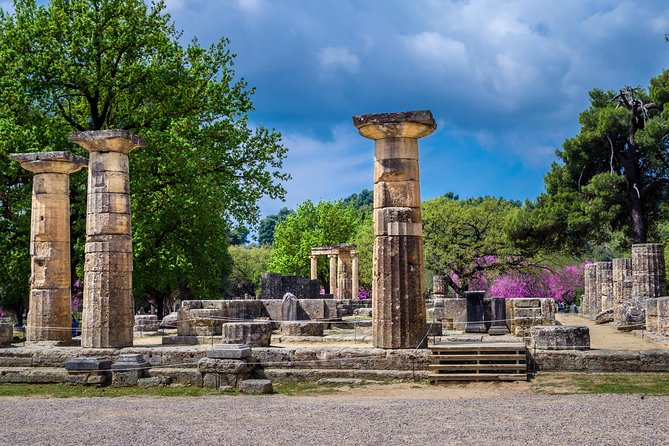
The Temple of Hera is older than the Temple of Zeus and was built around 590 BC. It began as a shared temple for Hera and Zeus before a separate temple was built for Zeus.
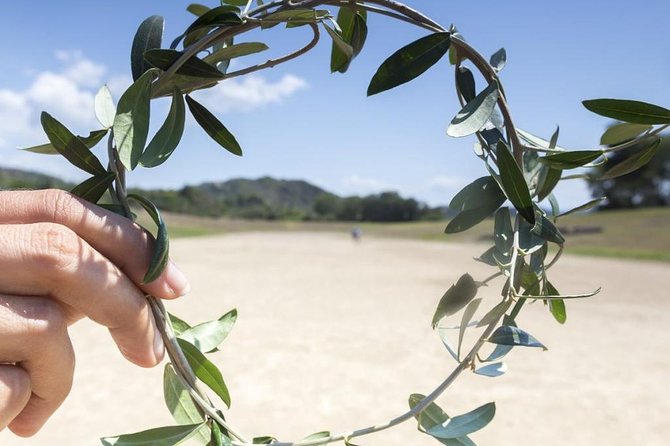
The ruins also connect ancient Olympia with the modern Olympic movement. The Olympic flame is lit at the altar here and then carried around the world. The ceremony takes place in the ruins, but do not assume you will see a full torch-lighting event during an ordinary visit. You can view the historic setting, not a scheduled ceremony.
Allow about 15 minutes for this stop. It is smaller than the Temple of Zeus, but its role in the Olympic tradition makes it one of the site’s essential points.
Nymphaeum, palaestra, and Philippeion
The Nymphaeum was a second-century water-distribution structure. It collected water from an aqueduct and sent it through channels around the sanctuary, helping supply the large crowds who came for the games in July and August. Its statues, stonework, cistern, and troughs show that Olympia needed practical infrastructure as well as grand temples.
The palaestra was a training ground for wrestling, boxing, and pankration. Pankration combined grappling, kicking, and punching, with rules enforced by umpires and judges. The building helps you see that athletes trained for serious competition, not merely ceremonial displays.
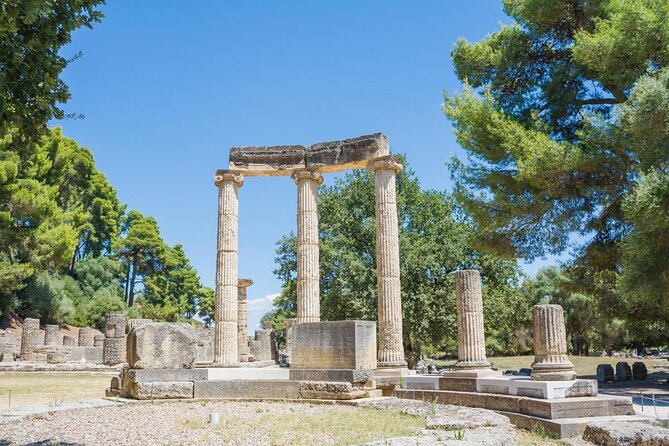
The Philippeion is a circular Ionic memorial built to honor Philip II of Macedon and his family after the victory at Chaeronea in 338 BC. It was unusual inside the Altis because it was dedicated to human figures rather than a god. Its original design included an outer ring of 18 Ionic columns and an inner ring of Corinthian columns.
These monuments receive about 15 minutes each in the planned timing. That is enough for a purposeful look, but not a long architectural study. A little preparation before you leave Athens will help you recognize why these less famous ruins matter.
Olympia’s two museums and the Archimedes collection
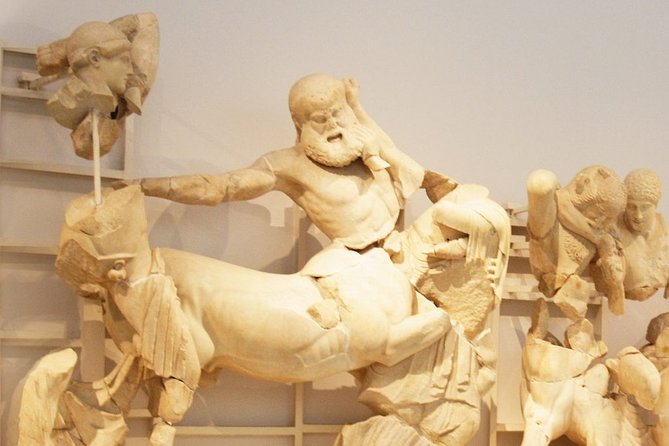
The Archaeological Museum of Olympia is an important part of the visit, not an afterthought. It holds objects from the surrounding area dating from prehistory through the Roman period.
Its best-known works include Hermes and the Infant Dionysus, attributed to Praxiteles, the Nike of Paionios, objects from the Temple of Zeus, and an oenochoe associated with Phidias. The museum’s bronze collection is especially important.
The planned visit lasts about 30 minutes. That is short for a museum with this much material, so focus on the major sculptures and pieces connected with the sanctuary. The museum also gives you a break from the sun, which can be just as valuable as the displays in a summer afternoon.
The Museum of the Olympic Games focuses on the competitions themselves. It explains the traditional start date of 776 BC, the four-year cycle called an Olympiad, and the long continuation of the games under Roman rule. Allow another 30 minutes.
The Archimedes Museum is a separate, unusual stop devoted to the ancient mathematician, physicist, engineer, astronomer, and inventor. It adds a different note to the day, moving beyond temples and athletics into ancient science and technology. Another 30 minutes is planned here.
Because the admission cost is not included, check the current combined or separate prices before you go. The tour information gives an adult admission price of 12 euros, while one experience account referred to paying 30 euros per person. That difference may reflect changed rates or different entries, so confirm the amount at booking rather than treating either figure as guaranteed.
Lunch and free time in Ancient Olympia
After the ruins and museums, you get about an hour in the village of Ancient Olympia. This is your chance to eat at a traditional Greek taverna, browse shops, and buy handmade souvenirs.
Lunch is not included, so budget for it separately. The stop is useful because it gives you a proper pause after the archaeological site. One account specifically enjoyed a meal at Ambrosia Café, but the important point is to use this hour for food, shade, and a reset before the drive back.
Do not expect a long village visit. An hour passes quickly once you sit down to order. If you want to shop, eat, and take a relaxed break, keep the museum visits moving at a sensible pace.
The three-and-a-half-hour return to Athens
The return drive takes about 3.5 hours. That final stretch is the main drawback of the tour. After walking across a large archaeological site, you may be ready for a hotel bed rather than more road time.
The private vehicle helps. You can stay with your own group, ask for the temperature to be adjusted, and use the ride to rest. Drivers have also made extra stops when time allowed, although you should not count on adding major sights to an already packed day.
The schedule is best for people who value seeing Olympia more than having a slow holiday rhythm. If you prefer short transfers and long visits, stay overnight near Olympia instead. If your base is Athens and your time is tight, this day trip saves you from arranging a separate car, route, and return journey.
Is $330.44 per person good value?
At $330.44 per person, this is not a cheap excursion. The price includes a private vehicle, an English-speaking professional driver, round-trip transportation, WiFi, and bottled water. It does not include lunch, entry to the archaeological site and museums, or a licensed guide.
The value improves when several people share the vehicle, since this is a private tour and group discounts may be available. It also makes more sense if you place a high value on door-to-door pickup and do not want to manage the long route yourself.
The value is weaker if you expect a full guided experience. You pay for transport and personal attention from the driver, not for an archaeologist walking beside you through every ruin. Add the guide option if interpretation is central to your visit, and check the admission fee carefully before comparing this with other tours.
Free cancellation is available when you cancel at least 24 hours before the start time. Changes or cancellations inside that window are not accepted for a refund.
Who should book this Olympia day trip?
I would recommend it to a couple, family, or small group with one clear priority: see Ancient Olympia from Athens in a single day. The private setting is especially useful if your group wants its own pace, has mixed energy levels, or appreciates a driver who can explain the places along the road.
It is also a good match for people who enjoy combining major sights with a little independence. You receive context in the car, then explore the ruins and museums on your own.
I would hesitate if you dislike long drives, struggle with heat, or need a licensed guide at every monument. The site is large, the day is demanding, and admission and lunch add to the advertised price.
FAQ
How long is the Ancient Olympia private tour from Athens?
The experience lasts about 12 hours. The route includes roughly one hour from Athens to Corinth Canal, 2.5 hours from Corinth Canal to Olympia, about three hours at the archaeological site, museums, and nearby attractions, one hour in the village, and about 3.5 hours back to Athens.
Is hotel pickup included?
Yes. At a hotel, the driver waits in the lobby. At an apartment, the driver waits at the entrance of the building.
Is transportation private?
Yes. Only your group participates, and private transportation in an air-conditioned vehicle is included.
Does the vehicle have WiFi and bottled water?
Yes. WiFi on board and bottled water are included.
Is the driver an official tour guide?
No. The drivers are not licensed site guides. They provide English commentary, can answer questions, and do not enter the archaeological sites with you. A licensed guide may be requested, depending on availability.
Are entry tickets included?
No. Admission to the Archaeological Site of Olympia and the museums is not included. The provided tour information lists an adult admission price of 12 euros, but one account refers to paying 30 euros per person, so confirm the current cost before booking.
Is lunch included?
No. Lunch is separate. You have about one hour in Ancient Olympia to eat at a traditional Greek taverna or café and browse village shops.
What should I bring?
Wear comfortable shoes. In summer, bring a hat, sunglasses, and sunscreen. These are especially important because the archaeological site and stadium are exposed, and the day can be very hot.
Should you book it?
Book this tour if Olympia is a must-see and you have only one Athens-based day to reach it. The Corinth Canal adds a worthwhile stop, the private car keeps the journey personal, and drivers such as George can make the long road more interesting with stories and helpful local observations.
Skip it in favor of an overnight stay if you want time to study every monument, take long museum visits, or avoid a tiring return drive. And if you do book, request a licensed guide, confirm the entry price, and plan for heat. Those three steps will make a costly and demanding day much more satisfying.