REVIEW · ATHENS
Athens Historical – Salamis Naval Battle Semi Private Tour
Book on Viator →Operated by 12 Gods Experience · Bookable on Viator
The most unusual part of this Athens tour is reaching the spot where Xerxes watched the Battle of Salamis unfold. You stand above the strait with the battle area before you, far from the crowds around the Acropolis. The view gives the ancient story a real sense of place.
I like the visit to the Pnyx, where Athens’ democratic assembly met, and the chance to see the reconstructed trireme Olympias up close. I also like the small van, bottled water, and maximum group size of seven, which should make the history talk easier to follow.
The main drawback is that you do not board the Olympias. One detailed account places the ship about 40 yards away, and the ticket for the maritime park is not included. The tour also depends on good weather and follows a fixed Tuesday-to-Saturday schedule.
In This Review
- Key points about the Salamis history tour
- Why Salamis matters beyond the Acropolis
- Starting at Mnisikleous Street in central Athens
- The Pnyx: democracy, hills, and room to think
- The Olympias at the Hellenic Maritime Heritage Park
- The guarded viewpoint where Xerxes watched the battle
- How much history do you get in four to five hours?
- Is $90.12 a fair price?
- Who will enjoy this most?
- Useful planning details before you go
- Should you book the Salamis tour?
- FAQ
- How long does the Athens Historical Salamis Naval Battle Tour last?
- Where does the tour begin?
- Where does the tour end?
- What language is the tour offered in?
- How many people can join the tour?
- Is transportation included?
- Is hotel pickup included?
- Is admission to the Hellenic Maritime Heritage Park included?
- Can I cancel for a full refund?
- What happens if bad weather cancels the tour?
Key points about the Salamis history tour
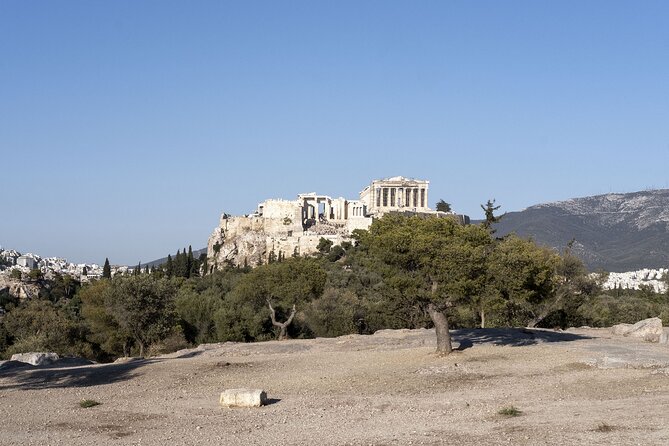
- Xerxes’ viewpoint: Reach a guarded area that is difficult to visit independently, with the Salamis battle site spread out before you.
- Pnyx in a quiet park: Learn about the birthplace of Athenian public debate in a greener, hillier setting than the packed central sights.
- Olympias trireme: See the modern reconstruction of an ancient Greek warship and hear why the design mattered in naval combat.
- Small English-speaking group: Travel by air-conditioned van with no more than seven people.
- Half-day format: Allow about four to five hours, including transportation from the central Athens meeting point.
- History-first itinerary: This suits you best if tactics, ships, political life, and military strategy interest you more than a long list of famous monuments.
Why Salamis matters beyond the Acropolis
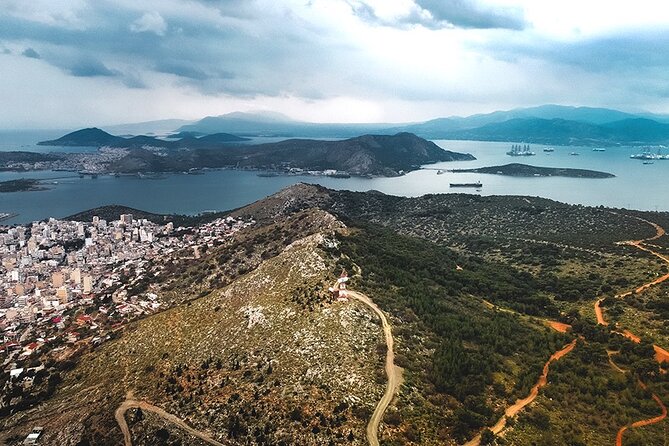
The Battle of Salamis in 480 BC was fought in a narrow stretch of water between the Greek mainland and the island of Salamis. The Greek fleet faced the much larger Persian force led by King Xerxes. The Greek victory helped prevent the Persian advance into southern Greece and became one of the defining naval battles of the ancient world.
You do not need to arrive with a degree in ancient history. A good guide can make the key point clear: numbers alone did not decide the battle. The Greeks used the confined waters to reduce the Persian advantage, while their smaller, oar-powered triremes could operate in conditions that made a huge fleet difficult to control.
That is why this tour works better as a story told across several places than as a simple museum visit. At the Pnyx, you consider the political world that produced Athens’ citizen army and navy. At the Olympias, you look at the ship type behind Greek naval power. At the final viewpoint, you see the setting where the battle could be understood from the Persian command position.
I like that the experience gives you a subject beyond the usual Athens checklist. You still meet in the center of town, but the focus quickly shifts from temples and marble to ships, strategy, and the people who made decisions in wartime.
You can also read our reviews of more private tours in Athens


Starting at Mnisikleous Street in central Athens
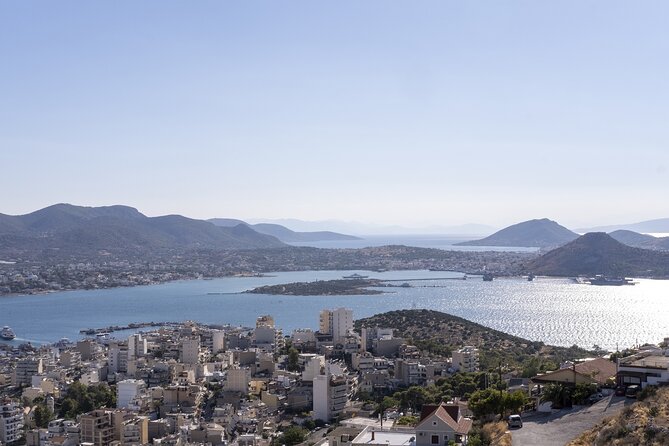
The tour begins at 12 Gods Experience, at Mnisikleous 14 in Athens. It ends at the same meeting point, so you do not need to arrange a separate ride back from the coast or from the final viewpoint.
The advertised duration is about four to five hours. The listed visits each receive roughly 40 minutes, with the rest of the time used for van transport and explanations. That makes this a practical half-day addition to an Athens stay, especially if you want to keep your afternoon or evening open.
The group is capped at seven people. That matters here because the subject needs explanation. A guide has to point out places across the water, explain how the ships moved, and connect the sites to one another. In a very large group, those details can get lost. With a small group, you have a better chance of asking about the battle, the ship design, or the political setting.
The vehicle is air-conditioned, and bottled water is included. Food and other drinks are not included, so eat beforehand or plan to buy something separately. Luggage storage is available on request at the meeting point, a useful detail if you are between accommodations or carrying bags after checking out.
Hotel pickup and drop-off are not part of the standard package. They may be arranged for an additional charge, but you should ask about that before booking if you do not want to reach Mnisikleous Street on your own.
The Pnyx: democracy, hills, and room to think
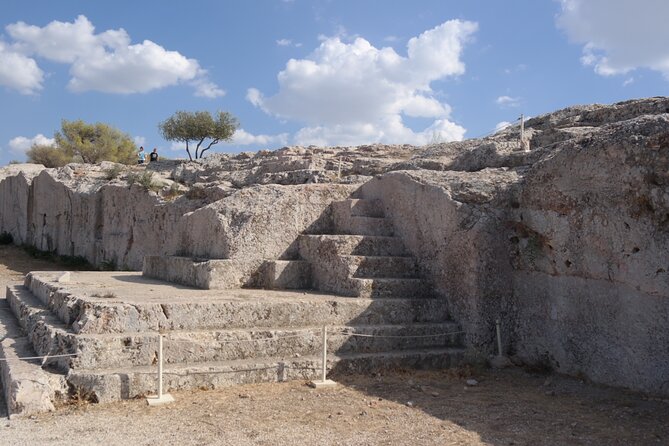
The first stop is the Pnyx, with about 40 minutes for the site and the guide’s explanation. This rocky hill is tied to the public meetings of ancient Athens. Here, citizens gathered to hear arguments and take part in decisions that shaped the city.
The Pnyx adds an important political layer to the Salamis story. Athenian naval strength was not only a matter of timber, oars, and trained crews. It was also linked to a city where citizens debated policy, voted on major questions, and took part in public life. Your guide can show how those two sides of Athens, democratic debate and military action, belonged to the same society.
The setting is one of the tour’s pleasant surprises. The Pnyx is in a hilly park with fewer people than the Acropolis and Plaka. You may see joggers using the paths, but the mood is generally calmer than at Athens’ headline monuments. This gives you time to listen without fighting through a crowd.
The nearby Prison of Socrates is also noted as part of the area, although it is not listed as a separate timed stop. Ask your guide whether there is time to point it out during your visit. Do not expect a full guided visit there unless it is specifically included on the day.
The site is free to enter. The footing is in a park with hills, so comfortable shoes are sensible. The bathroom warning is worth taking seriously: facilities near the Pnyx may close earlier than expected. If your tour runs later in the day, do not count on finding an open restroom here.
The Olympias at the Hellenic Maritime Heritage Park
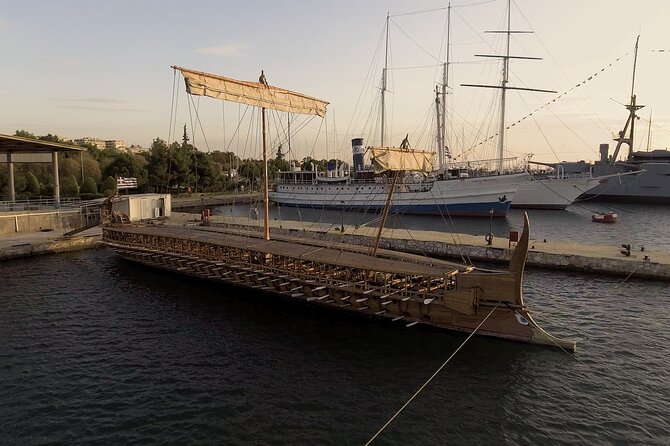
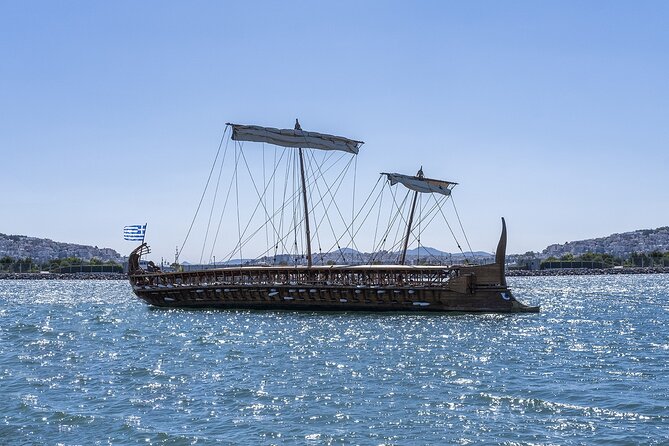
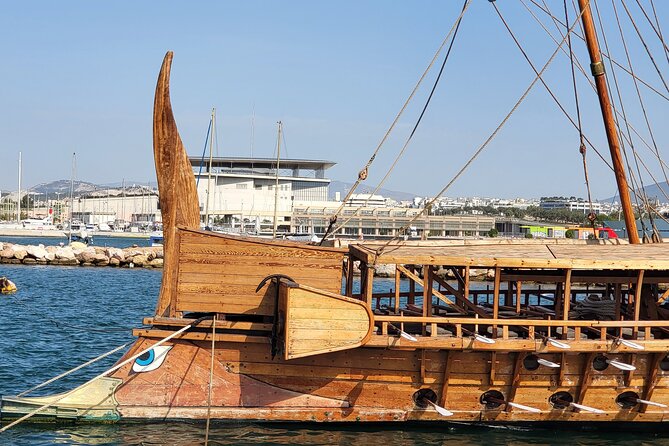
Next comes the Hellenic Maritime Heritage Park, where you see Olympias, a modern reconstruction of an ancient Athenian trireme. The visit lasts about 40 minutes, and the ship helps turn an abstract naval lecture into something you can picture.
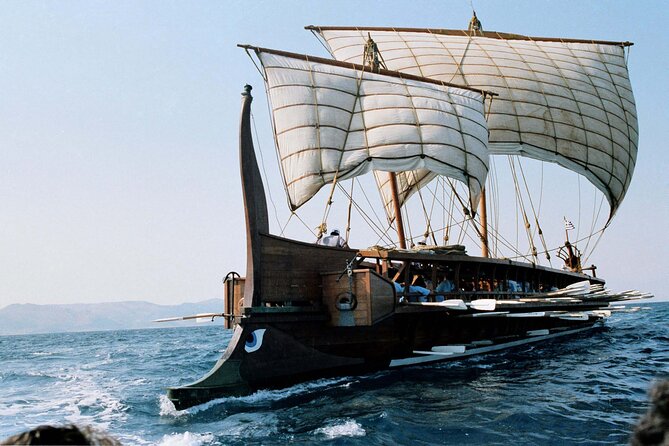
A trireme was built for speed, maneuverability, and a large rowing crew. Its long, narrow shape was suited to attack in formation, and its design helps explain why Greek naval tactics were so important at Salamis. The guide can also connect the ship to the technology of the period, including the way a vessel of this kind was used in close combat.
There is an important limit: you see Olympias, but you do not go inside or touch it. One account places the viewing point at roughly 40 yards away. If you are expecting a hands-on ship visit, adjust your expectations before you arrive.
Admission to the maritime park is not included in the $90.12 tour price. The supplied details do not state the separate admission cost, so check the current amount before booking if you are watching your budget closely. This is the one part of the outing where the headline price does not cover every possible site expense.
Even with that extra cost, the stop has real value for anyone interested in ancient warfare. A drawing in a book can show the shape of a trireme, but seeing the long hull and rowing layout gives you a better idea of the labor and coordination required to operate one.
The guarded viewpoint where Xerxes watched the battle
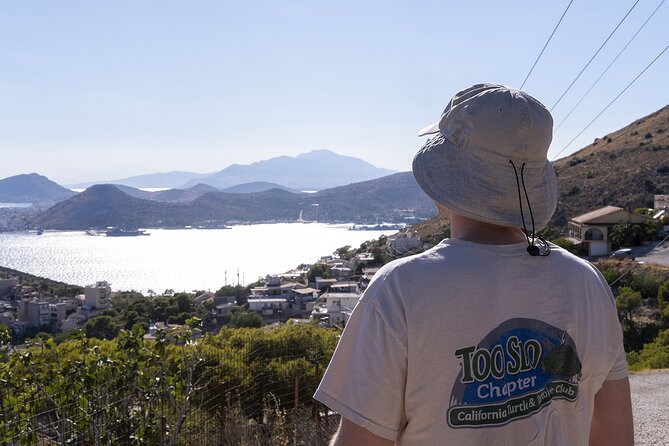
The final stop is the most distinctive. You visit the high point associated with Xerxes’ view of the Battle of Salamis, with the battle area visible across the horizon. The stop lasts about 40 minutes, allowing the guide to explain the position and the movement of the fleets.
This is also the reason I would not treat the tour as a simple sightseeing drive. Independent access can be difficult. A seven-foot chain-link fence and a guarded gate restrict entry, while the tour operator has permission to reach the area through its tourist license. In practical terms, booking the tour may save you from making a long trip only to find that you cannot enter.
The surroundings are not presented as a polished archaeological complex. Shipping containers and commercial activity may be visible, which can make the setting feel less romantic than a carefully preserved ancient monument. That contrast is useful, though. You are looking at a working modern area while trying to understand a battle fought more than two thousand years ago.
From this position, the guide’s explanation matters a great deal. The view alone will not teach you why the Greeks won. You need help identifying the strait, picturing the opposing fleets, and understanding how the narrow water limited the Persian force. If you enjoy maps, battle plans, and cause-and-effect explanations, this should be the strongest part of the afternoon.
The site is free to enter as part of the arranged access. You should not assume that the same access is available if you drive there independently. The guarded entrance is a practical detail, not a minor footnote.
You can also read our reviews of more historical tours in Athens



How much history do you get in four to five hours?
The tour gives you three stops, each with a clear role. The Pnyx explains the civic world of Athens. Olympias shows the vessel and technology. The final viewpoint places you above the battlefield.
That structure is easy to follow, but the experience depends on the guide’s delivery. The guide is described as a professional with strong historical knowledge, and the tour is offered in English. The supplied information does not name the individual guide, so you cannot request a particular person based on the details available.
You should expect a spoken explanation rather than a multimedia presentation. One detailed assessment suggested that a short historical video could add context, but no video is listed as part of the experience. If you learn best through maps, diagrams, or film, bring your own background knowledge or read about Salamis before going.
I would spend a little time before the tour learning three names: Xerxes, Themistocles, and Olympias. That small preparation will make the guide’s account easier to follow. You will also better understand why the battle was not simply a clash of ships, but a contest shaped by geography, command decisions, and the strengths of each fleet.
Is $90.12 a fair price?
At $90.12 per person, this is not the cheapest way to spend half a day in Athens. You can visit the Pnyx independently for free, and the maritime park admission is extra. The price makes more sense when you account for the air-conditioned van, bottled water, the small group, the English-speaking guide, and arranged access to the guarded viewpoint.
The strongest value comes from logistics and interpretation. Reaching the final site without permission may be difficult, and the three locations are spread out rather than sitting beside one another. You are paying to connect them in one outing, with someone explaining why they belong in the same story.
The price is easiest to justify if you would otherwise rent a car or arrange taxis. A car might take you toward the sites, but it would not solve the access problem at the fenced viewpoint, and you would need to build your own historical explanation. If you are mainly seeking famous architecture, the Acropolis ticket will probably give you more visual impact for your money. If ancient warfare is your priority, this tour offers a more focused subject.
The maximum of seven also improves the value for some people. A small group is more comfortable in a van and better suited to questions. I would not book it expecting a luxury vehicle, a full meal, or entry onto the ship. Book it for the access and the story.
Who will enjoy this most?
I would recommend the tour to you if you like ancient military history, archaeology, naval technology, or the way geography shapes events. It also suits repeat visitors to Athens who have already seen the major central sights and want a quieter half-day outside the usual route.
Families with older children may find the battle story engaging, especially if the children enjoy ships or strategy. The details say most people can participate, but the Pnyx is hilly, so anyone concerned about walking on uneven ground should consider personal comfort.
The tour is less suited to you if you want a beach outing, a food experience, or a long visit inside historic buildings. It is also not ideal if you need a highly visual site at every stop. Much of the value comes from listening to the guide and using the view to imagine the battle.
The tour is offered Tuesday through Saturday, from 10:00 AM to 3:00 PM, during the listed 2026 operating period. Check the exact start time when booking because the opening-hours range covers several possible departure times.
Useful planning details before you go
The meeting point is 12 Gods Experience, Mnisikleous 14, Athens 105 56. The activity returns there at the end. Confirmation is provided when you book, and mobile tickets are accepted.
Service animals are allowed, and the tour is near public transportation. Most people can participate. Hotel transfers are available only on request and cost extra, so make a plan for getting to the central meeting point.
Free cancellation is available until 24 hours before the start time for a full refund. Changes made inside that 24-hour window are not accepted, and late cancellations are not refunded. The cutoff uses local Athens time.
Good weather is required. If poor weather forces a cancellation, you can choose another date or receive a full refund. The tour also requires a minimum number of participants. If that minimum is not reached, you will be offered another date or experience, or a full refund.
Should you book the Salamis tour?
Book this tour if you want a focused, small-group history outing and the Battle of Salamis interests you more than another pass through Athens’ major monuments. The Xerxes viewpoint is the special reason to go, since independent access may be blocked by fencing and security. The Pnyx and Olympias give the story useful political and technical context.
Skip it if you need a fully self-guided day, dislike spoken historical explanations, or expect to board the trireme. Also remember to budget for the maritime park admission, which is not included.
For the right audience, this is a smart way to spend a half-day. You get a quieter park, a naval reconstruction, a hard-to-reach viewpoint, and a guide who can connect them into one clear account of how Athens faced Persia at sea.
FAQ
How long does the Athens Historical Salamis Naval Battle Tour last?
The tour lasts approximately four to five hours, including transportation and the three scheduled visits.
Where does the tour begin?
It begins at 12 Gods Experience, Mnisikleous 14, Athina 105 56, Greece.
Where does the tour end?
The activity ends back at the original meeting point.
What language is the tour offered in?
The tour is offered in English.
How many people can join the tour?
The maximum group size is seven people.
Is transportation included?
Yes. Air-conditioned van transportation from the meeting point is included.
Is hotel pickup included?
No. Hotel pickup and drop-off are not included in the standard price, but they may be arranged on request for an additional charge.
Is admission to the Hellenic Maritime Heritage Park included?
No. Admission to the maritime park is not included. The provided information does not state the separate admission price.
Can I cancel for a full refund?
Yes. You can cancel at least 24 hours before the start time for a full refund. Cancellations or changes made less than 24 hours before the start time are not accepted for a refund.
What happens if bad weather cancels the tour?
If poor weather causes a cancellation, you will be offered another date or a full refund. The same choice applies if the minimum number of participants is not reached.