REVIEW · ATHENS
Athens Private Tour: All Major Landmarks in 2 hours
Book on Viator →Operated by Greek Heritage: Private Tours & Transfers · Bookable on Viator
Athens packs an astonishing amount into a small area, and this private two-hour tour is built to give you the broad picture fast. You move between the Temple of Olympian Zeus, Kallimarmaro, Syntagma Square, Lycabettus Hill, and the Acropolis without spending your precious first day figuring out buses, taxis, and city streets. The tour is a moving introduction, not a full archaeological visit.
I like the private format, since your own group controls the pace and can ask questions along the way. I also like the practical pickup and drop-off service, plus the chance to finish at the Acropolis if you want to explore it afterward on your own.
The main limitation is clear: most stops last about 15 minutes, and you do not enter the Parthenon or Acropolis during the tour. At $89.36 per person, the value depends on group size and your priorities. You are paying for transport, a private driver, and orientation, not admission tickets or an in-depth walking tour.
In This Review
- Key points to know before booking
- What this two-hour Athens tour is really designed to do
- Temple of Olympian Zeus, a first look at ancient scale
- Alexander the Great and the city’s wider Greek story
- Panathenaic Stadium and the return of the Olympics
- Syntagma Square, Parliament, and the Evzones
- The Athenian Trilogy, three neoclassical landmarks
- Lycabettus Hill for Athens from above
- Seeing the Parthenon and Acropolis without entering
- Private transport, pickup, and the value of your time
- English commentary and the small-business touch
- Is $89.36 per person a fair price?
- Who should book this experience?
- Final verdict: a useful first look, not the whole Athens story
- FAQ
- How long does the Athens private tour last?
- Does the tour enter the Acropolis or Parthenon?
- Is hotel pickup included?
- Is port pickup available?
- Is this a private tour?
- Is the tour offered in English?
- What is included in the tour?
Key points to know before booking

- A two-hour city overview: Cover Athens’ main sights quickly, with several photo and explanation stops.
- Private transport throughout: Your group travels in an air-conditioned vehicle with WiFi and bottled water.
- English-speaking driver: Stavros, the owner of the small business, may host the tour and answer questions about the city.
- Acropolis viewed from outside: You gaze at the Parthenon and Acropolis, but entry is not included.
- Flexible ending: You can choose an Acropolis drop-off and continue exploring at your own pace.
- Port pickup costs extra: Hotel and apartment pickup are included, while pickup from the port adds €40.
What this two-hour Athens tour is really designed to do
Think of this as a city orientation with wheels. In two hours, you get a quick sense of how ancient monuments, modern government buildings, university institutions, marble stadiums, and hilltop viewpoints fit together.
That matters in Athens. The city can feel scattered when you first arrive, especially if you are trying to combine the Acropolis with Syntagma Square, the Panathenaic Stadium, and Mount Lycabettus. A private vehicle cuts out much of the walking between districts, giving you a useful first look before deciding where to spend more time.
The short schedule also explains the tour’s limits. Fifteen minutes at a monument is enough for a look, a few photographs, and a concise explanation. It is not enough for a slow inspection of carved details, a museum visit, or a full account of ancient Athenian politics.
If you have only a few hours in Athens, this approach makes sense. If you have several days and want to enter the major archaeological sites, you should treat this tour as an add-on rather than your main sightseeing plan.
You can also read our reviews of more private tours in Athens


Temple of Olympian Zeus, a first look at ancient scale

The Temple of Olympian Zeus is a strong opening stop because its remaining Corinthian columns communicate size immediately. The columns once reached about 17 meters, and even the surviving ruins give you a sense of the huge project ancient Athens pursued over centuries.
Construction began in the 6th century BCE under Athenian tyrants and was completed in the 2nd century CE. The long building period tells you something important about the ancient city: grand religious projects could outlast the rulers and generations that first commissioned them.
You have about 15 minutes here. That is enough to see the main remains and hear why the temple was dedicated to Zeus, king of the gods. The tour information also refers to a colossal statue of Zeus, although only ruins remain today.
The drawback is that this is a quick exterior visit. If you are fascinated by temple design, mythology, or the transition from Classical Greek to Roman-era Athens, you will want additional time elsewhere. Still, as a first stop, the temple gives the tour a strong visual beginning.
Alexander the Great and the city’s wider Greek story
The route includes a stop connected with Alexander the Great, though the supplied details do not identify a specific monument or location for this part of the experience. The focus is on Alexander himself: his rise to the Macedonian throne at age 20, his training under Aristotle, and his campaigns across Greece, Egypt, Persia, and Asia.
This short historical thread helps place Athens in a wider Greek and Hellenistic setting. Alexander’s conquests spread Greek language and culture far beyond mainland Greece, while his policy of blending Greek and Persian customs helped shape the Hellenistic world after his death in 323 BCE.
Because no separate duration is given for this stop, you should think of it as part of the driver’s running commentary rather than a long site visit. It adds useful context, but it is not a replacement for a museum or a dedicated Alexander-themed excursion.
Panathenaic Stadium and the return of the Olympics
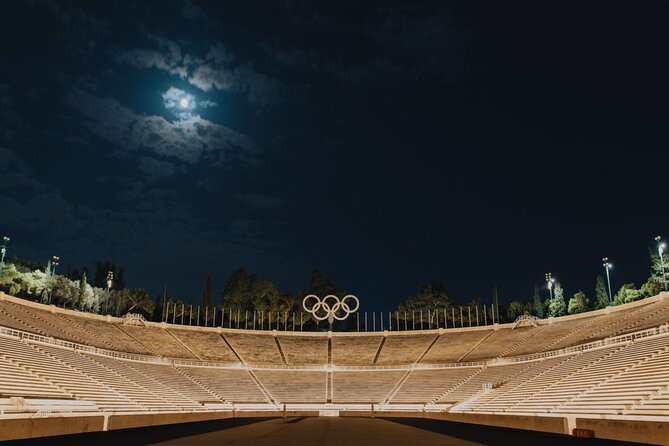
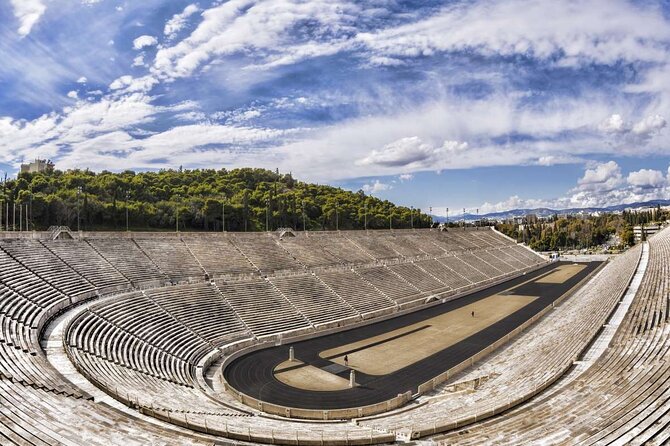
The Panathenaic Stadium, or Kallimarmaro, is one of Athens’ most memorable sights. Built entirely of white marble, its horseshoe shape is easy to recognize, and its connection with both ancient athletic contests and the modern Olympic movement makes it especially accessible.
The original stadium was built in the 4th century BCE and reconstructed in the 2nd century CE. It hosted the Panathenaic Games, a major event honoring Athena. Much later, it hosted the revival of the modern Olympic Games in 1896.
Your stop lasts about 15 minutes, with no admission ticket included. That timing works well for seeing the stadium from outside, taking photographs, and understanding its place in Athens. You will not have time for a leisurely walk through every section or a long visit inside.
I like this stop because it connects ancient life with a familiar modern idea. You are not only looking at marble seating and a running track. You are seeing a place where athletic competition has remained part of the story for centuries.
Syntagma Square, Parliament, and the Evzones
The tour then moves through the political heart of modern Athens at Syntagma Square. The Hellenic Parliament occupies a neoclassical building that began life as a royal palace in 1843 and became the seat of Parliament in 1934.
Outside, the Tomb of the Unknown Soldier honors Greek soldiers who died in war, with particular reference to World War I. The marble monument includes reliefs of battle and mourning, and an eternal flame keeps the focus on national remembrance.
The Evzones guard the tomb in traditional dress. Their ceremonial duties are one of the most distinctive sights in central Athens. A changing-of-the-guard ceremony takes place regularly, but the tour information does not promise that your two-hour visit will coincide with one. Keep your expectations practical: you may see the guards, but you should not book this tour solely for the ceremony.
The 15-minute stop is enough to understand the setting and take in the formal atmosphere. It also gives you a useful contrast with the ancient monuments. Athens is not only an open-air museum. It is Greece’s current political center, and Parliament remains part of daily national life.
A few more Athens tours and experiences worth a look





The Athenian Trilogy, three neoclassical landmarks

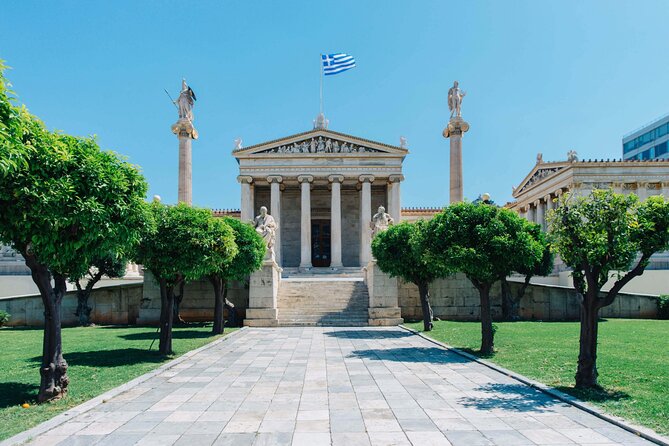
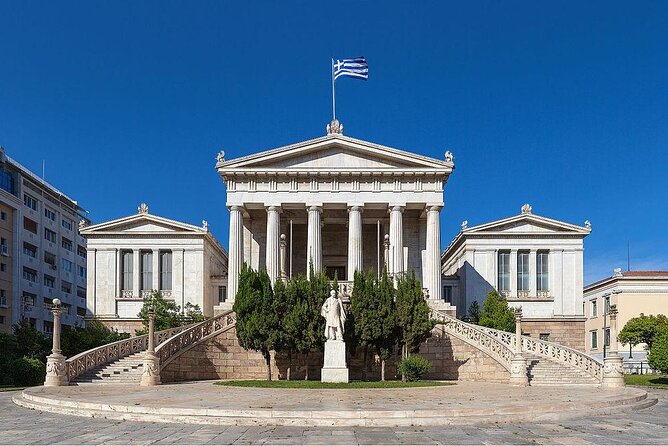
The route passes the Academy of Athens, the National and Kapodistrian University of Athens, and the National Library of Greece. Together, these buildings form the famous Athenian Trilogy, a group of neoclassical institutions in central Athens.
The Academy of Athens was founded in 1926 and takes its inspiration from Plato’s ancient academy. Its facade includes statues of Athena and Apollo, giving the building a grand public face even if you only see it from the street.
The University of Athens dates to 1837 and is Greece’s oldest and largest university. Its main building is another strong example of neoclassical design, and the institution remains an important center for education and research.
The National Library of Greece was founded in 1832. Its collections include manuscripts, rare books, and historical documents, while modern facilities support digital archives and public research.
These three stops are best understood as a drive-by architectural lesson. The supplied schedule does not assign each building its own 15-minute visit, so do not expect interior access or time to browse collections. Still, the trilogy adds depth to the tour by showing how 19th and 20th-century Greece presented its intellectual and national identity through public architecture.
Lycabettus Hill for Athens from above
Mount Lycabettus rises about 300 meters above Athens and offers one of the tour’s best chances to see the city as a whole. From the hill, you can look across Athens toward the Aegean Sea and surrounding mountains, with the Chapel of St. George at the summit.
The hill also carries a local myth. One story says Athena accidentally dropped a rock here while carrying it to the Acropolis. Whether you take the legend literally or not, it gives the rocky height a memorable link to the city’s patron goddess.
The tour allows about 15 minutes. That is enough for a viewpoint stop, but not for a serious climb or a long stay at the chapel. The route description refers to a winding path, so visitors who want to walk to the summit should plan separate time and suitable footwear.
I especially value this stop for orientation. The Acropolis can seem like an isolated monument when seen from street level. Lycabettus helps you understand its place within the wider city, while the high view gives you a break from the close-up stonework of the ancient sites.
Seeing the Parthenon and Acropolis without entering
The final major section focuses on the Parthenon and Acropolis. This is the moment many people will anticipate most, but the rules are important: you do not enter either site during the tour.
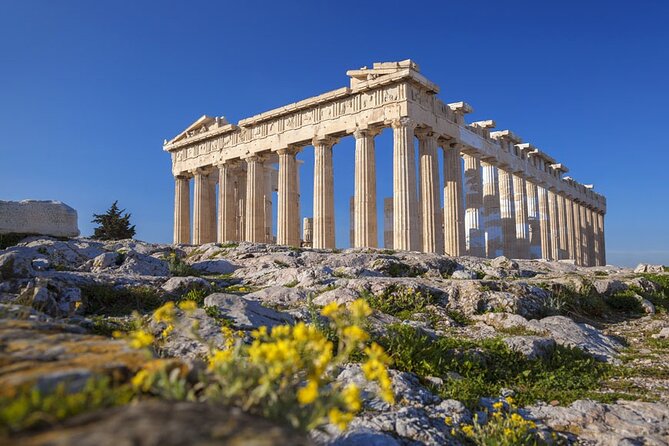
You stop and gaze at the Acropolis, the hilltop citadel that has represented ancient Athens for centuries. The site includes several famous structures and offers views across the modern city. The Parthenon, dedicated to Athena, was built between 447 and 432 BCE and is the best-known building on the hill.
The temple’s Doric columns, Pentelic marble, and sculpted frieze reflect the precision of Classical Greek architecture. It once held a large statue of Athena Parthenos. Centuries of war, weather, and reconstruction damaged the building, but its surviving form still makes the basic design easy to appreciate from below.
Fifteen minutes is enough for a first look and photographs. It is not enough to study the columns closely, visit the Acropolis Museum, or understand the full story of the citadel’s monuments. If you want to enter, the optional drop-off is the tour’s most useful feature. You can end your private ride at the Acropolis and continue independently.
Confirm the drop-off plan when arranging the tour. The supplied details call it optional, which means you should not assume the vehicle will automatically leave you there.
Private transport, pickup, and the value of your time
Hotel or apartment pickup and drop-off are included. The driver arrives five minutes before your chosen start time, and you provide the hotel name or full apartment address during booking.
This is especially helpful if you are staying outside the immediate center or want to avoid arranging a taxi early in the day. The vehicle is air-conditioned, and bottled water and WiFi are included. A child seat and booster are available, which makes the private setup more practical for families.
Port pickup is different. It carries an additional €40 charge, so include that in your calculation if you are arriving by ship. The tour provider also recommends downloading WhatsApp for easier communication with the driver.
The private setup matters more than the extras. Because only your group participates, you can ask the driver to explain a building, repeat a point, or adjust the focus within the available time. The tradeoff is that a car-based tour cannot give you the same close contact with the monuments as a guided walk.
English commentary and the small-business touch
The tour is offered in English with a fluent English-speaking driver. Stavros, the owner of the business, may host the experience. His role appears to combine driving, local orientation, and answers to questions about the city.
That personal contact is one of the most praised aspects of the experience. A strong driver can make a short tour feel useful by explaining what you are seeing rather than simply dropping you beside a monument. The available feedback also highlights Stavros’ friendly manner and his willingness to take time with questions.
The business is small, which may appeal to you if you prefer a direct, personal service over a large sightseeing operation. Still, the exact driver is not guaranteed in the information provided, so book on the basis of the stated English-speaking driver service rather than expecting a specific person.
Is $89.36 per person a fair price?
At $89.36 per person, this is not the cheapest way to look at Athens. The price makes more sense if you value private transportation, pickup and drop-off, air conditioning, bottled water, WiFi, and an English-speaking driver who can cover a lot of ground in two hours.
It is also more attractive for a group that would otherwise need several taxis. Group discounts are offered, but the amount is not specified. Ask about the final group price before booking.
The tour does not include admission tickets because the main stops are viewing stops. That keeps the outing simple, but it also means you may pay separately for the Acropolis, museums, or other sites if you continue exploring afterward.
I would call it good value for a short arrival-day orientation, a cruise stop with limited time, or a family group that wants door-to-door transport. I would not call it the best value if your main goal is detailed archaeology. In that case, spend your money on site entry and a longer guided visit.
Who should book this experience?
This tour suits you best if:
- You have only two or three hours in Athens.
- You want to see the city’s main landmarks before choosing where to return.
- You prefer private transport to public transit or walking.
- You are traveling with children or a mixed-mobility group.
- You want hotel pickup and a simple, organized route.
- You plan to explore the Acropolis independently after the drop-off.
It is less suitable if you want to enter every major monument, spend time inside museums, or walk through ancient sites with a specialist guide. The quick pace is the point, but it is also the compromise.
The tour has a perfect 5 rating from six reviews, with particular praise for the two-hour coverage, the owner’s personal service, and the way it helps you understand where Athens’ sights are located. That matches the experience’s clearest purpose: get your bearings fast, then choose your deeper visits.
Final verdict: a useful first look, not the whole Athens story
Book this tour if you need a compact, private introduction and want transport to do the hard work. The itinerary brings together ancient temples, Olympic landmarks, modern government, neoclassical institutions, hilltop views, and the Acropolis in one tidy route.
Do not book it expecting entry to the Acropolis or a detailed guided tour of the Parthenon. The best plan is to use the two hours as an orientation, then ask for the optional Acropolis drop-off and continue at your own pace if your schedule allows.
For a honeymoon finish, a first morning in Athens, or a short stop between other plans, this is a practical choice. For serious site visits, pair it with more time on foot.
FAQ
How long does the Athens private tour last?
The tour lasts approximately two hours. Several principal stops are planned for about 15 minutes each, with driving time between locations.
Does the tour enter the Acropolis or Parthenon?
No. The tour stops so you can view and photograph the Acropolis and Parthenon from outside. You may choose an optional drop-off at the Acropolis to explore it independently.
Is hotel pickup included?
Yes. Pickup and drop-off are included from any hotel or apartment location, provided you give the hotel name or complete apartment address during booking.
Is port pickup available?
Yes, but pickup from the port costs an additional €40. You must provide the ship name when arranging a port pickup.
Is this a private tour?
Yes. Only your group participates in the activity. The vehicle and transportation are private.
Is the tour offered in English?
Yes. The experience includes a fluent English-speaking driver.
What is included in the tour?
The tour includes an air-conditioned vehicle, WiFi on board, private transportation, bottled water, an English-speaking driver, and hotel or apartment pickup and drop-off. Service animals are allowed, and child seats and boosters are available.