REVIEW · ATHENS
BEST 7-Day CLASSICAL GREECE: Corinth Olympia Delphi Meteora more!
Book on Viator →Operated by WARMPENGUIN · Bookable on Viator
The great appeal here is scale. In seven days, you move from the Acropolis and Cape Sounion to Mycenae, Olympia, Delphi, Meteora, and the battlefield of Thermopylae. This is classical Greece in one fast-moving loop, with a private car and hotel stays already arranged.
I like the freedom to explore sites on your own, and I like that the itinerary includes smaller places such as Nafpaktos, Galaxidi, and Mystras, not just the famous monuments. The main consideration is pace: several days include long drives and multiple major sites, while entrance fees and licensed archaeological guides cost extra.
In This Review
- Key points to know before booking
- Why this route works for a first visit to Greece
- Day 1: Athens from the Acropolis to Cape Sounion
- Day 2: Corinth, Mycenae, and the port of Nafplio
- Day 3: Epidaurus, Mystras, and Sparta
- Day 4: Ancient Olympia and the road to Delphi
- Day 5: Delphi, Hosios Loukas, and Arachova
- Day 6: Meteora’s monasteries above Kalambaka
- Day 7: Vergina, Thermopylae, and Athens
- What the private driver can and cannot do
- Is $4,144.61 a good value?
- Who should book this tour?
- Should you book the 7-day Classical Greece tour?
- FAQ
- Is this a private tour?
- Is a driver included?
- Can the driver guide us inside archaeological sites?
- Are hotels included?
- Are entrance fees included?
- Is lunch included?
- Which vehicle will be used?
- Can I cancel for a full refund?
Key points to know before booking
- Seven days, one private vehicle: Your group travels with an English-speaking driver rather than joining a large bus tour.
- The route covers Greece’s major ancient sites: Expect Athens, Corinth, Mycenae, Epidaurus, Olympia, Delphi, Meteora, and Thermopylae.
- Hotels and breakfast are included: Accommodation is in at least 4-star or boutique-style properties.
- Sightseeing remains flexible: You may visit sites independently or request licensed guides for selected archaeological stops.
- Three vehicle and service levels: Discount, Gold, and Platinum packages change the vehicle, with the top option adding a three-course lunch.
- Entrance tickets are extra: Set aside a separate budget for archaeological sites, museums, monasteries, and the Acropolis.
Why this route works for a first visit to Greece
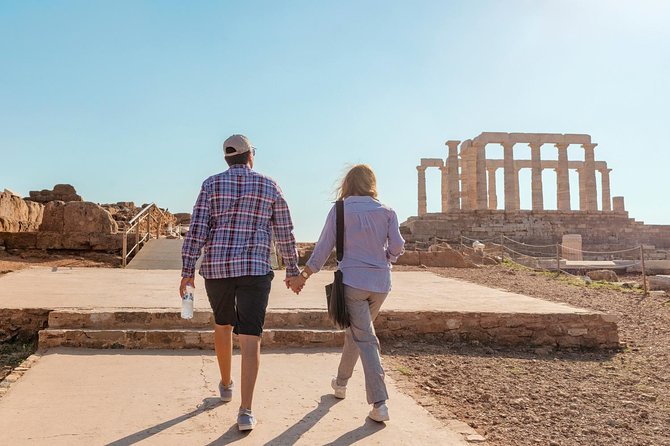
This is not a relaxed stay in one region. It is a road journey built around major monuments, with enough smaller stops to keep the days from feeling like a string of ticket booths.
You begin in Athens, cross the Peloponnese, continue west to Olympia, head north to Delphi and Meteora, and then return to Athens by way of Thermopylae. The route gives you a useful sense of how varied Greece is. You see busy Athens, mountain villages, medieval ruins, seaside ports, olive-covered valleys, and dramatic rock formations.
The private format matters. Your group has the vehicle to itself, and the driver stays with you during the day. That makes it easier to adjust the rhythm, spend longer at a favorite site, or skip the optional Monastery of Hosios Loukas. It also avoids the fixed seating and fixed meal stops of a large coach tour.
Still, do not mistake private for leisurely. The schedule covers a lot of ground. If you want a slow morning at every ruin, long museum visits, or several free afternoons, this route may feel crowded. If you want to see the major chapters of ancient Greek civilization in one trip, the packed schedule is the point.
A few more Athens tours and experiences worth a look

Day 1: Athens from the Acropolis to Cape Sounion

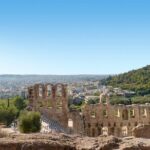
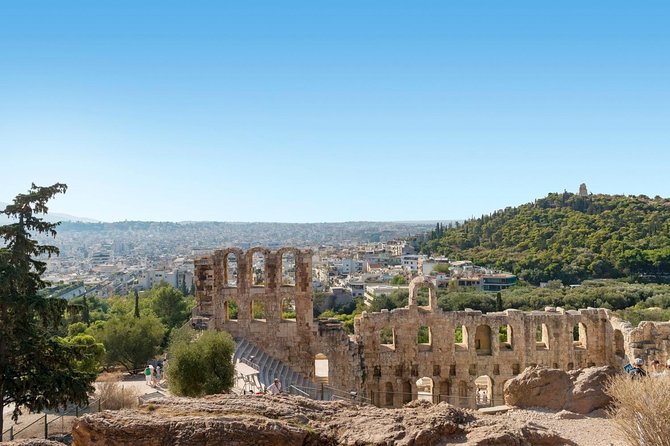
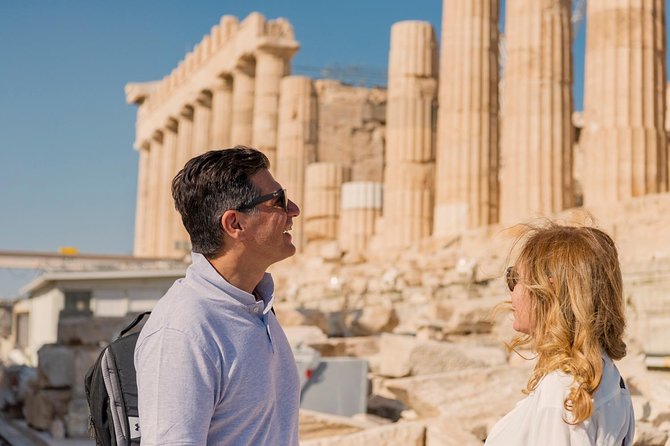
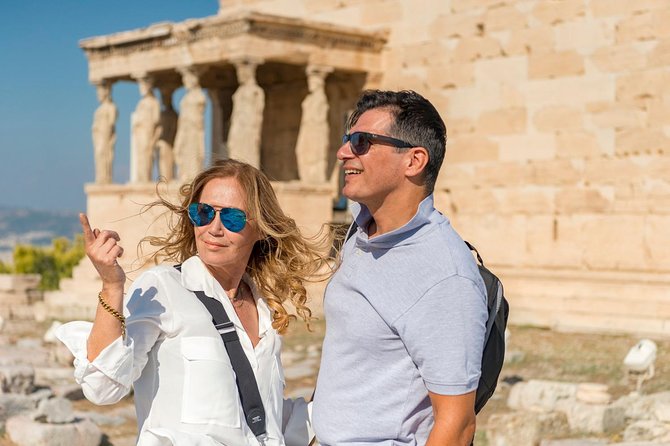
The opening day starts with the Acropolis, the obvious centerpiece of Athens and one of the most important stops on the entire route. You have about 90 minutes for the hilltop monuments, including the Parthenon, Temple of Athena Nike, and Erechtheion, along with a look at the Herodes Atticus Theatre below.
That time is enough for a focused visit, but not for lingering over every detail. The Acropolis involves uneven ground and exposed walking, so comfortable shoes, water, and sun protection are practical choices. Admission is not included.
Next comes the New Acropolis Museum, with about an hour to see sculpture and architectural pieces from the site. Pairing the museum with the hill is smart. The ruins show you the buildings in place, while the museum helps explain the objects and decoration that once filled them. Again, the ticket is extra.
The city tour then moves through Syntagma Square, where the Parliament building and Tomb of the Unknown Soldier provide a quick look at modern Greek civic life. The changing of the guard features Evzone soldiers in traditional uniform. At the Athenian Trilogy on Panepistimiou Street, you pause by the University, Academy, and Library, three elegant neoclassical buildings.
The Panathenaic Stadium adds a different kind of historical setting. Built entirely of marble, it is associated with the modern marathon and occupies the site of an earlier athletic stadium. The nearby Temple of Olympian Zeus and Arch of Hadrian show how Athens grew from a Greek city into a Roman imperial center.
The day ends at the Temple of Poseidon at Cape Sounion, about 70 meters above the sea. The stop lasts roughly two hours, and the temple is particularly well suited to late-day light. It is a strong finish, though the long ride out and back makes this an extended day.
Day 2: Corinth, Mycenae, and the port of Nafplio
The Corinth Canal is a brief engineering stop. You get about 20 minutes to see the cut linking the Gulf of Corinth with the Saronic Gulf and hear about its role in the route.
Ancient Corinth is the first major archaeological site in the Peloponnese. Allow about an hour to walk among streets, temples, markets, and fountains associated with Greek and Roman Corinth. The site also connects with the story of St. Paul, giving it interest beyond the classical period.
Mycenae is one of the day’s most memorable stops. The citadel was associated with Agamemnon in Greek legend and gives its name to the Mycenaean period, dated here from about 1600 to 1100 BC. You pass through the Lion’s Gate, see the massive defensive walls, and explore the remains identified with the palace area.
The nearby Treasury of Atreus adds another striking structure. You also have time for the on-site museum, which helps put the ruins and recovered objects into context. The visit lasts about an hour, so you will need to choose between moving quickly through the remains and spending more time in the museum.
Nafplio provides a welcome change of pace. The old port city has a medieval and Venetian character, views toward Bourtzi Castle in the bay, and craft shops and boutiques in the old town. The planned stop is about 90 minutes, enough for lunch and a short walk, though the town deserves more time if you enjoy cafés, waterfront meals, and small shops.
Day 3: Epidaurus, Mystras, and Sparta
The Ancient Theatre of Epidaurus is one of the route’s best-preserved classical settings. It forms part of the Sanctuary of Asklepios, an ancient healing center, and dates largely from the fourth century BC.
The theatre is famous for its acoustics. You can test them with a poem or song, as many visitors do, but the surrounding sanctuary is just as important. The 90-minute visit gives you time for the theatre and some of the religious buildings, though not an exhaustive study of the full site.
The route then turns toward Mystras, a medieval city and UNESCO-listed site near Sparta. Here, the focus shifts from classical Greece to the Byzantine era. Ruins include palaces, homes, churches, monasteries, workshops, streets, fortifications, and old water systems.
Mystras is spread across a hillside. The 90-minute stop can feel brisk because of the walking and elevation changes. If you have limited mobility, ask about the exact route and timing before booking, since the site is not simply one compact building.
Sparta is the lunch and town stop. You may see the ancient remains, visit the museum or olive oil museum, and take a break before continuing toward Olympia. The town itself is more practical than picturesque, but it helps connect the ancient Spartan story with present-day life.
Day 4: Ancient Olympia and the road to Delphi
Ancient Olympia receives two hours, making it one of the longer archaeological visits. This is where the ancient Olympic Games were held, and the site includes training areas, the stadium tunnel, the Temple of Zeus, the Temple of Hera, and the workshop associated with Phidias.
The Olympic flame is still lit at the Temple of Hera, adding a direct link between ancient ritual and the modern Games. The archaeological museum contains major finds from the site. Since admission is not included, confirm whether the archaeological site and museum require separate tickets before arrival.
After Olympia, the route crosses the Rion-Antirion Bridge, a major suspension bridge linking the Peloponnese with mainland Greece. It is a brief stop, but it breaks up the drive and gives you a striking modern counterpart to the ancient engineering seen earlier at Corinth.
Nafpaktos is a fine lunch stop. Its Venetian port is compact, scenic, and less demanding than another large ruin. You get about 90 minutes for food and a walk.
The evening stop is Galaxidi, a seaside village near Delphi. Two hours here allow time for a stroll, cafés, and dinner with sea views. Staying in or near a smaller coastal town rather than rushing directly into Delphi can make the evening feel more local and less tied to an organized sightseeing timetable.
- All Day Cruise -3 Islands to Agistri,Moni, Aegina with lunch and drinks included
★ 5.0 · 4,958 reviews





Day 5: Delphi, Hosios Loukas, and Arachova

Delphi sits on broad terraces above the valley, and the setting is part of its power. The sanctuary includes the Temple of Apollo, the Castalian Spring, the theatre, treasury buildings, the Temple of Athena, and the gymnasium associated with the Pythian Games.
You have about two hours at the site. That is enough to follow the main route and understand the relationship between the terraces, but Delphi rewards a careful pace because the paths rise and fall. The site description lists Delphi admission as free, while the general tour terms say entrance fees are excluded. Treat the overall policy as the safer guide and confirm current ticket arrangements before the trip.
The Delphi Archaeological Museum follows, with about an hour. Important pieces include the Sphinx of Naxos, the twin kouroi, and the Bronze Charioteer. The museum is not an optional extra in terms of understanding Delphi. It gives the statues a setting and makes the sanctuary visit far more than a walk among stones.
The optional stop at Hosios Loukas changes the tone again. This UNESCO-listed Byzantine monastery is about 1,100 years old and known for architecture and frescoes. You may omit it if you prefer more time elsewhere, which is useful on an already full day.
Arachova is the lunch stop, with craft shops and views over the Pleistos River valley. The village is a practical place to pause between Delphi and Kalambaka, the town below Meteora. The day combines ancient religion, Byzantine art, mountain roads, and local shopping, but it also includes substantial driving.
Day 6: Meteora’s monasteries above Kalambaka
Meteora is the visual high point of the route. Six surviving monasteries sit on sandstone pillars rising as high as 1,312 feet. The combination of rock and religious buildings is unlike anything else on this itinerary.
The visit includes at least two monasteries, usually selected from Grand Meteora, Varlaam, or Agiou Stefanou. You learn about the hermits and monks who lived in this difficult setting, while also getting wide views over the surrounding countryside.
The timing is about two hours, so this is a selected visit rather than a full survey of every monastery. Access conditions can vary by monastery, and some require stairs, so ask which two are planned and what walking is involved.
Kalambaka provides a 90-minute lunch break in one of the main squares. This is a useful pause after the monastery visit and before the final day’s return south. Meteora is one of the places where an optional licensed guide could add real value, especially if you want more than the basic story of the buildings and their occupants.
Day 7: Vergina, Thermopylae, and Athens
The final day includes a stop described as Veroia, with a visit to Vergina before turning south. The planned time is about 90 minutes. Because the description uses both place names, confirm the exact stop when arranging the tour.
Thermopylae follows, with a monument and a visitor center focused on the battle of 480 BC, when King Leonidas led the 300 Spartans. The one-hour stop is suited to a concise historical visit rather than a full day of study.
Kamena Vourla is the final break, offering a seaside lunch or rest stop in one of the local villages. From there, you return to Athens. After six days of ruins, museums, mountain roads, and long transfers, the sea stop is a sensible way to finish.
What the private driver can and cannot do
Your English-speaking tour driver stays with you throughout the day and can explain sites and places along the route. The driver cannot enter archaeological sites as a licensed guide, so you should not expect a full guided tour inside the Acropolis, Mycenae, Olympia, or Delphi unless you add that service.
You can request an expert licensed archaeological guide for one or more sites. I would consider one for the Acropolis and Delphi first, since both have layered monuments and complex stories. A guide at Olympia or Mycenae may also be worthwhile if ancient religion, archaeology, or mythology is a main interest.
The private format gives you flexibility, but it does not remove the need to plan. Ask in advance which stops are fixed, which are optional, and how much time is allowed at each site.
Is $4,144.61 a good value?
At $4,144.61 per person, this is a major expense. The price makes more sense for people who value private transport, hotel coordination, a small personal group, and a route that would be difficult to arrange efficiently on their own.
The included package covers a Superior Class sedan, Mercedes minivan, or Sprinter depending on group size, plus an English-speaking driver and at least 4-star or boutique-style hotels with breakfast. Gold upgrades the vehicle to a luxury E-Class Mercedes option, while Platinum includes a three-course lunch.
You still pay entrance fees. Licensed guides are also extra unless included in your chosen package. Lunch is optional, with traditional menus and vegetarian dishes available, and you should report allergies if you select a lunch package.
The value is strongest for families or friends who want a private vehicle and do not want to coordinate seven days of hotels, driving, and intercity transfers. A solo guest or couple focused mainly on low cost will probably find the price harder to justify.
Who should book this tour?
I would recommend it to a first-time visitor who wants to see the main classical sites beyond Athens without renting a car. It also suits families and groups with mixed interests, since the private schedule can be adjusted and the route includes archaeology, medieval sites, villages, museums, food stops, and seaside towns.
You should be comfortable with long days, frequent hotel changes, uneven archaeological paths, and regular time in the car. The tour is not the right pick if your priority is a slow Greek holiday with beaches, late mornings, or several days in one town.
WarmPenguin’s team includes David and Yiannis, who are identified as part of the company’s personal service. The tour can also be shaped around added interests, as shown by the option to add extra touring time in other Greek regions. That flexibility is worth discussing before you pay.
Free cancellation is available up to 24 hours before the start time. Airport pickup and pickup outside Athens can be arranged on request, sometimes with a supplement. Service animals are allowed, public transportation is nearby, and most people can participate, but ask about walking needs at Mystras and Meteora.
Should you book the 7-day Classical Greece tour?
Book it if you want maximum ancient Greece in minimum time, private transport, and hotels handled for you. The combination of Athens, Mycenae, Olympia, Delphi, and Meteora is difficult to match in one organized week.
Before booking, price the entrance tickets and any licensed guides you want, then decide if the Discount, Gold, or Platinum package fits your group. I would also ask for the precise daily driving times and confirm the Veroia and Vergina plan.
Choose this tour for breadth, comfort, and flexibility. Skip it if you prefer to settle into one region and explore at a slower pace.
FAQ
Is this a private tour?
Yes. Only your group participates in the activity, and transportation is provided according to group size.
Is a driver included?
Yes. A professional English-speaking tour driver accompanies you throughout the day.
Can the driver guide us inside archaeological sites?
No. The driver can provide information while traveling but cannot enter archaeological sites as a licensed guide. Expert licensed guides may be added for one or more locations.
Are hotels included?
Yes. The tour includes at least 4-star or boutique-style hotels with breakfast.
Are entrance fees included?
No. Entrance fees are listed as not included in the tour price. Confirm the current ticket arrangements for each site before departure.
Is lunch included?
Lunch is optional. You may add it separately or select a package that includes a traditional three-course lunch. Vegetarian dishes are available.
Which vehicle will be used?
The vehicle depends on your group size and package. Options include a Superior Class sedan, Mercedes minivan, or Sprinter. Gold and Platinum packages offer luxury E-Class Mercedes options.
Can I cancel for a full refund?
Yes, if you cancel at least 24 hours before the experience start time. Cancellations or changes made less than 24 hours before the start time are not accepted for a refund.