REVIEW · ATHENS
Full day Christian tour following Paul In Athens and Corinth
Book on Viator →Operated by Splendid Greece Tours · Bookable on Viator
Paul’s story comes alive at two dramatic settings: the Areopagus, where he addressed Athenians about the unknown god, and Ancient Corinth, where his work helped shape the early Christian church. The day also takes in the Acropolis, Ancient Agora, Corinth Canal, and the coastal road from Piraeus.
I like the private format, especially for cruise passengers who need a reliable round trip from the port. I also like the freedom to linger at the ruins, take photos, or adjust the pace. The main catch is important: your driver can explain the sites and lead you to their entrances, but cannot guide you inside without an added licensed guide.
In This Review
- Key points to know before booking
- Why Paul’s footsteps make this route worthwhile
- Pickup from Piraeus along the Saronic Gulf
- Acropolis: major monuments, limited guided access
- The Areopagus and Paul’s famous speech
- Ancient Agora: the everyday city behind the monuments
- The road to Corinth and the Corinth Canal
- Lunch in Ancient Corinth, with your own choice of restaurant
- Ancient Corinth and the setting of Paul’s work
- What the private format is really worth
- Timing, tickets, and who should book
- Should you book this Athens and Corinth tour?
- FAQ
- How long does the Christian tour from Athens to Corinth last?
- Can I be picked up at the Piraeus cruise port?
- Is the tour private?
- Are Acropolis and Corinth entrance fees included?
- Does the driver guide me inside the archaeological sites?
- Is lunch included?
- What information must cruise passengers provide when booking?
Key points to know before booking
- Paul’s Athens is centered on the Areopagus: A bronze plaque marks the place linked with his sermon about the unknown god.
- The private vehicle suits small groups: The $508.66 price covers up to three people, making the cost easier to justify when shared.
- Acropolis admission is extra: Tickets for the Acropolis, Agora, and Ancient Corinth are not included, and advance purchase is strongly advised.
- Your driver stays outside the archaeological sites: You receive historical context before entry, then explore independently unless you add a state-licensed guide.
- The route joins Athens and Corinth in one long day: Expect major monuments, coastal driving, a canal stop, lunch, and a return to your starting point.
- Spyros and Dimitris are names associated with the service: Driver assignments can vary, but prompt pickups and flexible timing are central to the experience.
Why Paul’s footsteps make this route worthwhile
This is not simply an Athens sightseeing circuit with a Christian label attached. The tour connects the places where Paul encountered the intellectual and religious world of ancient Greece with Corinth, an important city in his missionary work.
At the Areopagus, you can look across the modern city while considering the setting described in the Acts of the Apostles. Paul saw an altar dedicated to an unknown god and used that familiar religious idea as a bridge to his message. The bronze plaque at the foot of the rock records the famous speech, though the cramped, uneven site can make reading and listening a little awkward.
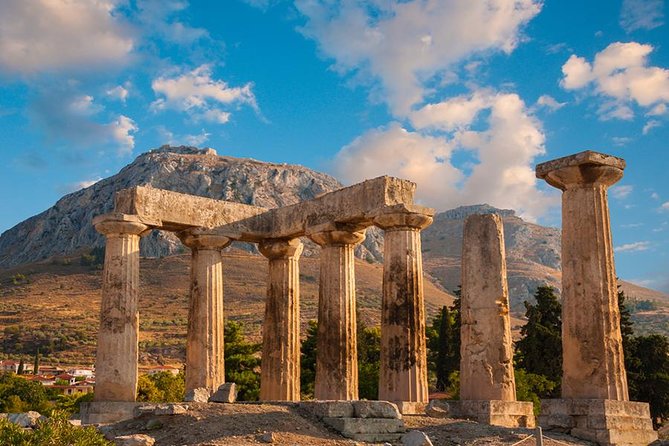
The Corinth portion adds a second layer. Ancient Corinth was a trading center at a strategic crossing between mainland Greece and the Peloponnese. Its location helped connect the western Mediterranean with the Aegean, Asia Minor, and the eastern Mediterranean. That busy commercial setting gives useful context for Paul’s time there.
I like that the day gives you both the biblical connection and the wider Greek story. You are not asked to view Corinth only as a religious stop. You also see why this place mattered as a city, port, market, and crossroads.
A few more Athens tours and experiences worth a look
- All Day Cruise -3 Islands to Agistri,Moni, Aegina with lunch and drinks included
★ 5.0 · 4,958 reviews

Pickup from Piraeus along the Saronic Gulf
The day begins around 8:00 a.m. at your Athens hotel or cruise ship pier. At a hotel, meet the driver at the main entrance. At Piraeus, walk outside the terminal exit, where the driver waits with a sign bearing your name.
The first drive follows the coast of the Saronic Gulf. The route offers a look at Piraeus and the Athens Riviera before turning toward the city’s ancient center. This opening ride is part of the appeal for cruise passengers, since you do not need to arrange a separate taxi or worry about finding transport back to the ship.
If you are arriving by cruise ship, provide the ship name, docking time, disembarkation time, and re-boarding time when booking. The eight-hour duration is approximate, so you should leave a sensible margin before sailing. The tour returns to the same hotel or port pickup point.
The vehicle is air-conditioned and sized for your group. Fuel, road tolls, local taxes, bottled water, and port pickup are included. Airport transfers from Athens International Airport can be arranged for an extra charge.
Acropolis: major monuments, limited guided access
The Acropolis is the day’s biggest ancient sight and requires the most energy. The route includes the Propylaea, Temple of Athena Nike, Parthenon, and Erechtheion. The visit is divided into short listed stops, but in practice you should think of it as one substantial Acropolis visit.
The Propylaea forms the monumental gateway to the sacred hill. The current structure was built during the building program of Pericles between 437 and 432 BC, though the plan was never fully completed. Its position on the western approach helps you understand how the Acropolis controlled the visitor’s first view of the sanctuary.
The small Temple of Athena Nike sits on a bastion at the southwestern edge. Built in the late fifth century BC, it honored Athena as a bringer of victory. Its location is especially striking because the temple sits above the approach, with open views beyond the walls.
Then comes the Parthenon, the central image of ancient Athens. Built in the mid-fifth century BC for Athena Parthenos, it was part temple, part civic statement, and part treasury for the Delian League. You can study its Doric columns, sculptural program, and position on the hill, but much of the pleasure comes from stepping back and seeing how the building works with the rock beneath it.
The Erechtheion is best known for its Caryatid Porch. Five of the original maidens are now in the Acropolis Museum, replaced on the hill by replicas. A sixth was taken by Lord Elgin and is displayed in the British Museum. This is a useful detail to know before visiting, since the porch you see on the Acropolis is not made up entirely of the original figures.
Admission fees are not part of the tour price. The driver can bring you to the entrance and explain the background, but tour drivers are not allowed to accompany you inside as official site guides. If you want continuous commentary among the monuments, request a licensed state guide at an additional cost. Availability is not guaranteed on the day, so arrange this ahead of time.
The Acropolis requires a moderate level of fitness. Expect exposed areas, uneven stone, and uphill walking. Wear sensible shoes, bring water, and treat the formal dress requirement seriously, especially if you want the day to feel respectful at religious and historic sites.
The Areopagus and Paul’s famous speech
The Areopagus sits beside the Acropolis exit, so it is an efficient stop. It is also the most direct Paul-related site in Athens.
In classical Athens, the hill was linked with the Council of Nobles and a judicial court that dealt mainly with homicide. Older myths connect it with the trial of Ares and with the case of Orestes. By Paul’s time, the location carried political, legal, and religious associations.
Paul’s sermon about an unknown god is commemorated by a bronze plaque at the foot of the rock. The stop takes only about 20 minutes, but it can be one of the most meaningful moments for Christian visitors. You can pause here, read the text, and look toward the city Paul addressed.
Do not expect a chapel, museum, or reconstructed preaching platform. This is an open rocky site, and the connection comes from the setting and the story. Your driver can explain the context before you explore it on your own.
Ancient Agora: the everyday city behind the monuments
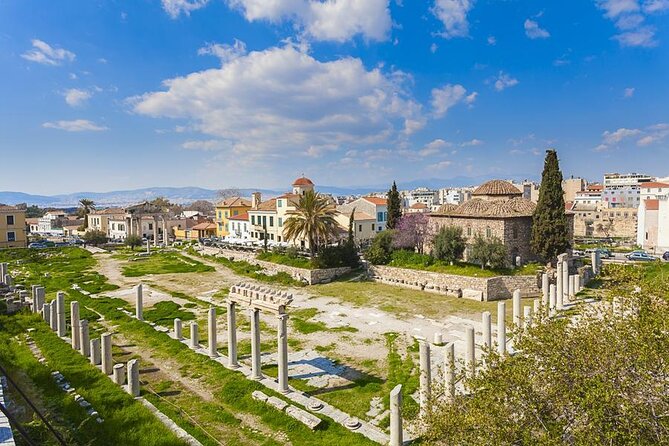
After the Acropolis, the route continues to the Ancient Agora. The listed visit lasts about an hour and 20 minutes, with roughly 20 minutes of travel from the Acropolis.
The Agora was not just a market. It was a gathering place for public life, trade, civic discussion, and daily business. The area was used for about 5,000 years, with layers from Archaic, Greco-Roman, and Byzantine periods. Excavation has exposed the changing functions of this central part of Athens.
I find the Agora useful because it balances the grandeur of the Acropolis. The Parthenon shows Athens at its most ambitious. The Agora helps you imagine how people conducted ordinary public life below the sacred hill.
Again, admission is extra, and the driver does not accompany you inside. If you have a particular interest in Paul, early Christianity, or ancient civic life, prepare a short list of topics in advance. That will help you use your time well once you enter independently.
- All Day Cruise -3 Islands to Agistri,Moni, Aegina with lunch and drinks included
★ 5.0 · 4,958 reviews





The road to Corinth and the Corinth Canal
The drive toward Corinth follows the Saronic Gulf and continues across the Isthmus of Corinth into the Peloponnese. The trip takes you from the dense center of Athens into a broader rural setting, with the sea and coastal road providing a pleasant change of pace.
The Corinth Canal is a quick but worthwhile stop, usually about 15 minutes. The modern canal is 6.4 kilometers long and only about 25 meters wide. It cuts through the isthmus at sea level and separates the Peloponnese from mainland Greece, effectively making the peninsula an island.
The canal dates from the late 19th century, but the idea is far older. In the sixth century BC, Periander of Corinth considered cutting through the isthmus. Instead, the ancient diolkos allowed ships to be hauled across on wheeled platforms. The canal stop makes the geography easy to understand and explains why Corinth became so important.
The tour material also points to Peloponnesian wine, including Moschofilero from Mantinia and Agiorgitiko from Nemea. Wine is not included, and this is not presented as a dedicated winery visit, but the regional detail can add interest to the drive.
Lunch in Ancient Corinth, with your own choice of restaurant
Lunch is free time at a traditional restaurant in or near Ancient Corinth. Food and drinks are not included, so budget separately.
This is a useful pause after a long morning of walking. You can choose what suits your group rather than being locked into a prepaid menu. One route described by the service includes a restaurant with a view toward the sea, though the exact restaurant depends on the day and your driver’s recommendation.
The flexible stop also leaves room for shopping in Corinth. Keep an eye on the clock, since the day includes a long return drive to Athens or Piraeus. A relaxed lunch is pleasant, but an extended meal can reduce your time at Ancient Corinth.
Ancient Corinth and the setting of Paul’s work
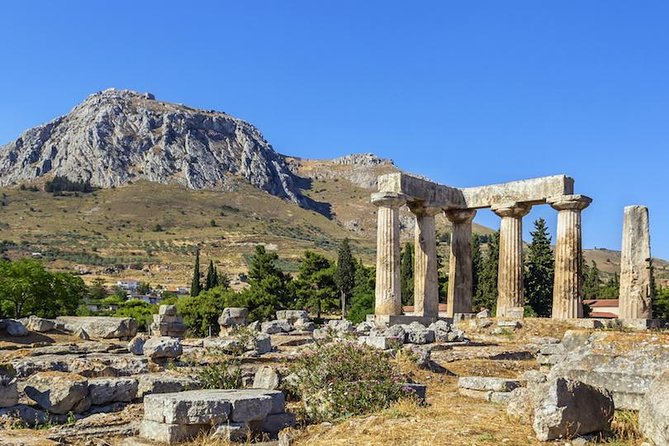
Ancient Corinth is about 20 minutes from the canal. Plan on roughly an hour and 20 minutes at the archaeological area, though your exact time depends on traffic, lunch, tickets, and your pace.
The city was inhabited as early as the Neolithic period. Its fertile soil helped support growth, but geography mattered even more. Corinth controlled routes between the Balkan peninsula, mainland Greece, and the Peloponnese, while nearby waterways linked different parts of the Mediterranean.
By the eighth century BC, Corinth had founded colonies such as Corfu and Syracuse. That wider network helps explain the city’s commercial reach and the mix of people Paul would have encountered there.
For a Christian visitor, the ancient city gives physical scale to Paul’s Corinthian ministry. You are walking through the remains of a place shaped by trade, movement, social divisions, and competing religious traditions. The biblical account feels more grounded when you can see the city’s streets and public spaces rather than treating Corinth as an isolated church-history name.
The archaeological entry fee is extra. Your driver can explain the site before you enter and point out the key areas, but you explore inside without official guiding unless you arrange a licensed guide.
Some groups also add a drive up to Acrocorinth, the large fortified hill above the ancient city. This was included as a customization for one group, but it is not listed as a standard stop. Ask in advance if you want to know if it can fit your schedule. Do not assume it will be possible on every departure.
What the private format is really worth
At $508.66 per group of up to three, this is a premium day rather than a budget excursion. Shared by three people, the transport cost is about $169.55 per person before entrance fees, lunch, and any licensed guide. For two people, the per-person cost rises, but the privacy and port pickup may still make sense.
The strongest value comes from convenience and control. You get a private air-conditioned vehicle, hotel or port pickup, a driver focused only on your group, and the ability to adjust the pace within the available hours. Past groups were able to spend extra time at ruins, add an Athens drive past the Temple of Olympian Zeus, National Gardens, and the Unknown Soldier, and make a photo stop near Acrocorinth.
The weak point is the guiding arrangement. If you expect a guide to walk through every monument and explain each detail, the base price may feel incomplete. Add the cost of a licensed guide if that kind of interpretation matters to you, and pre-purchase site tickets so you do not lose time at the entrances.
The driver names associated with this service include Spyros and Dimitris, with prompt pickup and good communication noted for both. Natalie and Nathaniel are also connected with the operation. Your assigned driver may be different, but the practical point is clear: confirm the pickup details and tell the company what you most want from the day.
Timing, tickets, and who should book
This is a full eight-hour schedule with several major sites and substantial driving. The listed stop times add up to a demanding day, and some of the timing is approximate. I would not book this expecting a slow, detailed examination of every monument.
You should book it if you want to connect Athens and Corinth in one private outing, especially from a cruise ship. It suits Christian visitors who want Paul’s story placed within ancient Greek history, couples or families who value a flexible vehicle, and small groups that can share the fixed price.
You may prefer a different arrangement if your main goal is an expert-led Acropolis visit. In that case, add the licensed guide or choose a tour that includes one from the start. You should also think twice if you dislike early starts, long drives, or walking over uneven ancient paving.
Free cancellation is available when you cancel at least 24 hours before the start time. Changes or cancellations inside that window are not accepted for a refund.
Should you book this Athens and Corinth tour?
Book this tour when Paul’s Athens and Corinth are your priority and you want a private day that handles the transport between them. The Areopagus and Ancient Corinth provide the strongest Christian focus, while the Acropolis and Agora give the day wider historical depth.
Before paying, decide if you need a licensed guide inside the sites, price the separate entrance tickets, and allow extra money for lunch. If you prepare for those additions, the tour offers a practical way to connect two important places without arranging several transfers yourself.
FAQ
How long does the Christian tour from Athens to Corinth last?
The tour lasts approximately eight hours and begins at about 8:00 a.m. It returns you to the same hotel or Piraeus cruise port pickup point.
Can I be picked up at the Piraeus cruise port?
Yes. Cruise passengers are picked up outside the terminal exit, where the driver waits with a sign showing your name.
Is the tour private?
Yes. Only your group participates, with a maximum of three people included in the listed group price.
Are Acropolis and Corinth entrance fees included?
No. Entrance fees for the archaeological sites and museums are not included. Advance ticket purchase is recommended because availability may be limited.
Does the driver guide me inside the archaeological sites?
No. The English-speaking driver provides historical and cultural information until you enter the sites. Drivers are not licensed to accompany you inside. A state-licensed guide can be arranged for an extra cost, subject to availability.
Is lunch included?
No. Lunch and drinks are not included. You have free time to eat at a traditional restaurant in Ancient Corinth.
What information must cruise passengers provide when booking?
Cruise passengers must provide the ship name, docking time, disembarkation time, and re-boarding time. This helps the operator plan the pickup and return to the port.
You Might Also Enjoy

More Full-Day in Athens
- All Day Cruise -3 Islands to Agistri,Moni, Aegina with lunch and drinks included
★ 5.0 · 4,958 reviews