REVIEW · ATHENS
Full Day Private Of Athens Highlights of Classical &Modern Athens
Book on Viator →Operated by Yomadic.Tours & Transfers · Bookable on Viator
Athens gives you ancient temples, Olympic history, lively markets, and a modern capital in one compact day. The main prize is the Acropolis and Parthenon, but the tour also takes you to the Panathenaic Stadium, Syntagma Square, Mount Lycabettus, Plaka, and other major sights.
I like the private vehicle and flexible plan, especially for families or cruise passengers with a ship to catch. I also like the practical touches: cold bottled water, Wi-Fi, air-conditioning, and pickup at your hotel or cruise port. The catch is that admission tickets are mostly extra, and six hours is not enough for a proper visit inside every site listed.
In This Review
- Key points to know before booking
- Why a private Athens day can work so well
- Reaching the Acropolis and Parthenon
- Acropolis Museum: a smart follow-up visit
- Olympic Athens at the Panathenaic Stadium
- Syntagma Square and the Evzones
- Plaka, Agora, and Monastiraki
- Mount Lycabettus and the city from above
- Temple of Olympian Zeus and the Roman chapter
- Vouliagmeni and Mikrolimano: optional coastal flavor
- Price, extra tickets, and overall value
- Who will get the most from this tour
- Should you book this Athens private tour?
- FAQ
- How long does the Athens private tour last?
- Where can pickup and return take place?
- Is airport pickup included?
- Is an official guide included?
- Are attraction tickets included?
- Can the itinerary be changed?
- What vehicle will the group use?
Key points to know before booking
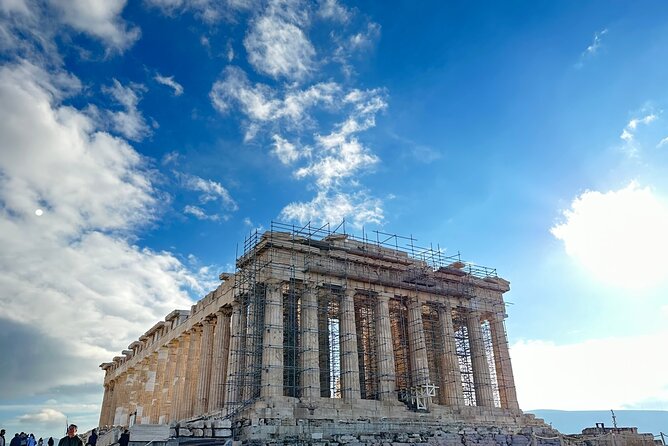
- The Acropolis takes center stage: You see the Parthenon, Propylaea, Temple of Athena Nike, Erechtheion, Theatre of Dionysus, Odeon of Herodes Atticus, and Areopagus.
- Your driver is not a licensed site guide: You receive English commentary in the vehicle and answers to questions, but the driver does not enter archaeological sites with you.
- The tour is built for flexibility: You can ask to include or skip sites, which helps if your group has children, limited mobility, or a tight cruise schedule.
- The itinerary mixes major sights with city views: Syntagma Square, the changing of the guard, Monastiraki, Plaka, Mount Lycabettus, and the Temple of Olympian Zeus round out the ancient sites.
- Plan for extra costs: The Acropolis, Acropolis Museum, Ancient Agora, Panathenaic Stadium, and other attractions require separate payment if you go inside.
- Bring water and sun protection: One family logged more than 10,000 steps, and Athens heat can feel stronger than expected on exposed marble.
Why a private Athens day can work so well
A private tour is useful in Athens because the city’s top sights are spread across busy streets, steep hills, and crowded pedestrian areas. Instead of working out taxis, metro connections, parking, and cruise-port timing, you have a driver moving your group between the main stops.
This is especially helpful if you arrive by ship at Piraeus. The tour is designed around pickup and return to the port, with enough structure to see the main sights without leaving you to manage the clock alone. You can also begin from an Athens hotel, apartment, or another agreed location.
The vehicle depends on group size. Groups of one to three use a sedan, while groups of four to seven use a minivan. Larger groups can be placed in a suitable vehicle, including a minibus. All vehicles are air-conditioned, nonsmoking, insured, and approved for tourist use.
I like the way this setup keeps the day personal. You are not joining a large coach group and waiting for dozens of people at every stop. If your children need a shorter visit at a museum, or you would rather spend more time at the Acropolis than at a market, you can request a change.
There is one important limit. This is not the same as hiring an official archaeologist or licensed guide. The English-speaking driver can explain the city and answer questions, but does not go inside the archaeological sites with you. If you want detailed commentary among the ruins, you can request a licensed guide for an additional fee listed as €250 per person.
You can also read our reviews of more private tours in Athens


Reaching the Acropolis and Parthenon
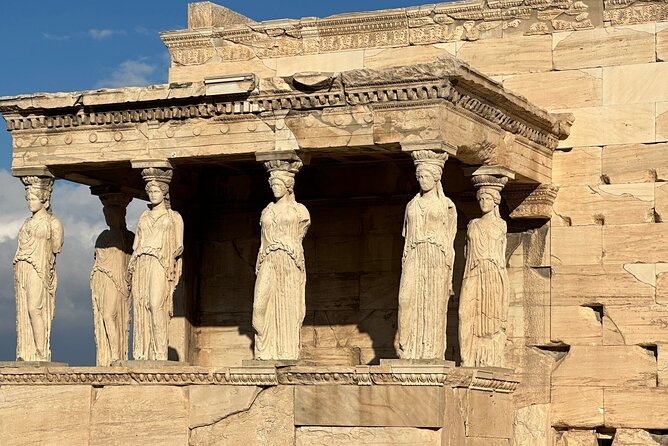
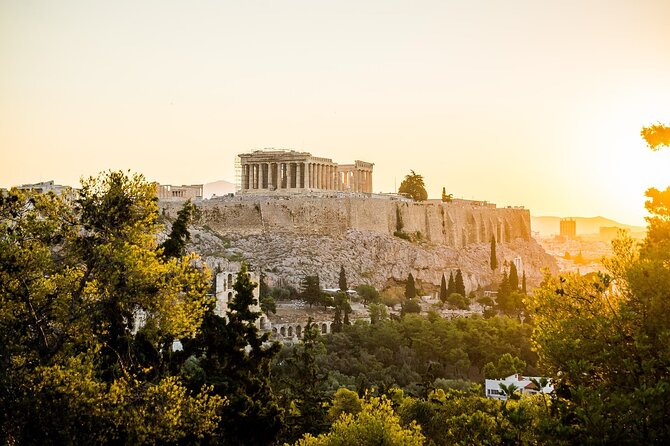
The day’s central experience is the Acropolis, the high rock above Athens. The word means upper city, and the site still feels like the city’s natural anchor. From the summit, you look across Athens while walking among buildings that shaped Western political thought, drama, architecture, and philosophy.
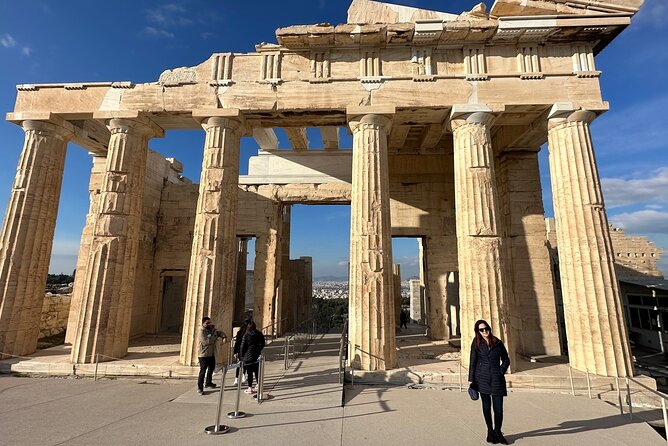
The approach begins at the Propylaea, the grand gateway commissioned during the rebuilding of the Acropolis under Pericles after the Persian Wars. Even before you reach the Parthenon, this entrance gives you a sense of the scale and ambition of ancient Athens.
Inside the Acropolis area, you can see the Temple of Athena Nike, built around 420 BC. Its position on a steep bastion beside the entrance makes it one of the first details you notice. The small temple was dedicated to Athena as Nike, or victory.
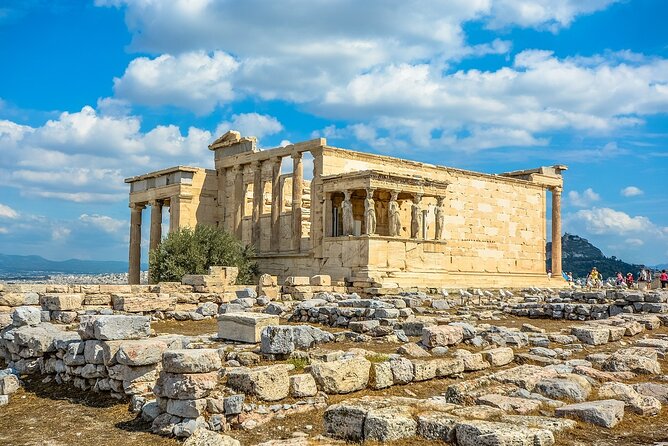
The Erechtheion provides a different kind of beauty. Its famous Caryatids, the sculpted Maidens supporting the Porch of the Maidens, are among the most recognizable figures on the hill. The original statues are protected, with museum displays helping you understand the details more closely.
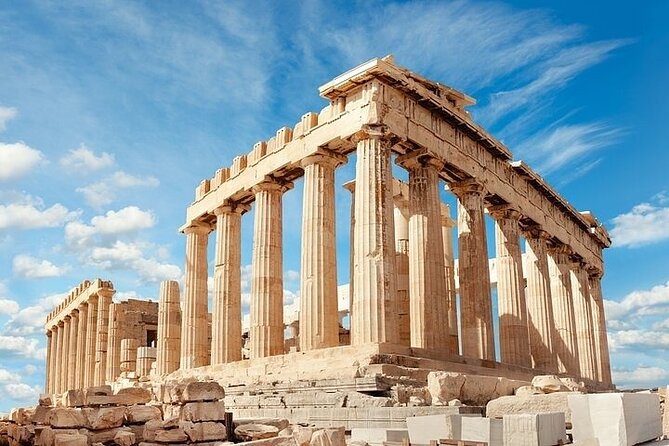
The Parthenon is the main event. Dedicated to Athena Parthenos, it is less a complete building today than a powerful arrangement of columns, marble, and open sky. Time, war, pollution, and restoration have altered it, but the surviving structure remains remarkably legible.
Your Acropolis visit also includes views of the Odeon of Herodes Atticus and the Theatre of Dionysus on the south slope. The Theatre of Dionysus is linked to the City Dionysia and could hold up to 17,000 people in its later form. This is the place to remember that ancient Athens was not only a city of temples. It was also a city of public performance, debate, and civic ceremony.
The Areopagus, or Mars Hill, is another likely sight along the route. It offers a different angle toward the Acropolis and the surrounding city. The rock is uneven and exposed, so wear shoes with a firm grip and take care on the stone.
The listed visit times for the Acropolis and Parthenon are about 45 and 55 minutes. Those times are useful for a cruise-day overview, but they are short if you want to read every sign, take your time with the views, and explore the slopes. I would treat this as a focused first visit, not a full archaeological study.
The Acropolis entrance ticket is not included. The supplied pricing lists it at €30 per person. Check current rates and entry arrangements before you go, since ticket rules can change.
Acropolis Museum: a smart follow-up visit
The Acropolis Museum sits at the foot of the Sacred Rock and gives you a clearer look at objects and sculpture connected with the site. The museum’s displays include Parthenon marble and finds from excavations on the Acropolis.
This stop matters because the hill itself can be hard to interpret. At the Acropolis, you are looking at buildings from a distance, often among scaffolding, crowds, and bright sunlight. In the museum, you can study details at close range and connect them to the temples you have just seen.
The planned museum visit is about 35 minutes. That is enough for a quick orientation, but not enough for a slow museum visit. The admission fee is listed separately at €20 per person.
The museum works best directly after the Acropolis, while the architecture and statues are fresh in your mind. If your group prefers outdoor views to museum displays, you may choose to skip it and use the time for another stop. That is one of the useful features of a private itinerary.
Olympic Athens at the Panathenaic Stadium
The Panathenaic Stadium, also called the Kallimarmaron, is made almost entirely of Pentelic marble. It hosted the first modern Olympic Games in 1896 and remains tied to the Olympic Flame ceremony.
The stadium began as a natural hollow between the hills of Agra and Ardettos. It was shaped into a stadium by Lycurgus in the fourth century BC for the Great Panathenaia, then rebuilt by Herodes Atticus between AD 140 and 144.
You can appreciate the long connection between ancient athletic festivals and the modern Olympics here. The curved seating and bright marble also make it one of Athens’ most photogenic stops.
The planned visit is about 20 minutes. You can enter for an additional fee listed at €20 per person, or simply stop for photographs from outside. That choice is sensible on a six-hour schedule, particularly if the Acropolis and museum are your priorities.
Syntagma Square and the Evzones
The tour then shifts from ancient Greece to the modern Greek state at Syntagma Square. The square takes its name from the constitution granted after the uprising of September 3, 1843. The former royal palace now houses the Hellenic Parliament.
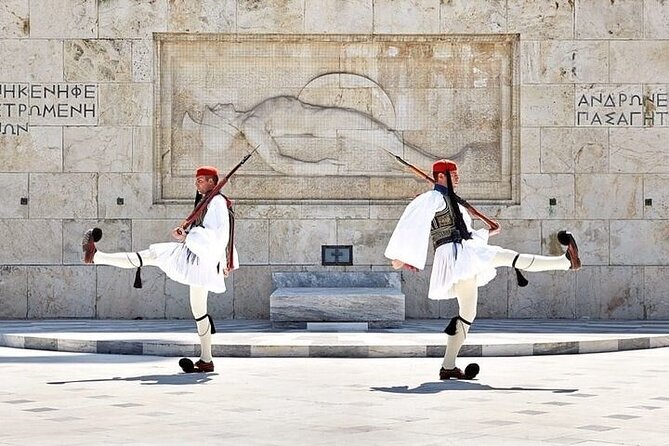
At the Tomb of the Unknown Soldier, you can watch the Evzones, the presidential guards in traditional uniform. The hourly change of guard uses slow, formal movements and takes about 15 minutes. It is not a long event, but it offers a memorable look at an active national ceremony rather than a monument viewed in silence.
Timing matters here. The schedule lists about 10 minutes for the guard ceremony, so your driver may need to adjust the route around the hourly change. Ask about the timing at the start of the day if this is high on your list.
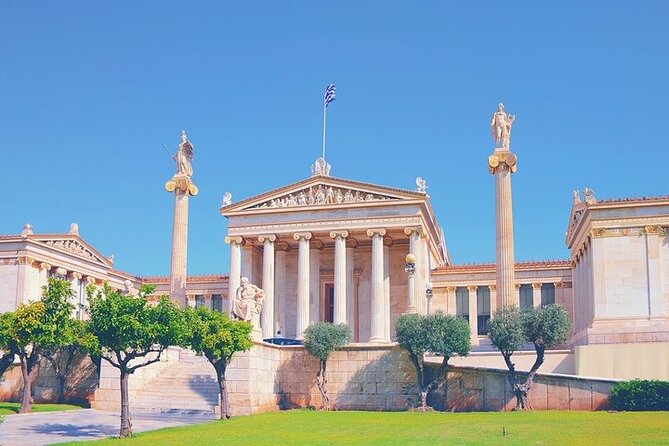
You may also pass the Academy of Athens and the National Library along Panepistimiou Avenue. Their neoclassical facades form part of Athens’ central civic core. These are mainly drive-by sights in this program, so expect a look and perhaps a photo stop rather than an extended interior visit.
A few more Athens tours and experiences worth a look
- All Day Cruise -3 Islands to Agistri,Moni, Aegina with lunch and drinks included
★ 5.0 · 4,958 reviews



Plaka, Agora, and Monastiraki
Plaka occupies the slopes around the Acropolis and is known for its narrow streets, neoclassical buildings, small shops, and archaeological remains. It is a good place to shift gears after a morning of formal monuments. You can browse for handmade goods, souvenirs, and simple Greek food.
The Ancient Agora offers a stronger connection to public life in Athens. It functioned as a commercial, residential, and meeting area and is closely linked with the development of democracy, philosophy, and free speech. The Temple of Hephaestus is one of the best-preserved ancient Greek temples and sits on a rise overlooking the Agora.
The planned Agora visit is about 30 minutes, with admission extra. That is enough to see the main area, but you may want more time if you care about the civic history of Athens. The Roman Agora and Hadrian’s Gate may also appear on the route, depending on how your group shapes the day.
Monastiraki offers a more everyday side of the capital. The flea market, food stalls, and central markets give you a chance to see present-day Athens rather than only its ancient remains. A meal stop can be arranged, but lunch is not included in the tour price.
You can choose a restaurant or taverna for Greek dishes and Mediterranean food, or use the time to explore on your own. Be clear about your preference before the tour begins, since a sit-down meal uses part of a six-hour schedule.
Mount Lycabettus and the city from above
Mount Lycabettus gives you a broad view over Athens and a useful contrast with the Acropolis. From this high point, the city’s ancient core, dense modern neighborhoods, and distant hills come together in one view.
The planned stop is about 15 minutes and admission is free. This is a short photo stop, not a long hill walk or a separate excursion. It is worth keeping if you want the best overall sense of Athens’ size, but it may be one of the first places to cut if your Acropolis visit runs late.
Temple of Olympian Zeus and the Roman chapter
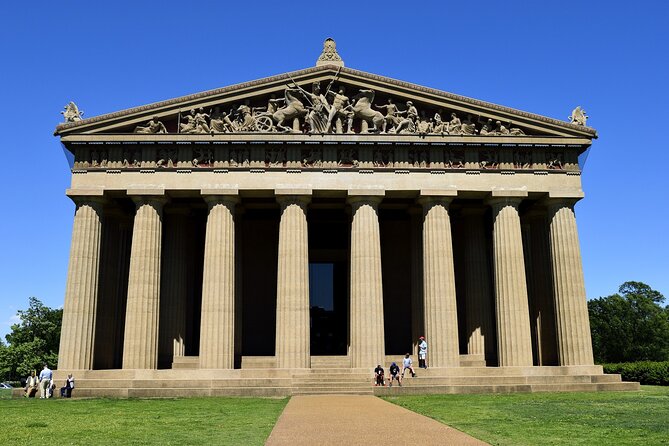
The Temple of Olympian Zeus shows the huge scale of an ancient project that was never fully preserved. The temple had enormous rows of columns and once held a gold-and-ivory statue of Zeus along with a statue of the emperor.
Only 16 columns survive. Even in its ruined state, the remains help you picture the size of the original complex. Hadrian’s Gate nearby marks the meeting of ancient Greek and Roman Athens and makes a good companion stop.
The program allows about 30 minutes here. Entry is listed separately at €20 per person, although the driver can take you to the area for photographs without entering. That outside option is practical if you are already paying for the Acropolis and museum.
Vouliagmeni and Mikrolimano: optional coastal flavor
The route extends beyond central Athens to Lake Vouliagmeni, about 20 kilometers south of the city center. The lake formed after an underground cave collapsed and is fed by thermal springs and seawater. Its mineral-rich water remains around 22 to 29 degrees Celsius year-round.
You can swim there if time, admission, and your clothing plan allow. Small Garra rufa fish are known for nibbling at swimmers’ feet, creating a natural exfoliating effect. The lake also has sunbathing areas and a café.
The scheduled stop is only about 20 minutes, so do not expect a full spa afternoon. I would view this as an optional coastal look, best suited to repeat visitors or groups that want something beyond ancient sites.
Mikrolimano in Piraeus offers another possible change of mood. This small horseshoe harbor has fishing boats, yachts, and seafood restaurants along the waterfront. It can work well as a lunch or dinner setting, but the supplied schedule does not give it a separate timed stop or include meal costs.
Price, extra tickets, and overall value
The advertised price is $179.59 per person. For a private six-hour vehicle with pickup, return, fuel, tolls, air-conditioning, Wi-Fi, bottled water, and an English-speaking driver, that can be fair value when shared by a small group.
The total cost rises quickly if you enter several attractions. The Acropolis is listed at €30, the Acropolis Museum at €20, the Ancient Agora at €20, and the Panathenaic Stadium at €20. The Temple of Olympian Zeus and National Archaeological Museum are also listed at €20 each when entered.
You should decide in advance which two or three sites matter most. A realistic plan might include the Acropolis, Acropolis Museum, and one shorter outdoor stop. Trying to pay for and fully explore everything listed would not fit comfortably into six hours.
Airport pickup costs extra. The information gives two different figures, €45 in one place and €60 per person elsewhere, so confirm the exact amount before booking an airport transfer. Hotel, apartment, and Piraeus cruise-port pickup and return are included within the stated service area.
Tips are not included. The tour also lists an optional licensed guide at €250 per person, although the wording around that fee should be confirmed because the amount is unusually high compared with the base tour.
Who will get the most from this tour
I would recommend this experience to a cruise passenger who wants a private route and a reliable return to the ship. It also fits families, small groups, and first-time visitors who prefer a driver to handle the city while they concentrate on the sights.
It is a good match if you want to combine ancient monuments with modern Athens in one day. You will see the Acropolis, Olympic sites, central squares, markets, viewpoints, and possibly the coast without having to arrange separate transport.
I would be more cautious if you want long, detailed visits inside museums and archaeological sites. The driver does not enter as a guide, and the short stop times favor breadth over depth.
Plan for sun, uneven ground, and plenty of walking. One family counted more than 10,000 steps, even with vehicle transfers. Cold water is provided, but bring extra water if possible, along with a hat, sunscreen, and an umbrella for hot days.
The cancellation policy allows a full refund if you cancel at least 24 hours before the start time. Poor weather can also lead to a new date or full refund. Pickup instructions are straightforward: meet in your hotel lobby, at the entrance of an apartment, or at the designated port gate, usually five to ten minutes early.
Should you book this Athens private tour?
Book it if you want efficient coverage and control rather than a slow specialist tour. The private car, flexible stops, cruise-port planning, and air-conditioning are the real value. Nikos, the driver named in the supplied experience details, arrived on time, supplied cold water, and handled the route in a comfortable van, which reflects the practical standard you should expect from this kind of service.
Choose a different format if your main goal is detailed interpretation inside every monument. In that case, add the licensed guide or book a dedicated Acropolis guide. For most first-time visitors with only one day, though, this tour gives you a useful overview of Athens and lets you decide where to spend your limited time.
FAQ
How long does the Athens private tour last?
The tour lasts approximately six hours.
Where can pickup and return take place?
Pickup and return are available from Athens and Piraeus hotels, residences, apartments, and the Piraeus cruise port. The exact meeting point may change if an apartment is in a pedestrian-only area.
Is airport pickup included?
No. Airport pickup costs extra. The supplied details list an additional charge of €45 in one section and €60 per person in another, so confirm the current amount before booking.
Is an official guide included?
No. The English-speaking driver provides commentary and can answer questions, but drivers do not enter archaeological sites with you. A licensed guide is available as an optional extra.
Are attraction tickets included?
Most attraction tickets are not included. Separate fees are listed for the Acropolis, Acropolis Museum, Ancient Agora, National Archaeological Museum, Temple of Olympian Zeus, and Panathenaic Stadium.
Can the itinerary be changed?
Yes. This is a tailor-made private tour, and you can request that sites be included or skipped. Family groups can also request changes to suit children.
What vehicle will the group use?
Groups of one to three people use a sedan, while groups of four to seven use a minivan. Other vehicle types, including an SUV, taxi, or minibus, may be used to suit the group size. All vehicles are air-conditioned and nonsmoking.
You Might Also Enjoy

More Full-Day in Athens
- All Day Cruise -3 Islands to Agistri,Moni, Aegina with lunch and drinks included
★ 5.0 · 4,958 reviews