REVIEW · METEORA
Meteora Scrambling Tour with Optional Pick-up
Book on Viator →Operated by TREKKING HELLAS · Bookable on Viator
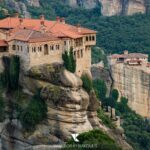
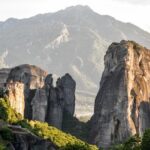
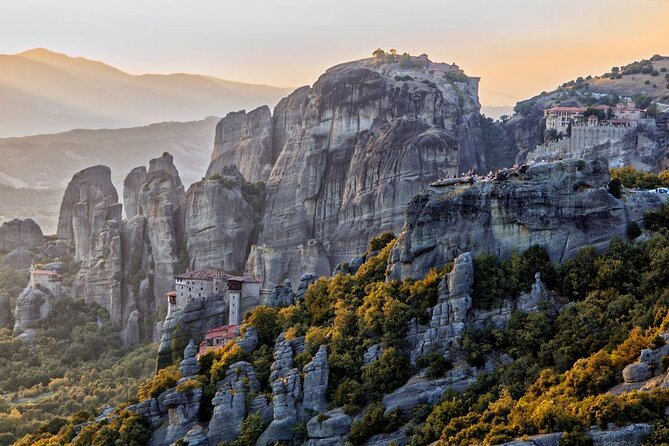
Meteora is famous for its monasteries perched on tall stone pillars, but this tour lets you experience the rocks from inside the formations rather than only viewing them from a road or monastery terrace. After a short uphill walk, you reach the famous needle rock, where your guide fixes the ropes and the real scrambling begins.
I like two things here. First, the guides provide the personal equipment and explain how to use it before you climb. Second, the route finishes at the Holy Cross of Hagia, where a broad balcony looks across the Thessalian plateau, the Pindos Mountains, and Meteora’s giant pinnacles. The main caution is simple: this is a proper physical workout, not a gentle sightseeing walk.
In This Review
- Key points at a glance
- Why this route feels different from ordinary Meteora sightseeing
- Getting fitted for the climb beneath Kimisis Theotokou
- The short uphill path and the first rock challenge
- Ferratas, rock-cut paths, and chimney sections
- Hagia’s Holy Cross and the view from the balcony
- What the $74.65 price includes
- Who should book this three-hour adventure
- Safety, weather, and what to pack
- Pickup, meeting point, and fitting it into your day
- My take on the guide service
- Final decision: is the Meteora Scrambling Tour worth booking?
- FAQ
- Where does the Meteora Scrambling Tour start?
- What time does the tour begin?
- Is pickup available?
- How long does the experience last?
- Is the tour offered in English?
- Is climbing equipment included?
- What level of fitness is required?
- What should I bring?
- What happens if the weather is bad?
Key points at a glance
- Ropes and ferratas at needle rock: Your guide sets the safety ropes before you tackle the more technical sections.
- A three-hour route with a real payoff: The climb ends at Hagia’s Holy Cross and its wide mountain views.
- Equipment and instruction included: You do not need to bring climbing gear, but you do need suitable clothing and shoes.
- Small group, maximum 15 people: The size allows the guide to coach you through the obstacles.
- Moderate fitness is required: The uphill approach, climbing sections, and height gain can be demanding, especially for anyone with knee problems.
- Optional pickup and English service: The meeting point is by the Kimisis Theotokou church, with pickup details sent one day before departure.
Why this route feels different from ordinary Meteora sightseeing
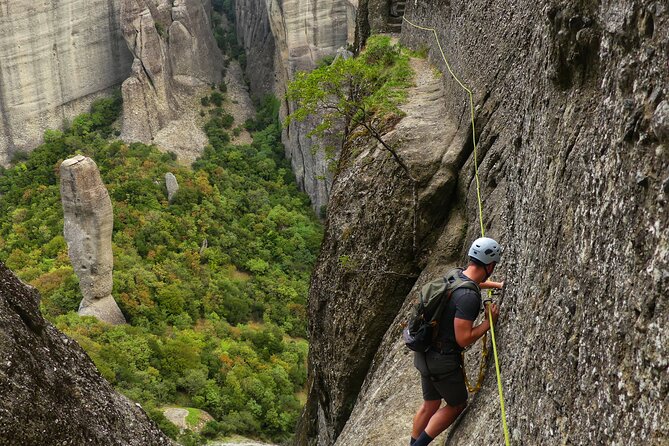
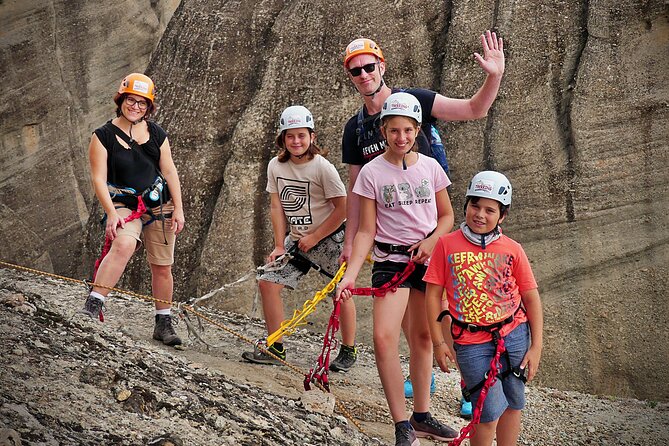
A standard visit to Meteora often means driving between monasteries, walking a few stone steps, and stopping at viewpoints. This outing takes another approach. You use your hands, follow rock-cut paths, pass through chimney-like sections, and clip into ferrata-style routes with help from your guide.
That makes the experience more active and more memorable, but it also changes the commitment. You are not simply signing up for a scenic walk with occasional photo stops. You need to be ready for a short uphill hike followed by a scramble that calls for balance, leg strength, and steady movement.
The route begins beneath the church of Kimisis Theotokou. This is the starting point for the activity, and the tour ends back at the same meeting point. The scheduled start is 9:00 a.m., while the exact pickup time, if you arrange transport, is sent one day before the outing.
The total duration is about three hours. That is long enough to make the physical challenge feel worthwhile, while still leaving much of the day free for monasteries, meals, or another Meteora viewpoint.
You can also read our reviews of more tours and experiences in Meteora.

Getting fitted for the climb beneath Kimisis Theotokou
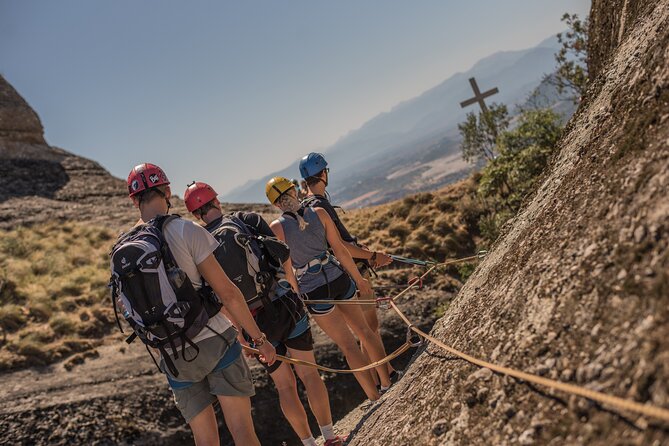
At the meeting point, your guide supplies the personal equipment and explains how to use it. This early briefing matters. Even if you have never tried a via ferrata or scrambling route, you get a chance to understand the gear before reaching the exposed parts of the climb.
The tour is offered in English. The group can include up to 15 people, which is not a private outing, but it is still small enough for a guide to watch the group and offer individual coaching. The supplied information also allows for two guides on some departures, and that can be especially useful when people move at different speeds.
You should arrive prepared rather than hoping to borrow basic hiking items. Bring a small backpack, comfortable clothing, a hat or beanie, sunglasses, sunblock, a waterproof jacket or membrane for rainy weather, and your own water bottle. Quick-drying clothing is preferred. Cotton or polycotton is better than denim, which can feel heavy and restrictive when you are climbing.
Light hiking shoes or hiking boots are recommended. This is not the place for smooth-soled casual shoes. Good footwear will help on the uphill path, uneven rock, and narrow sections where stable footing matters.
The company asks you to bring your own water bottle as part of its effort to avoid plastic water bottles. That is a small practical detail, but it is worth handling before you leave your accommodation.
The short uphill path and the first rock challenge
The approach starts with a short uphill trail between the rocks. This section gives you time to warm up, but do not mistake it for a flat stroll. Your body is already working before the ropes appear, and the later climb adds to that effort.
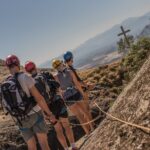
When the group reaches needle rock, the guide fixes the ropes and the scrambling section begins. This is the point where the outing shifts from hiking to hands-on climbing. You will need to follow instructions, use the equipment correctly, and move carefully rather than rush to keep up with the person ahead.
The word scramble is useful here. You are not being promised a long technical rock-climbing session, and the tour is designed to introduce people to climbing and scrambling at different levels. Still, the route includes real obstacles and can feel tough if you are not used to climbing over rock.
One family found the activity hard but worthwhile, while a participant with several knee surgeries could not reach the top. That is important guidance. The guides can be patient and helpful, but they cannot remove the uphill effort or the need to pull, step, balance, and keep moving.
Ferratas, rock-cut paths, and chimney sections
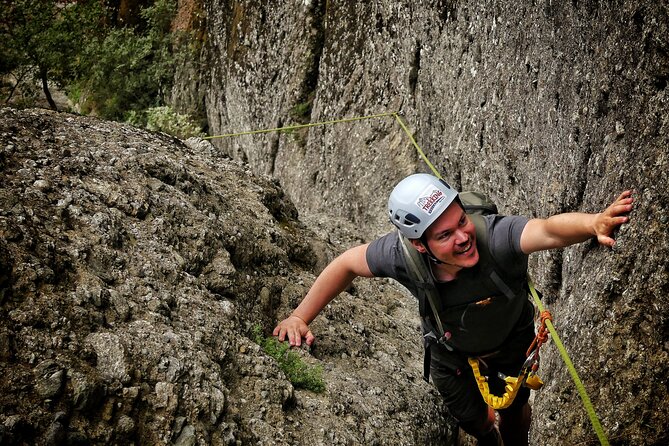
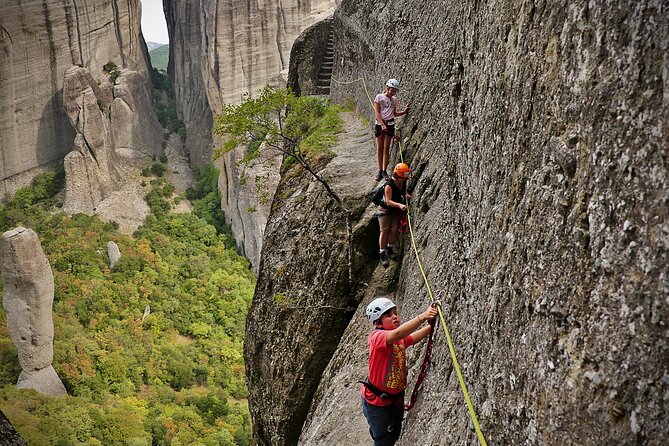
The most distinctive part of the route combines several types of movement. You meet ferratas, paths carved into the rock, and chimney-type climbing sections. Each presents a different problem, so the activity does not become a repetitive walk with a rope attached.
Ferrata sections give you a fixed route through the rock and require careful use of the safety system. The rock-cut paths add a sense of Meteora’s unusual construction and geology, while the chimney sections call for more direct climbing technique. Your guide coaches you through these changes and helps you judge where to place your feet and hands.
This is also where the small group has practical value. A guide can slow down, explain an obstacle again, and help someone who needs more time. Several participants praised the patience of the instructors, especially when coaching people through the more difficult sections.
Do not read that as a promise that every part will feel easy. One participant described the route as a cardiovascular workout, and that is a fair way to plan for it. You may find the climb manageable if you have decent fitness, but the combination of height, rock, and uphill movement can make it tiring.
Hagia’s Holy Cross and the view from the balcony
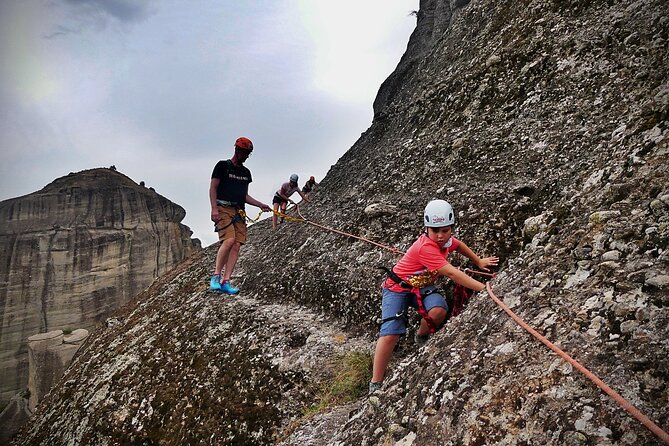
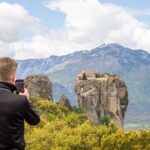
The final stop is the Holy Cross of Hagia. Reaching it gives the route a clear sense of purpose. You are not climbing simply to turn around at an arbitrary point. The destination has a large balcony where you can pause and look over the Thessalian plateau, the Pindos Mountains, and the tall Meteora rock pillars.
This is likely to be the quiet reward after the effort. The view is broad rather than confined to one monastery or one roadside lookout. You see the relationship between the isolated stone pinnacles and the wider mountain country around them.
The balcony also gives you a place to catch your breath and take in what you have just done. The contrast is part of the appeal: a demanding route through rock leads to an open viewpoint above the plateau.
You should still keep your expectations sensible. The tour lasts around three hours, so this is not an all-day mountain expedition, and the information provided does not promise a long break at the top. The main value is the combination of access, movement, instruction, and scenery.

What the $74.65 price includes
At $74.65 per person, the price is higher than a self-guided walk, but that is not the right comparison. A self-guided hike does not provide climbing equipment, rope setup, instruction, route-finding help, or coaching through ferrata and chimney sections.
The fee makes the most sense if you want to try scrambling without bringing your own gear or arranging a private climbing lesson. You are paying for the guide’s route knowledge, safety briefing, equipment, and supervision, as well as access to an active route that would be difficult to approach confidently on your own.
The value is less clear if you only want a view of Meteora. A regular sightseeing plan may suit you better if you dislike heights, have limited mobility, or would rather spend the morning visiting monasteries. This tour earns its price through the activity itself, not through a long duration or a large number of stops.
The maximum group size is 15. That keeps the cost below a private tour, though it also means the pace may be set by the group. If your party includes people with very different fitness levels, ask yourself if everyone will be comfortable with that arrangement.
Who should book this three-hour adventure
I would point this tour toward active adults, older teenagers, and young adults who want a physical way to see Meteora. It also suits families with older children who are comfortable with a demanding outdoor activity. One family of four with children in their upper teens and early twenties considered it one of the best activities of their Greece trip, but the same family also stressed that it was hard.
You do not need to arrive as an expert climber. The activity is built around instruction, and it can work for different ability levels when participants listen carefully and accept a slower pace. The guides are there to coach you through the obstacles, not to assume that everyone already knows climbing technique.
I would be cautious if you have significant knee trouble or poor cardiovascular fitness. A participant with several knee surgeries could not complete the climb, which shows that the route has a real physical limit. The provided requirement is moderate physical fitness, so treat that as a meaningful condition rather than a formality.
This is also a poor match if you want a relaxed morning. The route involves an uphill approach, rock movement, ferratas, and chimney-style sections. Even people who find it not especially difficult may still find it tiring.
Safety, weather, and what to pack
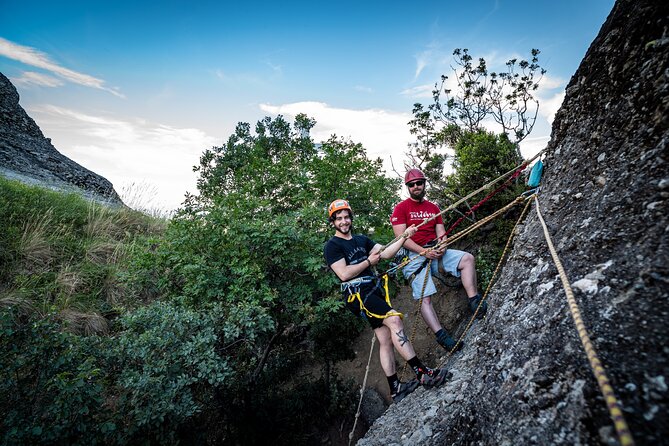
The guide supplies the necessary personal equipment and teaches you how to use it. Ropes are fixed at needle rock before the scramble begins, and safety precautions are part of the activity.
That said, equipment does not replace good judgment. You should follow the guide’s instructions, move at a controlled pace, and use shoes and clothing suited to the conditions. Quick-drying clothing is useful, and a waterproof jacket or membrane is recommended on rainy days.
Weather can affect the departure. The experience requires good weather, so a cancellation caused by poor conditions leads to the choice of another date or a full refund. The activity also requires a minimum number of participants. If that minimum is not reached, you can choose another date or experience, or receive a full refund.
You can cancel for a full refund if you do so at least 24 hours before the local start time. Changes or cancellations made later are not accepted for a refund. Since confirmation is sent within 48 hours of booking and is subject to availability, book with enough time if this is a key part of your Meteora plans.
Pickup, meeting point, and fitting it into your day
Pickup is offered, but the exact pickup time is sent one day before the activity. The listed meeting point is Qastiro Meteoramesohori in Kastraki, at postal code 422 00, Greece, beneath the Kimisis Theotokou church.
The outing begins at 9:00 a.m. and returns to the meeting point when it ends. That makes it fairly easy to pair with other plans later in the day, though you should leave extra time if you want to change clothes, eat, or recover before another demanding activity.
The meeting point is near public transportation. If you do not use the optional pickup, check how you will reach the church before the morning of the tour. The pickup details arriving one day ahead are useful, but you should not leave all transport planning until the last minute.
Because the route returns to its starting point, you do not need to arrange a separate pickup at the end. That is helpful in Meteora, where the rock formations and villages can make point-to-point planning less simple.
My take on the guide service
The strongest part of the experience is the hands-on instruction. The guides are described as patient, and that matters more here than a long lecture about the region. You need clear directions at the moment you face an obstacle, especially if this is your first time using climbing equipment.
The guiding also adds local context. Your guide shares information about the area and personal experience, so the route is more than a series of physical tasks. One departure had two guides who also explained the history of the region during the outing.
Do not expect a formal monastery tour. The focus is scrambling, safety, and outdoor movement, with regional stories added along the way. If you want detailed religious history inside the monasteries, plan a separate visit.
Final decision: is the Meteora Scrambling Tour worth booking?
Book it if you want to feel the rock under your hands, learn basic scrambling skills, and earn a wide view from Hagia’s Holy Cross. The equipment, instruction, English service, small maximum group, and three-hour format make the $74.65 fee reasonable for an organized first climbing experience.
Skip it if your knees are unreliable, your fitness is limited, or your ideal Meteora morning involves easy paths and monastery interiors. The scenery is a reward, but the physical challenge is the point of the tour.
For active families and anyone who finds a viewpoint more satisfying after a climb, this is a strong choice. Bring proper shoes, water, sun protection, and a waterproof layer, and treat the moderate fitness warning seriously.
FAQ
Where does the Meteora Scrambling Tour start?
It starts beneath the church of Kimisis Theotokou at Qastiro Meteoramesohori, Kastraki 422 00, Greece.
What time does the tour begin?
The scheduled start time is 9:00 a.m.
Is pickup available?
Yes. Pickup is offered, and the exact pickup time is sent one day before the activity.
How long does the experience last?
The activity lasts approximately three hours and ends back at the meeting point.
Is the tour offered in English?
Yes. English is the listed language for the experience.
Is climbing equipment included?
Yes. The guide provides the necessary personal equipment and explains how to use it.
What level of fitness is required?
You should have a moderate level of physical fitness. The route includes a short uphill hike, scrambling, ferratas, rock-cut paths, and chimney-style climbing sections.
What should I bring?
Bring a small backpack, comfortable quick-drying clothing, light hiking shoes or hiking boots, a hat or beanie, sunglasses, sunblock, a waterproof jacket or membrane for rainy days, and your own personal water bottle.
What happens if the weather is bad?
If poor weather causes the activity to be canceled, you will be offered another date or a full refund. You can also cancel for a full refund when you cancel at least 24 hours before the local start time.