REVIEW · ATHENS
Mycenae, Epidaurus, Nafplio private tour from Athens
Book on Viator →Operated by My Athens Transfers · Bookable on Viator
Mycenae and Epidaurus, all in one day. This private tour is built for time-saving Peloponnese sightseeing, with an air-conditioned car, Wi-Fi, and an English-speaking driver. I especially like the Nafplio free time built in for lunch, strolling, and castle views. One thing to plan for: the big site entrances are not included (you’ll buy tickets on-site).
You also get the comfort of a true private setup. Your driver picks you up and returns you to the same place (or another preferred point), and the timing is adjustable based on what works for your day. It’s a smart way to see a lot without feeling like you’re rushing a group tour.
The driver doesn’t go inside the archaeological sites with you, but they can answer questions in fluent English along the way. If you want a licensed guide inside the museums and sites, there’s an option to request one depending on availability.
In This Review
- Key Highlights That Make This Tour Work
- A Private Athens to Peloponnese Day With a Driver, Wi‑Fi, and Real Time in Town
- Corinth Canal: A Short Stop With a Big “Wait, That’s Real” View
- Mycenae’s Lion Gate and the Bronze Age Fortress Layout
- What you should expect in the Mycenae archaeological area
- Treasury of Atreus and the Museum: When You Want the Extra Layer
- A practical tip for this part of the day
- Epidaurus Theatre and the Asklepios Sanctuary
- The museum stop is optional in your priorities, but worth it if you like artifacts
- The sanctuary gives you the “why” behind the site
- Nafplio Free Time: Where You’ll Actually Feel Like You Left Athens
- Use Nafplio in a “choose your effort” way
- Price and Value: What $560.23 Covers (and What You’ll Pay On-Site)
- Who This Private Tour Is Best For
- Should You Book This Mycenae, Epidaurus, and Nafplio Private Tour?
- FAQ
- How many people can join this private tour?
- What’s the duration of the tour from Athens?
- Do you get hotel pickup and drop-off?
- Is Wi-Fi and air-conditioning included?
- Are entrance fees included for Mycenae and Epidaurus?
- Do you have a licensed guide on this tour?
Key Highlights That Make This Tour Work
- One-day efficiency: Mycenae and Epidaurus in a single run from Athens
- Comfort + connection: air-conditioned private vehicle and Wi-Fi on board
- English commentary without a crowd: your driver explains what you’re seeing
- Nafplio downtime that matters: real free time to eat, shop, and wander
- Bronze Age-to-medicine contrast: fortresses at Mycenae, then Asclepius at Epidaurus
- Ticket costs you can control: buy on-site for the main paid museums and sites
A Private Athens to Peloponnese Day With a Driver, Wi‑Fi, and Real Time in Town
This is the kind of day trip that only works because it’s private. You’re paying for a car and driver to handle the long in-between stretches, so you can spend your limited daylight on the monuments themselves. The total day runs about 8 to 9 hours, which is a busy schedule, but it’s manageable when you’re not also fighting public transit, transfers, and time lost to logistics.
The vehicle is air-conditioned, and it includes Wi-Fi and bottled water. That sounds small, but on a full-day route it makes a difference—especially in warmer months when you’ll be in and out of cars, then climbing stairs or walking uneven paths at the sites.
I also like that pickup is flexible. Since it’s private, you can usually request an adjustment to the start time. Your driver waits in the hotel lobby, at your apartment entrance, at the airport arrival hall, or at the port gate with a name sign—so you’re not playing meeting-point roulette.
You can also read our reviews of more private tours in Athens



Corinth Canal: A Short Stop With a Big “Wait, That’s Real” View
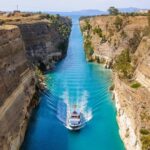
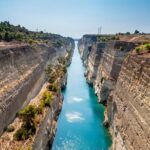
The tour breaks the drive with a quick 15-minute stop at the Corinth Canal. This isn’t a deep museum stop. It’s more like a reset button: you stretch your legs, look out over the narrow passage, and get that instant sense of scale.
What you’re seeing matters: the canal connects the Gulf of Corinth with the Saronic Gulf, cutting through the Isthmus of Corinth. The description you’ll hear is the kind that makes your brain click—this canal is 6.4 km long, and it’s only 21.4 meters wide at its base, which is why many modern ships can’t pass.
From the viewpoint area high up, you get the best angle to watch vessels navigating their way through the canal. It’s a quick photo moment, but it’s also a good way to understand where you are before you dive into the ancient sites.
Mycenae’s Lion Gate and the Bronze Age Fortress Layout
Mycenae is the main event for mythology fans and architecture nerds alike. Your time here is broken into focused chunks—so you’re not trying to see everything at once in a single blur.
You start with an overview stop at Mycenae (about 10 minutes). This is where you connect the site to the stories: the fortified citadel linked to King Agamemnon, plus reminders that Mycenae wasn’t just a legend—it was a major power in the second millennium BC. You’ll also hear about Mycenaean influence across southern Greece, Crete, the Cyclades, and parts of southwest Anatolia.
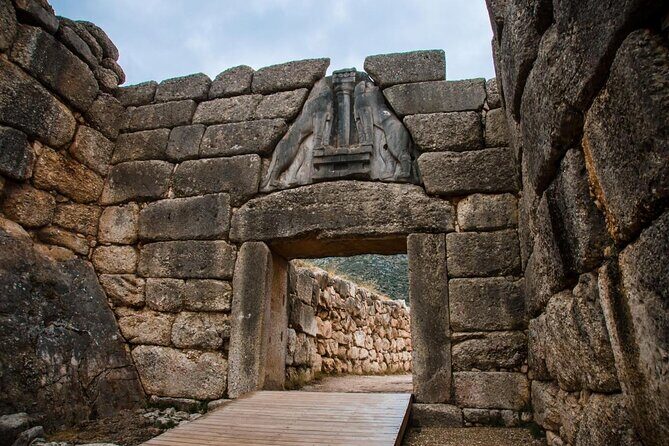
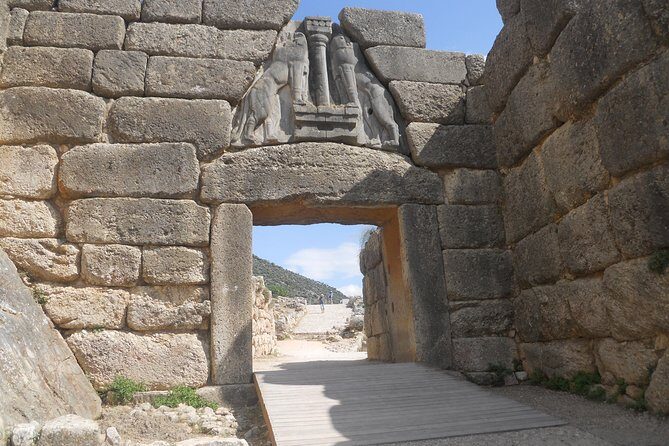
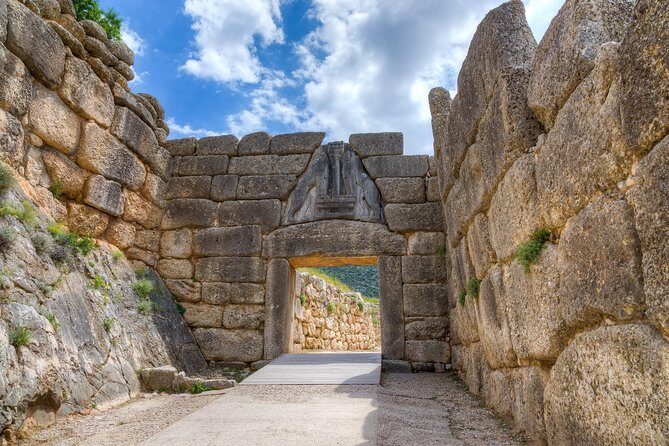
Then you move into the parts of the archaeological area where you’ll want to slow down. The Lion Gate is the star for first-time visitors. It’s the main entrance to the Bronze Age citadel and is famous for the carved relief above the doorway—lionesses or lions in a heraldic pose. Even if you don’t know the technical terms, you’ll recognize the significance fast. This is described as the sole surviving monumental piece of Mycenaean sculpture, plus the only Bronze Age Greece relief motif that remained known before modern archaeology because it wasn’t buried.
The Lion Gate stop is short (about 15 minutes), but it’s perfect for orientation. Standing there, you can picture how the citadel was defended and why power was displayed right at the entrance.
What you should expect in the Mycenae archaeological area
You’ll also have time at the Archaeological Site of Mycenae (about 40 minutes). This is where you see the fortified acropolis and the surrounding funerary and habitation areas. Most visible monuments come from the period 1350 to 1200 BC, so your visit is mostly stepping into that peak era.
You’ll learn about the Cyclopean walls and the overall layout—an almost triangular acropolis, reached through that Lion Gate entrance from the northwest. If you enjoy being able to map the place in your head, this structured stop is really helpful.
Budget note for Mycenae: some parts are listed as free and some are tied to ticketed entry. Practically, you should expect you’ll buy tickets on-site for the major Mycenae archaeological entry and the connected museum/tomb areas (more on cost later).
Treasury of Atreus and the Museum: When You Want the Extra Layer
If you only view the ruins from the outside, you’ll still have a great day. But Mycenae really clicks when you get a closer look at what people built to honor the dead and how they preserved the evidence.
The Treasury of Atreus (also called the Tomb of Agamemnon) sits on Panagitsa Hill and is a tholos or beehive tomb, built around 1250 BC. Your stop is about 15 minutes here, which is enough to see the doorway and the scale that makes this tomb famous. The details you’ll hear are the kind that stop you: the lintel above the doorway is described as weighing 120 tons, with huge dimensions.
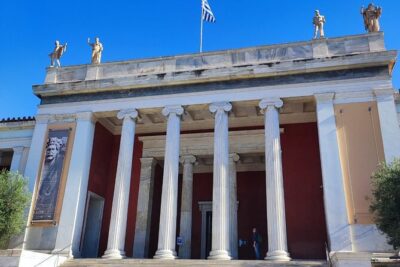
There’s also a museum element: the Archaeological Museum of Ancient Mycenae (about 40 minutes). This museum is known for reconstructions—especially temples, plus columns and inscriptions. That matters because without it, you might read the ruins as fragments. With the reconstructed context, you’ll understand how pieces relate to each other.
- All Day Cruise -3 Islands to Agistri,Moni, Aegina with lunch and drinks included
★ 5.0 · 4,958 reviews




A practical tip for this part of the day
Museums work best when you have a plan. Aim for the main rooms that connect to what you saw outside: the monumental entrance symbolism, the tomb structure, and the inscription/column themes. With only about 40 minutes, you’ll get more out of the visit if you focus on what answers your questions, like how Mycenae showed power and belief.
Epidaurus Theatre and the Asklepios Sanctuary
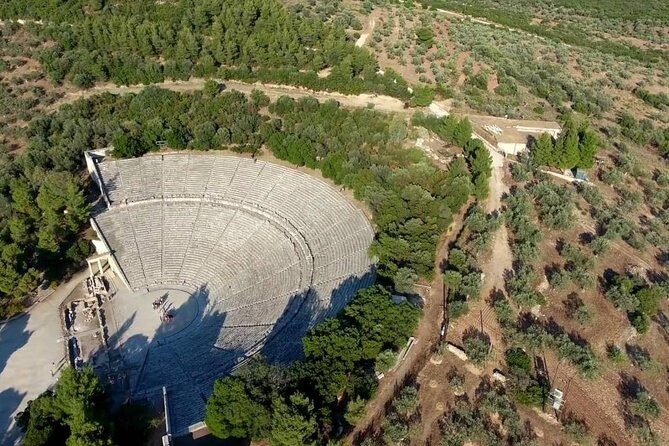
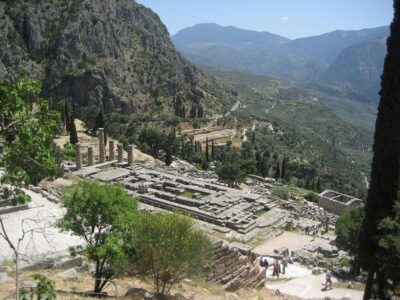
Then you shift from fortress to healing. Epidaurus feels different the moment you arrive. The setting is tied to the sanctuary of Asclepius, the god of medicine.
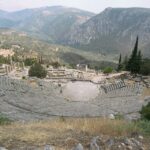
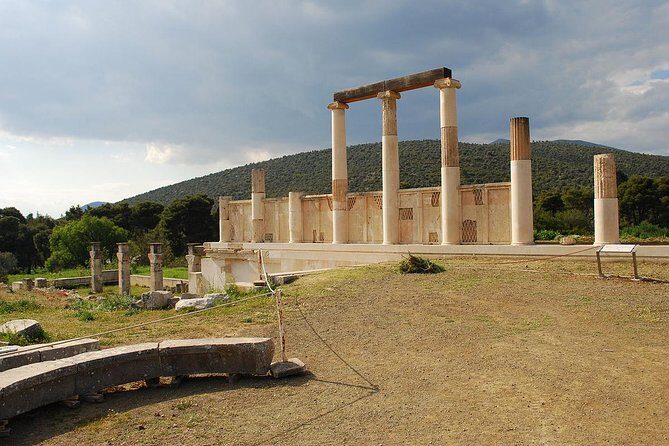
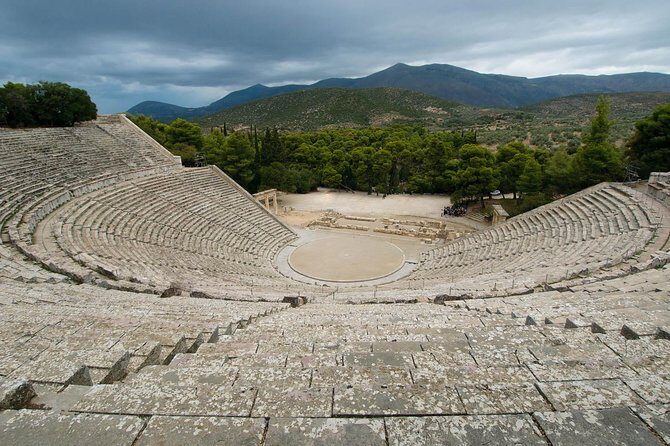
The heart of it for many people is the Ancient Theatre of Epidaurus (about 30 minutes). This theatre is repeatedly described as exceptionally perfect for acoustics and aesthetics. Even without doing any special performance, you’ll notice the design is built for sound travel and clear sightlines—what the Romans later appreciated too. The description notes that unlike many Greek theatres, the theatre didn’t need Roman modifications.
You’ll see the classic Hellenistic structure: theatron, orchestra, and skene. Standing in or near the theatre space, it helps to think of it as both an audience machine and a statement of cultural seriousness.
The museum stop is optional in your priorities, but worth it if you like artifacts
The Epidaurus Archaeological Museum is about 30 minutes and is described as having reconstructions of temples and columns and inscriptions, based on artifacts found at the site. This is one of those stops where you can turn confusion into clarity fast. If you like understanding what you’re looking at in the ruins, you’ll appreciate this.
The sanctuary gives you the “why” behind the site
You also visit the Sanctuary of Asklepios (about 10 minutes). The key idea is the sanctuary’s role as a major holy site dedicated to healing. The temple is described as built in the early 4th century BC, and the sanctuary is said to have rivaled other big cult centers like Zeus at Olympia and Apollo at Delphi.
Even with a shorter time here, you’ll leave with a better sense that Epidaurus isn’t just theatre-on-a-hill. It’s a whole healing complex where religious practice and public life overlapped.
Nafplio Free Time: Where You’ll Actually Feel Like You Left Athens
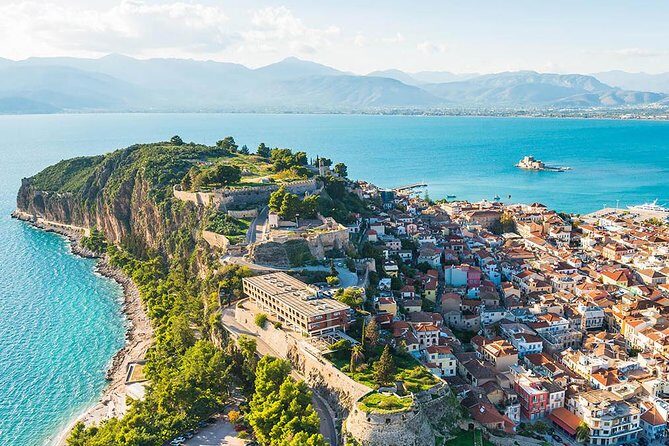
After all the stone sites, the schedule finally gives you breathing room. Nafplio is where you can slow down, eat something good, and enjoy the town’s layered look.
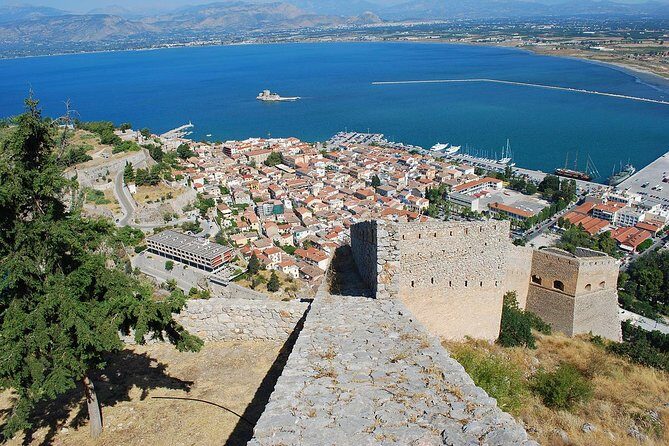
You get about 1 hour 30 minutes of free time. The area is described as the Naples of the East nickname—known for Venetian architecture, cobbled squares, and towering castles with views over the Argolic Gulf. That’s a helpful description because it tells you what you’re walking into: not a sleepy village, not a mega-city, but an old port town with strong visuals.
Use Nafplio in a “choose your effort” way
You can go light and wander the harbor side, grab coffee, and do casual shopping. Or you can go view-focused and tackle the fortifications.
The tour also includes quick stops:
- Bourtzi (about 10 minutes): a Venetian castle in the harbor. It’s all about photos and that classic postcard angle from the harbor side.
- Acronauplia: described as the oldest part of Nafplion, originally its own town until the 13th century, then folded into fortifications. Later, it was used as a prison and eventually the view became part of a tourism development with a hotel complex.
- Palamidi Castle (about 30 minutes): the big climb. The fortress is on a 216-meter hill, built by the Venetians during their second occupation (1686–1715). You’ll hear about the famous steps—913 steps from town to fortress, with local jokes that there are over a thousand, or 999 steps.
Palamidi is one of those “worth it if you’re up for stairs” stops. If you want the best views over Nafplio and the Argolic Gulf, you’ll like it. If you’d rather spend your energy on coffee and walking flatter streets, you can treat Palamidi as the optional higher-effort choice.
Price and Value: What $560.23 Covers (and What You’ll Pay On-Site)
This tour costs $560.23 per group, for up to 3 people. For a private day trip, that price is usually about paying for the convenience: a dedicated air-conditioned car, driver, and a route designed to link Mycenae, Epidaurus, and Nafplio without wasting time.
Where it gets especially reasonable is when you split the cost across a small group. Instead of paying per person for transportation, you’re sharing the vehicle/driver cost. That’s often the biggest budget lever on Greece day trips.
Now the part you should budget for: entrance fees are not included for key sites. You’ll buy on-site:
- €20 per person for Mycenae & the Archaeological Museum of Mycenae & the Treasury of Atreus
- €20 per person for Epidaurus & the Epidaurus Archaeological Museum
So if you’re traveling as a group of three and all adults are entering the paid areas, you should expect about €120 total in additional ticket costs. Your exact total depends on who is paying and which areas you choose to enter if anything feels skippable.
Who This Private Tour Is Best For
This tour is a great fit if you:
- Want a one-day route from Athens that covers both Mycenae and Epidaurus
- Like a mix of ruins, museum context, and real town time
- Prefer a private car over driving yourself or coordinating buses
- Travel as a small group (up to 3) and want the day to feel efficient
It may be less ideal if you’re hoping for deep, inside-the-site guided narration at every stop. The driver is great for answering questions and providing commentary, but they won’t enter the archaeological sites with you. If you want more formal guidance inside museums and sites, the option is there to request a licensed tour guide depending on availability.
Should You Book This Mycenae, Epidaurus, and Nafplio Private Tour?
Yes—if your priority is smart timing and you want the full “myth to medicine” arc in one day. The private format plus the Nafplio free time makes this feel like more than a checklist. You get the monuments, but you also get to live in the town for a bit, not just look through a window.
Book it if you’re the kind of traveler who likes structure: quick orientation stops, then focused time at the places that need attention (like the theatre, the tomb, and the museum reconstructions). You’ll also appreciate it if you’d rather pay for convenience than spend your energy on transportation puzzles.
Skip it (or consider alternatives) if you need a fully guided, licensed experience inside every paid site. In that case, you’ll want to arrange for a licensed guide request early.
FAQ
How many people can join this private tour?
It’s a private tour for your group only, and the price is listed per group up to 3.
What’s the duration of the tour from Athens?
The tour runs about 8 to 9 hours.
Do you get hotel pickup and drop-off?
Yes. Pickup and drop-off are included from hotel, airport, or port, and your driver returns you to the same place or a point you prefer.
Is Wi-Fi and air-conditioning included?
Yes. The vehicle is air-conditioned and includes Wi-Fi, plus bottled water.
Are entrance fees included for Mycenae and Epidaurus?
No. Entrance fees are not included and can be purchased on-site (Mycenae-related fees are listed as €20 per person, and Epidaurus-related fees are also listed as €20 per person).
Do you have a licensed guide on this tour?
A licensed tour guide is not included by default. A licensed guide may be available upon request depending on availability, while the driver provides commentary but is not a licensed site guide.