REVIEW · ATHENS
4 Days Private Tour: Corinth – Mycenae – Nafplio – Olympia- Delphi & Meteora
Book on Viator →Operated by Olive Sea Travel · Bookable on Viator
The best thing about this four-day trip is its sweep. In one route, you move from the Corinth Canal and Mycenae to the birthplace of the Olympic Games, Apollo’s sanctuary at Delphi, and the cliff-top monasteries of Meteora. It is a lot of Greece in a short time, with someone else handling the roads.
I like the private format, especially the freedom to pause in a mountain town, linger at a ruin, or change the pace after a long day. I also like the personal service: drivers including George, Terry, Andreas, and Alexandros have been praised for good restaurant advice, close drop-offs, and calm help when plans changed.
The trade-off is clear: this is a road trip with several long drives, not a slow village holiday. Entrance fees are extra, and the drivers cannot guide you inside the monuments or museums unless you arrange licensed guides at an added cost.
In This Review
- Key things to know before booking
- Why this route works for a four-day Greece trip
- Day one: Corinth Canal, Epidaurus, and the kings of Mycenae
- Nafplio: a graceful break after the ruins
- Day two: Olympia and the road to Delphi
- Day three: Delphi, Apollo, and the mountain road north
- Day four: Meteora monasteries and Thermopylae
- Private service, guides, and the real value of $1,483.31
- Who should book this four-day mainland route?
- Should you book it?
- FAQ
- Where does the tour begin and end?
- How long does the tour last?
- Is this a private tour?
- Are entrance fees included?
- Are hotels and breakfast included?
- Can the driver guide me inside the archaeological sites?
- Which major sites are included?
- Is lunch included?
- What is the cancellation policy?
Key things to know before booking
- Five major Greek sights in four days: Corinth, Mycenae, Olympia, Delphi, and Meteora form the backbone of the route.
- Private transport keeps the schedule flexible: Your group travels alone, with hotel, Airbnb, or port pickup and drop-off.
- Day one is packed: Epidaurus, Mycenae, and Nafplio all arrive before the overnight drive to Olympia.
- Licensed guides cost extra: Drivers explain Greece during the road portions but are not permitted to lead inside archaeological sites.
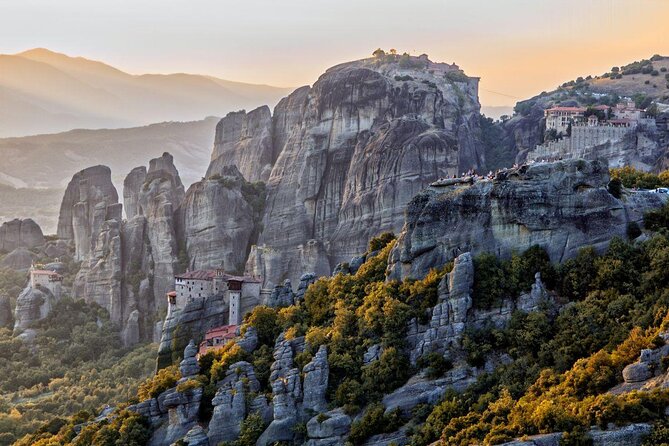
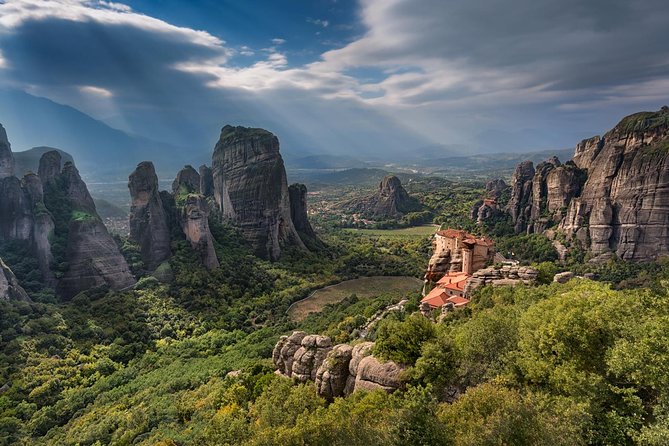
- Meteora is the visual high point: Great Meteoron and Agios Stefanos or Roussanou offer both monastery interiors and extraordinary views.
- The price reflects convenience: At $1,483.31 per person, the value depends heavily on group size, hotel choice, and how much you value a private vehicle.
Why this route works for a four-day Greece trip
This tour is designed for you if Athens is only part of your Greek holiday. Instead of making separate day trips from the capital, you travel in a loop across the mainland, sleeping along the way. That saves repeated drives back to Athens, though it also means changing hotels and packing your days tightly.
Private transportation is the central advantage. You are not waiting for a large group at each stop, and the driver can bring you close to site entrances and collect you near the exits. One particularly useful feature is the ability to adjust the pickup time and, within reason, the pace of the day.
The vehicle also turns the long stretches into useful sightseeing time. Drivers have explained local customs, Greek life, and the places along the road. Still, do not confuse a good driver with a site guide. If you want detailed explanations among the columns, statues, and museum displays, arrange a licensed guide in advance.
Accommodation and breakfast are included according to your booking, but the details of the hotels can vary. If your room and hotel setting matter a great deal, choose your own properties where possible. That gives you more control over location, views, and amenities.
You can also read our reviews of more private tours in Athens

Day one: Corinth Canal, Epidaurus, and the kings of Mycenae
The route begins west of Athens, following the coast and passing seaside villages with views toward Salamis. That island was the setting for the famous naval battle between Athens and Persia in 480 BCE, so even the opening drive carries a bit of context.
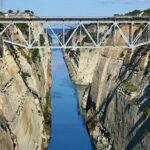
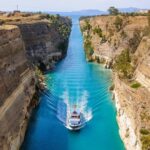
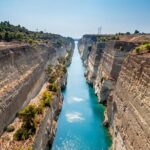
At the Corinth Canal, you get about 20 minutes to walk across a pedestrian bridge and look down into the narrow waterway. The canal opened in 1892, cutting through the isthmus and separating the Peloponnese from mainland Greece. It connects the Saronic Gulf with the Corinthian Gulf.
This is a brief stop, but a good one for photographs and a sense of the engineering problem solved here. Bungee jumping may be available on some days, although it is not part of the basic tour. The stop itself has no admission charge.
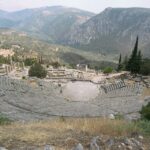
Next comes the Sanctuary of Asklepios at Epidaurus. Asklepios was the Greek god of healing, and the sanctuary once drew people seeking treatment. The setting is quiet and open, with the ancient theater occupying the highest part of the site.
The Ancient Theatre of Epidaurus receives about 30 minutes in the planned schedule. Its acoustics are the star. You can stand near the circular performance space while a companion speaks from below, then climb toward the upper seats for the full sense of its scale.
Thirty minutes is enough for a look and an acoustic test, but not enough for a leisurely visit to the whole sanctuary. The sanctuary admission is not included, and the driver will not accompany you inside as a licensed guide.
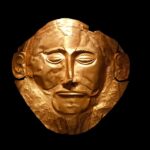
Mycenae gives the day its strongest dose of Bronze Age drama. Dating from the second millennium BCE, the citadel is linked to the world described by Homer, including Agamemnon and the Trojan War. The site is rougher and more exposed than Epidaurus, with uneven ground and open sun.
You will see the Lion Gate, often described as Europe’s oldest monumental architectural sculpture, along with the massive Cyclopean walls, Burial Circle A, and the remains of the palace. The name Mycenae later came to describe an entire period of Greek civilization, which helps explain why this site matters far beyond its famous legends.
Allow about an hour for the main archaeological area, then another 30 minutes for the museum. The museum puts objects from the citadel into a clearer setting, making it easier to understand the place as a working center rather than just a dramatic pile of stones.
Before leaving, the route includes the Treasury of Atreus, a superbly preserved tholos tomb. Its beehive-shaped interior is one of the finest surviving examples of Mycenaean building. The visit is short, around 20 minutes, but this is one stop I would not skip.
Nafplio: a graceful break after the ruins
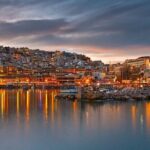
Nafplio changes the mood. After sanctuaries and citadels, you get a handsome harbor city with Venetian, neoclassical, and eastern influences. Nafplio served as the capital of Greece until 1834, and its waterfront setting makes it an appealing place to slow down.
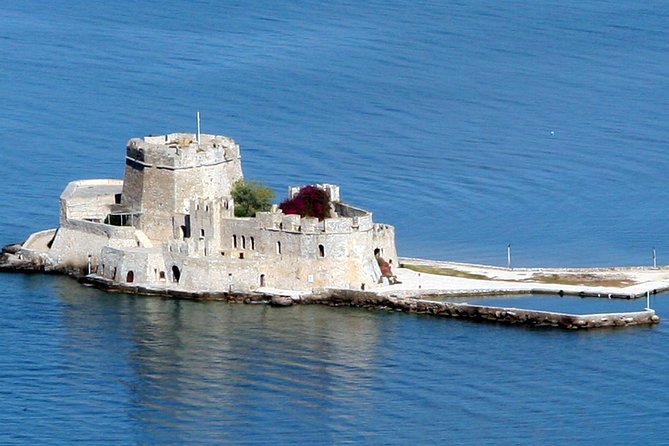
The planned visit lasts about two hours, including a walk through the old city and lunch at a traditional seaside tavern. Lunch is not listed as included, so budget separately for it. The port is also home to Bourtzi, a small fortress on an islet. You may see it from the harbor, but a separate boat visit is not specified.
A short drive up to Acronauplia provides a broad view over Nafplio and the harbor. The viewpoint takes only about 10 minutes, yet it adds perspective after walking the narrow streets below. Palamidi, the larger fortress above the city, is another major visual feature, though the schedule does not promise an interior visit.
The drive onward to Olympia is long. This is where a private car matters most. You can rest, ask questions, or request a short pause without managing a full coach group. Still, expect a demanding first day, especially if you have arrived from a cruise or a busy stay in Athens.
Day two: Olympia and the road to Delphi
Ancient Olympia deserves time. The planned visit lasts about three hours at the archaeological site, followed by an hour in the Archaeological Museum and 30 minutes at the Museum of the History of the Ancient Olympic Games.
The site was the sanctuary of Olympian Zeus and the birthplace of the ancient Olympic Games. You pass the Gymnasium, the Palaistra, the workshop of the sculptor Phidias, the Temple of Zeus, and the stadium where Greek competitors sought honor for their cities.
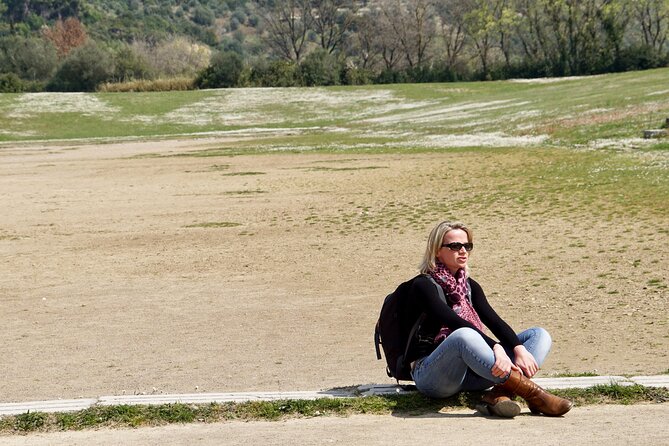
The stadium gives the visit its strongest physical connection to the past. Walking the track helps you picture the games as a religious and civic event, not just an athletic contest. The site is broad and open, so the heat can be a real concern in summer. Bring water, use the bottled water supplied by the tour, and keep a hat handy.
The Archaeological Museum contains the Hermes of Praxiteles, one of the most famous sculptures in Greece. It also displays tools associated with Phidias, who worked on the gold and ivory statue of Zeus, one of the Seven Wonders of the ancient world.
The separate Olympic Games museum covers a long span, from the second millennium BCE to the fifth century CE, with 463 ancient works. It is useful if you want the social and sporting side of Olympia explained alongside the religious remains.
After Olympia, the route reaches Nafpaktos on the northern shore of the Corinthian Gulf. Its old harbor is compact and attractive, framed by Venetian fortifications. The town was once an Athenian naval base during the Peloponnesian War, and the Venetians called it Lepanto.
You have about an hour here. It is a welcome coastal pause before the road turns inland toward Delphi. The schedule then takes you through central Greece, passing near Lamia, Trikala, and Karditsa before reaching Kalabaka, the town below Meteora.
This is another long driving section. The route avoids the national highway in favor of mountain roads and smaller towns. That choice offers a closer look at rural Greece, but it can also make the journey slower and more tiring. After settling into your hotel, you have time for an evening walk and a local dinner in Kalabaka.
Day three: Delphi, Apollo, and the mountain road north
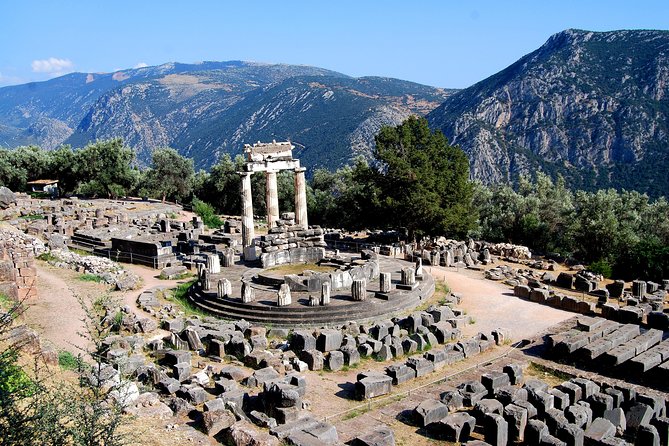
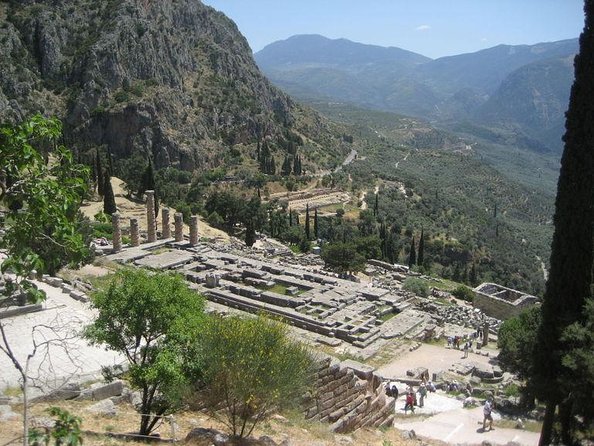
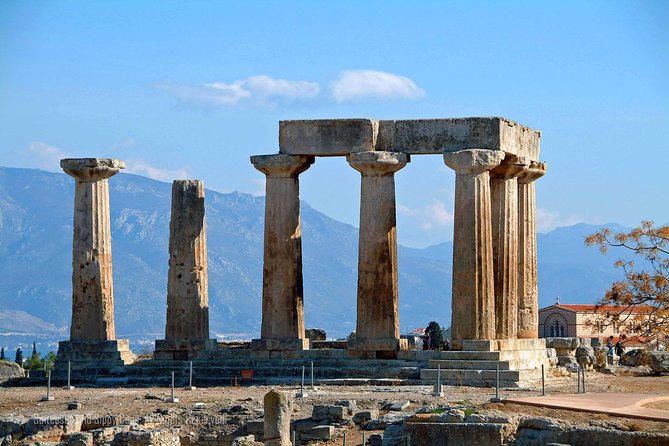
Delphi is one of the most powerful settings on the tour. The sanctuary was dedicated to Apollo and served as the seat of the oracle. Ancient Greeks regarded it as the center of the world, and its position on the slopes gives you wide views across the mountains of Phocis.
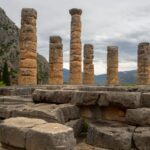
The archaeological site includes the Temple of Apollo, the theater, and the stadium. The nearby sanctuary of Athena Pronaia and the Gymnasium are also part of the wider Delphi area, though the exact time available for each depends on traffic and the pace of your group.
The Temple of Apollo is the essential stop. This was where the priestess known as the Pythia delivered Apollo’s oracles. Without a licensed guide, you can still appreciate the setting, but the religious rituals and political role of Delphi make much more sense with expert explanation.
The archaeological museum is scheduled for about an hour. It includes the famous Charioteer of Delphi and gold and ivory works. Since the site is spread along a slope, you should expect steps and uneven surfaces. Comfortable shoes will help.
Lunch takes place in the modern village of Delphi, with mountain views. The meal is not listed as included, so plan to pay separately. After lunch, the tour leaves the main highway and crosses the mountains toward Kalabaka.
That road section is scenic and more local in feel, but it adds to the day. If you prefer a relaxed pace, ask about the timing before departure. Private travel gives you room to adjust, but it cannot erase the distances between these sites.
A few more Athens tours and experiences worth a look
Day four: Meteora monasteries and Thermopylae
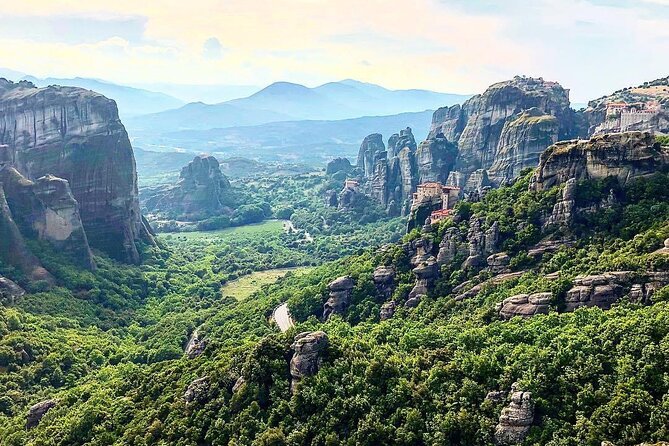
Meteora is the visual climax. Huge rock pillars rise above Kalabaka, carrying Eastern Orthodox monasteries that seem to hang in the air. That is the meaning of Meteora, and the combination of cliffs, faith, and human effort is unlike anything else on this route.
The tour visits Great Meteoron, the largest and most impressive monastery in the group. The planned time is about 30 minutes, which allows a focused visit but not a leisurely look at every room and display.
You then visit Agios Stefanos or Roussanou. Agios Stefanos is one of Meteora’s few female monasteries, with origins linked to the 15th century and wall paintings in its main church dated to 1560. Roussanou offers a different angle toward the cliffs and nearby monasteries.
The monasteries remain active religious places, so modest clothing is important. The short schedule may also feel rushed if you want to study the paintings, courtyards, and chapels. Entrance fees are extra, and opening hours can affect the plan. One family found that extreme heat and limited site hours required flexibility, so do not treat every listed stop as a guarantee of unlimited time.
Thermopylae follows on the drive back to Athens. The battlefield is linked to King Leonidas and the 300 Spartans who faced the Persian army. The Leonidas Monument sits opposite Kolonos Hill, where the final Spartan defense took place.
A 3D film at the historical information center adds a useful visual account of the battle. The visit includes about 15 minutes at the battlefield, 30 minutes at the center, and 10 minutes at the monument. It is a short history stop rather than a full museum visit.
The final break is at Kamena Vourla, a coastal town where you can have a traditional Greek lunch by the sea before returning to Athens. Again, lunch is separate from the tour price. The return drive completes a very full four days.
Private service, guides, and the real value of $1,483.31
At $1,483.31 per person, this is not a bargain tour in the usual sense. Its value improves when several people share the vehicle and when you compare it with the cost and stress of arranging transport, hotels, parking, and long-distance driving yourself.
The strongest practical benefit is flexibility. George allowed one group to rest by the pool at the Europa hotel in Olympia rather than follow the original morning pace. He also helped arrange a special photo stop in Meteora after asking where a guesthouse image had been taken.
That kind of personal attention is the reason to choose a private trip. Drivers Terry, George, Andreas, and Alexandros have been praised for friendly conversation, local restaurant suggestions, close drop-offs, and patience with side requests. Alexandros was also credited with adapting to heat and changing site hours.
Do keep the guide issue in mind. The drivers have strong knowledge of Greek history and culture, but they are not licensed to accompany you through the sites. Olive Sea Travel can arrange licensed guides for an added fee, and I would strongly consider doing so at Mycenae, Olympia, Delphi, and Meteora.
The tour includes private transport, pickup and drop-off at a hotel, Airbnb, or port, bottled water, and accommodation with breakfast according to your booking. Entrance fees are not included. Pickup time can be adjusted on request, and only your own group participates.
Who should book this four-day mainland route?
I would choose this tour if you want to see several major mainland sites without driving yourself. It works especially well for families, couples, or small groups arriving from Athens or a cruise port who value a private vehicle and personal attention.
It also suits people who want to combine archaeology with scenery and town life. You get ancient sanctuaries, a harbor city, mountain roads, seaside meals, and active monasteries rather than four days of ruins alone.
I would hesitate if you dislike long car rides, need a slow morning every day, or want fully guided visits included in the base price. The program is ambitious, and the site visits are often brief compared with the time spent on the road.
Before booking, ask about the exact hotels, the number of people in your group, the planned opening hours, and the cost of licensed guides. Also confirm which monastery will be visited, since the plan lists Agios Stefanos or Roussanou.
Cancellation is allowed for a full refund up to three full days before the start time. Changes or cancellations inside that window are not accepted for a refund.
Should you book it?
Book it if your priority is seeing the best of mainland Greece in four days with a private driver, flexible timing, and no need to navigate unfamiliar roads. The route is ambitious but thoughtfully connected, and Meteora, Delphi, and Olympia provide three very different high points.
Skip it if you want a relaxed holiday or expect a guide to explain every site without an extra charge. For the best version of this trip, travel with a small group, choose your preferred hotels, and add licensed guides at the major archaeological sites.
FAQ
Where does the tour begin and end?
The tour is based in Athens, with pickup and drop-off available at your hotel, Airbnb, or port. The pickup time can be adjusted upon request.
How long does the tour last?
The tour lasts approximately four days. Exact timing can change with traffic and the time of day.
Is this a private tour?
Yes. Only your group participates, and private transportation is provided throughout the trip.
Are entrance fees included?
No. Entrance fees for archaeological sites, museums, and monasteries are not included in the tour price.
Are hotels and breakfast included?
Accommodation and breakfast are included according to your booking. The exact hotels may vary, so ask about the properties before confirming.
Can the driver guide me inside the archaeological sites?
The drivers are not licensed to accompany you inside sites or museums. A licensed tour guide can be hired at an additional cost.
Which major sites are included?
The route includes the Corinth Canal, Epidaurus, Mycenae, Nafplio, Olympia, Nafpaktos, Delphi, Meteora, Thermopylae, and Kamena Vourla.
Is lunch included?
Lunch is not listed as included. The route allows time for meals at traditional tavernas in Nafplio, Delphi, and Kamena Vourla.
What is the cancellation policy?
You can cancel for a full refund at least three full days before the experience begins. Cancellations or changes made less than three full days before the start time are not accepted for a refund.