REVIEW · ATHENS
Private Biblical Apostle Paul steps in Ancient Corinth.
Book on Viator →Operated by Visit Greece with a private tour · Bookable on Viator
Ancient Corinth gives this day trip a rare double focus: you are walking through a major Roman-era city while following the path of Apostle Paul, who preached here and formed one of the early Christian communities. The Bema, where Paul defended his faith before Roman officials, gives the visit a personal point of reference.
I like the way the tour joins several sites that are hard to connect on your own, especially Kenchreai, the ancient port linked with Paul’s baptisms, and the spectacular Corinth Canal. I also like having a private vehicle and driver, since the six-hour schedule includes scattered sights rather than one compact ruin field.
The main thing to consider is that entrance tickets and lunch cost extra. You will also spend only about 30 minutes at Kenchreai and Acrocorinth, so this is a guided overview rather than a slow, highly detailed archaeological study.
In This Review
- Key points to know before booking
- Why Ancient Corinth matters to Christian history
- Three hours among the ruins of Ancient Corinth
- Kenchreai, the eastern port linked to Paul
- Acrocorinth and the fortress above the city
- The Corinth Canal, a four-mile engineering landmark
- What private transportation adds to the day
- Is $417.57 good value for up to four people?
- Who will get the most from this Corinth tour?
- Should you book the Apostle Paul Corinth experience?
- FAQ
- How long does the private Corinth tour last?
- Is pickup from Athens offered?
- How many people can join the private tour?
- Who is the driver and guide?
- Are entrance tickets included?
- Is lunch included?
- Can I cancel for a full refund?
Key points to know before booking
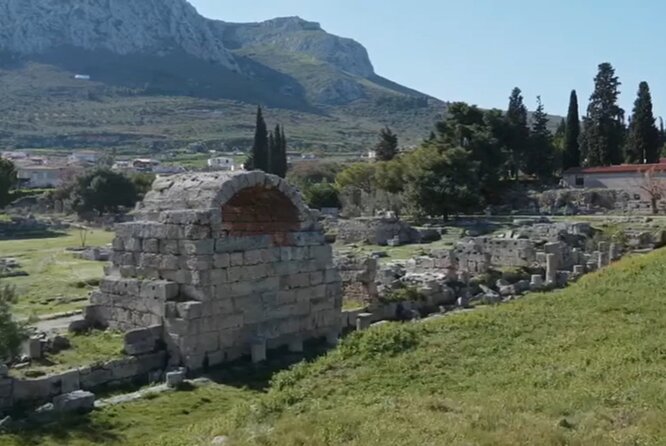
- The Bema connects the ruins directly to Paul’s time in Corinth, giving the Christian story a clear physical setting.
- Private driver Ilias Kanteres provides transportation for your group of up to four and can allow time at each stop.
- Kenchreai adds a quieter religious site to the better-known Ancient Corinth and canal visits.
- Acrocorinth offers a dramatic fortress viewpoint, though the scheduled stop is brief.
- The Corinth Canal is more than a photo stop, since it explains Corinth’s lasting strategic importance.
- The $417.57 group price can work well for four people, but Ancient Corinth admission and lunch are not included.
Why Ancient Corinth matters to Christian history
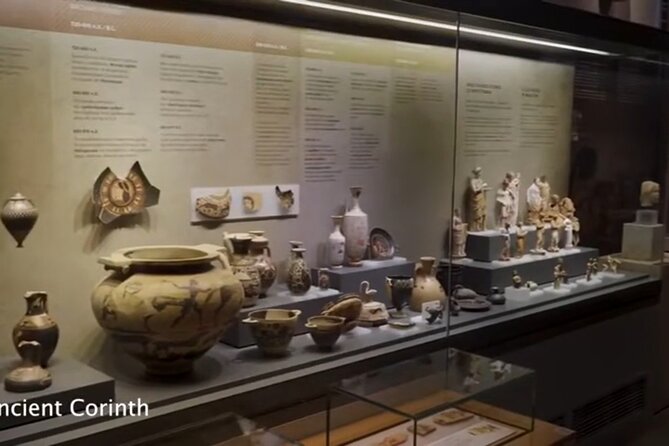
If you are interested in the Apostle Paul, Corinth is one of the strongest day trips from Athens. Paul came to this important commercial city in the 1st century AD and preached to a mixed population shaped by Greek, Roman, and eastern trade. The Christian community he helped establish later received the letters known as First and Second Corinthians, central texts for Christian teaching.
You are not simply looking at a church or a later monument. You are walking through the ancient city where Paul lived and preached among people moving through one of the busiest crossroads in Greece. That setting helps explain why Corinth mattered so much to early Christianity.
The Bema is the emotional center of the visit. This raised platform served as a public speaking and judicial area, and Christian tradition connects it with Paul’s appearance before Roman officials. The exact experience depends on how much time your driver gives you and how you explore the site, but the Bema offers a solid point for imagining the political pressure faced by a new religious movement.
Ancient Corinth also makes sense as a historical site beyond its biblical connection. Archaeologists have uncovered major sections of the city through work that began in 1896, led by the American School of Classical Studies at Athens. Greek Ministry of Culture excavations have added further findings over time.
You can also read our reviews of more private tours in Athens


Three hours among the ruins of Ancient Corinth
The tour allows roughly three hours at Ancient Corinth, by far the longest stop. That is appropriate because the archaeological area includes several important remains, and a rushed visit would reduce the place to a few photographs.
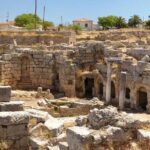
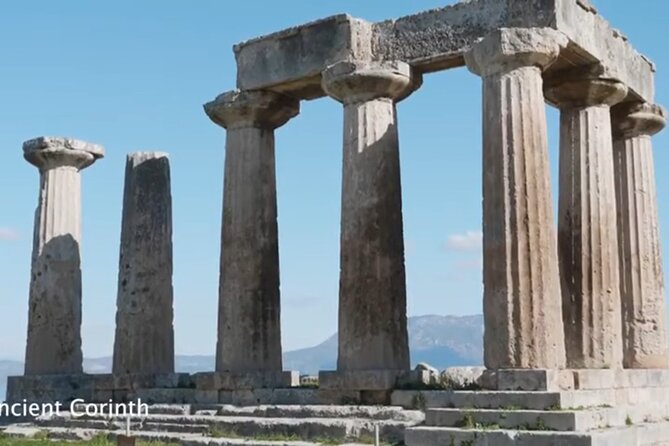
The Temple of Apollo is one of the first major sights to catch your attention. Its surviving columns are a reminder that Corinth was already an important Greek city before Roman rule and before Paul arrived. The ruins do not present a complete temple, so you need to use the site’s remains and the surrounding layout to picture its original scale.
The Roman Agora gives you a better sense of daily public life. This was not an isolated religious precinct. It was a working center of trade, politics, administration, and social contact. Paul’s message reached people in a city where merchants, officials, sailors, and local residents crossed paths.
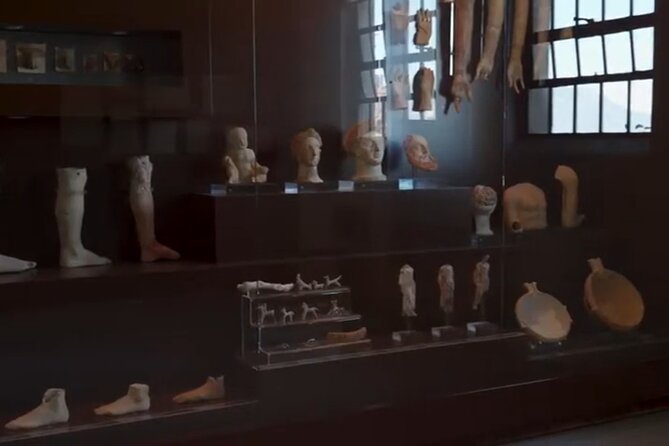
The archaeological museum adds useful context, particularly if you prefer objects and inscriptions to open-air ruins. It helps explain what the excavation has revealed and gives you a closer look at Corinth’s long span of occupation. Since the entrance ticket is not included, remember to budget for it separately.
I would use the three-hour stop in a deliberate way. Begin with the main ruins, set aside time for the Bema, then visit the museum if it is open and included in your plans. If your main interest is Paul, tell Ilias early in the day so the visit can keep the Christian sites at its center rather than becoming only a tour of classical architecture.
The site is spread out enough that comfortable shoes make sense. The supplied details do not specify the exact walking conditions or accessibility arrangements, so anyone with mobility concerns should ask the provider before booking. Most people can participate, but that broad statement does not replace a personal check about walking distances or uneven ground.
Kenchreai, the eastern port linked to Paul
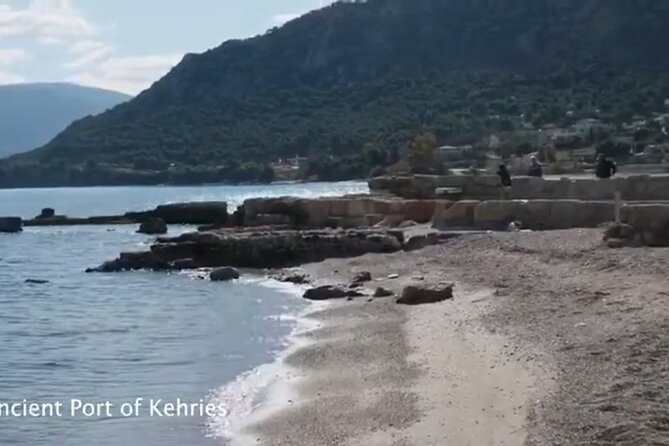
After Ancient Corinth, the route continues to Kenchreai, an ancient port on the eastern side of the Isthmus of Corinth. The stop lasts about 30 minutes and has no admission charge.
Kenchreai served Corinth’s eastern trade routes through the Saronic Gulf. A second port, Lechaion, handled routes west toward Italy and the rest of Europe. This division shows why Corinth was so important: the city controlled access between the eastern and western sides of Greece, while its ports connected the inland city to wider sea routes.
For Christian visitors, Kenchreai has a specific connection with Paul. The site is associated with the baptism of the first Christians. That makes it a useful companion to the Bema. At Ancient Corinth, you see the setting where Paul defended his faith. At Kenchreai, you connect the early community with the water and port routes that linked Corinth to the wider world.
Do not expect a large, fully restored attraction here. The 30-minute stop is best treated as a meaningful pause rather than a long archaeological visit. You will have enough time to understand why the place mattered and to take in the setting, but not enough for an extensive study of every surviving feature.
This is one of the tour’s more distinctive choices. Many day trips from Athens focus on Ancient Corinth and the canal alone. Adding Kenchreai gives the religious theme more depth and takes you beyond the most obvious sights.
Acrocorinth and the fortress above the city
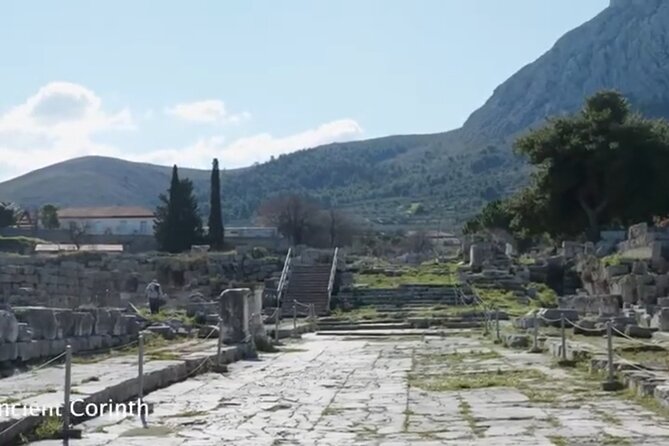
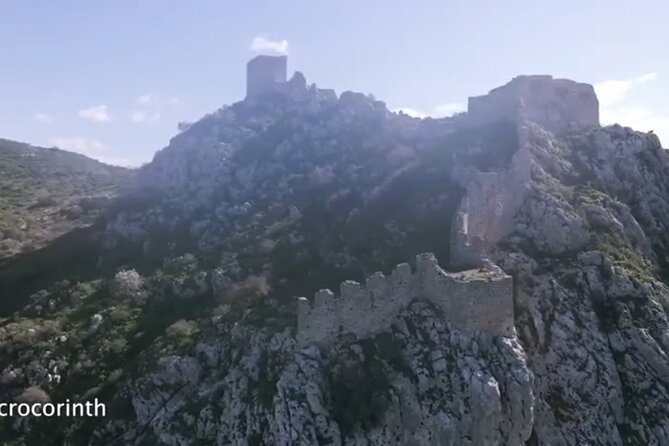
Acrocorinth rises on a huge rock above Ancient Corinth. The name means Upper Corinth, and the fortress controlled the route across the Isthmus. Its position made it a final defensive stronghold for southern Greece, especially because it commanded movement by land into the Peloponnese.
The tour schedules about 30 minutes here, with no admission charge listed. That is enough to appreciate the scale of the rock and the views, but it is not a full fortress exploration. The description identifies Acrocorinth as one of the most impressive acropolises on mainland Greece, and the setting explains why: the high rock dominates the ancient city below.
I would see this stop as a visual counterpoint to the ruins. Ancient Corinth shows you the city at street level, with temples, public spaces, and the Bema. Acrocorinth shows you the reason the site was so valuable to rulers and armies. The two stops work best together.
The short time here is also the clearest limitation. If your main goal is to walk extensively through the fortress, 30 minutes will feel tight. If you mainly want the view, the connection between the upper stronghold and the lower city, and a sense of Corinth’s defenses, the stop should serve you well.
Ask about the exact visiting plan before the day begins. The supplied information does not promise a full climb, a particular entrance, or extended fortress access. That matters because the rock and fortress can involve more walking than a simple roadside viewpoint.
The Corinth Canal, a four-mile engineering landmark
The final major stop is the Corinth Canal, with about one hour set aside. The canal cuts through the Isthmus of Corinth and links the Gulf of Corinth, connected to the Ionian Sea, with the Saronic Gulf, connected to the Aegean Sea. It also separates the Peloponnese from mainland Greece, making the peninsula effectively an island.
The canal is about 6.4 kilometers long and only 24.6 meters wide at sea level. It has no locks because it was dug at sea level. Modern ships often find it too narrow, and its economic role is now limited, but its tourist value remains strong.
The canal helps you understand Corinth’s geography in a way the ruins alone cannot. The ancient city prospered because this narrow neck of land connected major routes. Even before the modern canal, the isthmus was a major crossing point between the two sides of Greece. A stop here turns a map lesson into something you can see directly.
One hour is generous for a photo stop and a closer look at the cut through the rock. It also gives the day a change of pace after the archaeological site. You are no longer studying columns or foundations. You are looking at a modern channel built through the same strategic bottleneck that shaped Corinth for centuries.
Because the canal is mainly an outdoor viewing stop, conditions may affect how comfortable the visit feels. The tour includes water and an air-conditioned vehicle, which is useful after time outside at the ruins and fortress.
- All Day Cruise -3 Islands to Agistri,Moni, Aegina with lunch and drinks included
★ 5.0 · 4,958 reviews






What private transportation adds to the day
The experience lasts about six hours and includes private transportation in an air-conditioned vehicle. Pickup is offered, and the vehicle has WiFi, water, and a toilet. Your group can include up to four people, with no unrelated participants joining you.
That private format matters most because the route combines four separate stops. You are not limited to a fixed group pace, and you can raise questions or ask for a little more time at the places that matter most to you. The available information indicates that Ilias Kanteres gives groups time at each site and has also included the Apostle Paul’s Church on some outings.
Ilias is especially relevant if you want a personal, faith-focused day rather than a generic Corinth excursion. Make your priorities clear at the start: biblical sites, classical archaeology, the fortress, or the canal. With only six hours, a private driver can help you place attention where it will do the most good.
The route also includes time in transit from Athens, so you should not picture six full hours of walking among ruins. That is not a weakness. The sites are spread across the Corinth area, and private transport is the practical way to connect them in one day.
The vehicle amenities are modest but useful. WiFi can help with basic trip needs, while water, air conditioning, and a toilet reduce the small discomforts that can affect a long sightseeing day. Lunch is not included, so plan to ask about the meal arrangement before departure or bring your own plan.
Is $417.57 good value for up to four people?
The listed cost is $417.57 per group of up to four. Split four ways, that comes to about $104.39 per person before entrance tickets and lunch. For two people, the per-person cost is much higher, but you still receive private transportation and a full route through several Corinth sites.
I see the best value for a family or small group that wants a direct Athens pickup and a private schedule. You are paying for the vehicle, driver, coordination, and convenience of seeing Ancient Corinth, Kenchreai, Acrocorinth, and the canal in one outing. The price is less attractive if you are traveling alone or only want to visit the main archaeological site.
The missing admission costs should be part of your calculation. Ancient Corinth tickets are not included, while the itinerary lists free admission for Kenchreai, Acrocorinth, and the Corinth Canal. Lunch is also extra. Confirm the current ticket arrangements before you go, since fees and opening conditions can change.
The tour is booked an average of 67 days ahead, which suggests that advance planning is sensible, particularly if you need a specific date or are visiting Athens during a busy season. Confirmation is provided at booking.
Who will get the most from this Corinth tour?
I would choose this experience if Christian history is central to your trip. The Bema, Kenchreai, and Paul’s connection to Corinth give the day a clear purpose, while the Temple of Apollo and Roman Agora keep it useful for anyone interested in ancient Greece and Rome.
It also suits small groups who value privacy. Families, couples, and groups of up to four can share the vehicle and shape the emphasis of the day. The reviews attached to this experience give Ilias particularly strong praise for being personable, informative, and attentive to the group’s enjoyment.
The tour is less suited to someone who wants a slow, expert-led archaeological seminar or a long hike through Acrocorinth. The itinerary covers a lot of ground in six hours, so the approach is broad and practical. You see the major themes and places, but you will need a separate visit for a truly detailed study.
The same applies to independent visitors who already have a rental car and want to spend a full day at one site. In that case, the private tour’s main advantage is reduced planning and a driver who connects the locations. If that convenience has little value to you, the price may feel high.
Free cancellation is available up to 24 hours before the local start time for a full refund. Cancellations or changes made within 24 hours are not refunded or accepted, so keep the deadline in mind when arranging your Athens schedule.
Should you book the Apostle Paul Corinth experience?
I would book it if you want Paul’s Corinth placed in its ancient setting, not just a quick photograph beside a famous ruin. The combination of Ancient Corinth, Kenchreai, Acrocorinth, and the canal gives you religious, classical, military, and geographic context in one manageable day.
The strongest reasons to choose it are the private vehicle, the small-group format, and Ilias Kanteres’s personal approach. The main cautions are the extra cost of tickets and lunch, the short Acrocorinth and Kenchreai stops, and the fact that six hours includes driving between sites.
For a group of four, the price is easier to justify. For a couple or solo visitor, compare it with other Corinth options and decide how much you value private transport and flexibility. If the Apostle Paul connection is the reason you came to Greece, this route gives that interest a clear and worthwhile place in your itinerary.
FAQ
How long does the private Corinth tour last?
The experience lasts approximately six hours, including the visits to Ancient Corinth, Kenchreai, Acrocorinth, and the Corinth Canal.
Is pickup from Athens offered?
Yes, pickup is offered. The provided information identifies the tour location as Athens but does not specify the exact pickup points, so confirm your location when booking.
How many people can join the private tour?
The price covers one private group of up to four people. Only your group participates in the activity.
Who is the driver and guide?
The driver and guide identified for the experience is Ilias Kanteres.
Are entrance tickets included?
No. Admission tickets are not included. The itinerary lists Ancient Corinth as admission-ticket not included, while Kenchreai, Acrocorinth, and the Corinth Canal are listed with free admission.
Is lunch included?
No. Lunch is not included in the tour price.
Can I cancel for a full refund?
Yes. You can receive a full refund if you cancel at least 24 hours before the experience start time. Cancellations or changes made less than 24 hours before the start time are not accepted and are not refunded.