REVIEW · ATHENS
Sparta Full Day Tour
Book on Viator →Operated by H.P.Tours - Hellenic Private Tours · Bookable on Viator
The most striking thing about this tour is how much of the Peloponnese it packs into one long day: the Corinth Canal, ancient Sparta, the Olive and Greek Olive Oil Museum, and the hilltop Byzantine city of Mystras. You get a private car, hotel or port pickup, and an English-speaking driver who explains the sights along the way.
I like the freedom of having the vehicle to yourself, and I like the range of the day. You move from a modern engineering project to classical Sparta, then on to medieval Greece at Mystras. The main drawback is the length: 12 to 13 hours means a lot of road time, and your driver cannot accompany you inside the sites unless you pay extra for a licensed guide.
In This Review
- Key points to know before booking
- Why this Athens to Sparta day trip works
- The Corinth Canal: a short stop with a big story
- Ancient Sparta and the small archaeological museum
- Olive oil culture in Sparta
- Mystras, the day’s richest stop
- Driver commentary or a licensed guide
- Time, meals, and practical costs
- Who should book this private Sparta trip?
- Should you book the Sparta Full Day Tour?
- FAQ
- How long does the Sparta Full Day Tour last?
- How much does the tour cost?
- Is the tour private?
- Is hotel pickup included?
- Can the tour pick me up at Piraeus Port?
- Is airport pickup included?
- Is a tour guide included?
- Are entrance fees included?
- Is lunch included?
- What is included in the vehicle service?
Key points to know before booking
- A full Peloponnese day from Athens: See the Corinth Canal, Sparta, the Olive Oil Museum, and Mystras without changing hotels.
- Private transport for up to two people: The $845.90 price is per group, not per person, so the value improves if two people share it.
- Driver commentary, not a site guide: Your English-speaking driver explains the monuments and history but is not licensed to enter the sites with you.
- Mystras is the visual highlight: Medieval churches, fortifications, palaces, streets, and monasteries spread across a steep hill above modern Sparta.
- Extra costs matter: Lunch is not included, admission fees total €35 per adult, and a licensed guide costs an additional €240 in cash.
- Ask about the driver: Jimmy was especially praised for bringing the area’s story to life, if he is available for your date.
Why this Athens to Sparta day trip works
Sparta is not a quick side trip from Athens. You are looking at roughly two hours of driving after Corinth, plus the return journey. That makes a private tour practical: you avoid figuring out rural connections, changing buses, or arranging separate transport between Sparta and Mystras.
The drive also gives the day a clear shape. You leave Athens, cross the Corinth Canal, continue through the Peloponnese, spend the central part of the day around Sparta, and return to Athens in the evening. It is a demanding schedule, but it links places that are hard to combine independently in a single day.
The private format is important. The car is reserved for your group of up to two, and pickup and drop-off are included from an Athens hotel or the Piraeus cruise port. WiFi, bottled water, and air conditioning are provided, useful comforts on a long summer drive.
The quoted price is $845.90 per group. For one person, that is expensive. For two people sharing the full cost, it becomes easier to justify, especially when you consider the length of the day and the private vehicle. Still, add the €35 per adult in admission fees, lunch, and possibly the €240 guide supplement before you compare it with other tours.
A few more Athens tours and experiences worth a look
- All Day Cruise -3 Islands to Agistri,Moni, Aegina with lunch and drinks included
★ 5.0 · 4,958 reviews

The Corinth Canal: a short stop with a big story
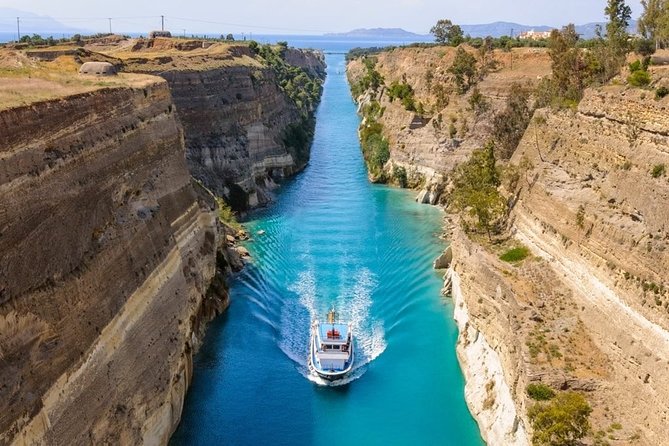
The first stop comes after about 45 miles on the national highway. You spend around 20 minutes at the Corinth Canal, where a narrow waterway cuts through the Isthmus of Corinth and links the Saronic Sea with the Corinthian Sea.
The canal was completed in the late 19th century, but the idea is far older. Before it existed, ships had to sail around the Peloponnese, adding about 185 nautical miles to the journey between the Aegean and the Adriatic. That explains why this seemingly narrow cut mattered so much to ancient rulers and merchants.
Periander, the tyrant of Corinth, is credited with considering a canal in the 7th century BC. His solution was the diolkós, a stone route where ships could be moved on wheeled platforms. Emperor Nero later tried to begin the canal in AD 67 with 6,000 enslaved workers, but his death stopped the project.
This is a brief stop, not a full archaeological visit. You will have time to look at the canal and hear its story, but do not expect a long walk or a major museum visit here. I like it as an opening chapter because it gives the day a strong sense of place, but the 20-minute limit means you will want to pay attention quickly.
Ancient Sparta and the small archaeological museum
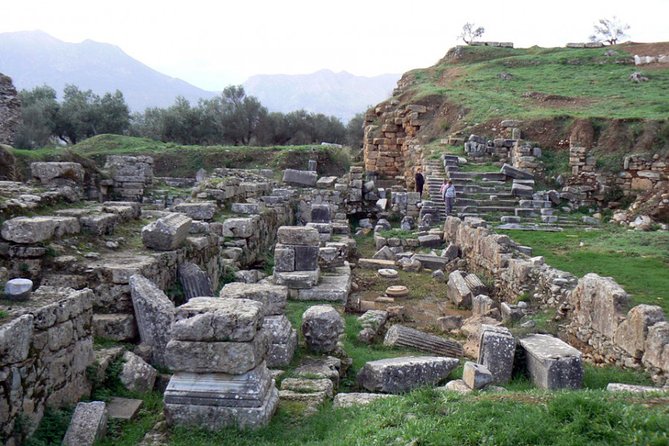
After about two hours through the Peloponnese, the tour reaches Sparta. Ancient Sparta is often reduced to stories of soldiers and strict discipline, but the remains offer a broader picture of civic, religious, and everyday life.
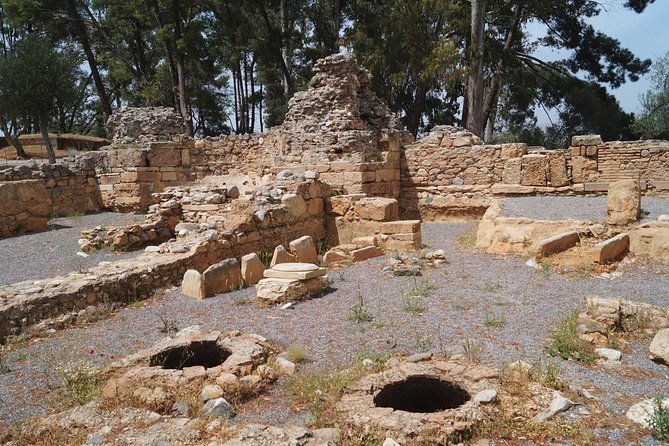
The ancient site includes the Temple of Athena Chalkioikos, identified by surviving traces at the northwest end of the Acropolis. The ancient theater, on the south side of the Acropolis, dates from the early Imperial period. Parts of its orchestra, retaining wall, inscriptions, and curved seating area remain.
You can also see the Circular Building of Unknown Destination, made with cut blocks and smaller stones. The preserved section may have been repaired during Roman times and may have played an important role in Spartan life. Nearby merchant stalls appear to date from the Roman Imperial period, while the remains of a mid-Byzantine basilica have been linked to the 10th-century Basilica of Saint Nikon.
The tour allows about two hours for the Sparta archaeological visit and museum. That is enough time for a meaningful look, but the exact balance between the outdoor remains and museum depends on the day’s pace. The driver can explain what you are seeing, yet cannot enter the site with you.
The Archaeological Museum of Sparta contains objects from Laconia dating from the Neolithic period through the later Roman era. Its displays include sculpture from the Archaic to Roman periods, material from major sanctuaries, Roman mosaic floors, rescue-excavation finds, and inscriptions that help explain the area’s past.
This museum is not just a collection of famous statues. It helps fill in the gaps left by the outdoor ruins. The remains at Sparta can feel scattered if you do not know what each structure once did, while the museum gives you objects and inscriptions to connect with the city’s religious and public life.
Admission is not included. The stated entrance cost is €35 per adult for the Archaeological Museum of Sparta, the Museum of the Olive and Greek Olive Oil, and the Mystras fortress and museum. Since admission arrangements can change, confirm the current breakdown when you book.
Olive oil culture in Sparta
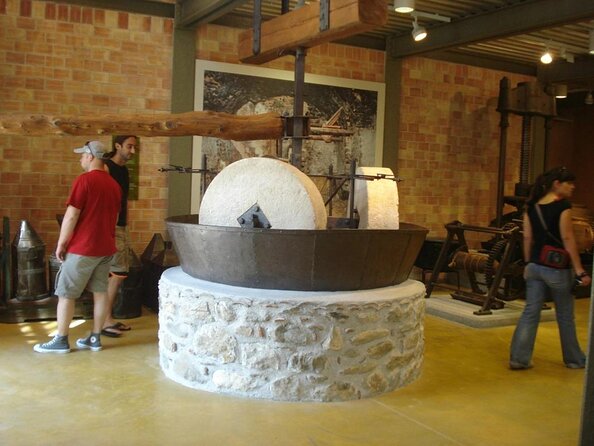
The Museum of the Olive and Greek Olive Oil takes about 30 minutes. That may sound like a short visit, but it adds a different kind of context to the day.
The museum follows the olive tree and olive oil in Greece from prehistoric times to the early 20th century. You learn about production methods and the part olive oil played in food, body care, household life, and lighting. It is a useful counterpoint to the military image of Sparta because it focuses on work, technology, trade, and daily habits.
I would not treat this as a reason to book the entire tour by itself. The visit is compact, and people mainly interested in ancient temples may prefer more time at Sparta or Mystras. But it helps you understand how central the olive has been to Greek life across many centuries.
The museum also makes the day feel less like a string of famous ruins. You are not only looking at stones and dates. You are seeing one of the products that shaped the economy and routines of the region.
Mystras, the day’s richest stop
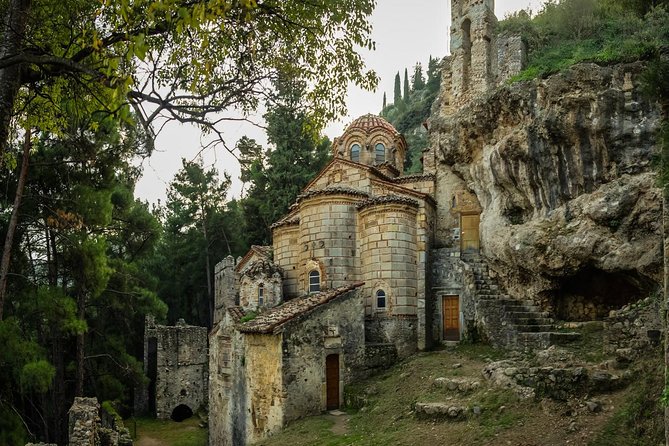
Mystras is the strongest reason to choose this particular route. The medieval city climbs a 620-meter hill above Sparta, with a fortress at the top and churches, convents, palaces, homes, streets, and public spaces spread below it.
William II of Villehardouin, prince of Achaia, built the fortress in 1249. The Franks surrendered it to the Byzantines in 1262, and Mystras became the center of Byzantine authority in southern Greece. From 1348, it served as the seat of the Despotate of Morea.
The city later changed hands between the Turks and Venetians. After 1834, residents gradually moved to modern Sparta, leaving behind the medieval ruins. Today, Mystras feels less like a single monument and more like an entire abandoned city scattered across a steep hillside.
The churches are especially important. Hagioi Theodoroi dates from 1290 to 1295. The Hodegetria was built around 1310, while Hagia Sophia dates from 1350 to 1365. Other notable churches include the Peribleptos, Evangelistria, and Pantanassa, built between the late 14th and early 15th centuries.
The one-hour-thirty-minute visit is useful but tight. Mystras is spread out, and the slopes make the walking more demanding than a flat city-center ruin. You should wear secure shoes and be ready for uneven ground. The tour information does not promise a particular route through the site, so ask the driver how much walking is planned before you begin.
The natural setting adds to the appeal. From the hill, you look toward Sparta and the Eurotas valley, while the buildings show how Byzantine rulers used architecture to express power and faith. The combination of fortifications, churches, and hillside streets gives Mystras a strong sense of a living medieval center, even though the town itself is now in ruins.
Mystras admission is included in the stated €35 per adult entrance cost along with the two Sparta museums. A driver can get you there and explain the background, but a licensed guide is needed for an in-site tour.
- All Day Cruise -3 Islands to Agistri,Moni, Aegina with lunch and drinks included
★ 5.0 · 4,958 reviews





Driver commentary or a licensed guide

The standard experience includes an English-speaking professional driver. He can explain the ancient monuments, Greek history, and interesting details about modern Greece while you travel between stops. He is not licensed to accompany you inside the archaeological sites.
That distinction affects the way you experience the day. You will get context in the car and then explore each site on your own. If you enjoy setting your own pace, taking photographs, and reading signs, this may be enough. If you want someone to point out the meaning of each ruin or explain the churches at Mystras as you walk, you should consider the optional guide.
The licensed guide costs €240, payable in cash, and is subject to availability. That is a substantial supplement, particularly for two people, but it changes the tour from private transportation with commentary into a more traditional guided visit. Ask about availability before the day rather than assuming a guide can be added at the last minute.
One driver singled out for praise was Jimmy, who was described as bringing the area’s story to life and helping create a pleasant day. If you can request a driver, it is worth asking if Jimmy is available. Do not treat that as a guarantee, since driver assignments depend on scheduling.
Time, meals, and practical costs
The full experience takes about 12 to 13 hours. The long duration is not a flaw in itself, since Sparta and Mystras are far from Athens, but you should be comfortable with a full day on the road. The schedule leaves limited room for spontaneous stops.
Lunch is not included. You will need to plan for a meal during the Sparta portion of the day. A local lunch was part of one especially positive experience, so ask the driver for help choosing a place rather than waiting until you are hungry and rushed. The tour price also does not include admission fees.
Pickup is offered from Athens hotels and Piraeus Port. At the port, there are three terminals. Your driver waits at the exit for the terminal where your ship docks. If a Terminal B or C exit is closed, you need to take the shuttle bus to Terminal A, a ride of about three minutes, where the driver will be waiting.
Airport pickup can be arranged for an additional fee, with the amount varying by vehicle type. For airport arrivals, the driver meets you at the customs exit at Athens International Airport, holding an H.P. Tours sign with your name.
Free cancellation is available if you cancel at least 24 hours before the start time. Changes or cancellations within 24 hours are not accepted for a refund.
Who should book this private Sparta trip?
I would recommend this tour to a couple who has already seen Athens and wants a serious day outside the capital. It suits people who value a private car, hotel pickup, and a flexible conversation with an English-speaking driver more than a low-cost group itinerary.
It is also a good fit for cruise passengers staying in Piraeus, provided your schedule allows 12 to 13 hours. The port pickup instructions are clear, but you should still allow plenty of time for the return journey before your ship’s departure.
The tour is less suitable if you want a relaxed pace. Mystras alone rewards more time, and the combination of Sparta, two museums, and a long return to Athens can feel packed. It may also disappoint if you expect the driver to guide you through every site. That service requires the extra licensed guide.
The route works best for people interested in several periods of Greek history, not only classical Greece. The Corinth Canal offers engineering and ancient trade, Sparta covers the classical and Roman periods, the olive museum explains daily life and technology, and Mystras brings you into the Byzantine era.
Should you book the Sparta Full Day Tour?
Book it if you want to cover the southern Peloponnese in one private day and you accept the long hours. The price is high, but for two people it buys door-to-door transport, a private vehicle, bottled water, WiFi, air conditioning, and an itinerary that would be difficult to arrange efficiently on your own.
Before paying, add €35 per adult for admissions, budget for lunch, and decide if the €240 guide supplement is worth it. If you want the most meaningful visit inside Mystras and Sparta, I would lean toward adding the guide if one is available.
Skip it if you prefer slow travel or plan to spend several days in the Peloponnese. In that case, staying near Sparta would give you more time at Mystras and less time sitting in the car. For a single, ambitious day from Athens, though, this is a well-targeted route with Mystras as its clear payoff.
FAQ
How long does the Sparta Full Day Tour last?
The tour lasts approximately 12 to 13 hours.
How much does the tour cost?
The price is $845.90 per group of up to two people.
Is the tour private?
Yes. Only your group participates, with no unknown passengers.
Is hotel pickup included?
Yes. Pickup and drop-off from Athens hotels are included.
Can the tour pick me up at Piraeus Port?
Yes. The driver meets you at the exit of the terminal where your ship docks. If a Terminal B or C exit is closed, take the shuttle to Terminal A, where the driver will wait.
Is airport pickup included?
Airport pickup is available on request for an additional fee. The fee varies by vehicle type.
Is a tour guide included?
No. The English-speaking driver provides explanations during the journey but is not licensed to accompany you inside the sites. A licensed guide may be arranged for €240 in cash, subject to availability.
Are entrance fees included?
No. The stated entrance cost is €35 per adult for the Archaeological Museum of Sparta, the Museum of the Olive and Greek Olive Oil, and the Mystras fortress and museum.
Is lunch included?
No. Lunch is not included in the tour price.
What is included in the vehicle service?
The tour includes an air-conditioned vehicle, private transportation, bottled water, WiFi on board, and an English-speaking professional driver.
You Might Also Enjoy



More Full-Day in Athens
- All Day Cruise -3 Islands to Agistri,Moni, Aegina with lunch and drinks included
★ 5.0 · 4,958 reviews