REVIEW · ATHENS
The adventure of Athens best and Poseidon’s temple in cape Sounion
Book on Viator →Operated by Athens Tours Greece · Bookable on Viator
The best part of this day is the contrast: Athens’ hilltop Acropolis in the morning, then the open Saronic Gulf coast and the Temple of Poseidon at Cape Sounion. A private car lets you cover far more ground than a walking tour, especially if you’re staying near the port or have only one full day.
I like the easy hotel or Piraeus cruise-port pickup, and I like having a private vehicle for the long coastal run to Sounion. The main catch is that admission fees and food are extra, and the driver cannot guide you inside the archaeological sites. Bad weather can also make the outdoor stops uncomfortable, so bring rain protection.
In This Review
- Key points to know before booking
- A full day from Piraeus to Cape Sounion
- The Acropolis, from the Propylaea to the Parthenon
- Syntagma Square and the center of modern Athens
- Plaka and Kallimarmaro
- The Athens Riviera and the long road south
- Lunch in Palaia Fokaia
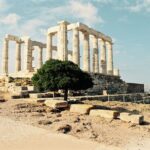
- Cape Sounion and the Temple of Poseidon
- Driver or licensed guide?
- What the price really buys you
- Who should book this private Athens tour?
- FAQ
- Where does the tour pick up?
- Where does the tour end?
- How long does the experience last?
- Is transportation private?
- Are entrance fees included?
- Is a licensed tour guide included?
- Is lunch included?
- Can I cancel for a full refund?
- Should you book it?
Key points to know before booking
- Acropolis highlights: See the Propylaea, Temple of Athena Nike, Parthenon, and Erechtheion, though entry tickets are not included.
- Private transport: Your group of up to three rides in an air-conditioned vehicle, with pickup and return in Athens or at Piraeus.
- Two major settings: Pair central Athens with Cape Sounion, where Poseidon’s temple overlooks the Aegean Sea.
- English-speaking driver: The driver explains Greek history and culture until you enter sites, but is not a licensed guide inside.
- Coastal lunch stop: You get free time in Palaia Fokaia for a waterside meal, at your own expense.
- Weather matters: Much of the day takes place outdoors, and one account describes a difficult experience in pouring, wind-swept rain.
A full day from Piraeus to Cape Sounion
This is an ambitious private day tour. It begins at your Athens hotel or at the cruise terminal in Piraeus and ends at the same place. The stated duration is about eight hours, though the listed driving and stop times add up to a long day on the road.
That extra time in the car is the price of seeing both the city and the cape. Athens and Sounion are not next-door sights. A private vehicle saves you from arranging separate transport and gives your small group a direct route along the Athens Riviera.
The group limit is three people, which makes the $480.44 price easier to assess. Split three ways, the cost is about $160 per person before tickets, lunch, and any optional guide. For a couple, it is a much bigger expense, but you are paying for a private vehicle, hotel or port transfers, and a driver for the whole day rather than for a seat on a shared bus.
If your ship docks at Piraeus, the meeting instructions are simple. Walk outside the terminal exit, where the driver waits with a sign bearing your name. At a hotel, meet at the main entrance and tell the porter or receptionist that you are expecting the driver.
You can also read our reviews of more tours and experiences in Athens.



The Acropolis, from the Propylaea to the Parthenon
The day heads first toward the Acropolis, the rocky citadel above Athens. This is the heart of the visit, but remember that the driver takes you to the entrance and explains the setting before you go in. The vehicle cannot accompany you through the monuments.
You begin at the Propylaea, the grand gateway on the west side of the Acropolis. The structure visitors see today was part of the building program led by Pericles in the fifth century BC. Designed by Mnesicles and begun in 437 BC, it was never fully completed, yet its Pentelic marble entrance still gives the hill a powerful sense of arrival.
Nearby is the small Temple of Athena Nike. Built between 426 and 421 BC, it honors Athena Nike, the goddess of victory. Its position on a bastion above the approach gives you a fine view toward the city and the sea, though the site itself is compact and the visit may be brief.
Then comes the Parthenon. Built between 447 and 438 BC for Athena Parthenos, it is the monument most people picture when they think of Athens. Architects Ictinus and Kallikrates designed it, while Pheidias supervised its sculpture and the wider building program.
The temple’s fame is deserved, but do not expect a quiet, untouched ruin. You will see columns, foundations, scaffolding or restoration work at times, and a busy hilltop with uneven stone underfoot. The scheduled 45 minutes at the Parthenon is enough to take in the main sight, but not enough for a slow study of every corner.
The Erechtheion offers a different mood. This elegant sanctuary on the north side of the Acropolis was built between 421 and 406 BC and was tied to Athena, Poseidon, the mythical king Erechtheus, and the old stories of Athens. Its porch with six female figures is one of the most recognizable details on the hill.
The figures on the building are casts. Five originals are in the Acropolis Museum and one is in the British Museum. That is useful context, since the porch can look complete at first glance even though the surviving statues are protected elsewhere.
Plan for moderate physical effort here. The tour data calls for a moderate fitness level, and that is sensible advice. The Acropolis involves walking across uneven surfaces, slopes, and exposed areas. Wear secure shoes, carry water, and buy your admission in advance if possible. Tickets are not included, and availability may be limited.
Syntagma Square and the center of modern Athens
After the Acropolis, the route shifts from ancient Athens to the capital you see today. The National Garden offers a green break behind Parliament and Syntagma Square. Covering more than 160,000 square meters, it contains hundreds of plant and tree types and was first designed in 1839 by order of Queen Amalia.
You then see the Hellenic Parliament, originally built as a palace for Kings Otto and George I. The building became the home of Parliament and the Senate about a century after its construction. Its position beside Syntagma Square makes it a useful place to connect the royal period of modern Greece with the country’s present political life.
The Tomb of the Unknown Soldier is directly in front of Parliament. It is a cenotaph for Greek soldiers killed in war and is guarded by the Evzones of the Presidential Guard. The hourly guard change is performed in slow motion, while the larger ceremony takes place every Sunday at 11 a.m.
The ceremonial uniforms draw attention, especially the pompom-topped shoes, but the guards are members of an elite light infantry unit. If your timing lines up with Sunday morning, you may see the full ceremony with a military band. At other times, the hourly change gives you a shorter look at the formal routine.
The tour also passes the Academy of Athens, the National Library, and the National and Kapodistrian University of Athens. Together, the Academy, University, and Library form the city’s neoclassical trilogy. You may not enter these buildings during the tour, but the drive gives you a quick view of one of central Athens’ most impressive architectural stretches.
The Old Parliament Building, now home to the National Historical Museum, adds another stop tied to modern Greece. The building housed the country’s first permanent National Assembly and later became a museum covering the period from Ottoman and Latin rule through the War of Independence and the development of the modern state.
Plaka and Kallimarmaro
Plaka is the most atmospheric neighborhood on the route. It spreads below the northeastern slope of the Acropolis, where narrow streets, small shops, sidewalk cafes, tavernas, neoclassical buildings, and ancient remains crowd together.
I would use any free time here for a short walk rather than treating Plaka as a drive-by photo stop. The Anafiotika area, with its whitewashed homes and island-like feel, is especially distinctive. The streets can be steep and irregular, so stay aware of the meeting time.
The Kallimarmaro, or Panathenaic Stadium, is another quick but worthwhile stop. It was rebuilt entirely in Pentelic marble and hosted the first modern Olympic Games in 1896. The marble changes from a cooler tone in morning light to a warmer bone-gold color later in the day.
The scheduled stadium visit is only five minutes, so this is a photo stop rather than a full stadium visit. That limitation is typical of a tour trying to connect so many places in one day. If the stadium is a priority for you, ask in advance how much time can be adjusted.
The Athens Riviera and the long road south
The route then follows the Athens Riviera, the coastal stretch from Piraeus toward Sounion. The city gives way to seaside suburbs, marinas, organized beaches, rocky coves, resorts, and open views across the Saronic Gulf.
This is one of the private tour’s strongest features. You are not simply being transported between two ruins. The drive shows you a different side of Attica, one connected to swimming, sailing, windsurfing, waterfront dining, and summer homes.
The listed time along the Riviera is about 90 minutes. Actual road conditions can affect the pace, and the day includes a substantial amount of driving. If you dislike long car rides, this is the key question to consider before booking. If you enjoy watching a city thin out into seaside communities, the drive becomes part of the experience.
- All Day Cruise -3 Islands to Agistri,Moni, Aegina with lunch and drinks included
★ 5.0 · 4,958 reviews



Lunch in Palaia Fokaia
Palaia Fokaia is scheduled as the lunch stop, with about an hour and 25 minutes of free time. The town sits on the coast in East Attica, and you can choose a restaurant on the water.
Lunch is not included, so budget separately for food and drinks. The open schedule is convenient for a private tour because you are not locked into a set group menu. On the other hand, no restaurant or meal price is specified, so you should ask the driver for current suggestions and allow enough time to eat without rushing to the next stop.
This break also helps divide the day. By this point you have already walked through the Acropolis and crossed central Athens. A waterfront meal gives you time to sit down before the final visit at Sounion.
Cape Sounion and the Temple of Poseidon
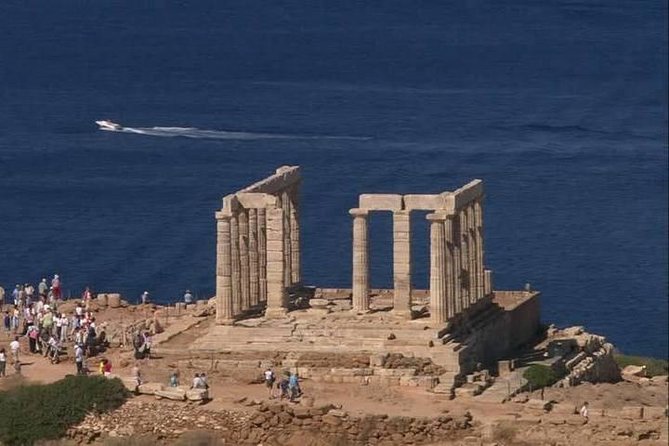
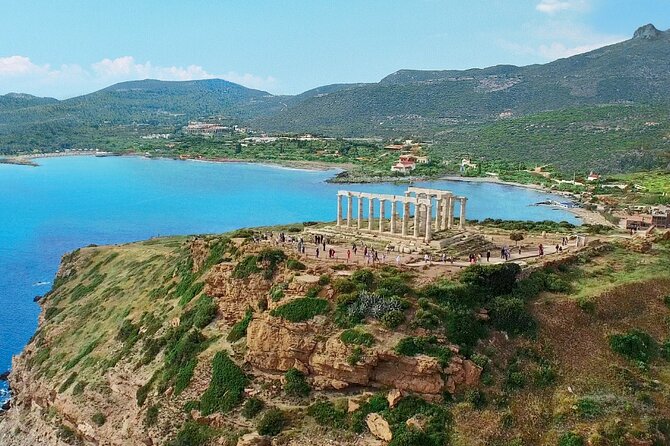
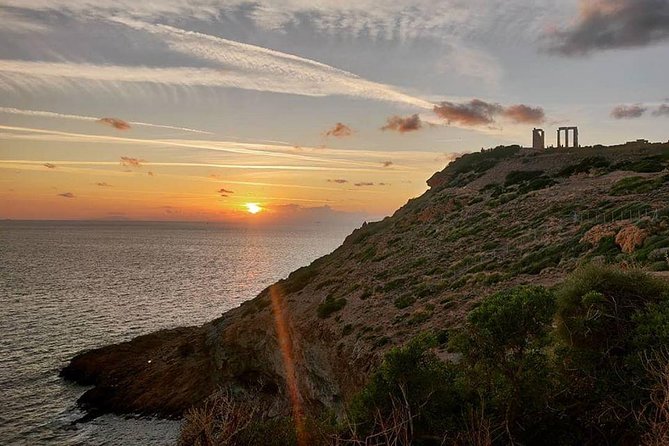
Cape Sounion is the southern tip of Attica. Its location mattered in ancient times because Athens could watch the sea routes toward the Aegean and Piraeus from here. The nearby Lavrion peninsula also had silver mines that helped Athens become a major power in the fifth century BC.
The cape has much older traces too, including reported Early Bronze Age graves. The fortress and sanctuaries belonged to the deme of Sounion, part of the political reorganization associated with Kleisthenes in 510 BC.
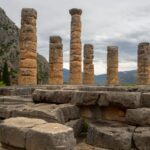
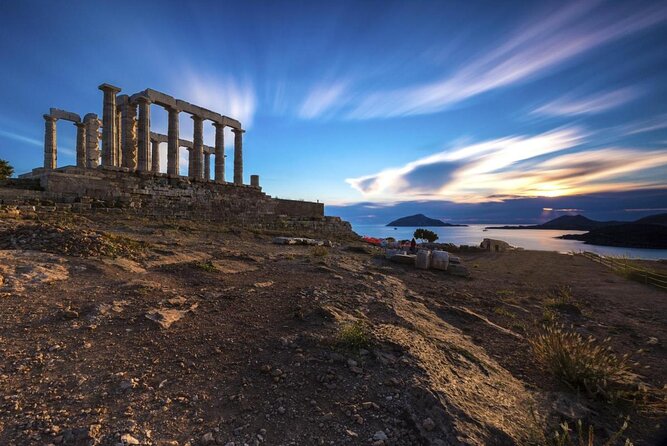
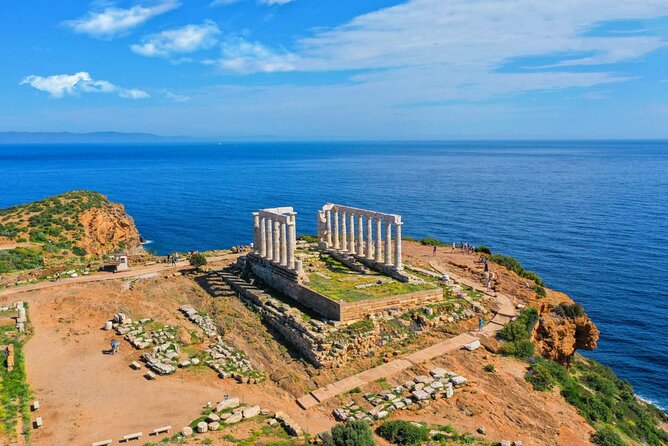
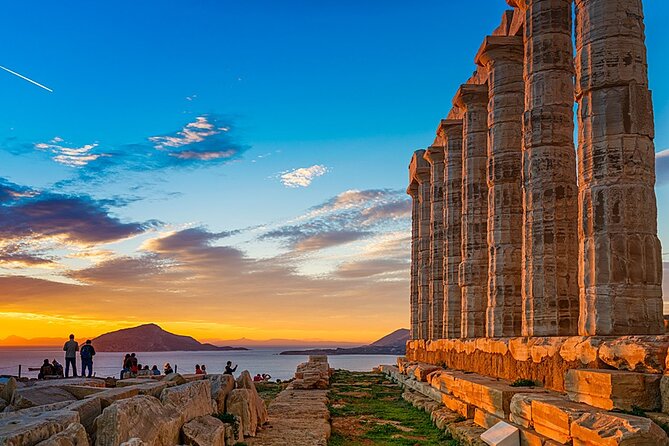
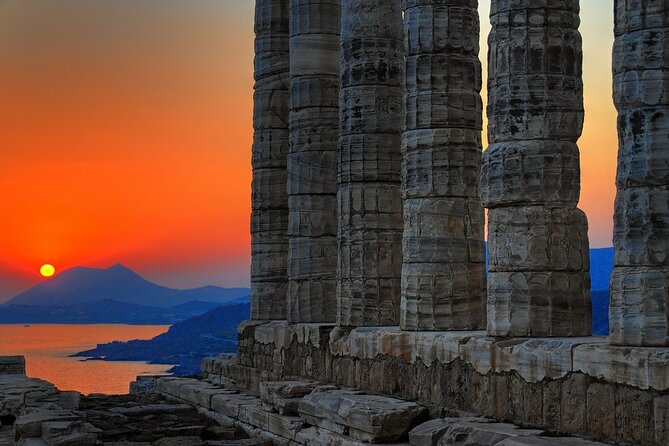
The Temple of Poseidon occupies the high point within the ancient sanctuary. Built from local marble in the Doric style, it faces the sea from steep cliffs. The combination of columns, open horizon, and exposed rock gives the site a different feeling from the enclosed monuments of the Acropolis.
The temple is tied to several stories. One tradition says that Menelaus stopped at Sounion on his return from Troy. Another connects the cape with King Aegeus, who was said to have drowned here, giving the Aegean Sea its name.
You get about 30 minutes at the temple, and admission is not included. That is enough to see the main remains and take in the setting, but it is a tight visit if you want a full archaeological reading of the sanctuary. The driver can explain the site before you enter, but a licensed guide is needed inside for formal guiding.
This is also the most weather-exposed stop. Wind and rain can make the cliffs and stone paths unpleasant, and one poor-weather account describes being dropped at sites without an umbrella or plastic bag. Bring your own rain jacket, compact umbrella, and protection for phones or cameras. Do not count on supplies in the vehicle.
Driver or licensed guide?
The included service is an English-speaking professional driver with good knowledge of Greek history and culture. He can explain the sites until you enter archaeological areas and museums, then waits while you explore independently.
That arrangement works well if you mainly want transport, orientation, and a private schedule. It costs less than adding a licensed guide and gives you freedom to move at your own pace within the allotted time.
It is not the same as a guided Acropolis visit. If you want detailed explanations beside the Parthenon, Erechtheion, and Temple of Poseidon, request a state-licensed guide for an extra fee. Availability is subject to the booking day, so arrange this before departure rather than hoping to find someone at the entrance.
What the price really buys you
At $480.44 per group of up to three, this is best judged as a private transport day, not an all-inclusive sightseeing package. The price covers an air-conditioned vehicle, an English-speaking driver, hotel pickup and drop-off in Athens, and port pickup and return at Piraeus.
It does not cover Acropolis or Temple of Poseidon tickets, museum admission, lunch, drinks, or a licensed guide. Airport transfers can be arranged separately for an added charge.
For three people, the cost can be reasonable compared with arranging several taxis and transfers on your own. It is also useful for cruise passengers who want a direct return to the ship. For one or two people, the value depends on how much you prize privacy and convenience.
The free-cancellation window is 24 hours before the start time. Changes or cancellations inside that period are not accepted for a refund.
Who should book this private Athens tour?
I would choose this tour if you have one packed day, want both Athens and Sounion, and prefer not to manage the transport yourself. It suits couples, families, or a group of three who want a private car and a direct port return.
It is especially practical for cruise passengers, provided your ship’s schedule allows a full eight-hour outing. Tell the provider your exact port and hotel details, and confirm how much time you have before departure.
I would not choose it if you want a slow Acropolis visit, long time in Plaka, or detailed guiding at every monument. The itinerary covers a lot, but the short stops and driving time require discipline.
FAQ
Where does the tour pick up?
Pickup is available at hotels in Athens and at the Piraeus cruise-ship pier. At a hotel, meet at the main entrance. At the port, exit the terminal and look for the driver holding a sign with your name.
Where does the tour end?
The tour returns you to the same location where you were picked up, either your Athens hotel or the Piraeus cruise-ship pier.
How long does the experience last?
The advertised duration is approximately eight hours.
Is transportation private?
Yes. Your group travels in a private, air-conditioned vehicle appropriate for the group size, with a maximum of three people.
Are entrance fees included?
No. Entrance fees for archaeological sites and museums are not included. The Acropolis and Temple of Poseidon both require separate admission.
Is a licensed tour guide included?
No. An English-speaking driver is included, but drivers are not licensed to accompany you inside archaeological sites or museums. A licensed guide can be arranged for an additional fee.
Is lunch included?
No. You have free time for lunch in Palaia Fokaia, but food and drinks are at your own expense.
Can I cancel for a full refund?
You can cancel at least 24 hours before the experience begins for a full refund. Cancellations or changes made less than 24 hours before the start time are not accepted for a refund.
Should you book it?
Book this tour when coverage and convenience matter more than a slow pace. You will see the Acropolis, central Athens, the Athens Riviera, and Poseidon’s temple without arranging separate rides. For a group of three, the private price is easier to justify.
Before paying, confirm the total ticket cost, ask about adding a licensed guide, and check the timing against your cruise departure. Pack sturdy shoes and rain protection. If you accept the long drive and short monument visits, this is an efficient way to connect Athens’ ancient center with one of Attica’s most memorable coastal sites.