REVIEW · ATHENS
Visit Acropolis Parthenon & Private Luxury Sunset PoseidonTemple
Book on Viator →Operated by Yomadic.Tours & Transfers · Bookable on Viator
The best part of this private Athens tour comes late in the day: after the city’s ancient monuments, you drive to Cape Sounion for the Temple of Poseidon at sunset, perched above the Aegean Sea. It is a memorable finish, and the long coastal ride gives the day a satisfying change of pace.
I like the freedom of a private vehicle, especially for a packed route that reaches both central Athens and Sounion. I also like the option to adjust the program, add a licensed guide, or shorten the sightseeing if you need airport transport. The main caution is that the itinerary is very full, and entrance fees are not included in the $197.79 price.
- Private transportation all day: Hotel, Airbnb, port, and some airport pickups are available, with sedan or minivan service based on group size.
- The Acropolis takes center stage: Parthenon, Propylaea, Temple of Athena Nike, Theater of Dionysus, and the Acropolis Museum are all included in the route.
- A broad Athens overview: You see the Temple of Olympian Zeus, Panathenaic Stadium, Neoclassical Trilogy, Plaka, Roman Agora, and Lycabettus Hill.
- A dramatic final stop: Cape Sounion and the Temple of Poseidon provide sea views and a famous sunset far from the city center.
- Andreas is a useful contact: Direct communication through WhatsApp can help with timing and meeting arrangements.
- Plan for extra costs: All major archaeological entrance fees, meals, and a licensed guide are separate.
In This Review
- A Full Day That Connects Athens and Cape Sounion
- Starting at the Acropolis and Parthenon
- The Acropolis Museum and What It Adds
- Olympian Zeus, Hadrian’s Gate, and the Panathenaic Stadium
- The Neoclassical Trilogy and Lycabettus Hill
- Plaka, the Roman Agora, and the Tower of the Winds
- The Athens Riviera and Lake Vouliagmeni
- Sunset at the Temple of Poseidon
- Private Vehicle, Comfort, and Group Size
- Is $197.79 a Good Value?
- Who Should Book This Experience?
- Should You Book It?
- FAQ
- How long does the tour last?
- Where can pickup take place?
- Is this a private tour?
- What type of vehicle is provided?
- Are entrance fees included?
- Is a licensed guide included?
- Is lunch included?
- Can the itinerary be changed?
- What happens if bad weather cancels the tour?
A Full Day That Connects Athens and Cape Sounion
This is not a slow, single-site tour. It is a private driving and sightseeing day that tries to cover the major ancient, civic, academic, and coastal sights around Athens in about eight to nine hours.
That breadth is the appeal. You can see the Acropolis in the morning, look across the city from Lycabettus Hill, pass the Neoclassical Trilogy and Presidential Palace, then finish at Poseidon’s temple beside the sea. It gives you a strong first look at Athens, particularly if you have only a short stay.
The trade-off is pace. Several stops are brief, and the published times do not add up neatly as a relaxed visit to every location. Think of this as a private overview with selected walks, photo stops, and historical explanation rather than a full guided excavation of every monument.
Your English-speaking driver provides historical information but is not licensed to accompany you inside archaeological sites. If you want detailed commentary among the ruins, request a licensed guide in advance. That costs extra and depends on availability.
Starting at the Acropolis and Parthenon
The day begins with pickup from your Athens hotel, Airbnb, or Piraeus port. Airport pickup is also possible, but it carries an additional charge. Groups of one to three use a luxury sedan, while groups of four to seven use a luxury minivan.
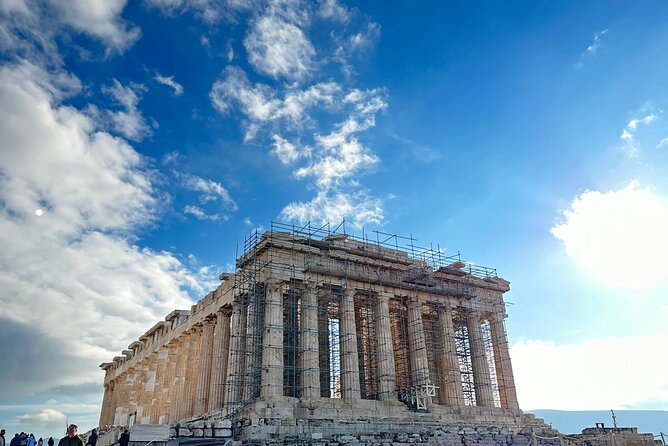
The Acropolis is the essential first stop. The name means the highest point of the city, and the rocky hill still gives you a clear sense of why ancient Athenians chose it for their great sanctuaries. From here, you look over the modern city while walking among monuments that shaped Western art, architecture, politics, and philosophy.
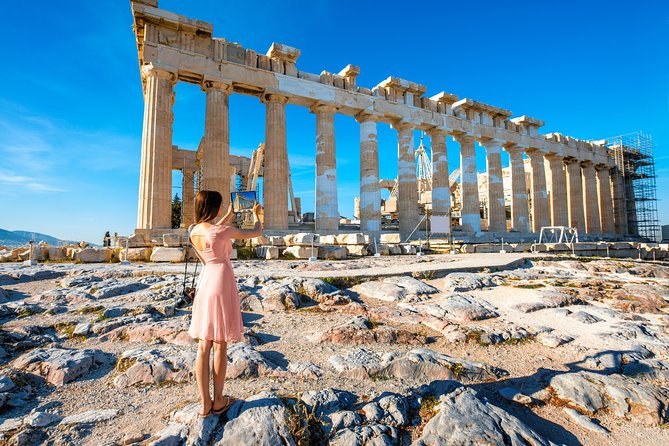
The Parthenon is the main attraction. Its Doric columns and carved marble are familiar from books and photographs, but the setting helps explain its power. You are not looking at an isolated building in a museum. You are seeing a temple placed high above Athens, designed to be visible across the ancient city.
The route also includes the Propylaea, the monumental entrance to the Acropolis. It was part of the rebuilding program associated with Pericles after the Persian Wars. Allow time to pause here, since the gateway itself is more than a passage to the Parthenon.
The small Temple of Athena Nike sits on a steep bastion near the entrance. Built around 420 BC, it is an early fully Ionic temple on the Acropolis. Its position is easy to miss when attention is fixed on the Parthenon, but the graceful scale and exposed location make it one of the hill’s most appealing details.
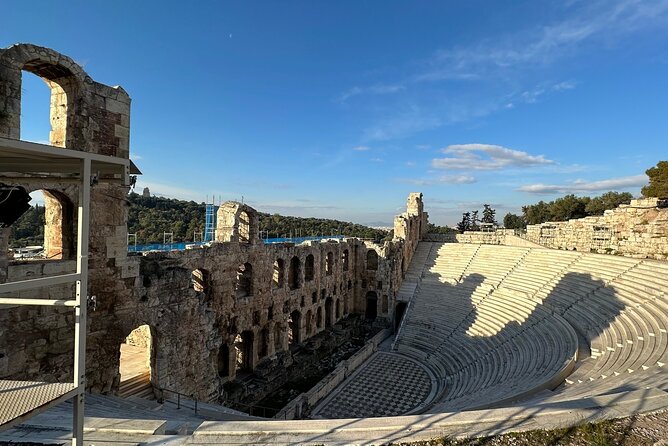
You also visit the Theater of Dionysus on the southern slope. This is where the City Dionysia was held, and the theater eventually held up to about 17,000 people. The site connects the Acropolis to the beginnings of Greek drama, not just temples and religious ceremony.
The scheduled Acropolis time is roughly two hours, with shorter allocations for individual monuments. That is enough for a useful visit, but not enough for a slow study of every structure. Wear shoes suited to uneven stone and expect the hill to be the most physically demanding part of the day.
You can also read our reviews of more private tours in Athens


The Acropolis Museum and What It Adds
The Acropolis Museum sits below the hill and is planned as a separate stop of about 45 minutes. Its modern galleries hold important statues and objects from the Acropolis, giving you a closer look at details that can be hard to read outdoors.
I consider the museum especially useful after the hill. The Parthenon’s sculptural decoration is fragmentary, and the museum helps place surviving pieces within their original setting. Still, 45 minutes is a short visit. You will need to move directly to the principal galleries rather than trying to see everything.
The entrance fee is not included. Confirm the day’s ticket plan before setting out, particularly if you hope to enter both the Acropolis and museum. The driver can explain the route, but a licensed guide is required if you want formal guiding inside the archaeological sites.
Olympian Zeus, Hadrian’s Gate, and the Panathenaic Stadium
After the Acropolis area, the route moves through central Athens by vehicle and on foot. Hadrian’s Gate is a quick visual stop, an ancient Roman-style arch that once marked the road between old Athens and the eastern complex around the Temple of Olympian Zeus.
The Temple of Olympian Zeus is one of the city’s most impressive open-air ruins. Construction began in the sixth century BC, but the temple was not completed until the reign of the Roman emperor Hadrian in the second century AD. Its surviving columns give you a clear idea of the scale of what was once the largest temple in Greece during the Hellenistic and Roman periods.
The planned visit is about 45 minutes. That is enough to walk around the remains and understand the size of the temple, though the grounds can feel exposed in strong sun. Bring water, even though bottled water is supplied in the vehicle.
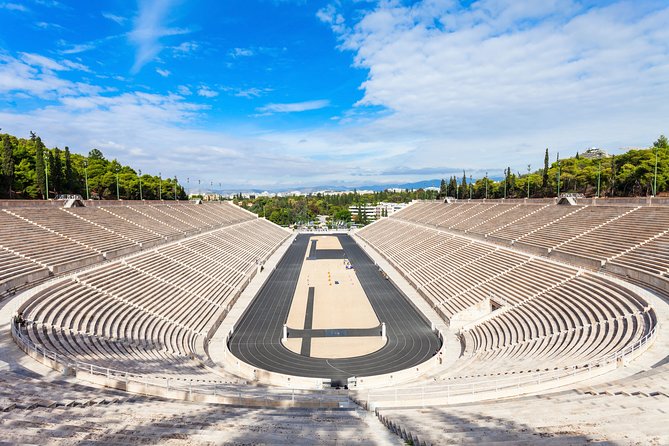
The Panathenaic Stadium provides a very different kind of ancient setting. Built for the Panathenaic Games and later rebuilt in marble by Herodes Atticus, it could hold about 50,000 people. After centuries of decline, it hosted events connected with the first modern Olympics in 1896.
The stop here is listed at about 15 minutes, so you should treat it as a compact visit and photo opportunity. The entrance fee is extra. If Olympic history is a major interest, you may prefer to spend more time here and shorten one of the less essential city stops.
The Neoclassical Trilogy and Lycabettus Hill
The route passes the Academy of Athens, University of Athens, and National Library of Greece. Together, the Academy and the original university and library buildings form Athens’ famous Neoclassical Trilogy. The Academy is Greece’s national research institution, while the university has operated since 1837.
The Academy stop is listed as free and takes about 10 minutes. The university and library are viewed along the route rather than treated as long interior visits. Their value is architectural and civic: they show how the modern Greek state presented itself after independence, using a grand classical style tied to ancient Athens.
Lycabettus Hill gives you the day’s broadest city view. At 277 meters above sea level, it is the second-highest point in the Athens basin and has the small Church of Agios Georgios at its summit. A cable car operates at the hill, though the tour information does not specify whether its fee or use is included.
The stop is planned for about 45 minutes. This is a good place to get your bearings. The Acropolis appears from another angle, and the dense city stretches toward the Saronic Gulf. On a clear day, you can better understand the relationship between Athens, the surrounding hills, and the coast.
The hill also comes with a local myth involving Athena, a crow, and the reason crows are said to have turned black. Your driver may bring out stories like this, adding a human touch to the monuments and viewpoints.
Plaka, the Roman Agora, and the Tower of the Winds
Plaka is the old neighborhood around the northern and eastern slopes of the Acropolis. Its narrow streets, neoclassical buildings, and proximity to ancient sites make it a natural transition between archaeological Athens and the present-day city.
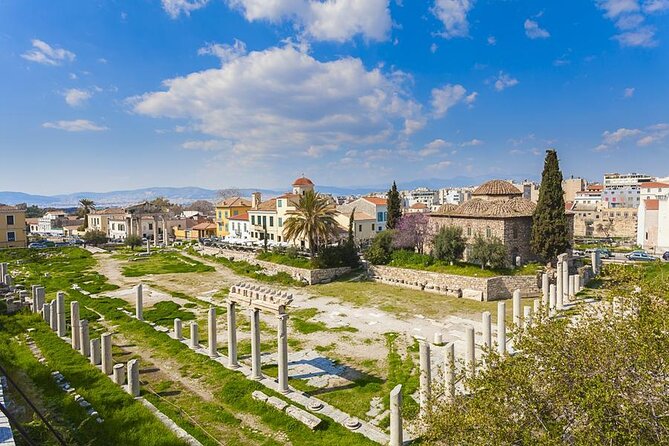
The Roman Agora is scheduled for about 45 minutes. It replaced some functions of the older Agora as Roman buildings and projects changed the area. The Tower of the Winds, a compact marble clock tower inside the Roman Agora, receives its own 10-minute stop, with admission included.
These stops work well together, but check exactly how much walking you want. The Roman Agora and Tower of the Winds require archaeological-site admission arrangements, and the driver cannot guide you inside without a licensed guide. If you are already tired after the Acropolis, you may prefer to use Plaka for a short walk and a meal rather than insist on every ruin.
The Ancient Agora is also part of the advertised Athens program, although the detailed stop list gives more attention to the Roman Agora. Confirm whether you will enter the Ancient Agora or simply pass nearby. Its entrance fee is not included.
A few more Athens tours and experiences worth a look




The Athens Riviera and Lake Vouliagmeni
The route then heads south through Glyfada and the Athens Riviera. Glyfada sits between Mount Hymettus and the Saronic Gulf and offers a change from central Athens’ ancient streets and heavy traffic.
Lake Vouliagmeni is a short, free stop on the return toward the city. The small brackish lake is fed by underground water currents passing through Mount Hymettus. It is a pleasant pause beside the water, though the planned 10 minutes is enough only for a look and a few photographs.
The coastal section adds variety to the day, but it also makes the timing more sensitive. Traffic in Athens and along the coast can affect the arrival at Sounion, especially if sunset is the priority. Tell the driver clearly that you want the Temple of Poseidon to remain the fixed point of the schedule.
Sunset at the Temple of Poseidon
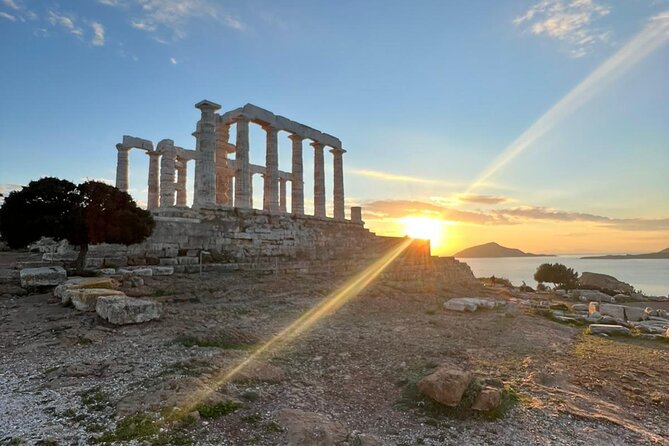
Cape Sounion lies about 59.6 kilometers from Athens, at the southern tip of the Attic peninsula. The drive takes you far from the city center to a headland surrounded on three sides by sea.
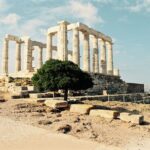
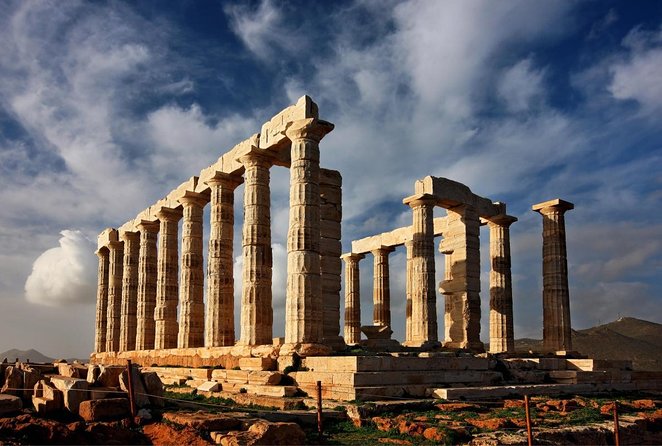
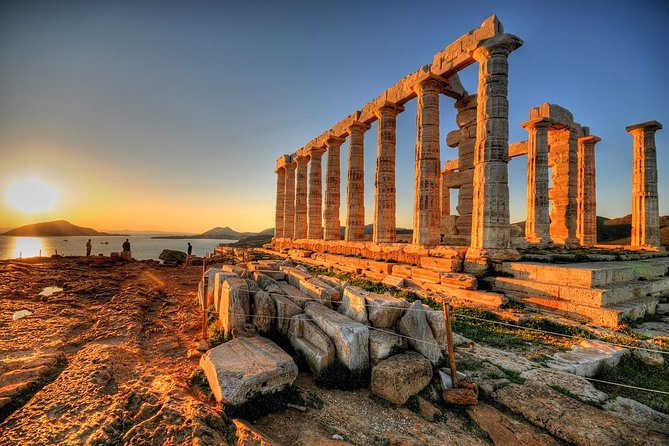
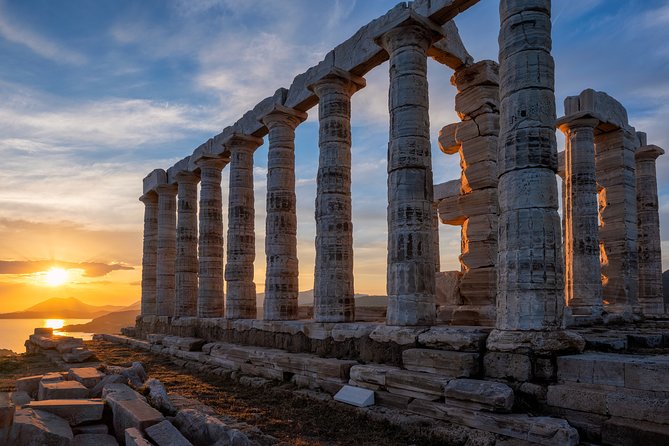
The archaeological site is planned for about an hour, followed by roughly 30 minutes at the Temple of Poseidon itself. The temple was built between 444 and 440 BC during Athens’ Golden Age. Its Doric columns rise nearly 60 meters above the sea, a setting that gives the ruins much of their force.
This is the emotional high point of the tour. At the Acropolis, you stand inside the city’s ancient religious center. At Sounion, you see a sanctuary placed at the edge of the Attic world, watching over the sea route. The sunset adds beauty, but the location matters even without perfect color in the sky.
The site is uneven and exposed, so comfortable shoes and a light layer are sensible. Admission is extra, and the tour does not include a licensed guide inside the temple. The driver can provide context and help with timing, but you should not expect a formal archaeological tour unless you add one.
The sunset schedule also depends on weather. If poor weather forces cancellation, you can receive a different date or a full refund. Since the experience is designed around the sunset at Sounion, ask about the expected timing before booking.
Private Vehicle, Comfort, and Group Size
Transportation is one of the strongest reasons to choose this experience. You are not changing buses between the Acropolis, central Athens, Lycabettus Hill, the Riviera, and Sounion. The vehicles include air-conditioning, WiFi, and bottled water, which matter on a long day in warm weather.
The tour is limited to your own group. That makes it easier to adjust the program, spend less time at a stop that does not interest you, or request a shortened version when you need to reach the airport. A prior arrangement described by the company involved a shortened Poseidon visit on the way to the airport, showing how the private format can work for a tight schedule.
Andreas is the named contact associated with the service. Direct, timely communication is useful, and WhatsApp is a practical choice for avoiding long-distance international charges. Car seats are available if requested in advance.
The driver is not the same as a licensed guide. This distinction matters. You receive transportation and historical explanation, but a site guide who accompanies you through the Acropolis, museum, Agora, or Poseidon temple must be arranged separately and costs extra.
Is $197.79 a Good Value?
At $197.79 per person, the tour is not the cheapest way to see Athens. You also need to budget for entrance fees, food, and possibly a licensed guide. For a solo visitor, the price may feel high compared with public transportation and independent admission.
The calculation changes for a small group. Up to three people share a luxury sedan, and four to seven use a minivan. If you value hotel or port pickup, air-conditioning, a private schedule, and the long trip to Sounion without arranging separate transport, the price can be reasonable.
The tour also saves planning time. You do not have to work out how to combine central Athens with Cape Sounion, and you can ask for a custom program. Still, ask for a clear estimate of all entrance fees before booking. The headline price covers the service and vehicle, not the full cost of entering the major sites.
The strongest value comes when you want both Athens and Poseidon in one day. If you have several days in the city, you may get more from visiting the Acropolis and museum slowly on your own, then taking a separate coastal trip.
Who Should Book This Experience?
I would recommend this tour to first-time visitors with one busy day, cruise passengers using Piraeus, families who need private transport, and small groups that want a flexible schedule. It also suits anyone who wants the Temple of Poseidon without renting a car or managing a long public transport day.
It is less suitable if you dislike fast sightseeing or want long, detailed time at each museum and ruin. History-focused visitors should add a licensed guide and consider removing some short photo stops. The itinerary tries to cover a great deal, and you will need to accept a few quick visits.
Free cancellation is available up to 24 hours before the start time. Last-minute changes are not accepted under the stated policy, so confirm pickup details and any guide request early.
Should You Book It?
Book this private tour if you want an efficient Athens overview with a memorable coastal finish. The combination of the Parthenon, Lycabettus Hill, Roman and classical ruins, Athens Riviera, and Poseidon’s temple is hard to fit together without private transport.
Before paying, ask for three things: the exact pickup time, the total admission cost, and whether a licensed guide is available for your date. If you can handle a full day and extra ticket costs, this is a strong choice for seeing Athens beyond the Acropolis. If you prefer depth over coverage, customize the program and give more time to fewer sites.
FAQ
How long does the tour last?
The experience lasts approximately eight to nine hours.
Where can pickup take place?
Pickup and drop-off are offered at Athens hotels, Airbnb residences, and Piraeus port. Airport pickup is available for an additional cost.
Is this a private tour?
Yes. Only your group participates.
What type of vehicle is provided?
Groups of one to three people use a luxury sedan. Groups of four to seven use a luxury minivan. Vehicles include air-conditioning, WiFi, and bottled water.
Are entrance fees included?
No. Entrance fees for the Acropolis, Parthenon, Acropolis Museum, Panathenaic Stadium, Ancient Agora, Roman Agora, and Temple of Poseidon are not included. The Tower of the Winds is listed with admission included.
Is a licensed guide included?
No. The English-speaking driver provides historical information but is not licensed to accompany you inside archaeological sites. A licensed guide may be requested for an additional cost, depending on availability.
Is lunch included?
No. Lunch, meals, and beverages other than the provided bottled water are not included.
Can the itinerary be changed?
Yes. The tour is private and the program can be customized according to your needs. Discuss changes with the provider before the tour.
What happens if bad weather cancels the tour?
If poor weather causes cancellation, you will be offered another date or a full refund. You can also cancel for a full refund up to 24 hours before the experience begins.