REVIEW · ATHENS
Ancient Corinth, Mycenae, Epidaurus, Nafplio Full Day Private Tour From Athens
Book on Viator →Operated by CRISPY LOCAL MONOPROSOΡΙ Ι.Κ.Ε. · Bookable on Viator
Three UNESCO sites, one efficient day.
This private full-day tour strings together Ancient Corinth, Mycenae, and Epidaurus with an easy Nafplio break, so you’re not spending your vacation figuring out buses and parking. I like the way the driver gives historical facts while you ride, and past drivers like Dimitris and George have kept groups moving on schedule (without the usual rush-energy). One consideration: you’ll still pay site admissions for the three big archaeological areas, and the full route is a long 9 to 10 hours with some uphill walking at the fortress stops.
If you want a day with minimal stress, this setup is hard to beat. The private car or minivan also makes sense when you’re booking far ahead and want a smooth start from wherever you’re staying in Athens.
In This Review
- Key highlights you’ll feel all day
- Why this Athens Peloponnese day trip saves you real time
- Corinth Canal: the quick stop that frames the whole region
- Ancient Corinth plus its museum: Paul’s world in stone and ground level context
- Mycenae: Lion’s Gate, Cyclopean walls, and the Agamemnon story
- Epidaurus theatre and the Sanctuary of Asklepios: acoustics and healing cult
- Nafplio: lunch, harbor photos, and why this town pulls people in
- Palamidi steps and Acronauplia fortifications: the views you work for
- Price and what $259.03 buys you (plus the small extra costs)
- What to expect from the driver experience (and how to get what you want)
- Who this tour is best for (and who should maybe choose something else)
- Tips to make the day feel smooth
- Should you book this Ancient Corinth–Mycenae–Epidaurus private day trip?
- FAQ
- What time does the tour start?
- Where do you get picked up in Athens?
- How long is the day trip?
- Is this a private tour?
- Which UNESCO sites are included?
- Are archaeological site admission fees included?
- Is lunch or food included?
- What if the weather is bad?
Key highlights you’ll feel all day
- Private group transport in an A/C car or minivan, with pickup from your Athens accommodation
- UNESCO checklist: Ancient Corinth, Mycenae, and Epidaurus in one go
- Learning on the move: the driver provides historical context during the drive (not a licensed site guide)
- Big-view stops at the Corinth Canal overlook and Nafplio’s harbor forts
- A payoff climb at Palamidi, with the option to take it at your own pace
Why this Athens Peloponnese day trip saves you real time
Peloponnese highlights are scattered. That’s the core problem with planning this on your own: each site is far enough away that travel time steals your energy. This tour solves that with one long, organized route that strings together the classic ancient stops, plus Nafplio for food and views.
You’re also not sharing a vehicle with strangers. With a private group, you get better timing control—especially useful when the day stretches across multiple ticketed archaeological areas. And because you get bottled water and A/C transport, the trip stays comfortable even when the sun is doing its thing.
The driver-style approach is a practical middle ground. You don’t get a licensed guide walking you through every room, but you do get context while you travel, which makes your time on-site feel less like random ruins and more like a story.
You can also read our reviews of more private tours in Athens



Corinth Canal: the quick stop that frames the whole region
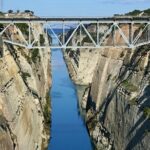
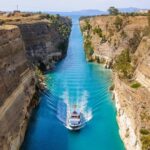
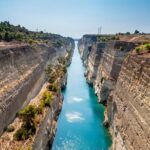
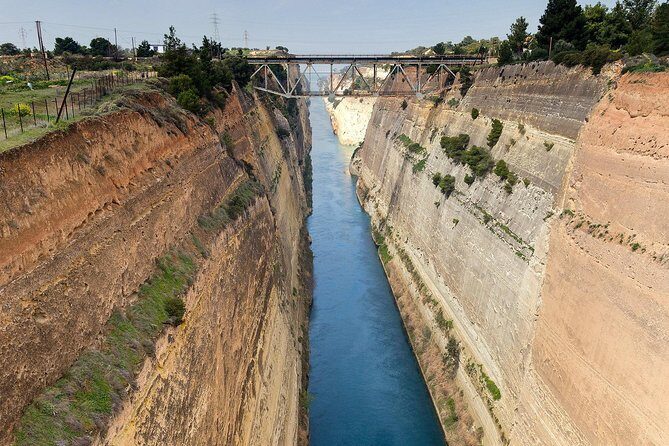
The day starts with the Corinth Canal, a famous cut through the narrow Isthmus of Corinth. It links the Gulf of Corinth in the Ionian Sea to the Saronic Gulf in the Aegean Sea—basically making the Peloponnese feel like it has a sea border rather than just a land connection.
What makes this stop memorable is the engineering and the scale. The canal is 6.4 kilometers long and only 21.4 meters wide at its base, and it has no locks. In plain terms: you get a sense of how narrow and intense this passage is, and you can watch vessels threading their way through steep limestone walls below.
You’ll spend about 10 minutes here, and admission is free. That’s enough time to get the key views and photos without turning it into a drag.
Practical tip: if you care about photos, aim to arrive ready—this kind of viewpoint stop is short, and parking and walking can eat a few minutes if you aren’t prepared.
Ancient Corinth plus its museum: Paul’s world in stone and ground level context
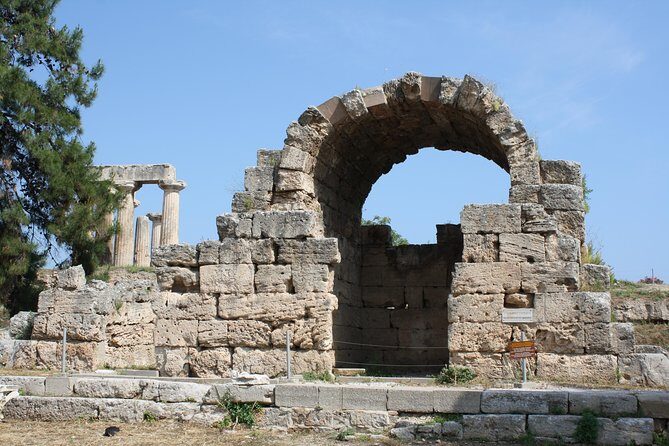
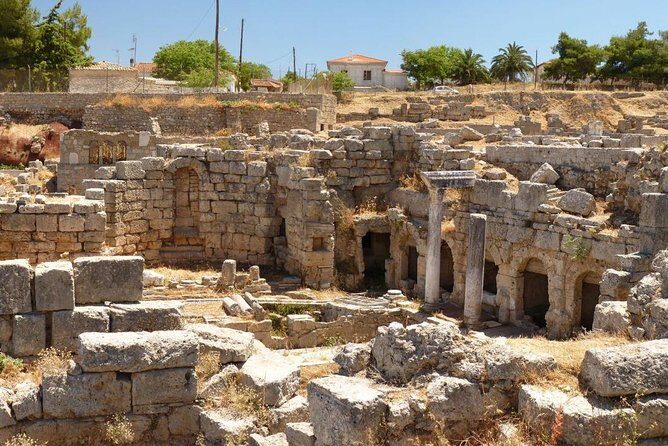
Ancient Corinth (Archaia Korinthos) is one of those places where the location matters as much as the ruins. Corinth was a city-state on the Isthmus of Corinth, roughly halfway between Athens and Sparta. That meant it sat on a natural route and carried influence far beyond its walls.
If you connect to the New Testament, Corinth has a very recognizable role. Paul’s letters to the Corinthians (First and Second Corinthians) connect directly to the city. The place is also mentioned in Acts as part of Paul’s missionary travels, and Pausanias’s Description of Greece includes Corinth.
On-site, Corinth was enormous—about 90,000 people in 400 BC—and it stayed important long after the ancient peak. The Romans demolished Corinth in 146 BC, later built a new city in 44 BC, and made it a provincial capital of Greece.
This stop runs about 1 hour at the archaeological site, and the Archaeological Museum of Corinth adds about 30 minutes. The museum isn’t included in the admission, and the site admission isn’t included either—so budget for those entry fees.
What I like about this approach: the museum timing works well right after seeing the ground-level remains. Even if you don’t become an overnight expert, you can start connecting artifacts to what you just saw.
Consideration: if you want to slow down and read every sign, you might feel time pressure at the 1-hour mark. The upside is that the tour still gives you the freedom to explore within that window.
Mycenae: Lion’s Gate, Cyclopean walls, and the Agamemnon story
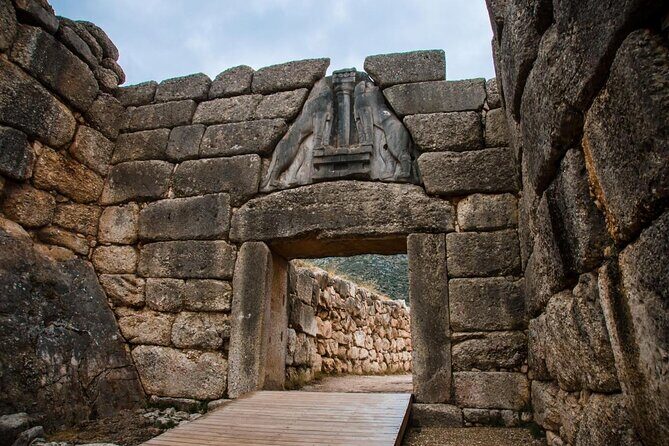
Mycenae is the kind of site that feels like it belongs in a myth because it literally is tied to the Agamemnon tradition. The fortified citadel was home to the mythical and powerful King Agamemnon, and the site gave its name to an entire Bronze Age civilization: the Mycenaeans.
This isn’t just about one pretty ruin. Mycenae was a major center of Greek civilization in the second millennium BC, a military stronghold that influenced southern Greece, Crete, the Cyclades, and parts of southwest Anatolia. Around 1600 BC to 1100 BC is called the Mycenaean period for a reason.
You’ll see the fortifications and key highlights like the Tomb of Clytemnestra and the famous Lion’s Gate. The walls are often described as Cyclopean—large stone work that still looks overpowering even after thousands of years.
The tour gives about 1 hour for the site itself, plus about 30 minutes at the Archaeological Museum of Ancient Mycenae near the Lion Gate. Admissions are not included for this area, and Mycenae’s admission fee is listed at €20 per person.
Then comes the most iconic single structure moment: the Citadel and Treasury of Atreus. This is the Tomb of Agamemnon, a large tholos or beehive tomb on Panagitsa Hill, built around 1250 BC. The lintel above the doorway is incredibly heavy—about 120 tons—with dimensions listed as 8.3 x 5.2 x 1.2 meters.
You’ll spend around 10 minutes here. Short, yes, but that’s actually the right pacing for a signature monument. You get the wow factor without exhausting your whole energy budget.
Practical tip: expect uneven walking around ancient areas. If you’re someone who dislikes stairs or rough ground, plan for slower movement and don’t try to cram every viewing angle.
Epidaurus theatre and the Sanctuary of Asklepios: acoustics and healing cult
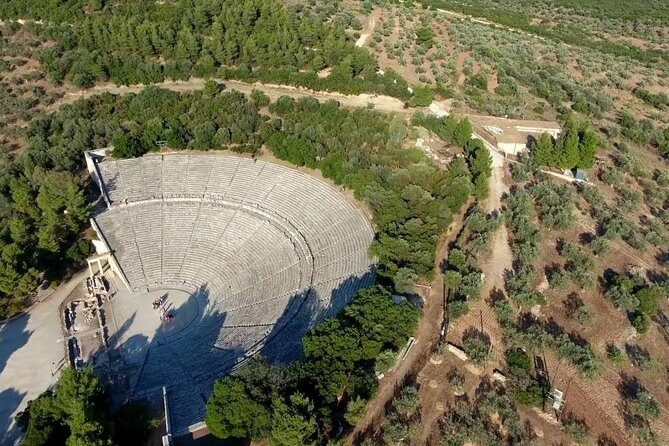
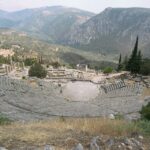
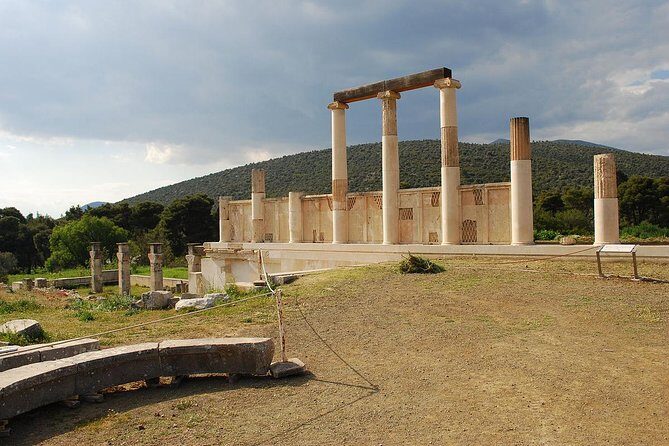
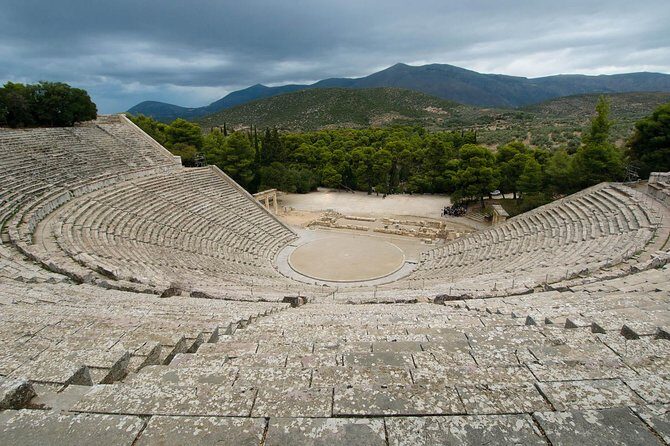
Epidaurus is where the day shifts from warrior-citadel energy into something quieter and more ritual-focused. The Ancient Theatre of Epidaurus sits in the sanctuary area dedicated to Asclepius, the ancient Greek god of medicine.
The theatre is famous for acoustics and aesthetics, and it’s considered the most perfect ancient Greek theatre for those reasons. Architecturally, it kept the classic Hellenistic structure: theatron, orchestra, and skene. During Roman times, it didn’t suffer the usual modifications you see at many Greek theatres.
You’ll spend about 1 hour here, with admission not included. That’s enough time to appreciate the space and still take in the sanctuary surroundings.
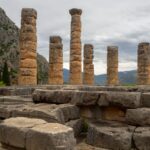
Next is the Sanctuary of Asklepios, where the Temple of Asclepius was built in the early 4th century BC. The sanctuary is described as a rival to major cult sites like Olympia and Delphi. The temple’s later fate connects to the late Roman Empire’s shifting policies toward pagan worship—if it was still in use by the 4th century AD, it would likely have been affected by closures tied to Christian imperial edicts.
This section is about 20 minutes, with admissions not included. The Epidaurus admission fee listed is €20 per person.
What this stop does for your day: it prevents the tour from turning into a checklist of fortresses only. You see how ancient Greeks built spaces for healing, worship, and public life, not just power and defense.
Consideration: if you’re particularly sensitive to long quiet seating or heat, you may want to take short breaks between the theatre and the sanctuary temple area.
A few more Athens tours and experiences worth a look
- All Day Cruise -3 Islands to Agistri,Moni, Aegina with lunch and drinks included
★ 5.0 · 4,958 reviews




Nafplio: lunch, harbor photos, and why this town pulls people in
After multiple archaeological stops, Nafplio feels like a reset. The tour schedule builds in time for a superb lunch, coffee, and shopping. Nafplio is often called Naples of the East—a nickname that points to its European-style feel.
It’s known for Venetian architecture, cobbled squares, and towering castles with commanding views over the Argolic Gulf. The town grew up along hills near the north end of the gulf, and it has a layered past: Middle Ages port power under different royal houses, then Venetian control, then the Ottoman period.
Nafplio was also politically important in modern Greek history. It served as capital of the First Hellenic Republic and then the Kingdom of Greece from the start of the Greek Revolution in 1821 until 1834.
You’ll spend about 2 hours in Nafplio, and the stop is listed as free admission. That time is enough to grab a meal, check out the harbor, and wander the back streets without feeling like you’re stuck inside a museum schedule.
One extra photo-friendly moment: view the water castle of Bourtzi, a Venetian castle in the middle of Nafplio’s harbor. The tour includes a harbor-side viewing time, which is a smart way to break up the day visually after ancient stone.
Practical tip: if you want photos, you’ll get your best results near the harbor side during your Nafplio window, since the time is limited.
Palamidi steps and Acronauplia fortifications: the views you work for
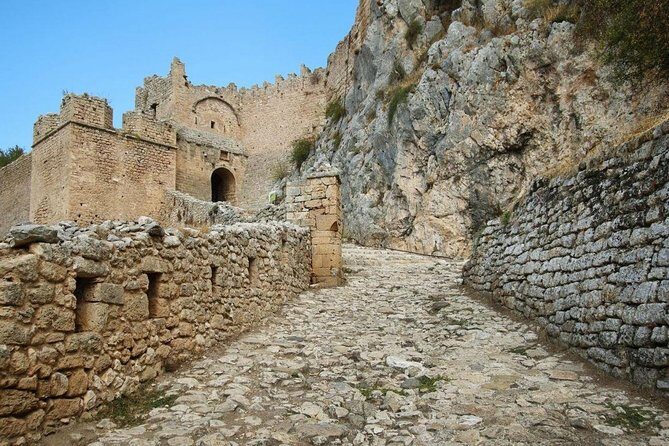
Palamidi is the fortress above Nafplio, reached by a winding stair. It sits east of Acronauplia on a 216-meter high hill, and it was built by the Venetians during their second occupation of the area (1686–1715). From the top, the views over the Argolic Gulf and Nafplio are the point.
The tour allocates about 30 minutes for Palamidi. Admission isn’t included, and the practical detail you should take seriously is the stairs count. The route is listed as 913 steps from town to fortress, while locals say it’s more like 999 steps to the top. Either way, plan your effort for the climb, not just the time on top.
If stairs are a concern, this is the segment to think about before you book. The tour says most travelers can participate, but Palamidi is still a physical ask compared with the canal overlook or museum rooms.
Then there’s Acronauplia, the oldest part of Nafplio. Until the 13th century, it was its own town. After Venetians and Franks arrived, it became part of the fortifications. The area was also used as a prison until the Greek government decided the view should benefit tourism, leading to construction of a hotel complex that still stands there.
The tour mentions this area as part of the Nafplio fortification story. It’s a good ending to the day because it ties together the Venetian layer, the modern tourism layer, and the old military use.
Price and what $259.03 buys you (plus the small extra costs)
At $259.03 per person, you’re paying for a private, time-efficient route. The biggest value is what you avoid: renting a car, negotiating parking, figuring out transit timing, and losing half your day to logistics. The tour includes private transportation in an A/C luxury car or minivan, bottled water, and a culinary gift.
It also includes historical commentary from the driver during the ride. That’s not a substitute for an official licensed guide inside every site, but it can be a huge help for making sense of what you’re seeing in the moment.
The one place where the math still matters is site admissions. They are not included for the archaeological sites at Mycenae (€20 per person), Corinth (€15 per person), and Epidaurus (€20 per person). The museum tickets for Corinth and Mycenae are also not included. If you’re budgeting ahead, those three main fees add up to €55 total for the big sites listed.
Add this up with your group size and you’ll see the logic. If you were to hire private drivers or rent a car while paying for multiple entries across three UNESCO sites, this pricing starts to make more sense fast.
Also note: if you want a licensed tour guide inside archaeological sites, it’s available upon request and depends on availability. The driver is not licensed to accompany you in the sites, so plan that decision in advance if guided interpretation is a priority.
What to expect from the driver experience (and how to get what you want)
A private tour lives or dies on the person behind the wheel and the way they manage time. The tour emphasizes professional drivers who offer insights and history facts while you travel.
That matters because it shapes how you experience each stop. If the driver gives you the right context before you arrive, you’ll usually spend your on-site minutes looking at the right things, not just wandering.
One thing I’d take into account: drivers may discuss aspects of local culture, including religion, as part of the historical setting. If that’s not your style, you can set the tone early. Tell the driver you want commentary focused strictly on the sites and history, and you’ll likely get better alignment with what you came for.
From the positive experiences shared, the common theme is pacing. The driver keeps the day moving while still leaving time to explore at your own pace.
Who this tour is best for (and who should maybe choose something else)
This is ideal if you:
- want a private Peloponnese day with minimal logistics
- like UNESCO-style classics and want three big sites in one shot
- enjoy learning while moving, not only while standing in front of ruins
- don’t want to manage driving between Ancient Corinth, Mycenae, Epidaurus, and Nafplio
It might be less ideal if you:
- want a fully licensed guide inside every archaeological space
- have limited tolerance for a long day and the stair-heavy part at Palamidi
- prefer to keep costs tight (since site admissions and museum entries aren’t included)
It’s also a good fit for people who like practical planning. The schedule is built around short, focused stop times: 10 minutes for the canal and Treasury of Atreus, about 1 hour for the big archaeological areas, and a couple of blocks of breathing room in Nafplio.
Tips to make the day feel smooth
Start early in your brain. The tour begins at 8:00 am with pickup from any accommodation in Athens, so you’ll want to be ready to go without rushing breakfast.
Wear shoes you trust for uneven ground. You’re moving through archaeological areas and climbing stairs for Palamidi’s views. A little preparation here pays off fast.
Bring spending money for admissions and any meals you choose in Nafplio. Food and drinks aren’t included, so your Nafplio lunch plan is yours.
And if you care about pacing, decide what matters most before you go. With a fixed day structure, you’ll enjoy the places you prioritize more—and feel less squeezed at the spots you’re only seeing because they’re part of the classic route.
Should you book this Ancient Corinth–Mycenae–Epidaurus private day trip?
I’d book it if your goal is a smooth, high-value UNESCO day that hits the major Peloponnese highlights without turning your vacation into a driving project. The private transport, A/C comfort, bottled water, and driver-led context make a long route feel manageable. The Nafplio break is also a smart counterweight to hours of stone ruins.
Skip it or consider a different format if you want licensed guiding inside every site, or if you know you’ll struggle with the stair climb at Palamidi. Also, if you dislike paying extra for admissions, do the budgeting math first so the €15 and €20 entries don’t surprise you.
If you like history, want iconic sights, and prefer an organized day you can trust, this one is a strong fit.
FAQ
What time does the tour start?
The tour starts at 8:00 am.
Where do you get picked up in Athens?
Pickup is offered from any accommodation in Athens. Airport or airport area pickup/drop-off has an extra charge.
How long is the day trip?
It runs about 9 to 10 hours.
Is this a private tour?
Yes. It’s private, and only your group participates.
Which UNESCO sites are included?
The tour visits three UNESCO-listed classical sites: Ancient Corinth, Mycenae, and Epidaurus.
Are archaeological site admission fees included?
No. Admission fees for Mycenae (€20), Corinth (€15), and Epidaurus (€20) are not included. Museum admissions for Corinth and Mycenae are also not included.
Is lunch or food included?
Food and drinks are not included. The Nafplio stop includes time for lunch, coffee, or shopping.
What if the weather is bad?
This experience requires good weather. If it’s canceled due to poor weather, you’ll be offered a different date or a full refund.