REVIEW · ATHENS
Athens Heart Walking Private Tour
Book on GetYourGuide →Operated by Be a Greek · Bookable on GetYourGuide
Athens reveals itself best on foot, and this private tour links its greatest ancient sights with lively streets, quiet garden paths, and the whitewashed lanes of Anafiotika. You begin near the Acropolis Museum and finish with the Temple of Olympian Zeus, the Panathenaic Stadium, and central Athens all connected in one long walk.
I like the local guide format, especially for a first day, because John, Bianca, and Dimitrios have each brought personal knowledge of Athens to the route. I also like the wide range of sights: this is not only an ancient-monument tour, but a look at coffee culture, shopping streets, government buildings, gardens, and neighborhoods.
The main consideration is the pace. Four hours covers a lot of ground, and the tour is not suitable for people with mobility impairments. Since entrance fees are not included, you should also see this as a city orientation and exterior sightseeing walk rather than a full inside visit to every archaeological site.
In This Review
- Key points at a glance
- Starting beside the Acropolis Museum
- Areopagus and the best early view
- Anafiotika, Plaka’s small Cycladic corner
- Roman Athens and Monastiraki’s market streets
- A coffee break before the city center
- The Metropolitan Cathedral and Ermou Street
- Syntagma Square and the Presidential Guard
- The National Garden and a slower stretch
- Kallimarmaron, the marble stadium
- Zappeion and the Temple of Olympian Zeus
- What the guides add to the walk
- Price, pace, and practical value
- Should you book the Athens Heart Walking Private Tour?
- FAQ
- Where does the Athens Heart Walking Private Tour begin?
- How long does the tour last?
- Is the tour private?
- What language is available?
- Is the Acropolis entrance ticket included?
- Is the Acropolis Museum included?
- What drink is included?
- Is food included?
- What should I wear or bring?
- Is the tour suitable for people with mobility impairments?
Key points at a glance

- A private four-hour route through central Athens: You get a guide dedicated to your group rather than a large shared party.
- A strong first-day introduction: The walk connects the Acropolis area, Plaka, Monastiraki, Syntagma, and major ancient monuments.
- Anafiotika adds local character: Its small lanes feel very different from the formal ruins and grand avenues nearby.
- The views from Areopagus are a major reward: You can look across Athens toward the Acropolis and the city below.
- A traditional refreshment is included: You receive Greek coffee, tea, or another beverage during a 30-minute break.
- No archaeological entrance tickets are included: Budget separately if you want to go inside the Acropolis, the Temple of Olympian Zeus, or other paid sites.
Starting beside the Acropolis Museum

The meeting point is outside the Acropolis Metro station on Makrigianni Street, at number 13. This is a practical place to begin because it sits close to the Acropolis Museum and the pedestrian routes around the Acropolis.
Your guide first takes you toward the Acropolis Museum and then uphill toward the Odeon of Herodes Atticus. The museum itself is not included, so this portion is about orientation and the surrounding setting rather than an indoor museum visit.
The Odeon is a stone theater built into the southwest slope of the Acropolis. Its curved structure and steep setting give you an immediate sense of how ancient Athens used the rocky hill above the city. You can expect a short walk of roughly 30 minutes to reach this part of the route, with time for your guide to explain the monument and its place beneath the Acropolis.
Because this is a private outing, you can ask basic questions without feeling you are slowing down a group. That matters in Athens, where the same stone, street, or monument can belong to several different periods.
You can also read our reviews of more walking tours in Athens



Areopagus and the best early view
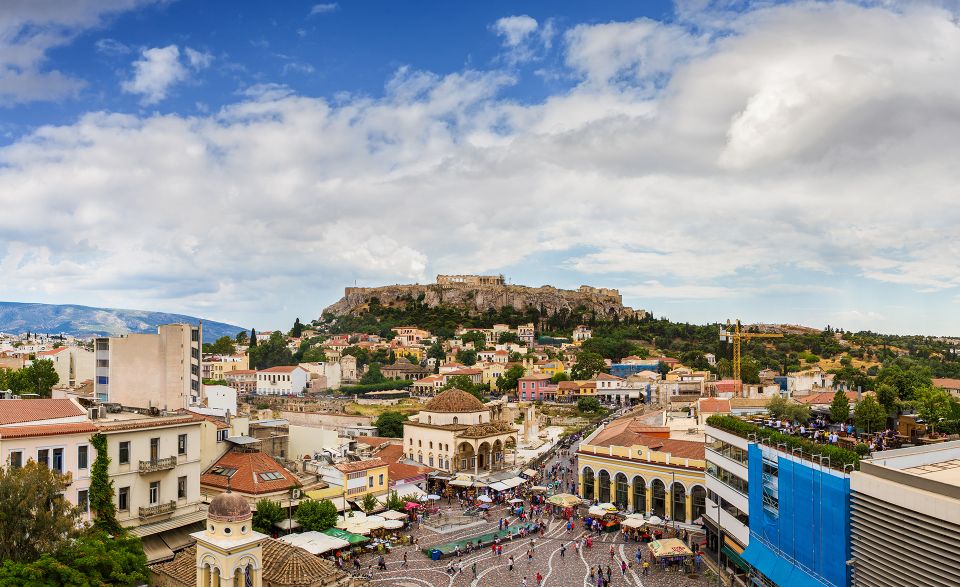
From the Odeon, the route continues toward Areopagus, a rocky outcrop near the Acropolis. The walk is listed at about 15 minutes, but the surface and slope deserve attention. Comfortable shoes are not just a suggestion here.
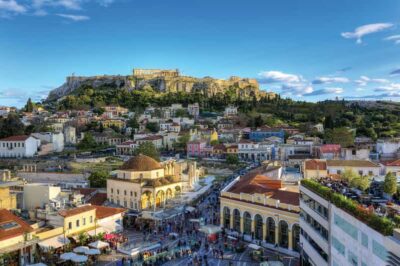
The reward is the view. From Areopagus, you can see the city spreading below, with the Acropolis rising above it. It is one of those places where Athens makes sense as a whole: ancient stone on the hill, dense modern streets around it, and the sea-level city extending beyond.
This stop is also useful early in the tour because it gives you a visual map. Later, when you pass through Plaka, Syntagma, and the National Garden, you will have a clearer idea of how these districts relate to the Acropolis.
Anafiotika, Plaka’s small Cycladic corner
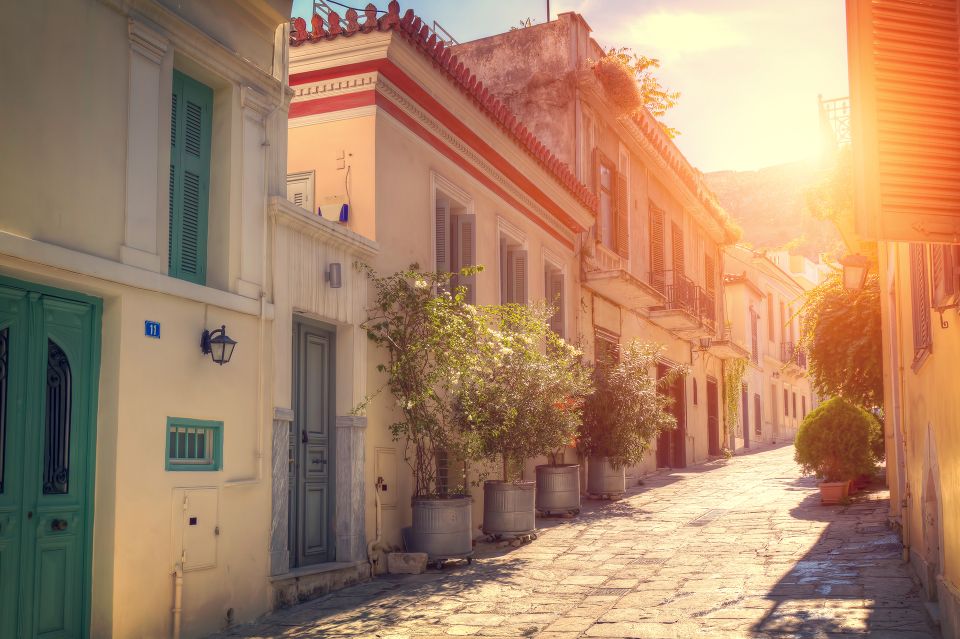
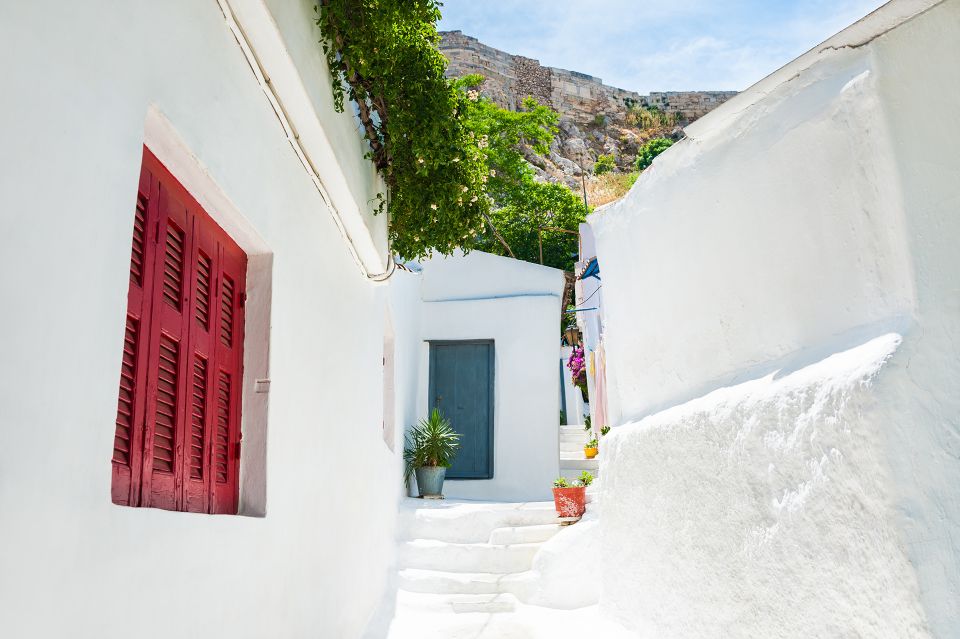
The path drops into Anafiotika, part of the larger Plaka area. This is one of the most distinctive sections of the walk. Its narrow lanes and small white buildings have a different look from the neoclassical buildings and crowded commercial streets elsewhere in central Athens.
Anafiotika sits just below the Acropolis, so the contrast is striking. You move from one of the most studied monuments in the world into a quiet residential pocket that feels almost separate from the city around it.
I like this part because it gives you a better feel for modern Athens than a list of ruins can provide. Your guide can help connect the neighborhood to the wider story of the city, while you simply enjoy the change in scale and mood.
The lanes are not designed for a fast, smooth walk. Watch your footing and do not expect a broad promenade. This section is best appreciated slowly, but the overall four-hour schedule means your guide will need to keep the group moving.
Roman Athens and Monastiraki’s market streets
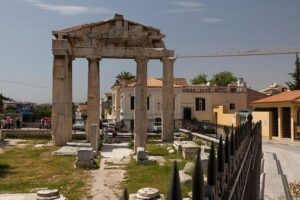
The Ancient Roman Agora follows Plaka. Its main feature is the Tower of Winds, an unusual octagonal structure that served as a timekeeping and weather station in ancient Athens. The site helps show how the city continued to develop long after the height of classical Athens.
Entrance fees are not part of the tour, so your visit may focus on the exterior and the explanation from your guide unless you choose to pay separately. This distinction is important. The tour takes you to many major sites, but it does not function as a ticketed archaeological-site program.
From there, you walk toward Monastiraki, one of the best-known central districts in Athens. The area is known for its flea market and its mix of shops, cafés, old streets, and archaeological remains. This is a useful stop for seeing the commercial side of the city, especially after the quieter lanes of Anafiotika.
The walking time between the Roman Agora and Monastiraki is listed at about 10 minutes. That makes this a fairly easy connection, though the exact feel will depend on the day and the crowds.
A coffee break before the city center
A 30-minute break gives you time for a Greek coffee, tea, or another beverage. One traditional refreshment per person is included, but other food and drinks are not.
This pause is more valuable than it may sound. A four-hour walking route can become a blur of names and dates, especially in warm weather. The break gives you a chance to sit, ask your guide about places you want to return to, and reset before the longer stretch toward Syntagma and the gardens.
Do not treat it as a full meal stop. The included item is a drink, and the tour continues afterward. If you need food during the walk, plan for that separately.
You can also read our reviews of more private tours in Athens




The Metropolitan Cathedral and Ermou Street
After Monastiraki, the route takes you toward the Athens Metropolitan Cathedral. This is another shift in the city’s character. You leave the market atmosphere and move into an area shaped by religious, civic, and commercial life.
The cathedral gives your guide a chance to discuss more recent Athens, not just the ancient world. The tour is designed to connect monuments with the living city, and this section helps make that promise real.
You then walk along Ermou Street, the city’s main commercial road. Its name comes from Hermes, the Greek god associated with commerce. The street is useful for practical orientation as well as sightseeing. If you plan to shop, this is the part of Athens you will want to note for later.
The walk toward Syntagma is listed at about 30 minutes. Since the tour covers so many places, you should expect commentary while walking rather than long, private talks at every stop.
Syntagma Square and the Presidential Guard
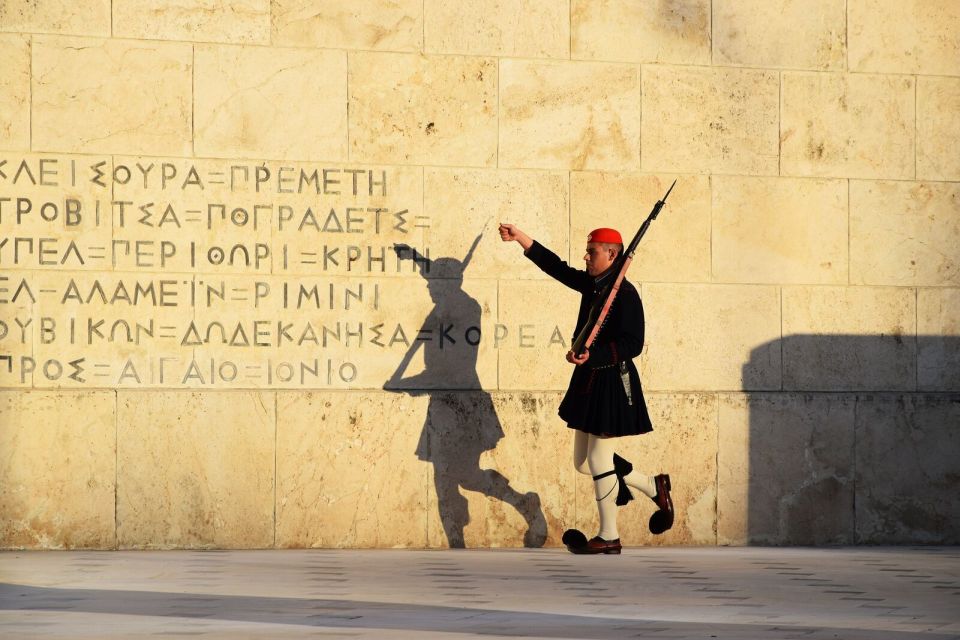
Syntagma Square is the center of modern Athens. In front of the Hellenic Parliament, you can watch the Changing of the Presidential Guard, one of Greece’s best-known public traditions.
The exact timing of the ceremony can matter, and the supplied tour information does not promise a particular daily schedule. Your guide will take you to the area, but you should not book this walk solely for a guaranteed full ceremony unless the start time has been confirmed.
The guards, their uniforms, and the formal routine offer a clear link between national tradition and present-day public life. After several ancient monuments, this is a useful reminder that Athens is not an open-air museum. It is also the capital of a modern country.
The tour also passes through the underground archaeological exhibition at Syntagma Metro station. This is a clever stop because it places archaeological discoveries inside an everyday transport hub. It lets you see how ancient remains fit into the working city without requiring another formal museum visit.
The National Garden and a slower stretch
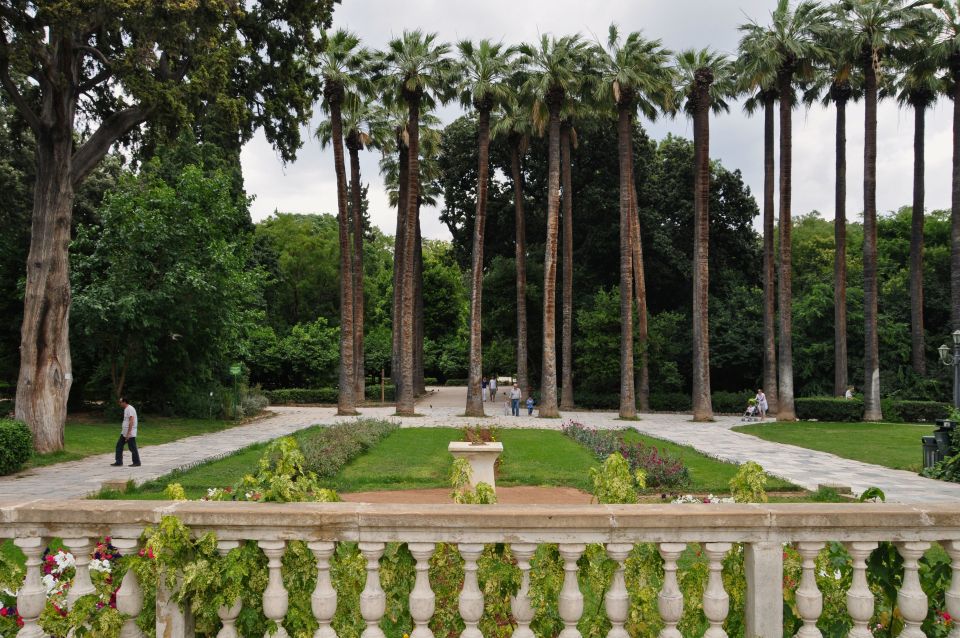
From Syntagma, you enter the National Garden. The walking segment is listed at about 30 minutes, and this section gives your feet a break from hard urban streets.
The garden is a chance to relax with family and feed the animals on display. That detail makes this section especially useful if you are traveling with children, although you should still expect a substantial amount of walking before and after it.
You pass the Presidential Palace before continuing toward the Panathenaic Stadium. The change from city square to garden to formal government district gives the route a pleasing rhythm.
The National Garden is not the main historical headline of the tour, but it may be one of the more comfortable parts. If Athens feels noisy or crowded earlier in the walk, this is where you can slow down and take in a calmer side of central Athens.
Kallimarmaron, the marble stadium
The Panathenaic Stadium, also called Kallimarmaron, is one of the tour’s most memorable stops. It is built entirely of marble and is described as the largest stadium constructed exclusively from that material.
The stadium’s pale stone makes a strong visual impression, especially after the darker ancient structures near the Acropolis. You can appreciate its scale from outside, while admission inside is not included.
This is a place where a guide adds useful context. Without explanation, it is easy to see only a grand white stadium. With the right background, you can better understand why it matters to Athens and to the modern revival of athletic traditions.
The walk from the National Garden takes about 30 minutes. By this stage, the route is physically demanding. If you walk slowly, need frequent rests, or want extended time at each monument, you may find the schedule tight.
Zappeion and the Temple of Olympian Zeus
The next stop is the Zappeion Megaron, a handsome building and public gathering place near the National Garden. Its setting gives you another view of Athens beyond the Acropolis and the old market districts.
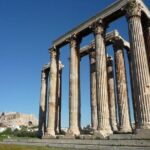
From Zappeion, the route continues to the Temple of Olympian Zeus. This was the largest temple in ancient Greece, and its surviving columns show the scale of the original project. Even in ruins, it is hard to miss the ambition behind the building.
The Arch of Hadrian is nearby. This Roman-era gateway marks the relationship between the older Greek city and the later Roman expansion of Athens. Seeing these two monuments together helps you understand that Athens was shaped by several major periods, not just the classical age.
The itinerary lists about 30 minutes of walking between several later stops, so the final section is not a quick hop from one monument to the next. Plan for a long day on your feet, even though the official duration is four hours.
The route is described as concluding at the Acropolis Metro station, while the detailed itinerary also lists Makrigianni 13 as the return point. Both locations are in the same Acropolis area, but confirm the exact end point and timing when you book.
What the guides add to the walk
The quality of a private walking tour depends heavily on the person leading it. The English-language tour has included John and Bianca. John was born and raised in Athens and is described as using humor while keeping the history at a manageable pace. That balance is useful when a tour covers ancient, Roman, royal, religious, and modern subjects in one morning or afternoon.
Bianca has been praised for making a first visit to Athens feel well organized and easy to follow. Dimitrios has led the route in Italian and is fluent in the language after studying Medicine in Bologna. If you need Italian, request it in advance rather than assuming every departure offers it.
The advertised language is English. One older booking included a guide who spoke Italian, while a separate Spanish-language experience was judged poorly because the guide’s Spanish and historical explanations were weak. I would treat that as a reason to confirm your preferred language carefully, not as a reason to dismiss the whole tour.
The overall rating is 4.8 from four reviews, a strong result but still a small sample. The most consistent strengths are the personal approach, the first-day orientation, and guides who can explain Athens without flooding you with facts.
Price, pace, and practical value
At $149 per person, this is not a bargain walking tour. It makes the most sense when you are sharing the cost with family or friends and want a private guide for four hours.
The price includes the guide, taxes and fees, and one traditional refreshment per person. It does not include food, extra drinks, archaeological entrance fees, souvenirs, or other personal costs.
I see the value in the route rather than in admission savings. You are paying for a local person to connect the Acropolis area, Anafiotika, Monastiraki, Syntagma, the National Garden, Kallimarmaron, Zappeion, and Olympian Zeus in one coherent outing.
If you want to enter the Acropolis or spend serious time inside each archaeological site, this is not the best standalone choice. You would need separate tickets and additional time. If you want a strong overview before exploring Athens on your own, the private format is easier to justify.
Wear comfortable shoes. The route includes slopes, uneven surfaces, long pavement stretches, and many hours of walking. The activity is not suitable for people with mobility impairments.
You can cancel up to 24 hours before the tour for a full refund, and reserve now while paying later. Starting times vary, so check availability before planning around the Changing of the Guard.
Should you book the Athens Heart Walking Private Tour?
Book it if you want a first-day Athens orientation led by one person who can connect ancient monuments with ordinary city life. It suits couples, families, and small private groups who value conversation, flexible questions, and a broad route more than long indoor visits.
It is especially useful if you want to see Anafiotika, Monastiraki, Syntagma, the National Garden, and the marble stadium in addition to the Acropolis area. Request an English-speaking guide such as John or Bianca if available, or confirm Italian support if Dimitrios is the right fit for your group.
Skip it if you dislike long walks, need a wheelchair-friendly route, or want every archaeological site included with admission. At $149 per person, the cost is easiest to defend when you share it with several people and use the tour as your introduction to Athens, then return independently to the places that deserve more time.
FAQ
Where does the Athens Heart Walking Private Tour begin?
It begins outside the Acropolis Metro station on Makrigianni Street, at Makrigianni 13.
How long does the tour last?
The walking tour lasts four hours.
Is the tour private?
Yes. It is offered for a private group.
What language is available?
The advertised tour language is English. An Italian-language guide, Dimitrios, has also led this experience.
Is the Acropolis entrance ticket included?
No. Entrance fees to archaeological sites are not included.
Is the Acropolis Museum included?
No museum entrance is included. The route begins near the new Acropolis Museum.
What drink is included?
Each person receives a Greek coffee or another traditional refreshment, such as tea or a different beverage.
Is food included?
No. Food and drinks beyond the included refreshment are not included.
What should I wear or bring?
Bring comfortable shoes because the tour involves several hours of walking.
Is the tour suitable for people with mobility impairments?
No. The tour is not suitable for people with mobility impairments.