REVIEW · ATHENS
Private Athens: Historical Walking Tour Including the Changing of the Guard
Book on Viator →Operated by Intrepid Urban Adventures - Greece · Bookable on Viator
Evzones in white make Athens feel alive. This private walk strings together the Changing of the Guard with an Athens-style route that shifts from monuments to everyday neighborhoods, guided by real people who know the stories (including guides like Babis and Theodore).
I especially love how the tour connects the big landmarks to what you’ll actually see on the street: Syntagma Square to the Acropolis walls, then shopping streets and local hangouts in Plaka and Kolonaki. The main drawback to plan for is that entrance fees aren’t included, so if you want inside the Acropolis, you’ll need to do that separately.
In This Review
- Key highlights worth knowing
- Start in Syntagma Square, Then Let the Evzones Set the Pace
- The Tomb of the Unknown Soldier: How to Watch the Changing of the Guard Well
- Metro to Acropolis Station: A Smart Shortcut to the Real Views
- Ancient Agora to Plaka Mood: Where Athens Feels Like a City, Not a Museum
- Adrianou Street Shopping: Souvenirs That Don’t Feel Generic
- Hadrian’s Arch and Diogenis Square: A Roman Pause Under the Acropolis
- Zeus Temple Ruins and a Coffee Pause: Feeling Time, Not Just Seeing It
- Panathenaic Stadium: The Olympics Connection You Can Actually Walk Through
- Kolonaki Square and the Academy Area: Ending in Present-Day Athens
- What You Pay for $149.14: Value vs. Extra Costs to Expect
- Who This Tour Suits Best (and Who Might Want Something Else)
- Should You Book This Private Athens Walk?
- FAQ
- Is this tour private?
- What language is the guide?
- Are entrance fees included?
- Is the metro ticket included?
- Where does the tour start and end?
- Can I cancel for a full refund?
Key highlights worth knowing
- Changing of the Guard timing: ceremony runs every hour at the Tomb of the Unknown Soldier.
- No-stress routing: a short metro hop helps you reach the Acropolis area efficiently.
- Acropolis walls without the ticket headaches: you’ll see key views, but entry inside the Acropolis costs extra.
- Local browsing on Adrianou Street: ouzo, olive oil, sponges, leather sandals, and more.
- From ancient to modern in one loop: Panathenaic Stadium, then Kolonaki and the Academy area.
Start in Syntagma Square, Then Let the Evzones Set the Pace

If you only visit Athens once, this is the kind of morning that gives you instant orientation. Syntagma Square is loud, busy, and full of that Greek capital energy. You meet your local English-speaking guide right here, surrounded by big neoclassical buildings, including the Grande Bretagne—long tied to royalty, and now a luxury hotel.
From the start, this tour has a practical feel. It’s not just stop-and-snap photos. Your guide points out details you’d likely miss if you’re walking on your own—what the buildings were for, what the square means in modern Athens, and why people gather in the same place, again and again.
Then comes the reason this tour is so popular: the guards.
You can also read our reviews of more walking tours in Athens



The Tomb of the Unknown Soldier: How to Watch the Changing of the Guard Well
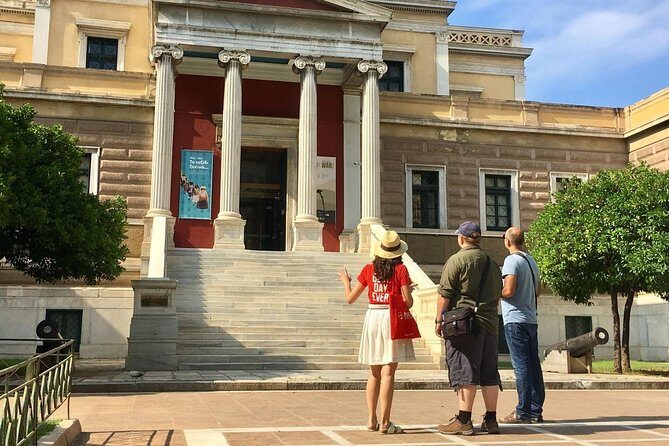
At the upper end of Syntagma, you’ll reach the Evzones at the Tomb of the Unknown Soldier. They wear traditional attire that looks almost theatrical at first glance: a white skirt, a red hat, and the old-style rifle. The point isn’t just the costumes. It’s the symbolism, and the way the ceremony turns a central square into a daily ritual.
One of the best parts is timing. The changing of the guard happens every hour, so your guide helps you line up your viewing window and understand what you’re actually seeing while you wait. This is where Theodore’s style (humor plus facts) really fits the moment—you don’t just stand there. You learn as the ceremony starts.
It’s also a good moment for first lessons in Athens etiquette and crowd flow. You’ll get a sense of where people naturally stand, how long to plan, and how to stay comfortable while you watch. In winter, you may find it easier to enjoy the ceremony without being packed in shoulder-to-shoulder; that’s worth considering if you prefer breathing room.
Metro to Acropolis Station: A Smart Shortcut to the Real Views
After the square, you’re not stuck walking the whole city loop. You take the metro to Acropolis Station, then walk along the area where the old city presses up against the modern one. This is a smart move in a 3-hour experience because it keeps your time focused on what you came for.
Once you exit, you’ll walk near the Acropolis walls and pass by the Ancient Agora area. Even without going inside the Acropolis itself, you still get the key advantage of this route: you can understand how these sites connect across streets and levels. Your guide explains how ancient roads and layouts shaped movement and customs that still show up in everyday life.
Important planning note: if you want to tour inside the Acropolis, you’ll need to do that separately. What you get here is the outside experience—views, context, and walking along the edges of classic Athens.
Ancient Agora to Plaka Mood: Where Athens Feels Like a City, Not a Museum

This portion is where the tour starts to feel less like a checklist and more like a lived-in city walk. By moving from the grand symbolism of the guard ceremony to the Acropolis area, you get a contrast you can actually feel.
You’ll spend time around the central hub of classic Athens history and hear what still carries forward. That may sound abstract, but on the ground it’s concrete: the patterns of streets, the sense of continuity, and the way people occupy the spaces around ancient ruins.
And then you shift toward Plaka’s old-town atmosphere. Plaka is where you can taste modern Greece as it’s lived, not just studied. Expect small streets, classic neighborhood vibes, and the kind of pedestrian energy you don’t get from a bus tour. This is also where a good guide earns their pay—pointing out what to notice, and which details are worth stopping for instead of steamrolling past.
Adrianou Street Shopping: Souvenirs That Don’t Feel Generic
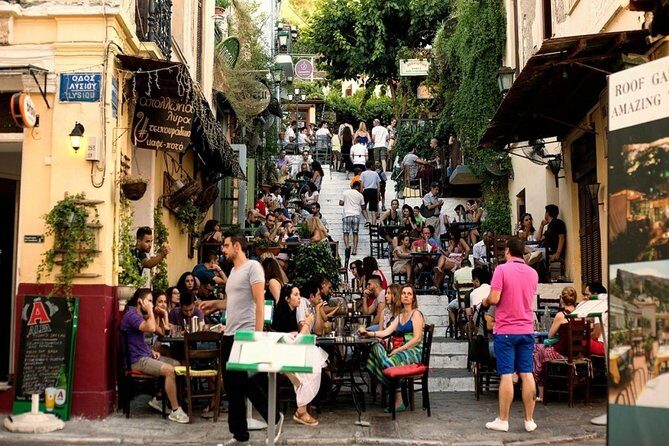
From the Acropolis area, you head toward Adrianou Street, one of those Athens streets where browsing feels like part of the experience. This stop isn’t about buying everything. It’s about seeing what local life looks like when it turns toward crafts and food products.
You’ll spot shops that specialize in things that are unmistakably Greek: ouzo, olive oil, sponges, leather sandals, and bags. It’s a practical place to pick up small, usable souvenirs—items you can use later, not just hang on a wall.
I like this stop because it gives you a break from constant stone-and-sun sightseeing. It’s also useful for your later trip planning. When you see what’s sold locally, you’ll get better at choosing what to taste and buy elsewhere in Athens. Your guide may also point you toward what’s worth paying for and what’s mostly mass-produced.
You can also read our reviews of more private tours in Athens





Hadrian’s Arch and Diogenis Square: A Roman Pause Under the Acropolis

Next up is Hadrian’s Arch, which sits near Diogenis Square and the wall under the Acropolis. This stop is quick but satisfying, because it shows you how Athens didn’t freeze in ancient Greece. The city kept changing—Roman emperors, new building ambitions, and shifting power all left physical marks.
Standing under (and near) the arch, you get a better sense of the layering in Athens. One empire, then another. One street alignment, then a different set of influences. Your guide connects the dots so it doesn’t feel random or decorative.
If you’re the type who likes photos, this is one of the stops that creates strong visuals without needing special lighting. Even on a busy day, you can usually get a clean angle and move on.
Zeus Temple Ruins and a Coffee Pause: Feeling Time, Not Just Seeing It

Then you’ll pause to see the ruins of the Jupiter (Zeus) temple area. It’s not an intact monument, and that’s exactly why it works. Ruins can actually be more instructive than full reconstructions, because they show the scale and the gaps your imagination fills in.
This is also a good moment for the included Greek coffee break. The tour gives you a chance to slow down, sit or stand comfortably for a bit, and let the sights land. The coffee part matters more than you might think: it breaks the walking rhythm so the information your guide shares doesn’t become one long sprint.
In Athens, good pacing is underrated. This tour builds in enough stops that you’re not just walking from one site to the next like a human metronome.
Panathenaic Stadium: The Olympics Connection You Can Actually Walk Through
One of the tour’s strengths is how it reaches beyond the usual ancient-only path. The Panathenaic Stadium is where the first modern Olympic Games took place, and where the 2004 Olympic marathon ended.
That fact alone makes the stadium worth it, even if you don’t care about sports. But what I really like is that your guide uses the location to tell a bigger story: Athens as both a birthplace myth and a modern host city. You’re not stuck in one timeline. You’re watching how Athens builds identity by linking past to present.
This stop tends to feel different from the rest of the walk because it’s a stadium. It has lines and sightlines. It changes the way you move and look compared with temples and arches. It’s also a refreshing change of pace after the walk through historic edges and streets.
Kolonaki Square and the Academy Area: Ending in Present-Day Athens

Finally, you move into Kolonaki Square, where daily life looks more like stylish Athens than ancient Athens. Kolonaki is a trendy residential neighborhood, and your guide helps you notice how locals shop, gather, and linger.
This is a smart way to end a historical walking tour. You don’t finish at another ruin and go home with only images of stone. Instead, you close with what Athens feels like now—modern architecture, neighborhood energy, and a sense of where people actually spend time.
The tour ends at the Academy of Athens (28 Panepistimiou Street). That finish point is a nice transition for planning the rest of your day. It’s also a helpful marker if you plan to wander afterward, grab food, or connect to other sights nearby.
What You Pay for $149.14: Value vs. Extra Costs to Expect
At $149.14 per person for about 3 hours, the value hinges on what you’re paying for: a private local guide, a planned route, and the ability to see the Changing of the Guard without guessing timing and logistics.
You should also budget for what’s not included. Entrance fees aren’t part of the price, and the metro ticket isn’t included either. If you plan to go inside the Acropolis, that’s an additional ticket you’ll need to buy separately. The tour is designed so you can see a lot from the outside, but it doesn’t pretend entrance costs are free.
Still, I think it’s good value because the guide work is the product. You’re not only getting directions. You’re getting context, pacing, and street-level guidance—plus the included coffee break and tips on what else to see, do, and eat.
One more value point: private means your group sets the pace. If you like photos, your guide can slow down. If you want to walk faster, you can. You’re not stuck waiting for a big group to catch up.
Who This Tour Suits Best (and Who Might Want Something Else)
This experience is best for you if you want:
- a private Athens walk with a local English-speaking guide
- a clear focus on high-impact sites in a short time
- both classic sights and modern neighborhood feel
- help timing the guard ceremony and understanding what you’re seeing
It may not be the best match if you want a heavy “inside ticket” day. The Acropolis is shown from the route, but entry is not included. If your priority is museum-depth visits, you’ll likely want a different tour structure that includes more internal access.
Also, if you hate walking, keep in mind it’s a walking tour with a metro segment. The tour is paced to fit the major sights, but it’s still a real city walk.
Should You Book This Private Athens Walk?
I’d book it if you’re aiming for the best mix of dramatic ceremony, iconic landmarks, and real neighborhood atmosphere in one morning. The Changing of the Guard is the headline, but what makes this worth it is the way the guide stitches each stop into a bigger Athens story—so the whole day feels connected instead of chopped into random photos.
Book it especially if you appreciate strong guiding. People consistently note guide expertise and personality, with names like Babis, Theodore, and Maeva showing up for exactly that reason. And if your guide has a little extra time, you might even get a more unusual add-on like a short underground passage beneath an old church—those kinds of details are what make a private tour feel personal rather than generic.
FAQ
Is this tour private?
Yes. It’s a private tour/activity, so only your group participates.
What language is the guide?
The tour includes an English-speaking local guide.
Are entrance fees included?
No. Entrance fees are not included, so places that require tickets would need separate payment.
Is the metro ticket included?
No. The metro ticket is not included.
Where does the tour start and end?
It starts at Syntagma Square and ends at the Academy of Athens (28 Panepistimiou Street).
Can I cancel for a full refund?
Yes. Free cancellation is available up to 24 hours in advance for a full refund. If you cancel less than 24 hours before the start time, you won’t get a refund.