REVIEW · ATHENS
Private Luxury Tour: Delphi & Thermopylae – The 300’s Legacy
Book on Viator →Operated by Pericles Century · Bookable on Viator
A 300-style day of big history and quick breaks. You get a private, air-conditioned ride out of Athens, then spend the day in two legendary places: Thermopylae (Leonidas and the battlefield) and Delphi (Apollo’s sanctuary and its top sights). It’s a long day, but the plan is tight enough that you’re not stuck wasting time on logistics.
What I like most is the relaxed, well-managed flow: pickup is handled from your hotel or the port, you get bottled water and onboard WiFi, and the driver keeps things moving without rushing. Another big win is the focus on the essentials at Delphi, including major ruins plus the Delphi Archaeological Museum for context. One thing to consider: entrance fees and the main museums are extra (and a licensed guide inside the archaeological sites isn’t included), so you’ll rely on your driver’s knowledge and the on-site signage for interpretation.
In This Review
- Key Things That Make This Tour Worth Your Day
- Athens to Thermopylae to Delphi: Why This Route Works
- Pickup, Comfort, and How the Day Feels on the Road
- Stop 1: Thermopylae Battlefield and the Leonidas Monument
- Stop 2: Thermopylae Museum (Your Story Makes Sense Here)
- Stop 3: Thermopylae Hot Springs for a Real Reset
- Stop 4: Delphi’s Temple of Apollo (The Big UNESCO Moment)
- Stop 5: Tholos of Athena Pronaia (A Photographer’s Favorite, but More Than That)
- Stop 6: Ancient Stadium of Delphi (Sports Culture, Not Just Ruins)
- Stop 7: Ancient Theatre of Delphi (Acoustics and Imagination)
- Stop 8: Delphi Archaeological Museum (Where You Get the Meaning)
- Stop 9: Lunch in Delphi (Own Expense, Picked to Suit the Day)
- Stop 10: Arachova Photo Stop for Mountain Views
- Price, Value, and the Real Cost After Extra Fees
- Who This Tour Fits Best (and Who Might Want Another Option)
- Should You Book the Delphi & Thermopylae Private Luxury Tour?
- FAQ
- Where does pickup happen?
- Is this tour private?
- How long is the tour?
- What vehicle will we ride in?
- Are entrance fees included?
- Is lunch included?
- Is there a licensed guide inside the archaeological sites?
- Do I need a mobile ticket?
- What should I wear and bring?
- What if weather is bad?
Key Things That Make This Tour Worth Your Day
- Private pickup and return from your hotel or port location, so you don’t wrestle public transit for a 9–10 hour day
- Thermopylae + Delphi in one shot, pairing the battlefield story with the UNESCO sanctuary sites
- Driver-led historical storytelling in English (the kind of careful, attentive service highlighted by past guests, including Dimitris/Dimitrios)
- Delphi museum time included on your schedule, giving you a real payoff beyond just ruins photos
- Short, smart breaks like the Thermopylae hot springs and a quick stop in Arachova for mountain views
Athens to Thermopylae to Delphi: Why This Route Works
This is the kind of day trip that makes sense if you want depth without spending multiple nights on the road. Thermopylae and Delphi are both in the same broader part of mainland Greece, so you can connect them in a single 9 to 10 hour loop. Instead of seeing one site and calling it a day, you get two different “modes” of ancient Greece: battlefield memory at Thermopylae, then ritual, athletics, and prophecy at Delphi.
Thermopylae hits you fast. You’re at the Monument of Leonidas—facing the idea of loyalty, sacrifice, and the famous stand from 480 BCE. Then you move into Delphi, where the storytelling shifts from war to worship, games, and mythology. The result is a full arc: conflict, then culture.
The logistics are built for convenience. You’re not doing transfers on your own. You’ll travel in a private vehicle with air-conditioning and bottled water, and you’ll start with pickup from your port or hotel. For a day like this, that matters more than people expect. A smoother start gives you more energy for the walking.
One more practical point: this is a private tour, and the group size determines the vehicle type. 1 to 4 people go in a luxurious sedan, while 5 to 7 people travel in a mini van. That matters for comfort and getting in and out quickly at each stop.
You can also read our reviews of more private tours in Athens


Pickup, Comfort, and How the Day Feels on the Road

Pickup is part of the value here. If you’re at a hotel or apartment, the driver waits outside your location. If you’re coming from a port, you’ll meet the driver at the arrival area with a sign showing your name. You’ll also use a mobile ticket, which keeps things simple on the day.
Inside the vehicle, you’re covered with WiFi on board and bottled water. That’s not just convenience fluff. When you’re traveling for hours and then walking through archaeological sites, you’ll be glad you don’t have to scramble for water or data.
The “luxury” part is mostly about friction-free travel. You’re going point-to-point, you’re not splitting time between waiting for buses and reading timetables, and you’re not navigating parking. It helps you spend more of your day outside the car.
Also, you’ll want to remember this is driver-led. The tour includes expert English-speaking tour drivers with extensive historical knowledge, but a licensed guide to accompany you into the archaeological sites is not included. That means you should be comfortable using site signage, and it’s smart to ask your driver questions during transit and at stops where allowed.
From the experience details, it’s a good match for anyone who likes history but also appreciates pace. The top feedback specifically highlights drivers like Dimitris/Dimitrios for being attentive and not rushing people. That’s exactly what you want on a day where you’re moving between multiple locations.
Stop 1: Thermopylae Battlefield and the Leonidas Monument
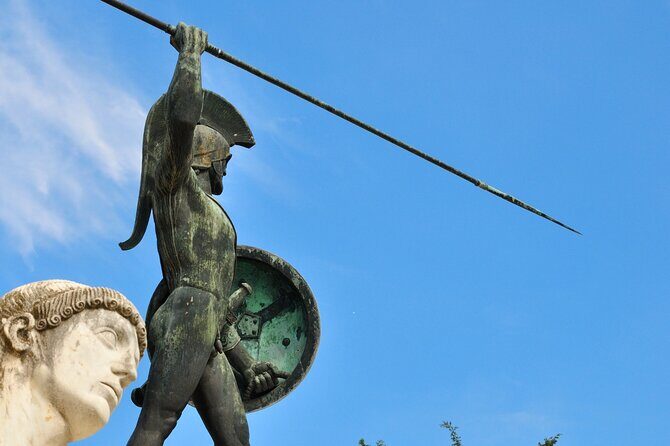
You start at Thermopylae with the Monument of Leonidas. This statue is built to anchor the story of the Spartans’ last stand. Leonidas is depicted holding his spear and shield, and the monument acts like a visual summary of the battle’s meaning—courage, resilience, loyalty, and the idea of freedom defended at a huge cost.
Right next to it, you’re in the historical battlefield area. Standing there doesn’t turn the past into a movie. But it gives you a sense of why this place became symbolic. The rugged setting makes it easier to imagine how an army might feel boxed in by terrain.
Time here is short—about 20 minutes—and that’s appropriate. The goal isn’t to “study” Thermopylae like a class. The goal is to get the emotional and historical start, then move on while the day still has momentum. Admission for this stop is listed as free.
What to watch for: plan for photos and a little walking around the monument/battlefield area. Comfortable shoes matter here because you’ll be shifting your weight on uneven ground.
Stop 2: Thermopylae Museum (Your Story Makes Sense Here)
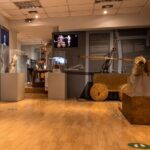
After the battlefield, the Thermopylae Historical Information Center adds the “how” and “why” behind the legend. This is an interactive museum experience with exhibits, audiovisual presentations, and displays focused on King Leonidas and the 300 Spartans facing the Persian army in 480 BCE.
Why this stop is so valuable: you’ll remember what you saw outside more clearly after you connect it to the battle details. The monument gives you the icon. The museum helps you understand the event behind the icon.
This stop is about 20 minutes, and the museum admission is not included. That’s one of the extra costs you should plan for when budgeting, but it’s also one of the better uses of time on a half-day style stop. If you skip it, you’ll still see Thermopylae—but you’ll probably leave with more questions than answers.
Stop 3: Thermopylae Hot Springs for a Real Reset
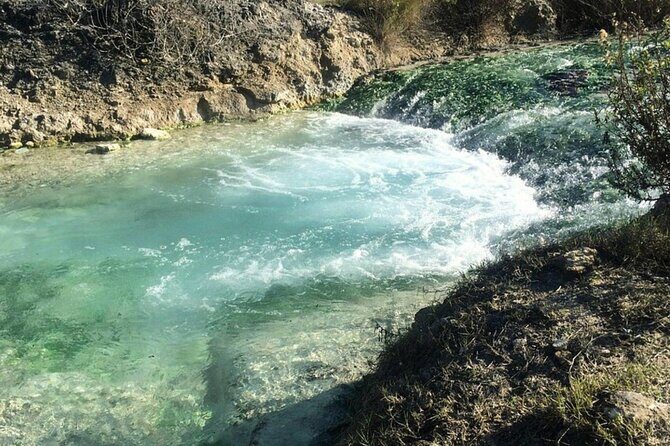
Then you get a break at the Thermopylae Hot Springs. This is short—around 10 minutes—but it’s a clever inclusion. After walking and museum attention, your body needs a pause. These mineral-rich thermal waters have been known since ancient times, and the setting offers a calmer mood than the battlefield area.
Admission is free for this stop, which is nice. It’s also a good moment to slow down for water, shade, or just letting your brain catch up.
Consideration: don’t expect a full spa session. It’s scheduled as a quick reset, not a long relaxation stop.
A few more Athens tours and experiences worth a look




Stop 4: Delphi’s Temple of Apollo (The Big UNESCO Moment)
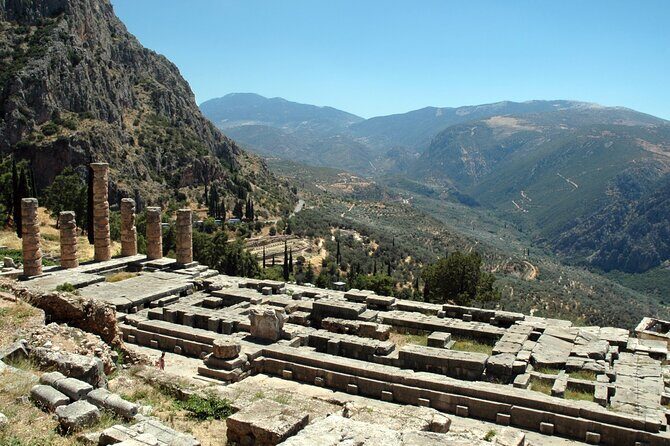
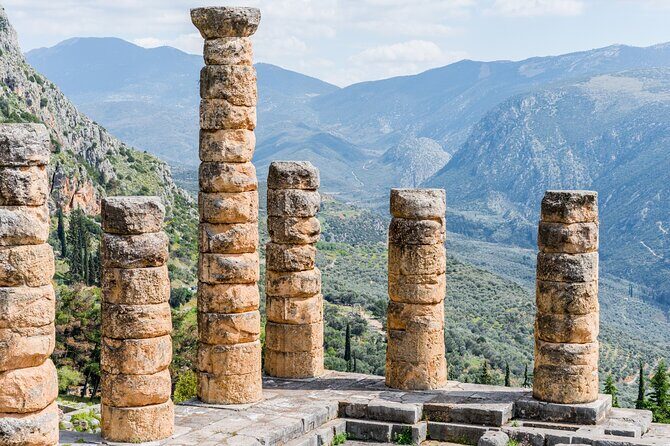
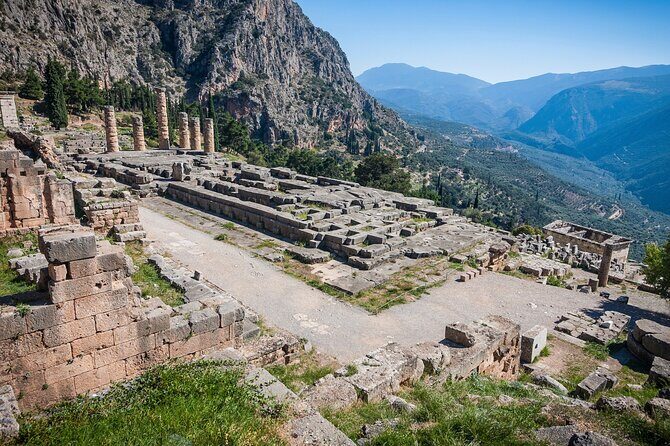
From Thermopylae you head into Delphi, where the spirit of the ancient site takes over—especially at the Temple of Apollo. This is the spiritual heart of Delphi and a UNESCO World Heritage Site. It was tied to the Oracle of Delphi, and it sits in a dramatic setting against Mount Parnassus.
You’ll get about 15 minutes at the Temple of Apollo ruins. That’s enough to appreciate the view lines and the overall scale of what’s left. It’s also enough to see why this sanctuary is central to the Delphi story: prophecy, worship, and Greek culture, all wrapped into one place.
Admission for this stop is not included, so budget extra for it. If you’re paying attention, you’ll notice how the ruins and the surrounding mountains reinforce each other. You can read the site as architecture and as landscape, even if the ruins are all that remains.
What I recommend for your visit: take 2 minutes to look before you start photographing. The temple area rewards patience more than rushing.
Stop 5: Tholos of Athena Pronaia (A Photographer’s Favorite, but More Than That)
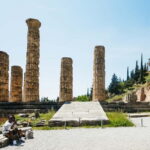
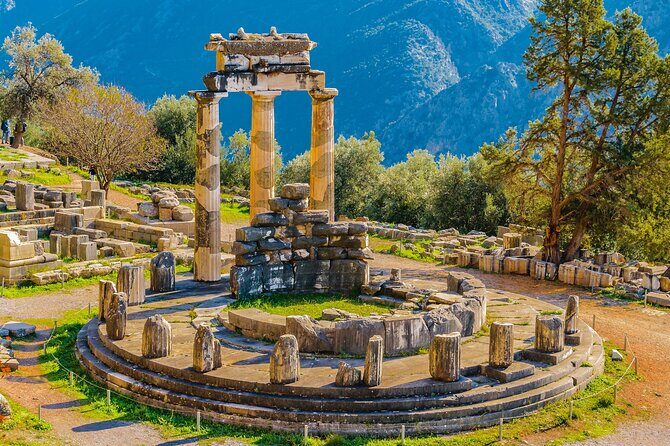
Next is the Tholos of Athena Pronaia, one of Delphi’s most photographed landmarks. It’s a circular sanctuary with columns and a design that’s visually striking even today.
This stop is about 15 minutes, and again, admission is not included. Dedicated to Athena (wisdom and protection), the Tholos is located near the entrance area to Delphi’s larger ancient sanctuary complex. That placement matters: it works like a threshold marker between the modern world and the sacred complex beyond.
Why it’s worth it: even if you’re not an architecture person, circular structures at ancient sites are always a good sign you’re looking at something planned, not accidental. The mountain backdrop makes the scene instantly memorable.
Stop 6: Ancient Stadium of Delphi (Sports Culture, Not Just Ruins)
The Ancient Stadium is where Delphi shows another side of itself: athletics and the Pythian Games. Here you’ll see stone seating and a long track tucked high on Mount Parnassus.
Time is about 10 minutes, and admission is not included. This isn’t the longest stop, but it’s a fun one because it breaks up the “sanctuary only” feeling. The views over the valley also help you connect the stadium with its real-world role.
Consideration: the stadium sits at altitude and up on the slopes. Wear shoes with solid traction, especially if the day is warm but the ground is dry and dusty.
Stop 7: Ancient Theatre of Delphi (Acoustics and Imagination)
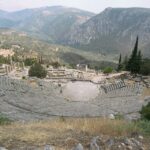
Then comes the Ancient Theatre, built into the slopes of Mount Parnassus. It hosted dramatic performances and musical contests during the Pythian Games.
You’ll have about 10 minutes here, and admission is not included. Even if you only get a quick look, the theatre’s structure gives you enough to imagine how crowds would have sat and watched. It’s one of those places where ruins can still feel functional—like it was made for voices to carry.
The views are also part of the experience. You can turn your head and see the valley and the broader Sanctuary of Apollo area.
What to do: pause at a few different seating angles. It changes how the space feels.
Stop 8: Delphi Archaeological Museum (Where You Get the Meaning)
The Delphi Archaeological Museum is one of Greece’s important museum collections, and this tour schedules about 1 hour there. This is a key part of getting value from the day, because museums translate what you’re seeing outside.
You can expect highlights like:
- the Charioteer of Delphi
- the Sphinx of Naxos
- treasures related to the Sanctuary of Apollo
Admission is not included, but it’s the kind of extra fee that tends to pay off. Without museum time, a lot of ruins can feel like a collection of stones. With museum time, you’re able to attach stories, names, and artistry to what your eyes are seeing.
Practical advice: if you’re trying to keep it efficient, focus on the standout pieces first, then let your guide-driver’s comments help you connect the dots.
Stop 9: Lunch in Delphi (Own Expense, Picked to Suit the Day)
Lunch is planned in Delphi at a local taverna, but meal cost is not included. The tour gives you about 40 minutes for dining, and your driver selects the restaurant.
This is one of those “small but important” inclusions. When you’re in a UNESCO site area for hours, it’s easy to end up hungry and stressed. Having a restaurant choice made for you can save time and reduce decision fatigue.
From the strongest feedback, the restaurant choice has been praised for views and good food. So even though you pay separately, the meal stop is designed to feel like a proper finish to the Delphi portion of the day.
What to plan for: bring patience for the menu. Greek tavernas do their own timing, and you’re on a tight schedule. If you have dietary needs, be ready to communicate them clearly.
Stop 10: Arachova Photo Stop for Mountain Views
On the way, there’s a short stop in the village of Arachova. It’s about 10 minutes, and the focus is quick photos and mountain scenery. This is not a shopping hour. Think of it as a scenic “breather” before the return ride.
Admission is free here, and it’s a nice way to end the day with a different vibe than ancient ruins—more village, more views, less stone.
Price, Value, and the Real Cost After Extra Fees
The price is $319.27 per person, and it includes a lot of day-trip heavy lifting: private transportation, air-conditioning, WiFi on board, bottled water, and pickup/drop-off from your hotel or port. There’s also a private-group vehicle arrangement (sedan for 1–4, mini van for 5–7), which can be a good deal if you’re traveling in a small family or a tight group of friends.
But here’s the honest math for your budget:
- Entrance fees for archaeological sites and museums are extra: about €23 per person listed
- Thermopylae Museum admission isn’t included
- Apollo/Tholos/Stadium/Theatre and the Delphi museum admissions aren’t included
- Lunch is own expense
- Gratuities/tips are not included, left to your discretion
So the total trip cost can be more than the headline price once you add admissions and lunch. Still, the value can be strong because you’re paying for private, door-to-door time in a day where public transport would be slow and tiring.
This tour tends to make the most sense if:
- you want comfort and pickup instead of self-guided travel
- you’re the type who likes a guided plan but still wants to look around at your own speed
- you’re traveling with 1–4 people and prefer a sedan
- you want a single-day shot at Delphi’s top sites plus Thermopylae
Who This Tour Fits Best (and Who Might Want Another Option)
This works best for history-minded visitors who also value pace and logistics. The route is packed, but it’s not frantic, and the driver-led approach is designed to keep the story clear.
It also fits well if you’re:
- short on time in Athens
- traveling as a couple, small family, or friend group (private vehicle makes it feel easy)
- interested in both the Thermopylae battlefield story and Delphi’s sanctuary and games
You might want to consider another option if:
- you prefer a licensed guide inside each archaeological site (not included here)
- you’re very sensitive to extra costs like museum admissions
- you want more free time at one location rather than quick stops across many
Should You Book the Delphi & Thermopylae Private Luxury Tour?
If you’re looking for a smooth, private day that hits the highlights of both Thermopylae and Delphi, this is a strong pick. The biggest strengths are the pickup convenience, the comfortable vehicle setup, and the fact that you get both Delphi ruins and a full hour at the Delphi Archaeological Museum for context.
I’d book it when you want the “big day” experience without the headache of planning transport and timing on your own. Just be ready for extra admissions (listed around €23 per person) and budget for lunch. If you’re okay with that, you’ll walk away feeling like you saw the core ideas of both places—not just collected photos.
FAQ
Where does pickup happen?
Pickup is available at designated locations. For hotel or apartment pickups, the driver waits outside your location. For port pickups, the driver greets you at the arrival area with a sign showing your name.
Is this tour private?
Yes. It’s a private tour/activity, and only your group participates.
How long is the tour?
The duration is about 9 to 10 hours, including travel time between locations.
What vehicle will we ride in?
Groups of 1 to 4 people are transported in luxurious sedan vehicles. Groups of 5 to 7 people are transported in comfortable mini vans.
Are entrance fees included?
No. Entrance fees for archaeological sites and museums are not included. The listed additional cost is €23.00 per person.
Is lunch included?
No. Lunch in Delphi is scheduled, but the meal cost is not included. Your guide selects a local taverna.
Is there a licensed guide inside the archaeological sites?
No. A licensed guide to accompany you into archaeological sites is not included.
Do I need a mobile ticket?
Yes, a mobile ticket is included.
What should I wear and bring?
Wear comfortable footwear for walking. Bring a hat and sunscreen, since Greece is often warm and sunny.
What if weather is bad?
The experience requires good weather. If it’s canceled due to poor weather, you’ll be offered a different date or a full refund.