REVIEW · ATHENS
St. Paul in Athens half-day private tour 4.5 hours – With Tickets
Book on Viator →Operated by Athens Tours Greece · Bookable on Viator
St. Paul’s famous sermon comes alive on the Areopagus, the rocky hill beside the Acropolis where he spoke about the unknown god to ancient Athenians. This private tour links that Christian story with the Parthenon, Ancient Agora, and the modern city, giving you a fast, useful introduction to Athens.
I like the convenient hotel or Piraeus pickup, and I like the private format, which lets your group adjust the pace. The air-conditioned vehicle also matters in Athens, especially after climbing the Acropolis. Your driver explains the city’s history and culture, while a licensed English-speaking guide can be added for €269.
The main drawback is time. Four and a half hours is enough for an overview, not a leisurely archaeological visit. One guest spent three hours at the Acropolis and then had to pass the other sights by vehicle, so you’ll need to protect time for the Ancient Agora and the St. Paul focus.
In This Review
- Key points to know before booking
- Starting at the Acropolis before the crowds
- The Acropolis, from Propylaea to Parthenon
- The Areopagus and the story of St. Paul
- The Ancient Agora and everyday Athens
- A driving tour through Athens landmarks
- Driver, guide, and the private-tour trade-off
- Is the $275.16 price good value?
- Who should book this Athens tour?
- Should you book it?
- FAQ
- What is the duration of the St. Paul in Athens tour?
- What time does the tour start?
- Where can pickup take place?
- Where does the tour end?
- Are Acropolis and Ancient Agora tickets included?
- Is a licensed tour guide included?
- Is this a private tour?
- Can cruise ship passengers book this experience?
- What is the cancellation policy?
Key points to know before booking
- St. Paul’s Athens setting: Visit the Areopagus, where Paul delivered his sermon about the unknown god.
- Acropolis first: The morning route heads directly to the Acropolis to limit traffic and crowds.
- Private vehicle and pickup: Your group receives hotel, Airbnb, or Piraeus port pickup and return.
- Two major admission sites: Acropolis and Ancient Agora entrance tickets are included in the tour price.
- Driver-led format: An English-speaking driver handles transportation and historical commentary. A licensed guide costs extra.
- A fast city overview: You’ll see many landmarks, but only the Acropolis and Agora receive substantial walking time.
Starting at the Acropolis before the crowds
The tour begins at 8:00 a.m. with pickup at your Athens hotel or Airbnb. Cruise passengers meet the driver outside the terminal exit, with the driver holding a sign bearing your name. From there, the vehicle heads directly to the Acropolis rather than spending the morning threading through central Athens traffic.
That early start is one of the tour’s smartest features. Athens can feel crowded and slow once sightseeing buses, taxis, and tour groups fill the center. Reaching the Acropolis first gives you a better chance of using your limited time well, though the hill itself will still involve walking and climbing.
The private vehicle is air-conditioned and sized for your group. Bottled water, road tolls, and local taxes are included. At the end, you return to the same pickup point, unless you have arranged another approved drop-off.
The tour is not presented as a long walking excursion through every corner of Athens. It is a driving and walking combination. That makes it useful for a first morning in the city, a short port visit, or a first look before spending more days exploring on your own.
A few more Athens tours and experiences worth a look

The Acropolis, from Propylaea to Parthenon
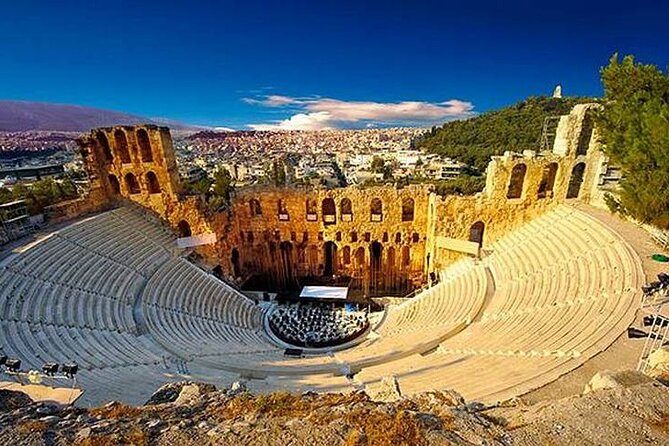
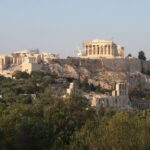
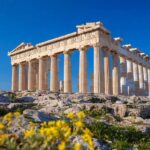
The Acropolis is the tour’s central stop. This rocky citadel above Athens holds the monuments most closely tied to classical Greek civilization: the Parthenon, Erechtheion, Propylaea, and Temple of Athena Nike.
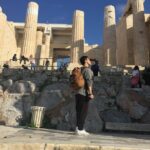
Your route includes the Propylaea, the monumental gateway designed by Mnesikles as part of Pericles’ fifth-century BC building program. Even with only about five minutes listed for this stop, it is worth pausing to notice the scale and ambition of the entrance. The unfinished plan still gives you a sense of how grand the approach to the sacred precinct was meant to be.
The nearby Temple of Athena Nike sits on a bastion at the southeast edge of the Acropolis entrance. Its name links Athena with victory, and the small temple occupies a spot with strong views over Athens. The Classical structure dates to 426 to 421 BC, replacing earlier shrines destroyed or altered during the Persian Wars.
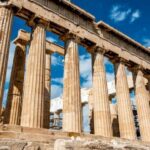
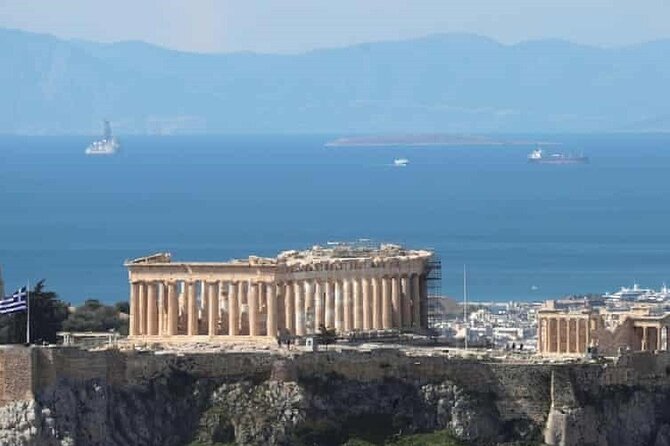
The Parthenon receives the longest scheduled visit, about 1 hour and 15 minutes. Built between 447 and 438 BC, it was dedicated to Athena Parthenos and formed the heart of the Periclean building program. The architects were Iktinos and Kallikrates, while Pheidias supervised the sculpture and wider artistic plan.
You will not walk inside the Parthenon, but you can study its exterior columns, sculptural program, and unusual refinements. The building was designed as a Doric temple, yet its construction includes subtle adjustments that make the structure appear straighter and more balanced from a distance.
The Erechtheion is another essential stop. Its irregular plan reflects the many sacred traditions tied to this part of the rock, including the contest between Athena and Poseidon and the worship of the mythical king Erechtheus. The best-known feature is the Caryatid Porch, where female figures take the place of columns.
The figures on the building are casts. Five originals are in the Acropolis Museum, and another is in the British Museum. That detail is useful because many people assume the statues on the porch are the original ancient figures.
The schedule allows only about five minutes at the Erechtheion, but the overall Acropolis visit is listed at 1 hour and 15 minutes. In practice, you should treat that entire block as your time for the hill, rather than expect a separate, extended visit at each monument.
The Areopagus and the story of St. Paul
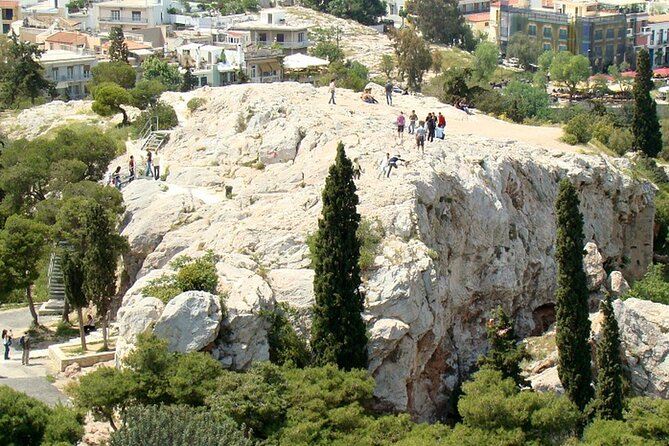
The Areopagus is the most important stop for the religious purpose of this tour. Also called the Hill of Ares, it sits just beside the Acropolis exit and was associated in classical times with a council of nobles and a court that handled serious cases, especially homicide.
Ancient stories connect the hill with the trial of Ares for the killing of a son of Poseidon. Another tradition places the trial of Orestes here after he killed his mother, Clytemnestra, and her lover. These myths help explain why the site carried such legal and religious weight before Paul arrived.
Acts of the Apostles describes Paul addressing the people of Athens after seeing an altar dedicated to an unknown god. A bronze plaque at the foot of the rock commemorates the speech. From this point, your driver can connect the physical setting with the Christian account, while also explaining why the site mattered in Athenian public life.
The Areopagus is rocky and uneven. You do not need to climb it to understand its importance, but careful footing matters if you want to walk onto the rock for views. This is a place where the tour’s theme feels specific rather than added as an afterthought. You are not simply visiting famous ruins and attaching a biblical reference later. You are seeing the traditional setting of Paul’s address.
The Ancient Agora and everyday Athens
After the Acropolis, the vehicle travels to the Ancient Agora. The planned drive takes about 20 minutes, followed by roughly 1 hour and 30 minutes at the site. This is the second major archaeological visit and one of the strongest parts of the tour for understanding how Athens functioned beyond its temples.
The Greek word agora refers to an assembly and, by extension, the place where people gathered. In Athens, that meant far more than shopping. Political discussion, commerce, public business, social life, and civic decisions all met here.
The Agora area was used for around 5,000 years, with repeated periods of construction, destruction, and rebuilding. What you see today is a layered archaeological site that includes material from Archaic, Classical, Greco-Roman, and Byzantine periods.
For the St. Paul theme, the Agora adds useful context. Paul’s message was delivered in a city where public debate and philosophical argument were part of daily civic life. A visit here helps you picture the setting in which a new religious message would have been heard, challenged, and discussed.
The long scheduled Agora visit is important, especially if you tend to linger at the Acropolis. One person on the tour spent about three hours on the hill, hired a separate guide there, and then had to see many remaining landmarks only from the vehicle. That was a self-made timing problem, but it is a useful warning. If you want the Agora, keep an eye on the clock.
A driving tour through Athens landmarks
The tour also passes a broad group of Athens sights. These stops are mainly panoramic or brief roadside visits, so your expectations should be realistic.
The Olympieion, or Temple of Olympian Zeus, was once a major sanctuary in southern Athens. The site includes the remains of the great temple, along with places linked to Apollo Delphinios and the Delphinion Court. It gives you a look at the scale of ancient religious construction beyond the Acropolis.
You’ll also see the National Garden, a large green space behind Parliament and Syntagma Square. Designed in 1839 for Queen Amalia, the former Royal Gardens contain plants and trees from many parts of the world. It offers a pleasant contrast to the exposed stone of the Acropolis.
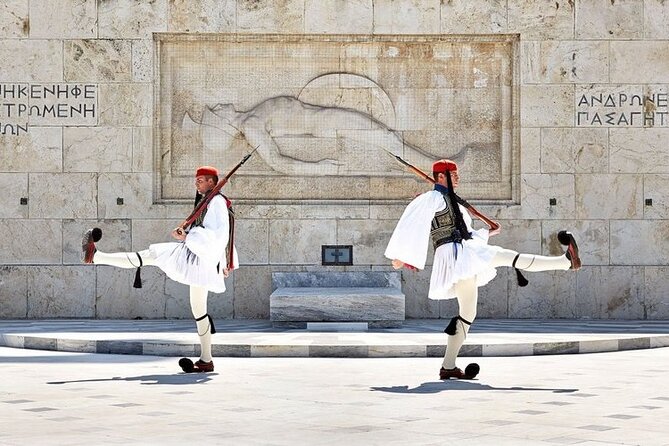
The Hellenic Parliament occupies the former royal palace built for King Otto and Queen Amalia. In front of it, the Tomb of the Unknown Soldier is guarded by the Evzones of the Presidential Guard. Syntagma Square, whose name means Constitution Square, has been a central gathering place in modern Greek political life since the nineteenth century.
The Kallimarmaro, or Panathenaic Stadium, is a particularly good photo stop. It is built entirely of Pentelic marble and hosted the first modern Olympic Games in 1896. The marble can shift in appearance with the light, from cooler tones earlier in the day to a warmer bone-gold color later on.
The Athens Metropolitan Cathedral may be included in the city drive, though the supplied timing does not promise an extended interior visit. Built between 1842 and 1862, it contains marble shrines associated with Agia Filothei and Patriarch Gregorius V.
Panagia Kapnikarea provides a sharp contrast. This small Byzantine church, founded around 1050, sits amid the shops and tall buildings of Ermou Street. Its crowded modern setting makes the church particularly memorable, even if you only see it briefly.
The Thissio area offers cafés, restaurants, boutiques, and views toward the Acropolis. It is close to Monastiraki and the historic center, and it can be a useful place to return after the tour for a slower meal or an evening walk.
You can also read our reviews of more private tours in Athens




Driver, guide, and the private-tour trade-off
The included service is an English-speaking professional tour driver with a good command of Greek history and culture. This is not the same as having a licensed guide accompany you inside every archaeological site.
A licensed English-speaking guide can be added for €269. That is a substantial extra charge, particularly when added to the listed price of $275.16 per person. If your group wants detailed interpretation at each monument, ask about the guide before booking. If you mainly need transport, tickets, orientation, and a flexible private schedule, the driver-led format may be enough.
Past bookings have involved drivers named Demetris and Christos, but you should not assume either person will lead your departure. The useful pattern is clear: the driver can make the experience personal and help you use a short visit well. One account describes a very clean van, a polite driver, and a special photo stop across from the Acropolis.
Private touring gives you control, but it also puts the clock in your hands. You can ask to spend longer at a favorite sight, but extra time at one place means less time elsewhere. The tour notes also allow customization within the Athens program and mention a possible six-hour arrangement, which differs from the advertised 4.5-hour duration. Confirm the exact length and price if you want the longer version.
Is the $275.16 price good value?
At $275.16 per person, this is not a cheap sightseeing transfer. The value depends on how many people share the private vehicle and how much convenience matters to you.
The price includes transportation, pickup and drop-off in Athens or at Piraeus, bottled water, road tolls, local taxes, and entrance tickets for the Acropolis and Ancient Agora. Those two admission fees are important because they are the tour’s main paid sights.
You are also paying for a private schedule. A taxi-based version would require arranging transport between the Acropolis, Agora, and the city center, while a standard group tour may not offer pickup at your hotel or the same ability to adjust the pace.
For a solo visitor or couple, the cost is harder to justify. For a larger private group, the per-person value may improve, especially if you are arriving by cruise and have only a limited window in Athens. Group discounts are offered, so check the final total rather than judging the price from the headline figure alone.
The extra €269 guide fee changes the calculation. Add it only if detailed archaeological and biblical explanation is central to your plans. Otherwise, use the included driver’s orientation and save the extra for the Acropolis Museum, another guided visit, or a meal in the city.
Who should book this Athens tour?
I would choose this tour for a first-time visitor with one morning, a cruise passenger with a carefully measured port schedule, or someone who wants the Christian connection made clear without giving up the major classical sites.
It also suits families or small groups who value hotel pickup and private transport. You can avoid gathering strangers, and you can make reasonable adjustments as the morning develops.
I would not choose it if you want a slow, highly detailed Acropolis experience. The tour covers a lot, and several landmarks are viewed briefly or from the vehicle. You may also prefer a licensed guide from the beginning if ancient art, architecture, and biblical history are your main interests.
The best strategy is to protect the Acropolis and Ancient Agora time first. Treat the other landmarks as a useful city introduction, not as full visits. That approach keeps the tour focused on its strongest material: Paul’s setting at the Areopagus, the civic world of the Agora, and the great monuments above Athens.
Should you book it?
Book this private Athens tour if convenience, a Christian history angle, and efficient sightseeing matter more to you than a slow archaeological study. The early Acropolis arrival, private vehicle, Piraeus pickup, and included tickets make it practical for a short stay.
Before paying, confirm the driver-led format, ask about the optional licensed guide, and make sure you understand how the 4.5-hour schedule handles the Acropolis and Agora. Keep your Acropolis visit within its planned window, and you’ll get a much fuller introduction to Athens than someone who spends the entire morning on one hill.
FAQ
What is the duration of the St. Paul in Athens tour?
The advertised duration is approximately 4 hours and 30 minutes. The tour information also mentions customization within the Athens itinerary and during 6 hours, so confirm the exact duration if you want a longer version.
What time does the tour start?
The standard start time is 8:00 a.m.
Where can pickup take place?
Pickup is offered from hotels and Airbnb accommodations in Athens, as well as Piraeus port. Airport pickup and drop-off are not included in the listed price, but can be arranged for an additional cost.
Where does the tour end?
The tour returns you to the same place where you were picked up.
Are Acropolis and Ancient Agora tickets included?
Yes. Entrance tickets for the Acropolis and Ancient Agora are included in the tour price.
Is a licensed tour guide included?
No. The included service is an English-speaking tour driver with knowledge of Greek history and culture. A licensed English-speaking guide can be added for €269.
Is this a private tour?
Yes. Only your own group participates in the activity.
Can cruise ship passengers book this experience?
Yes. Cruise passengers must provide their ship name, docking time, disembarkation time, and re-boarding time when booking. Pickup takes place outside the terminal exit.
What is the cancellation policy?
You can cancel at least 24 hours before the start time for a full refund. Cancellations or changes made less than 24 hours before the start time are not accepted for a refund.