REVIEW · ATHENS
4-Day Private Peloponnese, Delphi and Meteora Tour from Athens
Book on Viator →Operated by 4 Seasons Greece Tours · Bookable on Viator
The most remarkable thing about this four-day trip is its sweep. You move from the Corinth Canal and Mycenae to Olympia, Delphi, Thermopylae, and the cliff-top monasteries of Meteora without having to solve Greece’s long-distance transport puzzle yourself. It is a big route, but the private vehicle makes it possible.
I like the private format, which lets you set the pace and add stops. I also like the mix of famous ruins, small seaside towns, mountain roads, and comfortable hotel nights. The main drawback is simple: this is a packed trip with plenty of driving, and entrance fees, lunches, dinners, and a licensed guide cost extra.
In This Review
- Key points to know before booking
- What this four-day Greek route really covers
- Day 1: Corinth Canal and the ancient city of Corinth
- Epidaurus and the sound of classical Greece
- Mycenae, Tolo lunch, and evening in Nafplio
- Day 2: Olympia and the road across western Greece
- Nafpaktos and Galaxidi bring the pace down
- Day 3: Delphi, the oracle, and the mountain road to Thermopylae
- Day 4: Meteora monasteries above Kalambaka
- What the $1,942.01 price includes
- Who should book this private road trip
- Should you book it?
- FAQ
- Is pickup included from Athens?
- Is this a private tour?
- What type of vehicle is provided?
- Are the hotels included?
- Are archaeological entrance fees included?
- Is a licensed guide included?
- Which monasteries will you visit at Meteora?
- Are meals included?
Key points to know before booking
- Corinth, Epidaurus, Mycenae, and Nafplio share the first day, giving you an impressive but busy introduction to the Peloponnese.
- Three nights in four-star or boutique hotels with breakfast are included, with examples such as Ippoliti in Nafplio and Ganimede in Galaxidi, subject to availability.
- Olympia, Delphi, and Meteora provide the main ancient and religious highlights, while Nafpaktos, Galaxidi, and Kamena Vourla add slower seaside stops.
- Your English-speaking driver offers live commentary, and Petros is one named chauffeur praised for explaining sites during the drive.
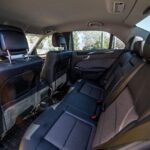
- Luxury air-conditioned transport includes Wi-Fi and bottled mineral water, plus pickup and return from Athens hotels, residences, the airport, or port.
- Site admission is usually extra, and a licensed guide is available at an additional cost if you want formal guiding inside the ruins and museums.
What this four-day Greek route really covers
This is not a light excursion from Athens. It is a private road journey across much of central and southern Greece, built around some of the country’s major ancient sites.
You begin in Athens and head west toward the Peloponnese. From there, the route bends south toward Epidaurus, Mycenae, and Nafplio, then swings west to Olympia. On the second and third days, you cross into mainland Greece, stay near Delphi, visit Thermopylae, and finish at Meteora before returning toward Athens.
That route is the tour’s great strength. You see places that would be awkward to connect by public transport in only four days. The tradeoff is time on the road. You should expect early starts, long stretches between stops, and several days when the ancient sites are more important than free time.
Because it is private, your group does not share the vehicle with strangers. You can ask to adjust the pace or add stops, although the listed schedule already fills the available hours. The driver handles the roads, parking, and transfers while you focus on the views and sites.
You can also read our reviews of more private tours in Athens

Day 1: Corinth Canal and the ancient city of Corinth
Pickup begins at your Athens hotel, Airbnb, residence, airport, or port. Your driver waits at the lobby or meeting point with a sign bearing your name, then takes you west toward the Peloponnese.
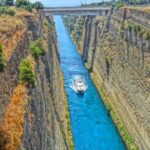
After about an hour, you reach the Corinth Canal. The canal cuts through the narrow Isthmus of Corinth for roughly six and a half kilometers, linking the Aegean and Ionian seas. You have about 15 minutes here, enough for photographs and a quick look at the waterway.
This is a brief stop, but it gives the first day a strong opening. The canal is a piece of modern engineering rather than an ancient ruin, and its narrow width helps explain why only smaller cargo and cruise ships still pass through regularly.
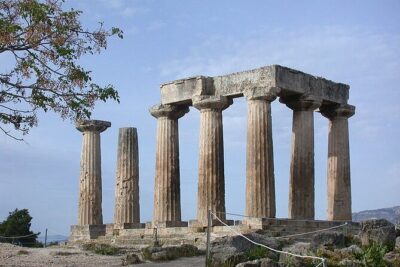
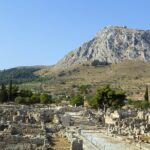
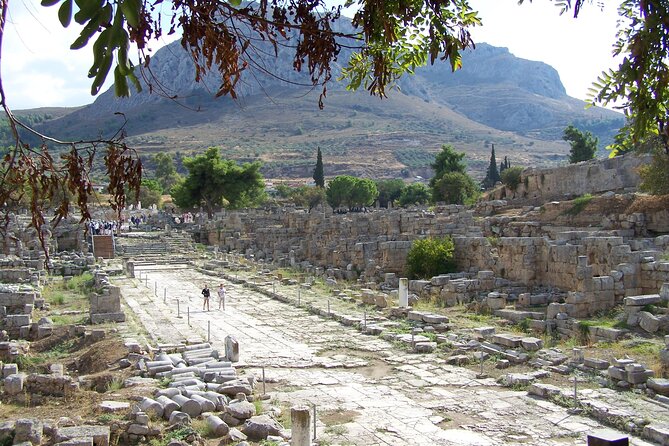
Close by, Ancient Corinth gives you your first serious archaeological visit. Plan on about an hour, not counting the entrance line or extra museum time. The site is dominated by the Temple of Apollo, a Doric building dating from about 550 to 530 BCE.
You will also see the Roman-era forum, baths, the Temple of Octavia, and the Bema, the platform associated with St. Paul’s address to the Corinthians. The nearby museum displays objects found in the area. Entrance is not included, so budget for a separate ticket.
I like the way Corinth sets up the rest of the tour. You see Greek architecture, Roman rebuilding, early Christian connections, and a museum in one stop. The drawback is that one hour can feel short if you want to read every display or examine the forum carefully.
Epidaurus and the sound of classical Greece
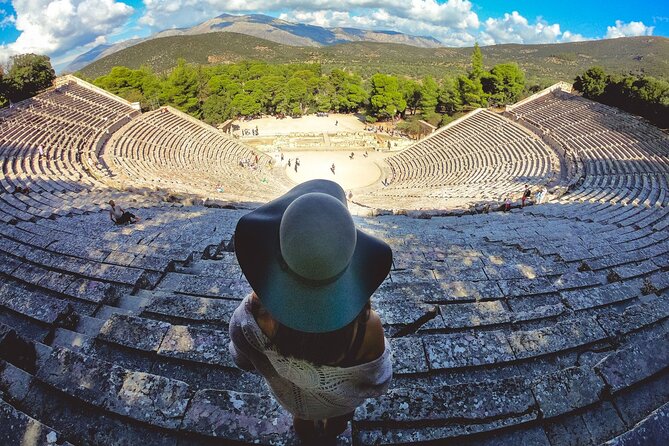
The drive deeper into the Peloponnese takes about 75 minutes. At Epidaurus, you spend around an hour and a half at the Sanctuary of Asclepius, a UNESCO World Heritage site known for its exceptionally preserved theater.
The theater is the star. Its rows of stone seats curve around the stage with a precision that still makes the famous acoustics easy to demonstrate. Stand in the lower performance area and speak softly while someone in the upper seats listens. The experience is quick, but it helps you understand the theater as a working place rather than just a pretty ruin.
The wider sanctuary includes the Tholos, the Stoa of Abaton, the stadium, and an on-site museum. It was a place connected with healing, so the site offers a different mood from the political and military remains at Corinth.
Entrance fees are extra. Wear shoes suitable for uneven ground, since you will be walking between several structures under the open sky. The visit is well timed for a first day, but you may feel the pressure of the clock because Mycenae and Nafplio still follow.
Mycenae, Tolo lunch, and evening in Nafplio
After Epidaurus, the route continues toward Tolo, a seaside village known for fish and seafood. Lunch is not included unless you choose the lunch option, so you can select a local tavern yourself or arrange the added meal option.
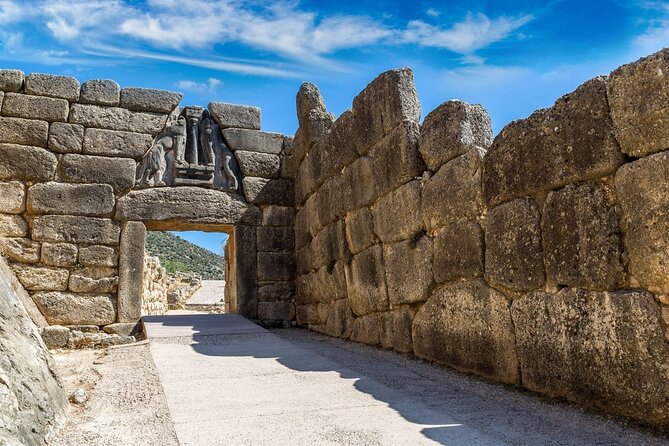
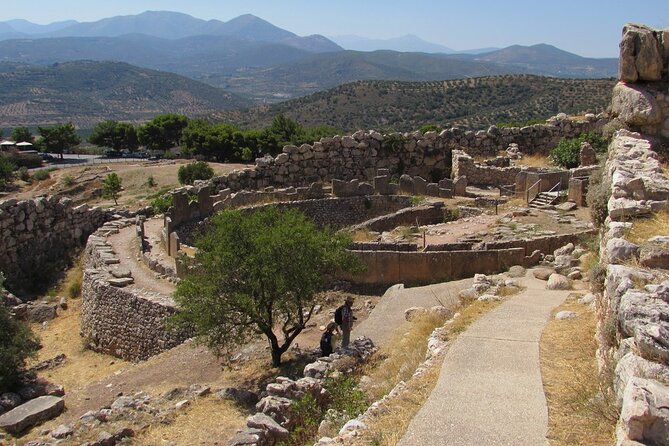
Mycenae comes next, with about an hour at the archaeological site. This was the center of the Mycenaean civilization, which dominated the eastern Mediterranean from the 15th to the 12th century BCE. The connection with Agamemnon and Homer’s Iliad gives the place a strong mythical pull, but the stonework is what makes the visit memorable.
You enter through the Lion Gate and pass the royal grave circles. The Treasury of Atreus, with its massive beehive-shaped chamber, shows why later Greeks imagined the builders as giants. The site is exposed, uneven, and hilly in places, so the visit rewards sturdy footwear and a little patience.
Nafplio is your first overnight base, and it is an excellent choice. Once the first day’s ruins are finished, you can walk around Syntagma Square, see the old Turkish mosques, and stroll along the waterfront toward views of Bourtzi Castle. The town has narrow cobbled lanes, neoclassical buildings, cafés, and tavernas.
Three nights in four-star or boutique hotels are included. In Nafplio, one example is Ippoliti, subject to availability. Hotel names are not guaranteed, so confirm the property before booking if accommodation matters to you.
Day 2: Olympia and the road across western Greece
After breakfast, you face a roughly two-hour drive to Ancient Olympia. This is another UNESCO site, set in the valley of the Alpheios River and associated with the ancient Olympic Games.
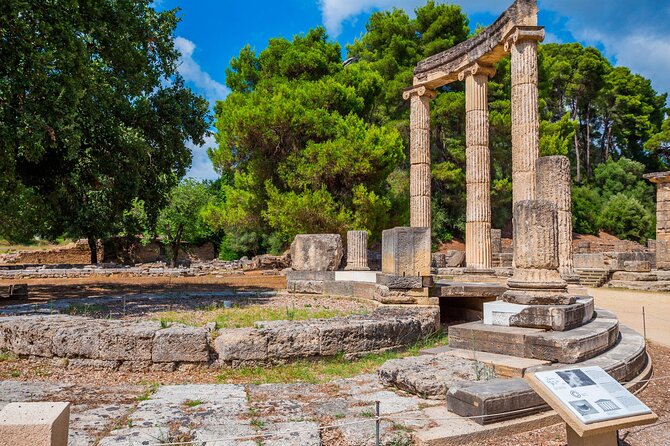
Allow about two hours for the archaeological site and museum. The ruins include the Temples of Zeus and Hera, the Bouleuterion, Prytaneion, stadium, gymnasium, palaestra, and the workshop linked with the sculptor Pheidias.
The museum holds several famous works, including the Nike of Paionios and Hermes with the infant Dionysus. For many people, Olympia is the emotional center of the first half of the trip because the name still connects directly with an event known around the world.
You can eat lunch in the modern village of Olympia. Lunch is extra, but the village taverns make a practical break before the next long drive. Entrance to the site and museum is also not included.
The day then shifts from ancient Greece to modern infrastructure. You cross the Rio-Antirrio Bridge, completed in 2004 for the Olympic Games. The bridge links the Peloponnese with western mainland Greece and crosses a wide stretch of water between Rio and Antirrio.
You have about 10 minutes for the bridge stop. It is short, but the structure gives you a welcome change after several archaeological visits.
A few more Athens tours and experiences worth a look
Nafpaktos and Galaxidi bring the pace down
After crossing the bridge, you stop in Nafpaktos for about 30 minutes. This small town has a Venetian harbor and castle, with a compact waterfront suited to a coffee or tea break.
Thirty minutes is enough to stretch your legs and see the port, but not enough for a full castle visit or a slow town walk. Treat Nafpaktos as a scenic pause rather than a major sightseeing session.
The overnight area is Galaxidi or Delphi, depending on hotel availability. Galaxidi has a seaside-resort feel, with the atmosphere of a Greek island, while Delphi places you closer to the next morning’s archaeological visit.
A possible Galaxidi hotel is Ganimede, noted for its breakfast, while Nidimos in Delphi is another example. Neither property is guaranteed, so ask for the confirmed hotel and location before departure. Breakfast is included, which matters on days when you leave early.
Day 3: Delphi, the oracle, and the mountain road to Thermopylae
Your driver takes you to Delphi after breakfast. The archaeological site and museum receive about two hours, though you will want to check how that time is divided between the two.
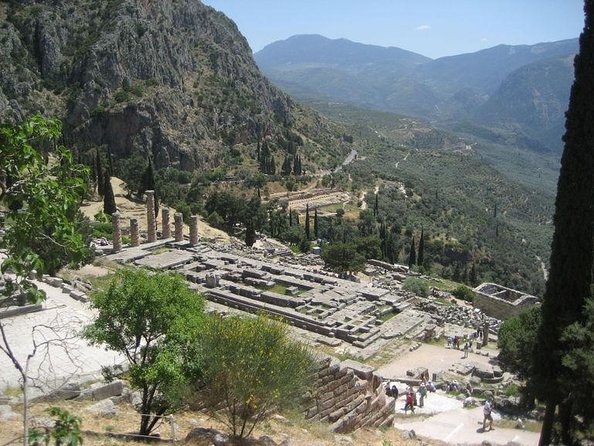
Ancient Delphi was considered the center of the ancient Greek world. City leaders, kings, and military commanders came to consult the Pythia, the oracle of Apollo. The sanctuary’s buildings show how much power and money gathered here over time.
The site includes the Temple of Apollo, the Amphictyonic Council, the Siphnian Treasury, theater, Tholos, gymnasium, and stadium. Delphi is set on a mountainside, so expect slopes and uneven walking. The setting is a major part of the experience, but this is not a flat, easy museum visit.
The museum helps put the scattered stones into context. Its collection includes the Charioteer, the Sphinx of the Naxians, and the statues of Kleobis and Biton. A licensed guide is not included, although one can be arranged for an extra fee.
Your driver provides English commentary during the trip and may explain the sites in a useful, conversational way. One named chauffeur, Petros, has been especially praised for explaining the ruins while driving and for making a formal guide unnecessary for one group. Still, a driver is not the same as a licensed guide, so choose the added guide if detailed archaeological interpretation is central to your trip.
Lunch is planned at a traditional tavern called To Patriko mas. It is known for a broad view toward the valley and sea, along with Greek food and service. Lunch is not part of the standard inclusions unless you select the lunch option.
In the afternoon, you continue to Thermopylae for about 30 minutes. This is the famous battlefield where 300 Spartans and 700 Thespians fought during the second Persian invasion of Greece.
The short stop works well as a historical pause between Delphi and Meteora. Do not expect a full-day museum visit. The attraction is the story, the location, and the chance to connect a modern road journey with one of the best-known battles of ancient Greece. Admission is extra.
Day 4: Meteora monasteries above Kalambaka
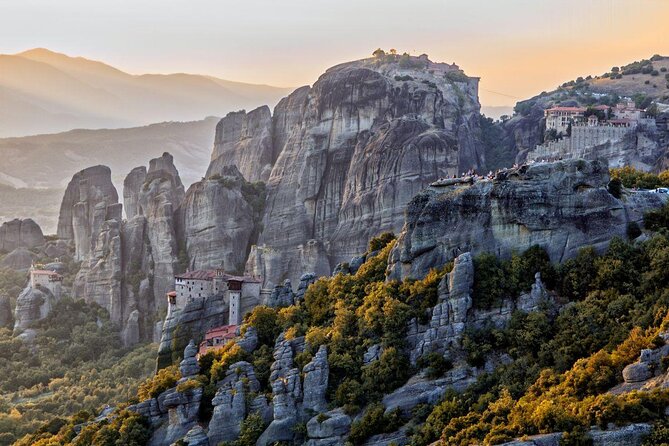
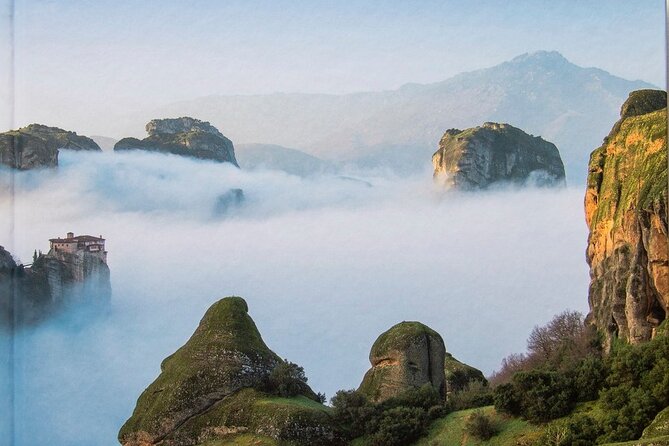
The final morning brings the most unusual scenery of the tour. You ascend toward Meteora, where six monasteries sit among tall rock pillars: Great Meteoron, Varlaam, Roussanou, Agios Stefanos, Holy Trinity, and St. Nicholas.
You visit two or three monasteries, depending on the day and visiting time. The selection is not fixed, so ask your driver which monasteries are open and planned for your visit. The total stop lasts about two hours.
The monasteries date from the 14th century and hold Byzantine and Christian objects, including monastic clothing, paintings, and etched glass. The setting is dramatic, but the interiors matter just as much. This is an active religious site, so modest clothing and respectful behavior are sensible.
The private vehicle is particularly useful here. Your driver can move you between the monasteries, wait while you visit, provide live commentary, and leave enough time for photographs and walking. Entrance fees are not included.
Meteora has also appeared in popular films and television. The Monastery of Holy Trinity was partly used in the 1981 James Bond film For Your Eyes Only, and the rock formations have appeared in Game of Thrones. Those references may add fun, but the monasteries are worth seeing for their own religious and architectural importance.
Afterward, you have about an hour in Kalambaka for lunch and a stroll. Food is extra, and the town is a practical place to stop before the return journey.
The last scheduled pause is Kamena Vourla, a seaside village where afternoon coffee or tea is offered by the sea. The driver then returns you to your Athens residence or the airport. The final return time will depend on traffic, monastery visits, and the length of your lunch stop, so avoid booking a tight onward connection.
What the $1,942.01 price includes
At $1,942.01 per person, this is a costly trip. Its value depends heavily on the size of your private group and how much you value convenience.
The price covers airport, hotel, residence, and port pickup and return; three nights of four-star or boutique accommodation with breakfast; private luxury transport; Wi-Fi; air conditioning; bottled mineral water; an English-speaking driver; and private evening transfers.
It does not cover archaeological admission, museum tickets, lunches, dinners, drinks, or a licensed guide. Those extras can affect the final cost, so ask for a clear estimate before booking.
For a couple or small family, the private setup can make sense because you are paying for a dedicated vehicle, hotel nights, and a driver across a long route. The value is weaker if you want slow sightseeing, local buses, or long free periods in each town.
Who should book this private road trip
I would choose this tour if you have four days, want to see several major sites, and do not want to rent a car. It suits first-time visitors who value door-to-door transport and prefer a flexible private schedule.
It is also a good fit for families or small groups. Wi-Fi, bottled water, air conditioning, and hotel breakfast remove several small daily hassles. The driver can adjust the rhythm more easily than a large group tour can.
I would hesitate if your priority is deep time at every ruin. Corinth, Epidaurus, Mycenae, Nafpaktos, and Thermopylae all have short or moderate visits. You will see a great deal, but you will not study every museum label or explore every side street.
Confirmation arrives at booking, and free cancellation is available up to 24 hours before the start time. Most people can participate, and the activity is private for your group. Public transport is nearby at some points, but this route is designed around private road transport.
Should you book it?
Book this tour if you want maximum geographic coverage with minimum transport planning. The combination of Olympia, Delphi, and Meteora is hard to arrange smoothly in four days without a private vehicle, and the overnight stops in Nafplio and the Delphi area keep the route from becoming one endless transfer.
Before paying, confirm the actual hotels, the group size, the expected admission costs, and whether you want a licensed guide. If you accept the long driving days and extra site fees, this is a strong choice for seeing Greece’s major ancient and religious landmarks in one well-organized sweep.
FAQ
Is pickup included from Athens?
Yes. Pickup and return are offered from Athens hotels, Airbnbs, residences, the airport, and the port. Your driver waits at the meeting point with a sign showing your name.
Is this a private tour?
Yes. Only your group participates, and the vehicle and driver are dedicated to your party.
What type of vehicle is provided?
Transport is by a luxury, air-conditioned vehicle with Wi-Fi and bottled mineral water.
Are the hotels included?
Yes. Three nights at four-star or boutique hotels with breakfast are included. Examples include Ippoliti in Nafplio, Ganimede in Galaxidi, and Nidimos in Delphi, subject to availability.
Are archaeological entrance fees included?
No. Admission fees for archaeological sites and museums are not included in the standard price.
Is a licensed guide included?
No. An English-speaking experienced driver provides live commentary. A licensed guide can be arranged at an additional cost.
Which monasteries will you visit at Meteora?
You will visit two or three of the six Meteora monasteries, depending on the day and visiting time. The six are Great Meteoron, Varlaam, Roussanou, Agios Stefanos, Holy Trinity, and St. Nicholas.
Are meals included?
Breakfast at the hotels is included. Lunches, dinners, drinks, and other meals are extra unless you choose the lunch option.