REVIEW · ATHENS
3 Days Private Tour: Delphi & Meteora
Book on Viator →Operated by Olive Sea Travel · Bookable on Viator
The best thing about this three-day private tour is its range. In one trip, you move from Byzantine mosaics at Hosios Loukas to Apollo’s sanctuary at Delphi, the cliff-top monasteries of Meteora, and the battlefield of Thermopylae. It is a long route, but private transport makes it far easier than piecing these places together yourself.
I like the freedom to set your pickup time and travel away from the main highway through central Greece. I also like the personal service promised by drivers such as Manos and Alex, who are praised for their stories, restaurant choices, humor, and care. The main catch is that drivers cannot guide you inside the archaeological sites or museums, and entrance fees are extra.
In This Review
- Key points at a glance
- Why this route works so well from Athens
- Day one: Hosios Loukas before Delphi
- Delphi, where the ancient world sought answers
- Day two: the long road to Meteora
- Meteora’s monasteries and towering rocks
- Day three: Thermopylae and the road back to Athens
- Drivers, guiding, and the feel of a private trip
- What the price includes, and what to check
- Who should book this tour
- Should you book the Delphi and Meteora tour?
- FAQ
- Where does the tour begin and end?
- How long does the tour last?
- Is this a private tour?
- Is hotel pickup available?
- Is accommodation included?
- Are entrance fees included?
- Is a licensed guide included?
- Which monasteries are visited at Meteora?
- Can I cancel for a full refund?
Key points at a glance
- Four major historic stops in three days: Visit Hosios Loukas, Delphi, Meteora, and Thermopylae without changing buses or managing several separate day trips.
- Private driving from Athens: Your hotel, Airbnb, or port pickup and return are included, with timing adjustable on request.
- A scenic route to Kalambaka: Day two uses mountain roads through Greece rather than taking the fastest highway route.
- Meteora photo time: An evening drive around the rocks is planned for sunset views, followed by visits to Great Meteoron, Agios Stefanos, and Roussanou.
- Accommodation depends on your booking: Three-star or four-star lodging with breakfast can be added, so check exactly what your price includes.
- Independent site visits: The driver knows the area and its history, but a licensed guide costs extra if you want explanations inside each site.
Why this route works so well from Athens
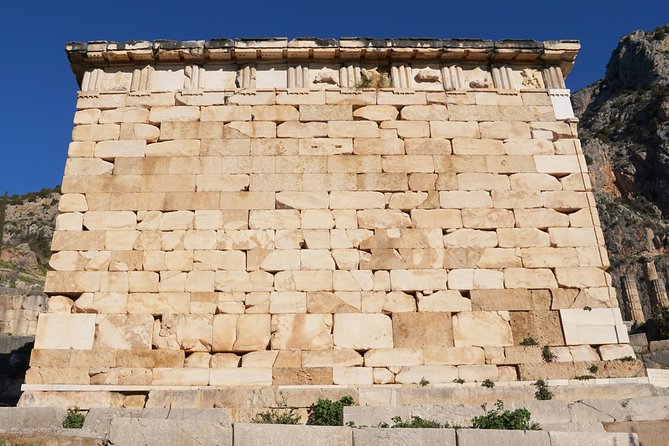
Delphi and Meteora are two of mainland Greece’s finest cultural stops, yet they are not natural neighbors for a quick day trip from Athens. Delphi lies west of the capital, while Meteora is much farther north. Adding Thermopylae on the return creates a logical loop, though you should expect plenty of road time.
A private vehicle is the key advantage. You are not tied to a large group’s bathroom breaks, fixed restaurant stops, or rigid departure times. Pickup is offered from a hotel, Airbnb, or port, and the time can be adjusted before the trip. That flexibility matters on a three-day journey.
The price is listed at $1,059.62 per person. That is a serious outlay, so value depends on group size and what you select for lodging. You are paying for a private vehicle, driver, bottled water, pickup and drop-off, and a route that would be awkward to arrange independently. Accommodation and breakfast are available according to the booking choice, but the information also lists them as not included, so confirm the exact package before paying.
You can also read our reviews of more private tours in Athens

Day one: Hosios Loukas before Delphi
The first stop is the monastery of Hosios Loukas, about an hour from the schedule. It represents the second golden age of Byzantine art, from the 11th and 12th centuries. Its main draw is the golden mosaic decoration, supported by finely planned Byzantine architecture.
This is a smart opening stop because it gives you a different side of Greek culture before the better-known ancient sites. Delphi is about pagan religion and Apollo. Hosios Loukas is about Orthodox worship and Byzantine art. The contrast helps you see Greece as more than a collection of classical ruins.
Admission is not included, and the planned visit is short. If Byzantine art interests you, one hour may feel tight. Ask your driver about the exact timing and ticket arrangements before the day begins.
Next comes Arachova, a mountain village at the foot of Mount Parnassos. The stop is only about 20 minutes, so think of it as a brief look and photo pause rather than a full village visit. Arachova is known as a winter resort, with skiing, mountain scenery, restaurants, and a lively evening scene favored by people from Athens.
The short visit gives you a sense of the mountain setting, but it will not allow much time for shopping or a proper walk. If you want to linger, you may need to give up time elsewhere. That is one of the useful advantages of a private tour: you can ask about adjusting the balance, though the full route already covers a lot.
Delphi, where the ancient world sought answers
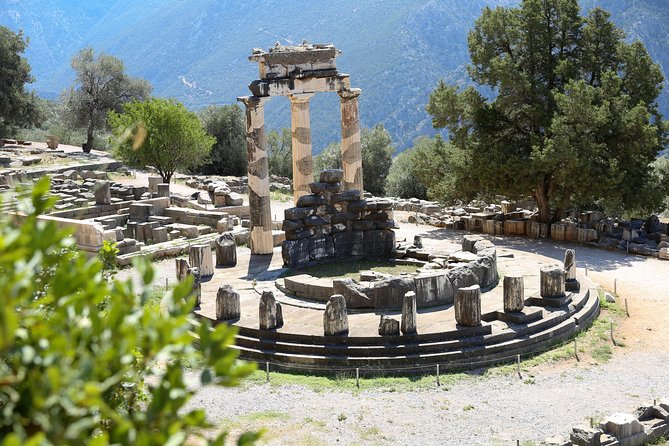
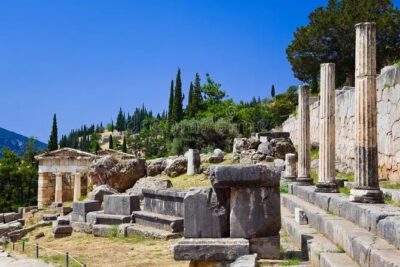
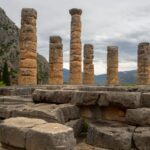
Delphi is the heart of the first day. The ancient sanctuary was devoted to Apollo and served as a Panhellenic religious center. Ancient Greeks regarded it as the center of the world, and the site still carries a strong sense of place because of its mountain setting.
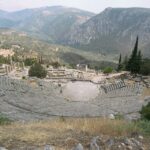
The schedule separates the main archaeological area into two parts. You first see the sanctuary and its wider setting, including views toward the mountains, the Gymnasium, and the sanctuary of Athena Pronea. Then you spend about an hour at the Temple of Apollo, the ancient theater, and the stadium.
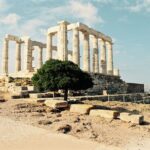
The Temple of Apollo is the site’s central image, but the theater and stadium help explain how Delphi functioned as more than a place for prophecy. The theater looks across the surrounding mountains, while the stadium recalls the athletic contests connected with the sanctuary.
Admission is extra, and the listed times are approximate. I would not treat the 30-minute and one-hour slots as guarantees. Traffic, lunch, ticket lines, and your interest in the ruins can change the day.
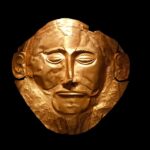
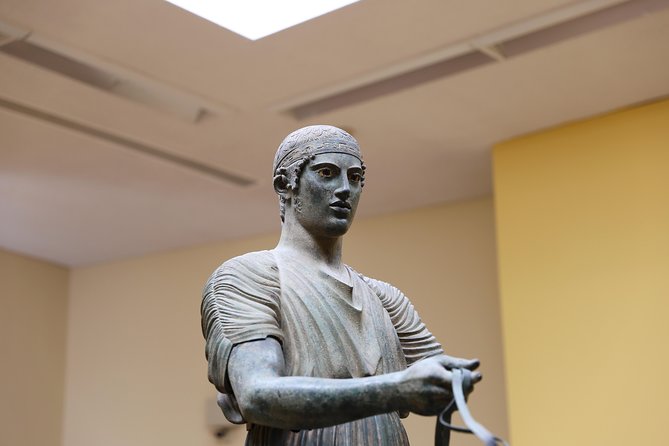
The Delphi Archaeological Museum gets another hour. This is where you see the famous Charioteer of Delphi and the gold and ivory statue. The museum gives useful context to the broken columns outside, especially if you do not hire a guide.
There is no licensed guide included inside the site or museum. Your driver can share historical information during the journey, but cannot accompany you as an official guide in the monuments. If you want a full explanation of the Oracle, the sanctuary’s buildings, and the museum pieces, budget for a licensed guide.
Lunch follows in the modern village of Delphi, with views over the mountains of Phokis. The restaurant is not fixed in the details provided. One driver praised in the feedback, Manos, is noted for selecting good restaurants and arranging a well-placed table. That sort of local help can make a difference, but you should still ask about menu prices before ordering.
Day two: the long road to Meteora
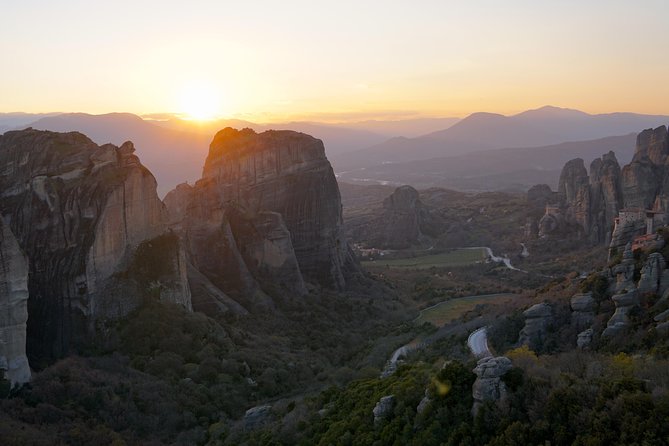
The second day is mainly a scenic transfer from Delphi toward Kalambaka. Rather than taking the highway, the route passes through Greek mountain country and by Lamia, with a rest at Trikala for lunch or coffee.
This choice favors scenery and a slower look at rural Greece over speed. If you want to see the countryside between the famous sites, it is a good use of a private vehicle. If you dislike long drives, this will be the hardest part of the tour. The exact duration depends on traffic and the day’s timing.
You finish in Kalambaka, the small town below Meteora. After settling into the hotel, the tour includes an evening drive around the hills for photographs of the huge rock formations under the Greek sunset. This is one of the most appealing details in the plan. Meteora is not only about entering monasteries. The rocks themselves are the main visual event, and changing light can make the evening drive worthwhile.
The rest of the day is free in town. Since the plan does not specify a particular evening meal or walking route, use the free time according to your energy. After Delphi and the mountain drive, a quiet evening may be more useful than another tightly scheduled activity.
Meteora’s monasteries and towering rocks
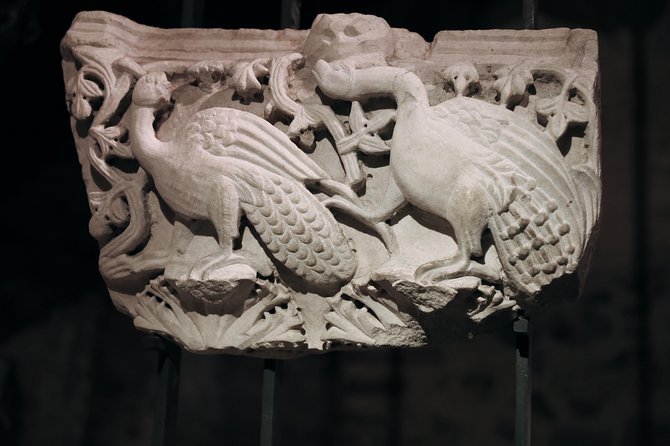
The monastery visits are listed with the second day’s Meteora program, although the overall schedule places them after the overnight stay. Either way, expect to visit three monasteries, each with a different character.
Great Meteoron is the largest and most impressive of the Meteora monasteries. It gives you the clearest sense of the scale of the religious complex and its position among the rocks. The planned visit is about 40 minutes, and admission is extra.
Agios Stefanos is one of Meteora’s few female monasteries. Its exact foundation date is uncertain, but evidence places its construction in the 15th century. The church contains wall paintings completed in 1560. This is also the easiest monastery to reach, an important detail if stairs or uneven access would make the other sites tiring.
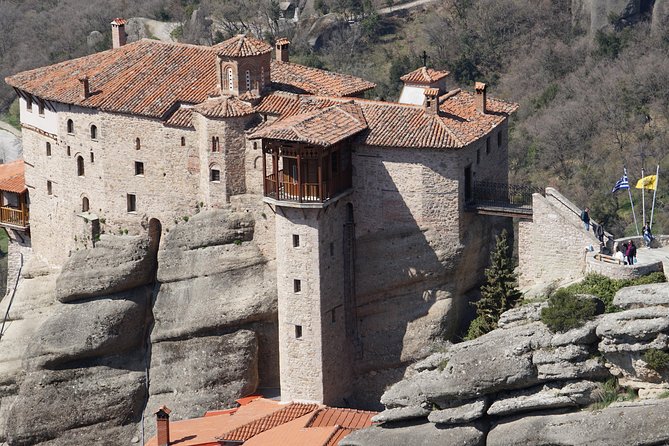
Roussanou provides another angle on the cliffs and neighboring monasteries. From here, a path leads toward the upper road and an off-road viewpoint where you can walk on bare rock. That sounds appealing for photographs, but use care and follow the driver’s local instructions. The route is described as a pathway and viewpoint, not as a formal paved attraction.
Meteora is a strong match for anyone who enjoys combining scenery with religious and cultural history. It is less suitable if you want a leisurely, unhurried monastery visit at every stop. The schedule allows roughly 30 to 40 minutes at each one, and admission costs are separate.
Dress and entry requirements are not detailed in the supplied information, so check current monastery rules before departure. Orthodox monasteries may have clothing expectations, and opening days can vary. Your driver should be able to help with the day’s plan, but do not assume every monastery will be open at every hour.
A few more Athens tours and experiences worth a look


Day three: Thermopylae and the road back to Athens
The return begins at Thermopylae, the battlefield linked with King Leonidas and the 300 Spartans who faced the Persian army. The battlefield stop is brief, about 10 minutes, followed by another 10 minutes at the Leonidas Monument.
The short timings tell you what this part of the trip is: a focused historical stop rather than a full archaeological visit. You see the place connected with the battle and the statue of Leonidas opposite Kolonos Hill, where the Spartans made their final stand.
The Kainotomiko Kentro Istorikis Enimerosis Thermopylon, or historical information center, adds about 30 minutes. Its 3D film presents the battle and the people who died defending their freedom. Admission is extra. This center may be the most helpful part for visitors who want a clear explanation rather than only a roadside monument.
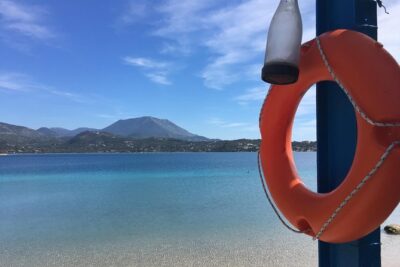
After Thermopylae, you stop in Kamena Vourla for lunch by the sea. The village offers a change of mood after the mountain sites, with traditional fishing boats and a coastal setting. The lunch stop is listed as one hour, and admission is free.
Then you return to Athens. Traffic affects the exact arrival time, so do not schedule a tight flight, ferry, or important appointment immediately afterward.
Drivers, guiding, and the feel of a private trip
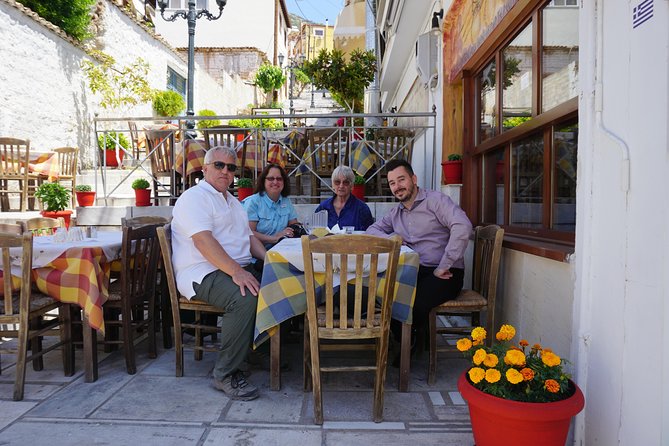
The drivers are described as professional and well informed about Greek history, but they are not licensed to accompany you inside sites or museums. This distinction matters. You get practical help, historical conversation during the drives, and personal transport. You do not automatically get a formal tour of Delphi, the museum, or the monasteries.
Manos is praised for his stories about Greek life, humor, attention to personal needs, and restaurant choices. Alex is described as a very pleasant driver who made the three-day route feel relaxed and free of stress. You can request a preferred driver, though availability is not guaranteed.
A private tour also means only your own group participates. That is valuable for families, couples, and small groups with different walking speeds. It is less economical for a solo visitor unless convenience matters more than cost.
What the price includes, and what to check
The package includes private transport, bottled water, pickup and return, and a driver. Accommodation with breakfast is included only according to the selected booking option, with three-star or four-star choices available.
Entrance fees are not included. That affects Delphi, the archaeological museum, Hosios Loukas, the Meteora monasteries, and the Thermopylae information center. A licensed guide is also extra.
Before booking, confirm these points:
- Which hotel category is included
- Whether breakfast is included in your exact price
- The number of people covered by the per-person rate
- Which entrance tickets you need to pay locally
- Whether a licensed guide can be added for Delphi or Meteora
- The planned pickup time and return estimate
Cancellation is allowed for a full refund if you cancel at least three full days before the local start time. Cancellations or changes made later are not accepted for a refund.
Who should book this tour
I would choose this trip if you have three days, want Delphi and Meteora in one sweep, and value having a driver more than keeping costs low. It is especially useful when public transport connections seem too awkward or when you want to start and finish at your own Athens accommodation or port.
It suits people who enjoy a mix of ancient ruins, Byzantine art, Orthodox monasteries, mountain roads, and sea views. It also works well for a group that wants private space and restaurant help rather than a large coach tour.
I would hesitate if you need long visits at each monument, dislike extended drives, or want a guide explaining every site from start to finish. In that case, add a licensed guide and accept that the price will rise, or split Delphi and Meteora into separate trips.
Should you book the Delphi and Meteora tour?
Book it if your priority is efficient private transport with a human touch. The route covers a remarkable amount of central Greece, and the sunset photo drive around Meteora is a particularly good addition. Drivers such as Manos and Alex can make the long hours feel easier through local stories, humor, and practical help.
Do not book without checking the lodging package, entrance costs, and guide arrangements. If you understand those extras and are comfortable with a full three-day schedule, this is a strong way to connect Athens with four very different places.
FAQ
Where does the tour begin and end?
Pickup and drop-off are offered at your hotel, Airbnb, or port in Athens. The tour returns to Athens after the Thermopylae and Kamena Vourla stops.
How long does the tour last?
The experience lasts approximately three days. Exact times can change with traffic and the time of day.
Is this a private tour?
Yes. Only your own group participates in the private activity.
Is hotel pickup available?
Yes. Pickup is offered from a hotel, Airbnb, or port, and the pickup time can be adjusted on request.
Is accommodation included?
Accommodation with breakfast depends on the booking option you select. Three-star or four-star accommodation may be available, so confirm the exact package before booking.
Are entrance fees included?
No. Entrance fees are not included and must be paid separately.
Is a licensed guide included?
No. The drivers provide transport and historical knowledge but are not licensed to accompany you inside sites or museums. A licensed guide can be requested for an additional cost.
Which monasteries are visited at Meteora?
The route includes Great Meteoron Monastery, Agios Stefanos, and Roussanou Monastery.
Can I cancel for a full refund?
Yes, if you cancel at least three full days before the experience start time, based on local time. Later cancellations and changes are not accepted for a refund.