REVIEW · ATHENS
4 Days Classical Private Tour/ Corinth,Mycenae,Nafplio,Sparta,Olympia,Delphi
Book on Viator →Operated by GREECE TAXI · Bookable on Viator
The most striking thing about this four-day private tour from Athens is its reach. In one long loop through the Peloponnese and central Greece, you visit Corinth, Mycenae, Nafplio, Sparta, Mystras, Olympia, Delphi, and Thebes. This is not a gentle sightseeing sampler. It is a serious historical journey with plenty of road time.
I like the freedom of having a car and driver for your own group, especially on routes where public transport would be awkward. I also like the scenic side roads, onboard Wi-Fi, direct hotel pickup, and the chance to stop at places such as Nafpaktos and Galaxidi. If your driver is Nikolaos, you may also benefit from the warm, personal style that made this journey especially memorable for one couple.
The main consideration is pace. You cover a huge portion of Greece in four days, and the archaeological sites are not accompanied by a licensed guide unless you pay extra. Hotel accommodation, entrance fees, and an archaeologist guide are also additional costs, so the advertised price is not the full trip total.
In This Review
- Key points to know before booking
- Why this route is ambitious but worthwhile
- Day one: Corinth, Mycenae, and Nafplio
- Day two: Nafplio, Sparta, and Mystras
- Day three: Olympia and the Gulf of Corinth
- Day four: Delphi, Livadia, and Thebes
- What the $1,376 price really covers
- Who should book this four-day Greek tour
- Should you book it?
- FAQ
- Where does the tour begin and end?
- What time does the tour start?
- Is this a private tour?
- What type of vehicle is available?
- Is accommodation included?
- Do I need to reserve a room for the driver?
- Is a licensed guide included at the archaeological sites?
- Are entrance fees included?
- Is Wi-Fi available during the drives?
- How far in advance should I book?
Key points to know before booking
- Eight major historical destinations: Corinth, Mycenae, Nafplio, Sparta, Mystras, Olympia, Delphi, and Thebes all appear in the route.
- Private transport for your group: Choose a sedan or SUV for up to three adults, a minivan for up to seven people, or a minibus for up to fourteen.
- Four UNESCO World Heritage Sites: The route includes Mycenae, Mystras, Olympia, and Delphi.
- Long drives made easier: Air-conditioning, Wi-Fi, tolls, ferry tickets, fuel, parking, and hotel pickup are included.
- Driver, not site guide: Your English-speaking driver handles the route and transport, but an archaeologist guide must be booked separately.
- Nafplio and Olympia require planning: Rooms should be reserved at least two weeks ahead, particularly for weekends and holidays.
Why this route is ambitious but worthwhile
This tour is built for you if Greece means more than Athens, island beaches, and a quick look at the Acropolis. It links major sanctuaries, Bronze Age citadels, Byzantine ruins, Venetian forts, and towns shaped by the Greek War of Independence.
The route also gives you something a large coach tour cannot: control. You travel only with your own party, can adjust the start time, and are collected from your Athens, Piraeus, or airport accommodation. The suggested departure is 8:00 in the morning, or earlier in summer, which matters because several sites close by late afternoon in winter.
The roads are a large part of the experience. You cross the Corinth Canal, pass beneath Mount Taygetos, travel beside the Gulf of Corinth, take a ferry near the Rio-Antirrio Bridge, and climb toward Mount Parnassus. Onboard Wi-Fi is a practical benefit during the longer stretches, though it does not make the journey short.
The strongest personal touch comes from the driver. Nikolaos is specifically praised for using scenic, less-used roads, avoiding crowds where possible, answering questions patiently, and making the trip feel relaxed rather than mechanical. A driver’s style can shape a private tour, so if you have a preferred driver, ask the operator if he is available.
You can also read our reviews of more private tours in Athens


Day one: Corinth, Mycenae, and Nafplio
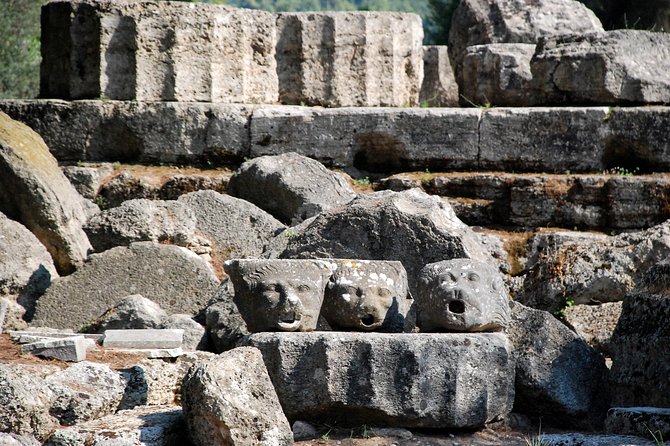
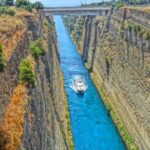
Your first stop is the Corinth Canal, a quick but worthwhile introduction to the journey. The canal cuts through the Isthmus of Corinth and links the Gulf of Corinth with the Saronic Gulf, separating the Peloponnese from mainland Greece.
You get about 15 minutes here, enough for photographs and a walk across a pedestrian bridge. The canal is roughly 6,400 meters long, and its steep sides make the scale easy to appreciate from above. Do not expect a full museum visit or lengthy exploration. This is a photo stop, but a good one.
At Ancient Corinth, the tour slows down. This was one of the major cities of ancient Greece, and the site includes the Temple of Apollo, the theater, shops, public buildings, baths, and other remains. Corinth also has a strong connection with Saint Paul, who lived and preached here, making the site meaningful for visitors interested in early Christianity as well as classical Greece.
Allow about an hour for the archaeological area, plus 30 minutes for the museum. The Temple of Apollo is the visual anchor. Its surviving limestone columns date from around 550 BC and belong to one of the earliest Doric temples in the Peloponnese.
The Archaeological Museum of Ancient Corinth adds useful context, with objects from prehistoric, Geometric, Hellenistic, Roman, and Byzantine periods. The entrance charge is not included. The stated combined ticket is €15 in summer and €8 in winter, though you should confirm current prices before departure.
Mycenae changes the mood completely. This is the legendary kingdom linked with Agamemnon, but the site is valuable even if you set the myths aside. Its massive walls, Lion Gate, citadel, and tholos tombs show the power of the Mycenaean civilization during the Late Bronze Age.
The Treasury of Atreus, also called the Tomb of Agamemnon, is especially impressive. Its name comes from Heinrich Schliemann, but archaeologists do not believe it can be firmly connected with Atreus or Agamemnon. The tomb’s great stone chamber and corbelled roof make it one of the finest surviving monuments of Mycenaean Greece.
Plan about 15 minutes for the tomb and 90 minutes for the main site. The small museum beside the citadel displays finds from the area and helps explain what you have seen. The combined ticket for the tomb and archaeological site is listed as €20 in summer and €10 in winter, with free admission for visitors under 19 and reduced prices for those over 65.
The day ends in Nafplio, where you stay overnight. This is a welcome change after the ruins and driving. Nafplio is a handsome coastal town with a long Venetian, Ottoman, and Greek history. It was the first capital of modern Greece before the capital moved to Athens in 1834.
Palamidi Castle rises above town and rewards the climb with views over Nafplio and the Argolic Gulf. The stairway from town is commonly described as 913 steps, while the route inside the fortress adds more. Local menus play on the popular figure of 999 steps. You can also reach the fortress by vehicle, which is sensible if your day has already included substantial walking.
Allow 90 minutes for Palamidi. The ticket costs extra. The fortress is large, so wear firm shoes and do not treat this as a quick viewpoint stop.
Day two: Nafplio, Sparta, and Mystras

Begin in Nafplio with the Archaeological Museum, housed in a Venetian building on Syntagma Square. The building itself is worth seeing, but the main prize is the Bronze Age armor from Dendra, displayed with related weapons and vessels.
The museum takes about an hour, and admission is listed as €6, with a €3 reduced ticket. Afterward, Acronafplia offers another view over the town and bay. This is Nafplio’s oldest fortress, with layers of construction linked to the Romans, Franks, Venetians, and Ottomans. Allow about 30 minutes for a short walk.
The route then reaches Argos, one of Europe’s oldest continuously inhabited cities. The stop is presented as a pass-through destination rather than a full visit, so ask your driver if you want time for its ancient monuments.
Sparta can surprise you. The modern city is not a preserved ancient town, and the ancient remains are spread out rather than gathered into a grand monumental center. The Archaeological Museum is small and occupies a 19th-century neoclassical building. It takes about 30 minutes, with a listed general ticket of €10.
The ancient acropolis and theater require about an hour. The remains are quieter and less visually overwhelming than Mycenae or Delphi, but that is part of the appeal. Sparta’s power came from its social and military system, not from monumental architecture. The site makes more sense when you remember Thucydides’ observation that a deserted Sparta would not look as powerful as its reputation.
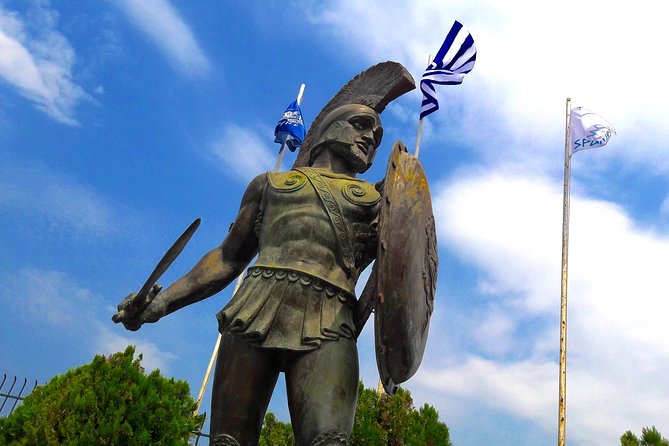
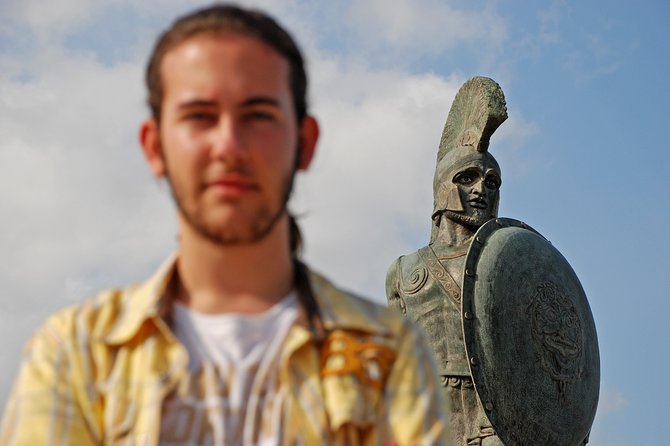
The Leonidas monument provides a compact link to the famous battle of Thermopylae. The statue carries the traditional Molon labe message, and a nearby ancient structure is believed to have served as the tomb of Leonidas, though its use has not been proved.
Mystras is the day’s major stop. Built on the slopes of Mount Taygetos around a fortress erected in 1249, Mystras became a major Byzantine center before its abandonment in 1832. Churches, monasteries, palaces, and stone streets remain scattered across the hillside.
You need about two hours here, and the walk is uneven and uphill in places. This is one of the tour’s four UNESCO World Heritage Sites, and it deserves more than a rushed glance. The general ticket is listed as €20 in summer and €10 in winter.
The drive near Mount Taygetos adds a dramatic natural setting. At 2,407 meters, Taygetos is the highest mountain in the Peloponnese. Its slopes also explain Mystras’s defensive position and its striking views across Laconia.
You spend the night in or near Olympia according to the route description. This is one of the places where advance planning matters most. Rooms in selected boutique or three-star and four-star hotels can be arranged, but accommodation is an added charge and prices rise on weekends and holidays.
Day three: Olympia and the Gulf of Corinth
Olympia is the emotional center of the tour for many people. The sanctuary hosted the Olympic Games every four years from 776 BC, and the ruins spread through a calm valley where the Alpheios and Kladeos rivers meet.
The archaeological site takes about two hours. You see the ancient stadium, temples, athletic facilities, and remains from several periods. The setting is open and spread out, so comfortable shoes and water are useful.
The combined entrance fee for the site and two museums is listed as €12 in summer and €6 in winter, with free entry for those under 19. The Archaeological Museum of Olympia is essential, not optional decoration. Its collection includes the Hermes of Praxiteles, the Nike of Paionios, and offerings connected with the Persian Wars.
The Museum of the Olympic Games takes about 30 minutes. Its displays explain the original events, including running, wrestling, boxing, and chariot racing, along with the rules that shaped the ancient competition. It also covers the role of Hercules and Pelops in Olympic tradition and the restrictions placed on women who tried to watch.
From Olympia, the route turns toward the Gulf of Corinth. Near Rio, you view the Rio-Antirrio Bridge, a major cable-stayed bridge opened just before the 2004 Athens Olympics. Instead of crossing by road, the tour uses a ferry from Rio to Antirrio, a ride of about 20 minutes. This is a pleasant break from the vehicle and gives you a different view of the bridge.
Nafpaktos is a good town stop, with a sheltered harbor and a fortress-town setting. It was known as Lepanto during the Venetian and Ottoman periods, and the Battle of Lepanto took place nearby in 1571. You get about an hour, enough to walk around the waterfront and absorb the town’s position at the entrance to the Gulf of Corinth.
Galaxidi follows with a shorter 30-minute stop. It sits around two natural harbors and has a small maritime character, with restaurants, bars, stores, fishing boats, and yachts. It is not a major ancient site, but it breaks up the historical schedule with a coastal pause.
The final drive climbs toward Mount Parnassus and an overnight stay in a traditional village on its slopes. This setting prepares you for Delphi the next morning and gives the day a more local, scenic finish.
Day four: Delphi, Livadia, and Thebes
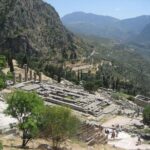
Delphi is one of Greece’s essential ancient sites. The sanctuary was home to the oracle of Apollo, and the ancient Greeks regarded it as the center of the world. The omphalos, or navel stone, expressed that idea.
The site sits on the southwest slope of Mount Parnassus, with broad views toward the Gulf of Corinth and the valley below. Give yourself 90 minutes at the Temple of Apollo and surrounding sanctuary, then another hour for the Archaeological Museum of Delphi.
The museum is among Greece’s most important archaeological collections. Its statues, architectural sculpture, and smaller offerings trace the sanctuary from the eighth century BC through Late Antiquity. The site and museum ticket is listed as €20 in summer and €10 in winter.
The Tholos of Athena Pronaia is a separate stop and one of Delphi’s most recognizable structures. This circular building was constructed between 380 and 360 BC, with 20 Doric columns around its exterior. Allow 30 minutes.
From Delphi, the route continues to Livadia, an ancient town associated with the oracle of Trophonius. The stop lasts about 30 minutes, so treat it as a brief town break rather than a full archaeological visit.
The Archaeological Museum of Thebes is the final major stop. Its collections cover periods from the Paleolithic through the Byzantine era, with finds from across Boeotia. The museum takes about an hour, and the listed admission is €6 in summer and €3 in winter.
You return to Athens in the evening. The final day is still demanding, but the sights are well chosen. Delphi supplies the grand finale, while Thebes adds archaeological depth that many standard Greek tours leave out.
A few more Athens tours and experiences worth a look


What the $1,376 price really covers
The listed price is $1,376.08 per person. That is a substantial amount, but it includes private transportation, fuel, toll roads, parking, ferry tickets, air-conditioning, Wi-Fi, and pickup and drop-off from Athens, Piraeus, or the airport.
The value depends heavily on your group size. A private sedan or minivan shared by several people can make sense when you compare it with arranging several intercity transfers, taxis, and hotel connections on your own. You also gain flexibility and avoid the wasted time of moving between bus stations.
Do not mistake the headline price for an all-in total. Hotel rooms cost extra, with different rates for boutique or three-star and four-star properties. You must also pay archaeological entrance fees, and the tour visits many sites. The supplied cost guidance describes fees of about €10 per person in winter and €20 in summer per site, but actual combined tickets vary.
An archaeologist guide costs an additional €180 per booking. I consider this worthwhile if you want mythology, architecture, and excavation details explained on site. Without one, your driver can provide route commentary and general help, but cannot accompany you as a licensed guide inside the archaeological areas.
Who should book this four-day Greek tour

I would choose this tour if you have limited time and want to see the Peloponnese without renting a car. It suits history-focused visitors, families who want a private vehicle, and small groups willing to spend several hours on the road each day.
It is also a good choice if you value personal service. Pickup at your accommodation removes the need to navigate Athens traffic or find a meeting point, and the route can be adjusted when the standard 8:00 start does not suit you.
I would hesitate if you prefer slow mornings, long meals, or several nights in one place. The schedule is packed, and some stops are short. You should also be comfortable with uneven ground, steps, and uphill walking at Palamidi and Mystras.
Book at least two weeks ahead. Nafplio and Olympia can fill up, and the driver needs a room if you arrange your own hotels. Children are accommodated in the vehicle options, with up to two children aged 10 or younger traveling free according to the booking details.
Should you book it?

Book this private tour if you want maximum historical coverage with minimum transport hassle. The combination of Mycenae, Mystras, Olympia, and Delphi is hard to match in four days, and the private format lets you travel at your group’s pace.
Skip it if you want a relaxed holiday or expect guided interpretation at every ruin. In that case, add the archaeologist guide and budget carefully for rooms and entrance tickets. For an ambitious first look at mainland Greece, however, this is a powerful route, especially if you can secure a personable driver such as Nikolaos and accept the long hours required to see so much.
FAQ
Where does the tour begin and end?
Pickup and drop-off are offered from hotels or apartments in Athens, Piraeus, or the airport. Another pickup location can be requested.
What time does the tour start?
The suggested start time is 8:00 in the morning. An earlier departure is suggested during summer, and the time can be adjusted if needed.
Is this a private tour?
Yes. Only your group participates in the activity.
What type of vehicle is available?
You can request a sedan or SUV for up to three adults, a minivan for one to seven people, or a minibus for one to fourteen people. The price varies by group size and vehicle type.
Is accommodation included?
No. Hotel accommodation is an additional charge. The operator can arrange selected boutique, three-star, or four-star hotels with breakfast.
Do I need to reserve a room for the driver?
If you arrange your own hotels, you must reserve an extra room for the driver. The driver’s room is complimentary when accommodation is arranged through the tour.
Is a licensed guide included at the archaeological sites?
No. The English-speaking driver is not a licensed tour guide for accompanying you inside sites or museums. An archaeologist guide can be hired separately for an additional fee.
Are entrance fees included?
No. Admission to archaeological sites and museums is paid separately. Listed prices vary by site, season, and combined ticket.
Is Wi-Fi available during the drives?
Onboard Wi-Fi is included in the private vehicle, giving you a way to stay connected during the longer journeys.
How far in advance should I book?
Booking at least two weeks ahead is requested because rooms must be reserved for you and the driver. Nafplio and Olympia are especially popular, and weekend or holiday rates may be higher.