REVIEW · ATHENS
Indulge to the beauty of Greece with the 4 days Classical Greece private tour
Book on Viator →Operated by Athens Tours Greece · Bookable on Viator
The big appeal here is the sweep: in four days, you travel from the Corinth Canal and Mycenae to Olympia, Delphi, Meteora, and Thermopylae. This is a fast-moving private road trip through some of mainland Greece’s most important ancient and religious sites.
I like the privacy of a car and driver for a route that would be awkward by public transport. I also like having three hotel nights and breakfast included, plus free time in Nafplio and other stops. The main drawback is the pace: long drives and several major archaeological sites leave little room for lingering.
In This Review
- Key points to know before booking
- A four-day route with a lot of Greece packed in
- Day one: Corinth Canal, Ancient Corinth, Mycenae, and Nafplio
- Day two: Olympia and the road toward Delphi
- Delphi: the ancient center of the Greek world
- Day four: Meteora monasteries above Kalambaka
- Thermopylae and the return to Athens
- What the $3,275.19 price really covers
- Practical details that shape the experience
- Who should book this Greek mainland circuit?
- Should you book it?
- FAQ
- How long does the tour last?
- How many people can join the private tour?
- Is hotel pickup available?
- What transportation is included?
- Is an English-speaking guide included?
- Are entrance fees included?
- Are meals included?
- What should I bring?
- Can airport transfers in Athens be arranged?
- Is the tour physically demanding?
- What is the cancellation policy?
Key points to know before booking
- Mycenae and Delphi bring the strongest ancient-world atmosphere, with myth, temples, oracles, and mountain views tied closely to Greek history.
- Meteora is the visual high point, with Orthodox monasteries perched on towering rock pillars above Kalambaka.
- Private transport makes the route practical, especially for reaching Olympia, Delphi, Meteora, and Thermopylae in one trip.
- Your driver can explain the sites outside the gates, but a licensed guide inside the archaeological areas and museums costs extra.
- Three nights of accommodation and breakfast are included, while entrance fees, lunches, dinners, and drinks are not.
- Plan for moderate walking, steps, sun, and long stretches in the vehicle. Comfortable shoes, water, a hat, and sunscreen matter.
A four-day route with a lot of Greece packed in
This tour is best understood as a private grand circuit rather than a relaxed holiday. You leave Athens and cross the Corinth Canal, enter the Peloponnese, continue to Mycenae and Nafplio, then reach Olympia. From there, the route heads north toward Delphi and Kalambaka, with Meteora and Thermopylae before returning to Athens.
That range is the reason to consider it. You see ancient cities, sanctuaries, museums, medieval monasteries, small towns, and changing scenery without arranging separate hotels or rental-car logistics.
The tradeoff is simple. Four days is enough to sample these places, not enough to know them thoroughly. The published schedule also contains overlapping references to Delphi and Kalambaka, so I would confirm the exact overnight order and departure times before paying.
You can also read our reviews of more private tours in Athens

Day one: Corinth Canal, Ancient Corinth, Mycenae, and Nafplio
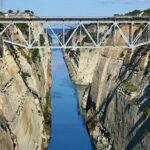
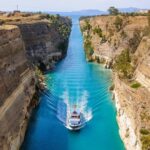
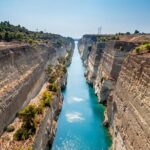
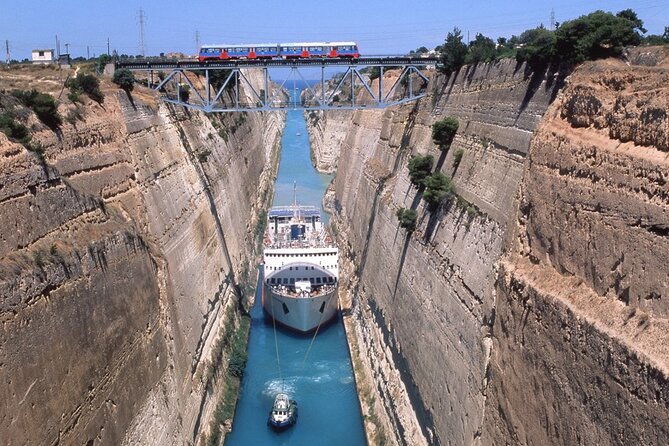
The first stop is the Corinth Canal, a narrow cut through the Isthmus of Corinth connecting the Gulf of Corinth with the Saronic Gulf. It separates the Peloponnese from mainland Greece and shortens the sea route around the peninsula.
You have about 20 minutes here, which is enough for photographs and a quick look from the viewpoint. The canal is a feat of modern engineering, though the idea goes back to the sixth century BC. Corinth’s ruler Periander is said to have considered the project in 602 BC, but the completed canal had to wait more than two thousand years.
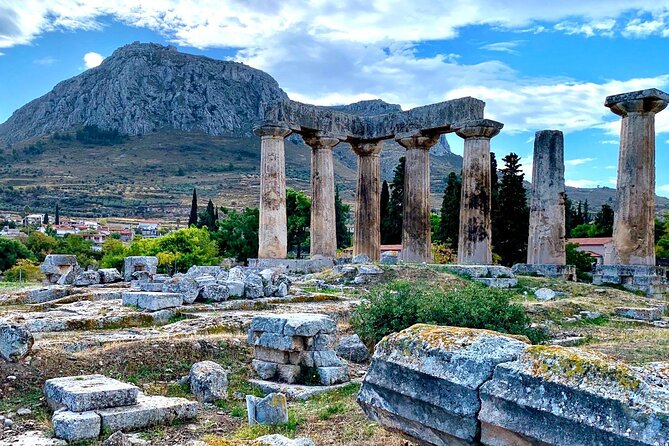
Next comes Ancient Corinth, where the visit lasts about an hour. Its location explains its importance. Corinth sat at the meeting point of land routes across Greece and sea routes between the western and eastern Mediterranean. That position helped it grow into a major trading and colonial power.
The site is at the foot of Acrocorinth, the fortified hill above the town. You will see the remains of an ancient urban center rather than one single dramatic monument, so a guide can make a real difference here. The entrance fee is not included.
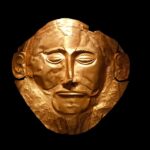
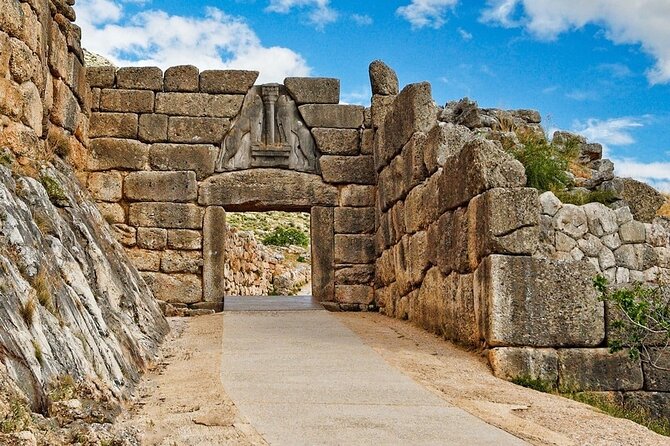
Mycenae is the day’s major archaeological stop, with about two hours scheduled. This was the palace center associated with Agamemnon and the Mycenaean civilization of the Late Bronze Age. Homer’s stories, later Greek tragedies, and centuries of art all helped turn Mycenae into one of Greece’s most famous ancient places.
The setting is powerful. Massive stone walls, high ground, and the remains of a palace complex make the site feel older and more severe than the classical temples you see later. Allow time for walking on uneven ground and standing in the sun. The entrance fee is extra.
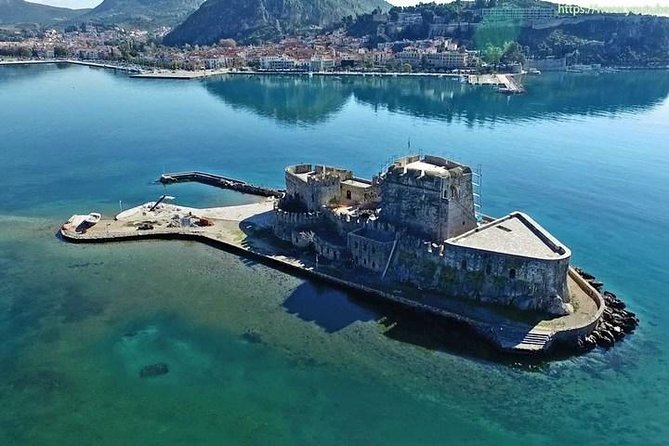
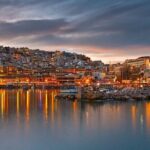
The day ends in Nafplio, one of the most pleasant towns in the Peloponnese. It served as the first capital of the modern Greek state from 1823 to 1834. With two hours here, you can stroll among Venetian and neoclassical buildings, Ottoman fountains, statues, and old fortifications.
Nafplio is also a useful change of rhythm after two archaeological sites. You get free time rather than a tightly directed visit. That makes it a good place for a coffee or meal, though food and drinks are your responsibility.
You then continue toward Olympia for the overnight stay. This is a long opening day, so bring snacks. The vehicle is private and air-conditioned, but the schedule includes several hours on the road.
Day two: Olympia and the road toward Delphi
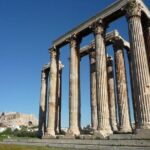
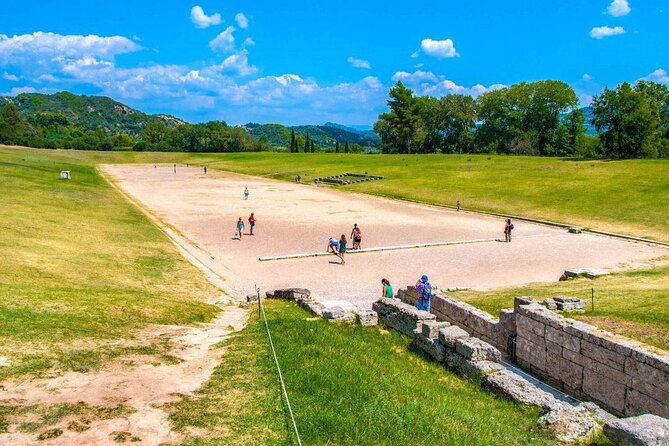
Olympia is tied to one of the most enduring ideas in ancient Greece: the Olympic Games. The games began in 776 BC as a festival honoring Zeus, bringing Greek communities together every four years while hostilities were suspended for the event.
The archaeological area includes the stadium, temples to Zeus and Hera, athletic training spaces, and buildings used for religious and social purposes. The site sits in the valley of the Alpheios River, surrounded by green hills and open space. It feels less like a city ruin and more like a broad sanctuary.
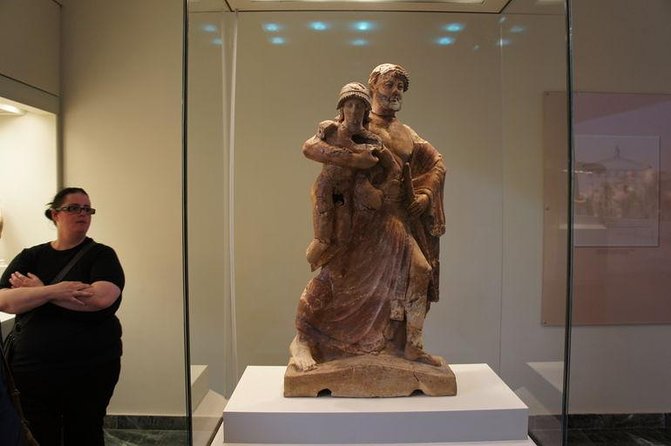
About an hour is scheduled for the main Olympia visit, followed by the Archaeological Museum. The museum is close to the site and holds sculptures, bronzes, and finds spanning roughly 3,500 years. The Hermes statue attributed to Praxiteles is one of the best-known pieces.
Olympia’s museum is not a minor add-on. If you rush through the ruins, the museum helps fill in the missing detail. It also gives you a chance to cool down indoors, useful in summer.
The schedule gives only brief stated times for the museum and archaeological-site entries, while the overall day includes the transfer toward Delphi. Ask the operator how much time is actually allocated to each place. The listed entrance fees are not included, and the three Olympia museums may not all be part of the visit.
The drive then crosses Central Greece, passing near Thebes, Livadia, and Arachova before reaching Delphi. This is one of the route’s longest transfers. You will see changing mountain country from the car, but this is not a walking tour of each town.
The itinerary refers to an overnight in Delphi and later to arrival in Kalambaka. Because the timing is written in a slightly confusing way, confirm where you sleep on the second and third nights. That detail affects how much time you have at Delphi and how early you leave for Meteora.
Delphi: the ancient center of the Greek world
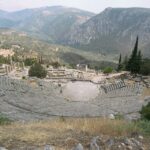
Delphi sits on the lower slopes of Mount Parnassus, overlooking the valley toward the Gulf of Corinth. Ancient Greeks considered it the center of the world, marked by the omphalos, or navel stone. The sanctuary was famous for the oracle of Apollo, whose priestess, the Pythia, delivered prophecies that influenced rulers and city-states.
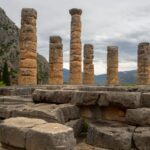
The archaeological area climbs along the slope, so expect steps and uneven paths. About an hour is scheduled for the general visit, with another 30 minutes for the Temple of Apollo. The temple was rebuilt several times after fire and earthquake damage, and the ruins you see today date mainly from the fourth century BC.
The Temple of Apollo is the heart of the sanctuary. It held the oracle and occupied the most important position on the site. Even in ruin, the setting explains why Delphi carried such authority. The mountain backdrop and steep terraces give the visit a strong sense of place.
The omphalos is another short stop. The marble piece on display is a later copy of the sacred stone once kept inside the temple. It was said to mark the point where two eagles released by Zeus met after flying from opposite ends of the world.
Below the main sanctuary is the Tholos of Athena Pronaia, one of Delphi’s most recognizable monuments. Its circular design and surviving columns make it a favorite photographic stop. You will spend about 20 minutes here, and admission is listed as free.
Delphi rewards context. The driver can explain the site before you enter, but drivers are not licensed to accompany you through the archaeological grounds or museums. If you want detailed interpretation while walking among the ruins, arrange a state-licensed guide in advance. Availability is not guaranteed on the day itself.
Day four: Meteora monasteries above Kalambaka
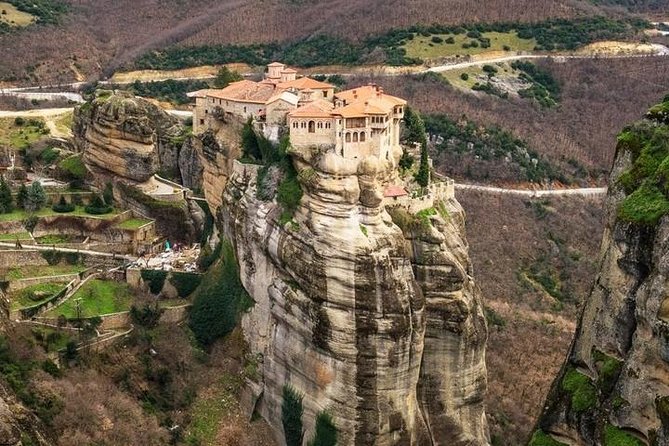
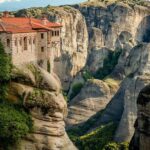
Meteora is the visual centerpiece of this journey. Huge rock pillars rise above the Thessalian plain, carrying Eastern Orthodox monasteries that seem to cling to the cliffs. Six monasteries remain active or visitable within the complex, and Meteora has UNESCO World Heritage status.
The base town is Kalambaka, while Kastraki sits among the rocks and serves as a starting point for the monasteries. Both towns give you a closer look at daily life around Meteora, though the main reason to come is the dramatic relationship between stone, sky, and monastery.
The schedule allows about two hours at Meteora, followed by visits to several monasteries. This is ambitious. The listed monastery times add up to several hours, before accounting for driving, parking, opening hours, and the walk between viewpoints. Confirm the final order with the operator.
The Great Meteoron is the oldest and largest of the monasteries included here. Founded by Saint Athanasios the Meteorite in the 14th century, it occupies the most prominent rock. You should expect steps and a moderate amount of walking, with an entrance fee not included.
Saint Nicholas Anapafsas is smaller and built into a limited rock platform. Its stacked design reflects the tight space. The visit includes about 40 minutes, and the monastery’s chapels, crypt, and frescoes give it a different character from the larger foundations.
Saint Stephen is another 40-minute stop. Its buildings developed over several centuries, and the monastery is dedicated in part to Saint Charalambos. Varlaam, also scheduled for 40 minutes, began with the hermit Varlaam and later became an organized monastery in the 16th century.
The Holy Trinity Monastery requires particular effort. The path descends toward the cliff, then rises by 145 carved steps. The reward is a high viewpoint over the other monasteries and the rock formations. If stairs are difficult for you, ask which monasteries can be visited comfortably before finalizing the plan.
Rousanou, dedicated to Saint Barbara, is now a nunnery. It was restored in the 20th century and occupies a smaller, striking rock site. The monastery visits are not included in the tour price, so carry cash or confirm current payment arrangements before setting out.
Dress matters at Meteora. These are functioning religious sites, not only monuments. Modest clothing is required, and rules can differ by monastery. The supplied information specifically recommends comfortable shoes, sunscreen, and hats, all sensible for exposed paths and summer heat.
A few more Athens tours and experiences worth a look
Thermopylae and the return to Athens
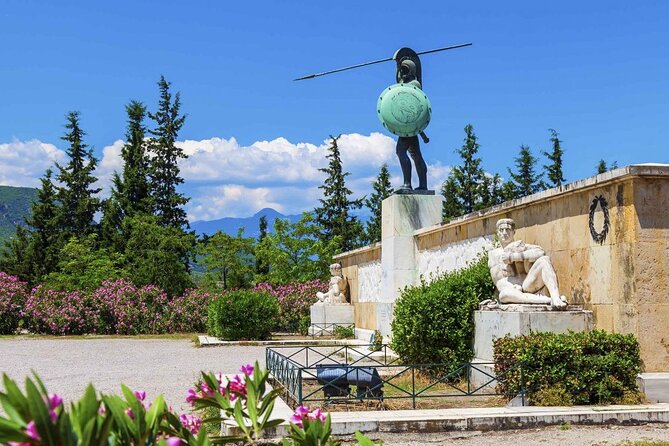
The final historical stop is Thermopylae, famous for the 480 BC battle between the Greek forces led by King Leonidas and the Persian army under Xerxes. The coastal pass of antiquity has shifted because sediment from the Spercheios River moved the shoreline, so the modern memorial is not beside the exact ancient waterline.
The Leonidas Monument is a quick ten-minute stop. Its inscription honors the Spartans who died obeying their laws. You will also have about 20 minutes at Thermopylae itself, including the area associated with the hot sulfur springs that gave the place its name.
This is a brief farewell to ancient Greece rather than a full museum visit. The driver can give background before you continue south, and then the route returns to Athens.
What the $3,275.19 price really covers
The price is $3,275.19 per private group of up to two people. Split between two, that is about $1,637.60 per person. That is a serious price, but the comparison is not with a basic coach excursion.
You are paying for a private air-conditioned vehicle, private transportation over four days, an English-speaking professional driver, three hotel nights, and three breakfasts. The private format also lets you travel without strangers and offers some flexibility in how you use free time.
Still, the price does not cover everything. You must budget separately for archaeological-site and museum admissions, meals, drinks, and any licensed English-speaking guide inside the sites. The driver can guide you to the entrances and explain Greek history and culture, but cannot legally lead you through the sites as a licensed guide.
For two people who value privacy and do not want to drive unfamiliar mountain roads, the arrangement can make sense. For budget-minded visitors, the extra entrance fees and meals push the total higher, and a group tour may cost less.
Practical details that shape the experience
Hotel pickup is offered from the main entrance of your hotel. At a cruise port, you walk outside the terminal, where the driver waits with a sign bearing your name. The return is to the same general pickup point.
The tour is offered in English and is private to your group. Athens airport transfers can be arranged on request. Confirmation arrives when you book, and the operator suggests pre-purchasing admission tickets because availability may be limited. Tickets can also be bought in advance for a small service fee.
Bring snacks for the long drives. One published account particularly praised the Delphi and Meteora portions and the accommodation in Delphi and Meteora, but also gave the practical warning that the road stretches can be long and food stops should not be taken for granted.
The tour requires moderate fitness. You will walk at Ancient Corinth, Mycenae, Olympia, Delphi, and Meteora, often on uneven ground. Summer visitors should carry water and use sunscreen and a hat.
The cancellation terms are worth noting: a full refund is available when you cancel at least six full days before the start time. Cancellation two to six days ahead receives a 50 percent refund, while cancellation less than two days before departure is nonrefundable.
Who should book this Greek mainland circuit?
I would choose this trip if you want the major mainland sights in one organized route and prefer a private car to buses or a rental car. It suits couples who want their own vehicle, families who value a fixed plan, and first-time visitors who want the driver to handle the roads, hotels, and transfers.
I would be cautious if you prefer slow mornings, long museum visits, or several nights in one town. The schedule is full, and Meteora in particular may feel compressed if every monastery listed is attempted.
The strongest portions are Delphi and Meteora. Mycenae is essential for anyone drawn to Homeric Greece, while Olympia is rewarding for visitors interested in sport, religion, and ancient civic life. Nafplio gives the route a pleasant town break, and Thermopylae adds a compact but memorable historical stop.
Should you book it?
Book this four-day tour if convenience, privacy, and breadth matter more to you than a leisurely pace. It is a useful way to connect far-flung sites that are difficult to combine independently in such a short time.
Before booking, ask for the exact hotel names, the confirmed night-by-night schedule, the expected entrance costs, and the number of monasteries that can realistically be visited. If you also add a licensed guide for Delphi, Olympia, Mycenae, and Ancient Corinth, the cost rises, but the ancient sites will make more sense.
For a first mainland Greece trip, this is a strong route with one clear warning: you will spend plenty of time in the car. Pack snacks, wear good shoes, and accept that this is a highlights tour, not a slow archaeological study.
FAQ
How long does the tour last?
The tour lasts approximately four days and includes three nights of accommodation.
How many people can join the private tour?
The price covers one private group of up to two people.
Is hotel pickup available?
Yes. Pickup is arranged at the main entrance of your hotel. Cruise-port pickup is also available outside the terminal exit.
What transportation is included?
An air-conditioned vehicle and private transportation are included for the route.
Is an English-speaking guide included?
An English-speaking professional tour driver is included. The driver can explain Greek history and culture until you enter archaeological sites and museums, but is not licensed to guide inside them. A licensed English-speaking guide can be arranged for an extra cost.
Are entrance fees included?
No. Entrance fees for archaeological sites and museums are not included.
Are meals included?
Three breakfasts are included. Other food, drinks, lunches, and dinners are not included.
What should I bring?
Comfortable shoes are recommended because the tour involves moderate walking. In summer, bring sunscreen and a hat. Snacks are also useful during the long drives.
Can airport transfers in Athens be arranged?
Yes. Athens airport transfers are available on request.
Is the tour physically demanding?
A moderate level of physical fitness is recommended. Meteora includes walking and, at the Holy Trinity Monastery, a route involving 145 carved steps.
What is the cancellation policy?
You can receive a full refund if you cancel at least six full days before the experience start time. Cancellation two to six days before departure receives a 50 percent refund, while cancellation less than two days before departure is nonrefundable.